Even more wisdom

Dictionaries struggle to define the word ‘love’. Because it’s not a ‘thing’ it’s hard to describe, so dictionaries use phrases such as ‘strongly liking another person’ and also talk about romance. Not exactly comprehensive. But, since you can’t put love under a microscope you can’t analyse its constituent elements. You can only talk about how love is felt or shown, especially when that love is between people. (Loving your job, your house, your garden, even your dog, isn’t quite the same.)

Describing wisdom is as problematic as describing love. You can’t sum up wisdom with a word or phrase; instead you give examples of wise decisions or actions. That’s what I’ve done in the last two blogs, and this one isn’t different.

I’ve listed six categories in which wisdom matters. I could have listed 16, and by next week even more. But one I’ve listed here is about knowing when to stop, and I will stop writing about wisdom (at least for a long time) after this blog.

Here goes with (hopefully) even more wisdom.

Value

Oscar Wilde wrote that a cynic was ‘a man who knows the price of everything and the value of nothing.[1]

It’s a great line, and likely true concerning many people. The second half is disturbing: that, someone could know many things but know nothing about their value. Not know where worth really lies. Not know what’s truly important.

Wise people don’t make that mistake. They understand what matters, and they prioritise and pursue those things rather than the trivial and ephemeral, things that are unimportant and don’t last.

I’ve been privileged to pour myself into work that has deeply affected people’s lives, both in the UK and many other countries. I have seen some people change; others, scattered around the world, I simply knew about through friends and colleagues.

Not everyone can have jobs aimed directly at transforming and improving lives. Sadly, some have hated their jobs. Their work, it seemed to them, contributed nothing other to boost the profits of a large multinational corporation. Why did they not find other employment? They didn’t leave because they were well paid. One was so well paid he had three cars: a Jaguar, a Porsche, and a Maserati. And he bought a ranch as well. I’m not suggesting cars or a ranch are ‘sinful’ – just that directing your life towards accumulating wealth or owning ‘things’ produces no lasting worth.

Wise people know where value really lies, and set their goals accordingly.

Health

My mother started smoking in her mid teens, a long time before the general population had any idea that cigarettes were harmful. My father probably started around then too, but never smoked heavily except perhaps during World War II when he was in the army. As my brother and I were growing up, mum and dad both discouraged us from smoking because ‘it causes shortness of breath’. But – unknown to them – smoking was much more serious than that. It was killing them. My mother’s heart was badly affected, and she died aged 55. My dad immediately stopped smoking but that couldn’t eradicate the damage already done. He had a massive heart attack when 64, and survived it, probably because he was already in hospital and got immediate attention. He reached 79, and then died of a second heart attack. Our most favourite aunt – my mum’s sister – smoked all her adult life, and she died aged 74.

You’ll gather I have strong feelings about the harm cigarettes do to the human body. Thankfully I took my parents’ advice and never smoked, not even once.

This paragraph isn’t meant to be a rant about cigarettes, but a statement that wise people take good care of their health. At a minimum that’ll involve a good diet and exercise. I married well, and Alison ensures we eat only what’s good for us. Diet: tick. And we walk our dogs up and down hills every day, and Alison is a committed gardener while I play golf two or three times a week. Exercise: tick.

I spoke at a large conference in the north of Scotland, a talk during which I said we should care for our health to avoid hastening death. One man came to me straight afterwards, anxious to persuade me that we can’t hasten our deaths. We can die only when God has ordained it. My answer was along the lines that God has ordained that we care for the bodies he’s gifted us so we can fulfil all the potential he’s invested in us. That man and I didn’t argue, but also didn’t agree. Oddly, we stayed in touch, became friends and that led to the publishing of four of my books.

Whether we believe our bodies are gifts of God, wisdom dictates we care well for them. Damage your body at your peril. You can’t trade it in for a replacement.

Family

I have attended many retirement events, at which we celebrated people’s long service and achievements. At the end the retirees would speak. Almost always they’d say that if they had it all to do over again, they’d give less time to their work and more to their family. It seems their children had grown up strangers to them. I vowed to never have to give that speech. Certainly Alison and the family made sacrifices because of my work, but we all survived, and now our grown-up children are our best friends. We get on great. Whatever wisdom helped that happen, I’m grateful for it.

Destiny

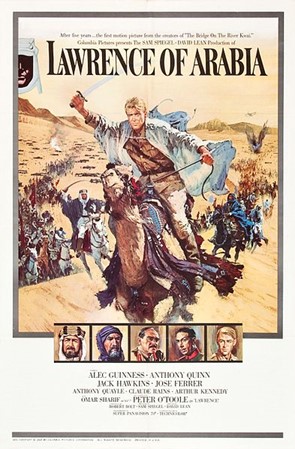
Image in public domain

In the 1962 film Lawrence of Arabia, based on the life of T.E. Lawrence, there’s a short scene that influenced me significantly. Lawrence is doubting he can continue leading Arab tribes in battles against the Turks during World War I. Exhausted and emotionally troubled, Lawrence considers giving up the fight. Then the top general challenges him with words like these: ‘Many go through life with no awareness of a destiny. But it is a terrible thing to have a destiny, and not to fulfil it.’ Those words stir Lawrence, lift him from his depression and weariness, and he presses on to win significant battles.

The words in the film were probably the work of a script-writer and not original. Yet they captured Lawrence’s situation, and impacted me when I was worn down. I knew I had a calling, a destiny, and it hit me freshly that it would be terrible not to fulfil it.

My guess is that most people don’t think of having a ‘destiny’ for their lives. The word sounds grandiose. But many do have some sense of purpose or opportunity. There is something they could do and should do. It would be terrible to reach old age and suddenly realise they’ve left it too late to do what they’ve always believed they were in this world to do. A wise person thinks early on about their purpose and potential, and moves steadily towards that goal.

Starting and stopping

I’ve always been tempted to take on more things than I can handle. Giving in to that temptation inevitably leads to stress and incompetence – stress, because we’re overworked; incompetence, because there’s only so many things we can do well.

But most of us are under constant pressure: to join a committee, take on a task, support a good cause. I’ve been asked to lend a hand – it sounded so innocuous – ‘I just need a little help with a project…’ Before long I was doing the project and he’d gone fishing.

Perhaps the only way to have a quiet life is to be hopelessly incompetent, because then no-one asks you to do anything.

Incompetence, though, is a bad solution. Rather, the wise person considers whether a new thing is a right thing.

To be a right thing, three conditions have to be met, best done by asking ourselves questions:

  1.  Does this thing fit with the particular gifts or abilities I have? Most of us could do all sorts of things, but there are some things we’re particularly good at. Those things – which especially fit our skill-set – are likely to be the tasks we should take on.
  2. Should someone else be doing the new task? Many things can be done by many people, so this task doesn’t specifically require me. Just because I could do it doesn’t mean I should do it. Beware those who say, ‘You’re the only one I could ask’ because the real truth may be that ‘You’re the only one I have asked’. Some people don’t look far afield when enrolling help. Don’t be a soft touch.
  3. Can you stop doing other things in order to do the new thing? There’s a saying, ‘If you want something done, ask a busy person’ – because they’re the kind of person who’ll say ‘yes’ when asked to help. But that’s exploitation. They hate to say ‘no’, so soon become overloaded. Unless, that is, they let other things go. I wrote an earlier blog under the heading Necessary Endings (available in Archives, April 11, 2021). I’d been helped by a book with that title by Henry Cloud, a clinical psychologist. He sums up his message early on: ‘…the tomorrow that you desire and envision may never come to pass if you do not end some things you are doing today.’ Wise people limit their work so they can work well. And survive their workload.

Appreciation

One of our dog behaviour books tells us that far beyond any other kind of treat, the greatest motivator for a dog is praise. Lots of enthusiastic ‘Good boy’ ‘Good girl’ ‘Well done’ statements with gentle stroking is key to good dog behaviour. Humans need appreciation too.

I can think of a boss – not one I ever had, thankfully – who was never grateful for what any of his staff did. No recognition of excellence; no recognition of working all hours to get a project finished. Their work was taken for granted; no need for thanks. But if a project went wrong or was late, he flew into a temper and raged at his staff even if the problem had nothing to do with them. You can guess what that boss’s bullying and ungrateful behaviour did to his staff: how little they enjoyed their work; how much they dreaded what might lie ahead as they walked through the office door each morning; how demotivated they were about continuing in that employment.

A wise person is an appreciative person, someone who says ‘you did a great job’. If we can’t appreciate people we’re in the wrong job. Recognising worth and sharing praise is rarely dwelt on in management books, but, done sincerely, appreciation bonds a team and builds achievement.

The Old Testament book of Proverbs says ‘fools despise wisdom’ (ch.1:7). And the New Testament book of James says ‘If any of you is lacking in wisdom, ask God, who gives to all generously and ungrudgingly, and it will be given you’ (ch.1:5). So, fools reject wisdom. But those with a little wisdom can seek more, which God will give. I agree – I’d be a fool not to.


[1] Spoken by Lord Darlington, in Lady Windermere’s Fan, a play first performed in 1892. Wilde wrote the play while living in the English Lake District, hence the source of the name Windermere.

More wisdom

It’s hard to say exactly what wisdom is. Just as it’s hard to say what a chameleon is. ‘Surely it’s not difficult with a chameleon. Look, there’s one – that blue old-world kind of lizard. And another one – oh, oddly that one’s yellow. Maybe, then, yellow ones are not chameleons… Wait a minute, there’s something else that looks like a chameleon but it’s green. Too confusing. I’ll stick with the blue one. But hang on a minute. It’s not blue any more – it’s red.’

Of course, as most know, chameleons have a remarkable ability to change colour – using various combinations of pink, blue, red, orange, green, black, brown, light blue, yellow, turquoise, and purple. Sometimes they change to camouflage themselves, sometimes to regulate their temperature, sometimes to look aggressive to predators, and some may even use colour to signal to other chameleons. All that variety makes it hard to say what colour a chameleon is. But, of course, there’s something at the core – the DNA – that is always chameleon.

I think of wisdom like that. Dictionaries can use words like ‘experience’ or ‘knowledge’ about wisdom, but they just describe how wisdom appears, like blue or red is how a chameleon might appear.

When we’re talking about wisdom we have to be content with that. In the last blog I wrote that wisdom is something which is practised, in other words the way wisdom shows itself. We see attitudes and actions we recognise as wise. So, this time, I have listed five characteristics of wise people.

They use knowledge well

My son sent me a concise example of that: ‘Knowledge is knowing that a tomato is a fruit. Wisdom is knowing not to put it in a fruit salad.’ Hard to argue with that.

Knowledge is usually a wonderful thing to have, but wisdom happens when we do good with what we know.

So, I know my car could reach 100 mph, but I’m foolish if I go that fast. And I know I could simply pick up and cut down a (small) tree with my electric chainsaw, but I’m an idiot if I don’t put on protective gear before using the chainsaw. And, when the children were very young, I knew they’d go anywhere I took them, but I’d have been reckless to run across a busy road hoping they’d follow safely.

Wisdom is not simply about having knowledge, but about doing good with knowledge.

They have strong self-awareness

The Apostle Paul wrote this: ‘Do not think of yourself more highly than you ought, but rather think of yourself with sober judgment…’ (Romans 12:3)

Prince Charles Edward Stuart, 1720 – 1788
Portrait in Public Domain

If only Bonnie Prince Charlie had had such wisdom. In 1745 Charles Edward Stuart[1] crossed from France to Scotland believing he’d get massive support across Britain to restore the Stuart monarchy. He had early success, winning battles and taking troops into England as far south as Derby. But support in England was low, and Charlie withdrew his army back to Scotland. On 16 April, 1746, two armies confronted each other on a rugged moorland at Culloden, near Inverness: the Jacobite army of Bonnie Prince Charlie and the British government army under the leadership of the Duke of Cumberland. The day ended with a rout of the Jacobite army, Charles fleeing the battlefield, eventually escaping to the western highlands and islands, and then by ship back to France.

Why such a defeat? As with all battles, there were many factors and still many opinions. But one is that Charles wanted to prove his skills as commander rather than let his generals get the glory. But he took exhausted men into battle after a failed overnight mission, then waited while many were cut down by enemy artillery fire before hand-to-hand fighting had begun. His chosen battleground was boggy and unsuited to the ‘Highland charge’ which in other places had overwhelmed the enemy. The day was decisively lost, with many dead and wounded. Afterwards Jacobites were hunted throughout Scotland and many put to death. Bonnie Prince Charlie was welcomed back in France, but his later life was not good: he had several affairs, fathered illegitimate children, and became an alcoholic. He died in Rome in 1788, aged 67.

Forty two years earlier, at Culloden, he believed he was a better leader than he really was. It was disastrous for him and his supporters. Wise people exercise sober judgment.

They treat others well

One style of management centres on the willingness of a boss to perch himself on the edge of a colleague’s desk and simply talk. Not a business meeting; not a conversation with an agenda. Just a chance to get to know the staff member, who they are as well as what they do. Perhaps ground-level insights about the business will emerge, but the fundamental purpose is just to be interested. That style of leadership can be overdone, of course. An employee desperately trying to finish a project before a deadline won’t appreciate a chat about last Saturday’s football. But valuing people, knowing them, being interested in their views – that’s wisdom.

It’s even good for people’s health. Apparently research shows there’s great value in direct interaction with colleagues because it releases hormones which improve mood, trust and the ability to learn and remember. The same doesn’t happen via video, messages or emails.[2]

It makes sense that the more you know someone the more able you are to work together. My guess is that there would also be fewer fights between neighbours if they were friends rather than just ‘the people who live next door’.

They have good instincts

In the last blog I mentioned King Solomon’s prayer: ‘…give your servant a discerning heart to govern your people and to distinguish between right and wrong.’ (1 Kings 3:9) God answered that prayer, and from then until now Solomon has been thought of as one of the wisest people who ever lived.

Two parts of that prayer relate to good instincts. One is to have a discerning heart and the other the ability to distinguish between right and wrong.

To discern is to see something clearly, perhaps to have a sure grasp of facts, or perhaps what we call a ‘sixth sense’, an ability to know something without using the five ordinary senses.

To distinguish between right and wrong seems clear. Often it is. But not always. Situations can be ambiguous. Someone’s hurt and I’m driving them to the hospital. If I exceed the speed limit they’ll get help more quickly, but if I exceed the speed limit I might cause an accident, more injuries and possibly deaths. What do I do? Or, another example, a colleague’s language is borderline racist or misogynist. His words aren’t directed at me, but I’m offended and others could be seriously harmed. Do I report him? Do I try and correct him? Either of those will end my relationship with him, but if I do nothing his inappropriate language will continue and do real damage.

In both these examples I could argue the case for either course of action. I hope I’d end up doing whatever my instinct told me was right in the specific circumstances. Like Solomon I’d be praying for discernment and to know what would be right and what would be wrong. Wisdom is having an instinct for hard-to-resolve issues that occur constantly in our lives.

They have more than one speed

No-one should drive like my aunt whose top speed on all roads – all roads – was 25mph. She was dangerous.

But my meaning here isn’t about speed in that sense. Rather, they should be people who look before leaping, and leap after looking. I’ll explain.

There are foolish people who charge through life without taking time to think about what’s ahead. Ivor was like that. He’d have an idea for a new business, borrow money, buy equipment, and rent office space… But what he never did was research the business potential. Were there clients for his services? Were there customers for his products? Again and again he rushed headlong into ‘new opportunities’, but each business failed with serious financial consequences. Ivor had bright ideas, but constantly leapt without looking. (Jesus had words about that kind of folly – the person who began to build but wasn’t able to finish – see Luke 14:28-30.) Wise people look before they leap.

But I also said wise people leap after looking. Of course that statement depends on what you learn from looking. If you stand on the bank of a raging river, look carefully at how far it is to the other side, and realise it’s twice as far as an Olympic long-jumper could cover, then you’re an idiot to attempt even your best leap. You’ll be swept away.

Of course you can’t always leap. But it’s foolish to never leap.

When I left school I went straight into journalism with The Scotsman, which was considered the premier newspaper in Scotland. I was a good reporter, and after two or three years was trusted with being the only journalist on duty on a late shift or on Saturdays. The pay was good. The work was varied and interesting. I saw a great career path ahead. And then I left. I gave it all up. I sensed another direction would be right for my life, so spent many years studying, became a church minister and later headed up major Christian organisations. Like now, it was hard to get into journalism, especially on a national paper, and some of my colleagues in the newspaper office must have thought me mad to leave. Perhaps family and friends did too. But I knew what I was doing. I’d ‘looked’ and now it was time to ‘leap’. It was the right thing – the wise thing – to do.

I’ll finish here for this blog piece. There’s more to say about wisdom, and I’ll try to do that next time.

For now I’ll close with more wise words from the Bible:

Blessed are those who find wisdom,
    those who gain understanding,
 for she is more profitable than silver
    and yields better returns than gold.
 She is more precious than rubies;
    nothing you desire can compare with her. (Proverbs 3:13-15)


[1] Bonnie Prince Charlie’s full name was: Charles Edward Louis John Casimir Sylvester Severino Maria Stuart. Aren’t you glad you’ve never had to write anything like that on an official form?

[2] https://macaulay.cuny.edu/career-blog/the-importance-of-talking-to-your-coworkers/

Wisdom

In ancient times, when kings judged hard cases, two prostitutes stood before their king. I’ll call them Anna and Bella. Anna began their story. They shared a house, both became pregnant and in time gave birth to sons. One night, Bella’s baby died. Quietly Bella got up, took Anna’s baby and placed her dead child in his place. When morning came, Anna awoke and, to great distress, found her baby lifeless. But she looked closely, and realised it was not her baby. It was Bella’s.

Before the king could respond, Bella protested that Anna is lying – her baby is the one who died. The argument continued, but never got beyond ‘Her baby died; ‘No, her baby died’. There was no way to know who was telling the truth? Or was there?

The king had a large sword brought, and ordered that the living child should be cut in two so each woman could have half.

Anna wept. She loved her son and couldn’t let him die, so begged the king to give the child to Bella.

Bella, though, said the king was right that neither should have the child, so ‘Cut him in two!’

Then the king ruled: the child must go to Anna, the mother who so valued the child’s life she’d give him up in order that he would live. ‘Do not kill him; Anna is his mother’ he ordered.

Word of the ruling spread throughout the land. People were in awe of their king ‘because they saw that he had wisdom from God to administer justice’.

The king was Solomon, ruler of Israel for 40 years from 962 BC. The case of the two women and one baby is described in the Old Testament, 1 Kings 3:16-28 (my quotations from New International Version).

Early in his time as king, Solomon sensed God speak to him in a dream asking what he wanted God to give him. His reply had nothing to do with riches or power over his enemies, but: ‘…give your servant a discerning heart to govern your people and to distinguish between right and wrong’ (1 Kings 3:9). And God gave him what he asked for.

Ever since the dispute over the baby, Solomon was seen as having the wisdom of God. Even some 3000 years later, people wish they had ‘the wisdom of Solomon’.

The title of this blog site is ‘Occasionally Wise’. I’d never claim to be all-wise about anything, hence the word ‘occasionally’ in that title. Wisdom is important, very important. Yet I realised I’d never written about it. Until now.

The dictionary I consulted for a definition of ‘wisdom’ used these words: experience, knowledge, and good judgment. I checked several others, and mostly they used the same or similar words.

To me, it seems hard to define wisdom, if we’re thinking of a ‘quality’ someone can possess. Do I know anyone who is so imbued with wisdom they are wise for every circumstance on every occasion? I don’t think I do, and I’m very sure I’m not like that. But if we can’t possess wisdom, I believe we can become people who mostly practise wisdom – train our minds and hearts so that generally we act wisely.

But it’s best to get away from definitions and, in this blog, I’ll write about what wisdom is not.

The writers of dictionary definitions won’t like some of this!

Wisdom is not knowledge    Knowledge is a great tool, but no guarantee of right decisions. Josef Mengele was a doctor and a Nazi SS officer. He had both a medical degree and a doctorate in anthropology. So he was exceedingly knowledgeable – a clever man but also an extremely wicked man. The name he acquired in the Auschwitz concentration camp was Angel of Death. He was happy to assess victims to die in gas chambers, because it gave him opportunity to select those on whom he would perform appalling and deadly medical experiments, especially on identical twins. He knew much, but applied it in ways so unwise he is remembered only for infamy.[1]

Wisdom is not experience    It’s wise to learn from experience. No question about that. But the problem is that many don’t learn from experience. They hold the same beliefs, same assumptions, same values, same goals, and therefore make the same mistakes. That explains the oft-quoted trite saying: ‘If you always do what you’ve always done, you’ll always get what you’ve always got’. The sentence is simplistic, but often simply true.

I’ve counselled people on debt, who swore they’d change, and off they went to spend again because it made them feel better. I’ve counselled people on their marriages, about sharing, listening, nurturing, and each said they’d learned, but back they went to squabbling and hating each other, so much I thought they were happy that way. Except they weren’t. Experience had not brought them wisdom.

Wisdom is not authority    A strong leader – someone who points a clear way forward and motivates others to follow – is assumed to be wise. They know the direction to take. They know how to get there. They know how to take others with them. But authority by itself is not wisdom. Napoleon lacked nothing in the authority department, but in 1812  led almost half a million troops in an invasion of Russia. That campaign has been called one of the most lethal military operations in history. Within six weeks he’d lost half his men because of disease, hunger, and extreme weather. More followed when heavy snows fell. Only 120,000 survived, and Napoleon’s image of invincibility had gone.

Hitler – another heavily authoritarian leader – made a similar mistake. In 1941 he dispatched troops to conquer the Soviet Union. Battles lasted until 1945, by which time almost 40 per cent of all deaths in World War II had occurred on the Eastern Front. The battle for Stalingrad in the winter of 1942 trapped 300,000 German troops who froze and starved, and only 91,000 were left when they surrendered. Eighty per cent of all German military deaths occurred on the Eastern Front. It’s widely reported that Hitler thought himself a military genius and ignored his top generals. He used his authority, but his lack of wisdom cost millions of lives.

Wisdom is not taking the easy way    Perhaps one of the best known parables of Jesus is the story of two men and their house building. Probably they were equally good at designing houses. Both places were impressive. The issue that divided them was where they built. One took on the tough task of finding rock for his house’s foundation. The other took the easy way – there was plenty sand so ‘I’ll just build here,’ he decided. Then came the day of the Great Storm – rain fell for hours; the streams flooded; the wind was gale force. The house on the rock stood firm. The house on the sand collapsed with a great crash. That story of Jesus – recorded in Matthew 7:24-27 – is usually called the parable of the wise and foolish builders.

What was wise was the hard way – perhaps it cost more money, certainly it took more time. But the house lasted. The man who opted for the easy way – cheap and quick – lost everything. The easy way always looks… easy. And therefore attractive, because you can have it quickly and at little cost. But the easy way is nearly always the wrong way, not the way of wisdom.

I’ll stop here. After several long blogs, actually very long blogs, one of modest length may be particularly appreciated. A wise choice for me to make.

Next time I’ll write more positively about what it is to have wisdom. Hopefully I’ll find sufficient wisdom for that.

———————–

I realise there was a longer-than-usual gap before this blog appeared. My apologies for that, but I had another of these study pressure moments when my priorities temporarily had to shift. It was the right thing to do – the wise thing to do – but I’m still sorry for the delay. Thank you for your patience.


[1] When World War II ended, Mengele escaped to South America where he consistently eluded Nazi hunters. He eventually died in 1979 from drowning after suffering a stroke.

The Forth Bridge… built for the ages

Imagine… You’ve drawn and redrawn dozens of designs, consulted countless experts about your plans, worked with officials to secure approvals. And now, at last, the first day of construction has dawned. How do you feel? A mix of relief, excitement and also some terror. This has got to work…

That day and these feelings came for the designers, engineers, and constructors of the Forth Bridge on 6th June, 1883. If you’ve followed the story of the bridge through the preceding blogs, you’ll understand that behind that day lies a long history of crossing the Firth of Forth: ferries for people, animals, carts; ferries that carried trains; plans for bridges; plans for tunnels. Every major project had stalled or failed. And June 1883 is only 3 years, 5 months, 1 week and 1 day since the bridge over the nearby River Tay collapsed in a storm with the loss of 75 lives. Now they are daring to bridge the Forth?

Benjamin Baker (designer), John Fowler (consulting engineer), and William Arrol (building contractor) must have been nervous. Yet, they’d already poured their skills and hearts into this project, and their will for it to succeed was as strong as the steel with which the bridge would be built. So the work began.

Because the Forth Bridge became recognized around the world as an engineering marvel, there are mountains of technical information about its design and construction. I’ll try to keep the story moving, though mostly the remarkable engineering work at this bridge is the story. But, if the detail is too much, jump ahead a little to find what interests you.

Foundations

I was pastor of a new church in Livingston, West Lothian. Initially we met in a school but when numbers grew money was raised, a site bought, and foundations were laid for our own church building. But there was a complication for those foundations. Years before, our site had been a dumping ground for loose soil. So our contractor’s team had to dig through all that landfill until they reached firm ground, a solid base. Then, in the trench they’d formed, they poured concrete which, when set, became the foundation on which our building would rest.

In principle, that’s what they did for the Forth Bridge. But its foundations would be under water, and you can’t pour concrete into a tidal river.

So what do you do? You use caissons.

Imagine an open-ended metal cylinder. It could be a tin can without its top and bottom. Now, scale up that can to immense size, something like an old-style gasometer (UK) or a giant water tank (USA). Then picture that sunk into water, and eventually filled with concrete, and you begin to understand what holds up the Forth Bridge.

Each caisson for the Forth Bridge was 70 feet (21.3 metres) in diameter and between 50 and 90 feet (15.2/27.4 metres) high. When empty, each weighed around 500 tons. When filled with concrete they would weigh up to 20,000 tons. They were constructed on shore from wrought-iron, towed out and sunk exactly where a pier was needed.

But you couldn’t just sink a caisson and hope for the best. It had to sit solidly in precisely the right place and at precisely the right depth, with no movement whatsoever. The base of each caisson was pre-shaped for its location, but more work was needed for a perfect fit. That required men with explosives, shovels, pick axes and sledgehammers to blast and break rock so the caisson sat perfectly on the boulder clay and rock beneath the river bed.

The Firth of Forth is tidal, and the changing depth of the river created challenges for excavations inside caissons. You can’t work down a caisson with water pouring in at high tide. Some caissons could be protected by a cofferdam –a temporary circular barrier to hold back water. Then what’s enclosed could be pumped out and work done inside. But others – those near South Queensferry in particular – were under water at high tide and low tide. How could men work at the bases of these caissons?

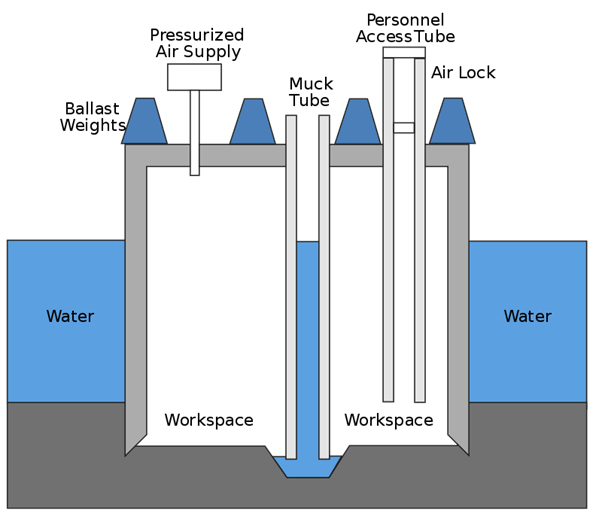
Yk Times, CC BY-SA 3.0, via Wikimedia commons
Schematic cross section of a pressurized caisson

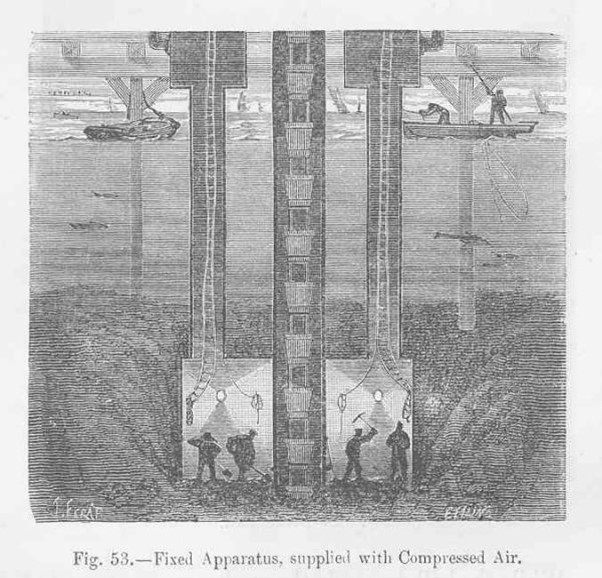
The answer was the ‘pneumatic method’. A pneumatic caisson is sealed at the top, then filled (or partially filled) with compressed air. That creates a protected space within which diggers can work. The illustration and line drawing help explain how it was done. An airlock gave workmen entry to one or two shafts down to the work area, and the mud and rock they excavated was lifted to the surface via another shaft, a ‘muck tube’.

The pressurised air flow had to be controlled precisely: a) so that the workers had an adequate supply of fresh air; b) to hold back any significant inflow of water or mud beneath the edges of the caisson.

Sonrel, L., Public Domain, via Wikimedia Commons
Line drawing of work at base of pressurised caisson

This was dangerous work. A failure with the compressed air would mean the workmen drown. And compressed air risked serious health problems when returning to the surface.

What they called caisson disease is what we now call decompression sickness (DCS) or the bends. Wikipedia describes it as:

‘a medical condition caused by dissolved gases emerging from solution as bubbles inside the body tissues during decompression. DCS most commonly occurs during or soon after a decompression ascent from underwater diving…’[1]

The workers at the bottom of a caisson were breathing air in high ambient pressure conditions and then surfacing to the lower pressure outside the caisson. Unless the pressure was reduced slowly the result would be, at least, severe joint or skeletal pain and very possibly death.

Only one death from caisson disease was recorded at the Forth, but just a few years earlier, during the construction of the Eads Bridge across the Mississippi River, 15 caisson workers died, two were permanently disabled and 77 severely afflicted because of the disease.[2]

Before moving on, imagine the conditions for these caisson workers:

  • they climbed down ladders into a sealed space under the River Forth;
  • they had no more than seven feet (2.1 metres) of headroom;
  • their whole shift was spent hacking at clay and rock with heavy tools, then lifting the muck into ‘baskets’ to be pulled to the surface;
  • if there was an emergency with the compressed air or flooding, they’d have to exit, but to escape to the surface quickly would likely kill them.

Of all miserable and risky jobs, that must rank near the top of the list.

The only humorous thing I’ve found about the pneumatic caissons comes from Murray (in his book The Forth Railway Bridge) who describes a visitor descending into the underwater chamber to see the work. Impressed, he brought out his flask, and offered the men (mostly Italians) a ‘wee dram’ of his whisky. No doubt they appreciated it. And there’s no doubt the visitor didn’t realise his flask was now full of compressed air until, that is, he climbed out of the airlock at the surface and his flask exploded.

It took three years for the caissons to be finished. They’d been filled with 21,000 tons of best Portland cement and surrounded by 740,000 cubic feet of best Aberdeen granite. But the piers are built. Now it’s 1886 and at last work on the bridge itself can start.

Superstructure

This will be a giant of a bridge:

  • Its overall length will be more than 1.5 miles (2467 metres)
  • It’ll rise almost 450 feet (137 metres) above its foundations, 361 feet (110 metres) above high tide
  • It’ll be made of steel weighing 53,000 tonnes (52,163 imp tons; 58,422 N Am tons)
  • The riggers will use 6.5 million rivets (that’s the oft-quoted number, but several experts think the real number of rivets was 7 or even 9 million)

Whole villages of huts had already been created on both shores, and on Inchgarvie island. Some of these accommodated workers, though many of the ‘briggers’ had to be transported to the site each day. There were other huts for joiners and carpenters, offices, sheds to store materials, and larger ones for the assembly of steel plates. At the busiest time for construction, the village and building site at South Queensferry covered 60 acres.

The local site was not equipped to manufacture the largest bridge parts. They were made of the best steel in foundries in Glasgow, Motherwell and Swansea. Large plates and girders were cut at South Queensferry, where a huge loft was set up so templates and patterns for those plates could be drawn ‘life-sized’ on a blackened floor.

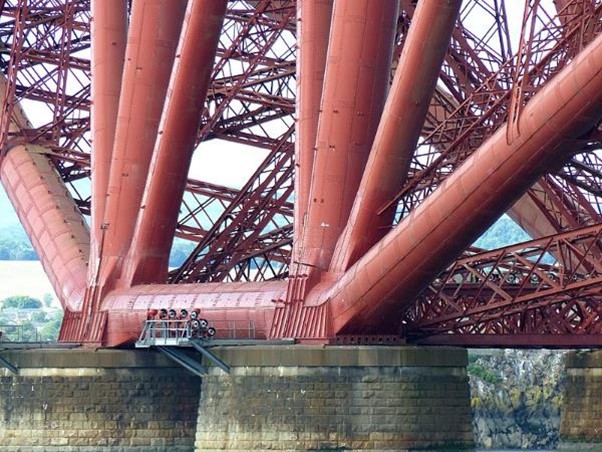
The bridge would be of enormous weight, but not as much as it might have been. To lighten the load the major compression members were designed as tubes, using steel 1¼ inches (3.2 cm) thick and 12 feet (3.6 metres) in diameter. (As a child I remember being told that workers walked up and down inside those tubes. I wished I could do that!) The bridge designer, Benjamin Baker, said that the weight those tubes would carry (i.e., the bridge’s own weight, plus the weight of trains and wind pressure) would be the same as a transatlantic liner filled with cargo. The tubes would be held together with a  web of steel girders. Expansion joints allowed for up to 18 inches (46 cm) of movement caused by temperature variations. (The photograph of the base resting on its piers provides a good close-up of the compression tubes and girders.)

A. Pingstone, Public Domain, via Wikimedia Commons
Close up photo of bridge resting on its piers

The first bridge section built were the towers. They had to be first because this was a cantilever bridge. Let me explain.

Here’s one description of a cantilever design: ‘This type uses a pillar anchored vertically into the ground to support a horizontal deck extending out from one or both sides across the span.’[3] In other words, a strong vertical piece is the sole support for an attached horizontal piece.

The simplest example of cantilever design involves a diving board. Usually there’s an upright tower, from which a diving platform or board projects out. All the weight is carried back down to the ground by the tower. Now – in a flight of imagination – picture two identical diving boards facing each other, with their diving platforms meeting in mid air. What do you have now? You have a bridge. You could walk across from one tower to the other, each half of the platform you’re crossing fixed to its tower.

Wilhelm Westhofen, Public domain, via Wikimedia Commons
Small section of original bridge design drawing

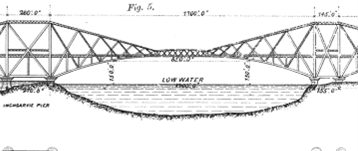
That’s almost exactly the design of the Forth Bridge. I’ve put part of an original design drawing of the bridge alongside – it shows just two towers (the rectangular vertical sections supported by X-shaped girders), each tower consisting of two pairs of pillars,[4] with upper arms stretching sideways from the top and tilting downwards. Each arm reaches track height where it supports a small ‘suspended span’ in the middle. (Further weight is taken by the lower, curved compression members.)

The Forth Bridge is actually a twin cantilever design. That sounds complicated but isn’t. Imagine standing with each of your arms stretched sideways away from your body while you hold a bag of flour in each hand. You are now a twin cantilever because you reach out in two directions. Then imagine another person stands in exactly the same posture next to you, your hands touching only to share the weight of the bag of flour you both now hold. Finally let’s add a third person, again arms outstretched and sharing the weight of the flour bag held by his neighbour. You have created the Forth Bridge. What three people can do holding bags of flour is parallel to what’s done with pillars and cantilever arms in the Forth Bridge. You can see that shape by looking now at the full-length design drawing (just below). Each tower has twin vertical pillars because their cantilever arms reach out sideways in opposite directions. Instead of a bag of flour, they each support a small span of girders where their arms almost touch. At the far right and far left the arms rest on pillars that carry the ends of the rail track to the shore.

Wilhelm Westhofen, Public domain, via Wikimedia Commons
Full length version of original design drawing

Of course, by major steelwork those cantilever arms (working with lower compression tubes) bear most of the weight of the whole bridge. They’re linked to the track where trains cross and to other parts of the bridge. The suspended spans between them are far lighter for those cantilever arms than bags of flour are for us.

{{PD-US-expired}} Public Domain
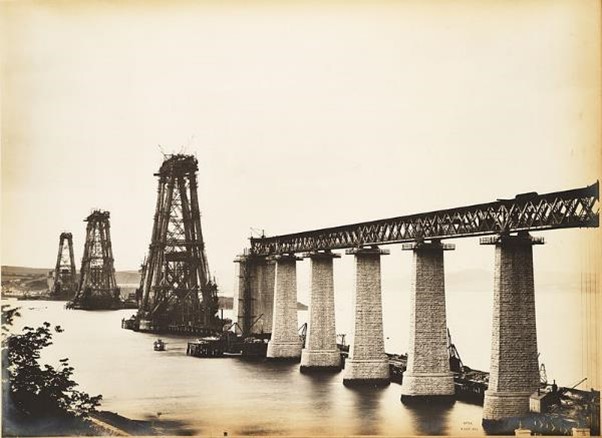
View from S Queensferry, 1887 – almost the only work on the bridge at this stage is the construction of the towers
{{PD-US-expired}} Public Domain
View of bridge in 1888 – the twin cantilevers arms from each tower reach out, with support from a lattice of trusses

If – hopefully – you’ve followed some of my amateur explanation, you’ll understand that the weight in a cantilever design depends on the vertical towers because they’re the only parts which rest on the foundations. Nothing else about the Forth Bridge could be built until they were in place. Even then the cantilever arms had to be added at an equal rate to both sides of  the towers to ensure balance. So – as further photos show – the  bridge gradually expanded outwards from each of the three towers until eventually they were within ‘touching distance’ of each other, and could be finally linked by those short spans.

One more detail. The Forth Bridge is technically a cantilever-truss design. The construction expert I quoted earlier writes: ‘Cantilever bridges are often supported with trusses. A bridge truss takes the load off the deck and transfers it to the supporting piers and abutments, helping the cantilevers withstand tension in the upper supports and compression in the lower ones.’[5] I believe he’s saying the trusses within the Forth Bridge push the weight of trains onto the larger structural members.

Accidents

Many died during construction of the bridge. In an earlier blog, I said the number was more than those drowned in the Tay Bridge disaster, which was 75. Official figures for deaths while building the Forth Bridge give a number of 73. So I was wrong – maybe. The hesitation is because sometimes men killed working on the approaches to the bridge were not counted, nor those who died later from injuries sustained while working on the bridge. Perhaps some were never counted. Of course there were also those who only nearly died, such as the eight men who fell from the bridge while working and were rescued from drowning by boats stationed in the water below. As of 2009, the official figures say this: ‘Of the 73 recorded deaths, 38 were as a result of falling, 9 of being crushed, 9 drowned, 8 struck by a falling object, 3 died in a fire in a bothy, 1 of caisson disease, and the cause of five deaths is unknown.’[6]

I said in an earlier blog that there was a surprising explanation for so many accidents. That was drunkenness. Any worker found drunk was sent off the site immediately to sober up. Otherwise he risked his own life and the lives of others. Murray’s book records that Arrol (the main contractor) considered the drinking so bad he instructed that more foreigners should be employed as they didn’t drink as much as the Scots! But drunkenness wasn’t the only cause of accidents. Apparently some of the younger briggers were foolhardy enough to ignore safety ropes and jump from girder to girder while hundreds of feet up. Not all were successful.

Most likely the high accident and death toll was simply because it was dangerous to build a bridge so high and so wide through all seasons across a wide estuary exposed to the frequently severe North Sea weather.

Finished, tested and opened

Work on the bridge was 24/7, stopping only when the strongest of winds made it impossible to be on the bridge safely. Night-time work required lighting. Gas was too expensive; oil lamps were dangerous. So they used electricity, very new at the time.[7] Occasionally it failed, leaving workers in exposed locations in darkness.

Finally the work neared its finish. The last connections had to be made when the steel was in precisely the right position, neither expanded because of a high temperature nor contracted because of a low temperature. Temporary bolts were inserted initially, and then they had to wait several days more for a good temperature. On the morning of 14th November, 1889, everything was exactly right, and the final connection made. Thirty six temporary bolts still had to be removed, but before that could be done the temperature dropped, the bolts sheared with a sound like a cannon firing, and a small shake went through the bridge. But, as the bridge designer said later, the only consequence was that work removing 36 bolts was saved.

The official load testing of the bridge took place in late January, 1890. The test involved two trains, but each ‘train’ actually consisted of three locomotives towing 50 wagons loaded with coal. The total weight was 1880 tons, more than twice the design load for the bridge. They moved across the bridge, stopping several times for deflection measurements to be made. Nothing adverse was found. The bridge passed its test! The first official crossing took place the next month involving railway company dignitaries.

The official opening was on 4th March, 1890. One of the guests on the day was Gustave Eiffel, the civil engineer responsible for the Eiffel Tower which had opened to the Paris public only the previous year. But it was the Duke of Rothesay, later to become King Edward VII, who hammered home the last rivet, this one gold plated. Oddly, though there are several line drawings of the opening ceremony, I believe there are virtually no photographs.

Facts from then until now

At the time of opening, the Forth Bridge had the longest single cantilever bridge span in the world. In 1919 the Quebec Bridge in Canada exceeded it, but the Forth Bridge continues to be in second place.

The total construction cost was £3 million, a huge sum in the 1880s but unsurprising for a bridge of such strength across a wide estuary. Cost is a major reason why few other bridges like it have been built.

Probably no-one has ever known the overall number employed to build the bridge. That would have to include all the staff in design, engineering and construction offices, in foundries in other cities, those who worked on approach piers and railways lines to the bridge, building sheds for storage, preparing meals for workers, and so on and on. Many briggers stayed for only a few weeks before moving on, in total a very large number. The only figure commonly stated is that 4,600 men were employed at the height of construction.

It is a myth that painting the Forth Bridge is continuous. For generations it was said that when the painters finished at one end they immediately restarted at the other end. That has never been true.

Right now the Forth Bridge requires virtually no painting. A major refurbishment project began in 2001. For ten years sections were screened off to allow sandblasting, minor repairs to the steel, and then a special coating applied of virtually impermeable paint (tinted red). No further work is expected for 20 to 25 years.

As a child I was told people threw pennies out of train windows while crossing the Forth Bridge. It was supposed to bring good luck. It was certainly not good luck for those sailing underneath the bridge who could have been killed by any object thrown from above.

Another thing I learned as a child is that the Luftwaffe tried to bomb the bridge during World War II. This is not true. What is true is that, on 16 October, 1939, 12 German bombers tried to bomb ships moored in the Forth, near to the Rosyth Naval Dockyard and thus also close to the Forth Bridge. Ships were damaged and 16 sailors lost their lives. Two enemy planes were brought down by Spitfires. It was the first air raid over Britain during the war, but the bridge was never the target.

In July 2015 the Forth Bridge was made a UNESCO World Heritage Site. It’s the sixth World Heritage Site in Scotland, and now has the same status as the Taj Mahal and the Great Wall of China. Since 1973 the Forth Bridge has also been a Category A listed building.

Currently 190–200 trains per day cross the Forth Bridge, carrying about 3 million passengers each year.

My Forth Bridge lapel badge!

The bridge has been used in films, notably The 39 Steps in both the 1935 and 1959 versions (though it is not mentioned in John Buchan’s book). It has also been used to market soft drinks, anti-corrosive paint, women’s fashions, oatcakes and it has undoubtedly sold tens of millions of postcards. It’s often been the backdrop for any product from Scotland. Last Christmas my son and daughter-in-law, who live in Edinburgh, sent me a card to which was attached a Forth Bridge badge. Great choice.

Today three bridges cross the estuary of the Forth. Alongside the Forth (rail) Bridge stands the Forth Road Bridge, a suspension bridge, which was opened in 1964. Next in line upstream is the Queensferry Crossing, another road bridge, opened in 2017. The Crossing is the longest three-tower, cable-stayed bridge in the world. Each bridge was built in a different century.[8]

Final thought

I believe nothing made with human hands beats what God has made, such as a dramatic sunset, an awesome mountain range, or the intricate design of a snowflake.

But, even so, we must not be blind to the amazing things that amazing people have made. The Bible says ‘God created mankind in his own image … both male and female’ (Genesis 1:27). That doesn’t mean we look like God but does mean at least some of God’s attributes are found in us. Those include creativity, precision, a sense of what is literally wonder-full.

The Forth Bridge has always filled me with wonder, and the more I’ve looked into its design and engineering the more I’m amazed by the creativity and carefulness of those who imagined and those who built that bridge. I’d be impressed if they’d done it with all the toys of modern technology; they did it without even a calculator.

Not everything we make is good, but many things are. Let’s be grateful for the gifts, the learning, the hard work that people have put in to make these things special.

Andrew Shiva / Wikipedia / CC BY-SA 4.0 
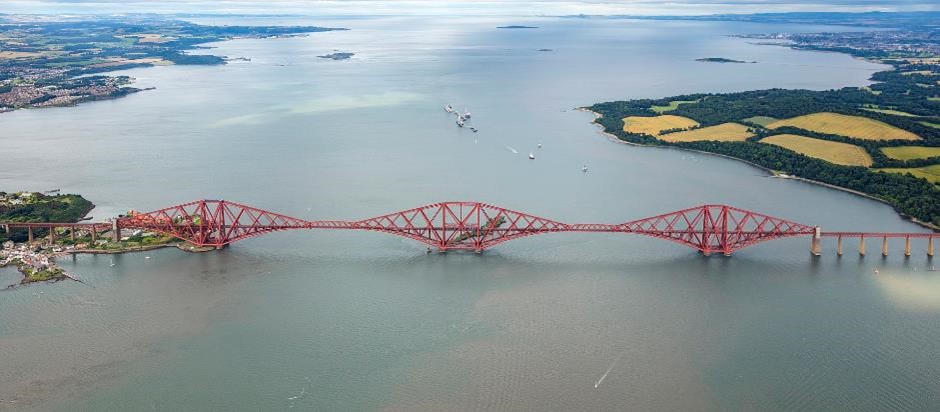
A magnificent 2016 photo of the Forth Bridge, looking downstream (east) towards the North Sea. The built-up area in the upper right is a small part of Edinburgh.

This three-part story of the Forth Bridge is over. First, thank you for your patience, Each part has been at least 50% longer than most blogs (this one even more than that – sorry!). Second, I’m far from being at my best with technical things, so if I’ve got details wrong, please forgive. Third, more normal blogs will be written from now on – in other words, ‘normal service will be resumed as soon as possible’.

——————————

[1] https://en.wikipedia.org/wiki/Decompression_sickness

[2] https://en.wikipedia.org/wiki/Eads_Bridge

[3] https://www.bigrentz.com/blog/types-of-bridges

[4] Because this illustration (and the next) are side profiles, they show only the pillars on the near side of the bridge. Each has a corresponding pillar on the far side, what will be eventually the other side of the railway track. That’ll be more obvious in later photographs.

[5] https://www.bigrentz.com/blog/types-of-bridges

[6] https://en.wikipedia.org/wiki/Forth_Bridge#Accidents_and_deaths

[7] The first time any street in the world was lit by electricity was in 1878 (in Newcastle), only eight years before superstructure work on the bridge began.

[8] I recommend this site for beautiful photos of the three bridges over the Forth: https://www.scotland.org/about-scotland/scotlands-stories/the-bridges

And there is an excellent short video (approx. 7½ minutes) showing construction and features of the three bridges over the River Forth: https://www.youtube.com/watch?v=tgeFKVX2C-o


The Forth Bridge… deceit, disaster and design

It’s 1853, three years after Thomas Bouch launched his ‘floating railway’ over the Firth of Forth. But – though trains are now being ferried over the river – Bouch is disappointed and frustrated.

Why is he dissatisfied? There are fundamentally two reasons.

First, ferrying trains is not a great solution. Certainly Bouch’s employers in the Edinburgh and Northern Railway are happy – they’ve launched a similar ferry to cross the other east coast estuary of the River Tay. But the ferries carry only a train, not its carriages. That makes everything awkward. Here’s what happens for a train leaving Edinburgh and going north:

– leaves its first carriages on the south shore of the Forth

– gains its second carriages on the north shore of the Forth

– leaves its second carriages on the south shore of the Tay

– gains its third carriages on the north shore of the Tay.

Only after all that does the train have an uninterrupted journey north to Aberdeen. All the transitions before that are time-consuming and logistically complicated.

Second, ferrying is also a horrible experience for passengers. Think how the journey just described is for them. Trains are unheated so they arrive at the Forth already chilled, stand on a pier as the wind whips off the water, clamber on board a ferry which has no shelter for passengers, so they huddle beside the train or boxes or carts while the ferry sails through rough seas. Then they do it all again when they get to the Tay. They’re frozen, miserable and frightened. They’ve occupied three different sets of carriages, walked down or up four piers, and stood on open decks across two wide estuaries. No-one thinks this is a good experience.

Bouch agrees. There’s a centuries-old saying that you can’t make a silk purse out of a sow’s ear – if something is fundamentally bad you’ll never make it wonderful, no matter what you do. His ferries are better than nothing, but they’ll never be a good solution to crossing the east coast of Scotland estuaries.

Bouch is also frustrated. His goal and his passion is to build bridges over the rivers Forth and Tay, not organise a ferry service. Bouch had a self-confidence which some would consider arrogance. And a boldness many would think reckless. That’s before mentioning his super-abundance of ambition and determination.

Rather than sticking to a diet of dissatisfaction, in 1853 he informs his employers, now called the Edinburgh, Perth and Dundee Railways Company, that he wants to build a bridge over the Tay. They don’t take long to answer him. Bouch gets a near-instantaneous ‘no’, and he’s told his idea is insane. Bouch is not in the least happy with that response. Soon after he resigns and establishes his own consultancy firm.

The next few years saw two trends among rail companies: the amalgamation of firms and fierce competitiveness between them to establish the best route north. Then Bouch’s old company was consumed by the North British Railways Company, and Bouch believed new leadership meant new opportunity. He knew the company was desperate to improve the northern route, so in 1860 he approached the North British directors promising he could build bridges over both the Forth and the Tay.

This time Bouch is not rebuffed. It’s a new and more optimistic age, and Bouch leaves with a commission to put his plans on paper.

For the Firth of Forth Bouch planned a lattice-girder bridge. Gardeners know about training plants up a wooden or plastic lattice structure. A lattice bridge is fundamentally the same, a criss-crossed web design, strong and resistant to bending. Perhaps the most famous lattice structure is the Eiffel Tower in Paris.

Bouch’s design was not a problem, but his proposed location was. The river between North and South Queensferry was too deep, so Bouch planned to build his bridge five miles upstream where it was shallower. However, there was a problem. Yes, the depth from surface to river bed was shallower, but below that river bed was more than 200 feet (61 metres) of mud. Mud could not support the piers of a bridge.

Or could it?

At the end of the last blog, I asked if there was ever a serious proposal for bridge supports simply to float in the river. Bouch’s proposal was almost that.

Bouch wouldn’t be stopped by 200 feet of mud on the river bed. He pressed forward with a plan for a two-mile bridge held up by 61 stone piers. Those piers would not sit on rock but on mud. His logic was like this: think of walking on wet sand – your footprints press down but they don’t keep sinking because the sand compresses and holds you up. Bouch’s piers would so compress the mud that the piers would sit – or float – firmly in place.

Convinced? Bouch was, but many were not. Not for a bridge set in a tidal estuary where the water was never still, and, on stormy days, would experience turbulence above and below the surface. An official enquiry studied his plans, and asked hard questions. But Bouch stood firm, showed great confidence, and argued his bridge would stand strong. Remarkably Bouch was given a ‘green light’ and in 1866 a beginning was made.

Work started in June and in August it was stopped. Because of new concern about the design? No – it stopped because of financial deceit. For some time the accounts of the North British Railway Company had been falsified to show profits which never existed. The books had been misrepresented, well and truly cooked, and the company was actually in serious financial trouble. Shareholders were up in arms. One day company directors turned up at the Forth, ordered that work stop immediately, and the builders’ employment was terminated with immediate effect.

Once more Bouch was thwarted. He was about to bridge the Forth, and suddenly he wasn’t. The disappointment was enormous.

However, Bouch was Bouch. Though he was down, he was certainly not out.

In the last blog, I also said we’d find out why Thomas Bouch was hired and then fired. That story comes next.

The action now moves 40 miles north, to the River Tay.

The North British Railway Company is being revived under a new chairman, John Stirling. In 1864, with Bouch at his side, Stirling asks officials in Dundee to provide financial support for a bridge over the Firth of Tay. They agree, and work begins in 1871. (I told the story of the Tay Bridge in an earlier blog. You can find it among those posted here: https://occasionallywise.com/2021/10/).

Bouch was not only responsible for the design of the Tay Bridge, but for its manufacture, construction, and maintenance. Everything was under his control.

But the work at the Tay did not get Bouch’s sole attention. By 1873 he had a new design for a bridge over the Forth. This bridge could be built over the deep water between North and South Queensferry because it would be a suspension bridge, with one of its towers securely anchored on Inchgarvie island, approximately half way across the river. (There is a map showing Inchgarvie island in my last blog.) The towers of the bridge would be 600 feet (183 metres)  high, with 1600 foot (488 metre) spans in either direction from the centre tower. Steel chains would hold two railway tracks.

Design of Bouch’s suspension bridge.
Attrib: Wilhelm Westhofen, Public domain, via Wikimedia Commons

But there was new concern about this design, this time not about the foundations but the ability of the bridge to withstand wind pressure. Experts gave cautious support, but they would not say this was the best possible design. Despite the concerns, the official Act permitting construction was passed in 1873, and a consortium of railway companies formed The Forth Bridge Railway Company to build the bridge.

At first nothing happened. For one thing there was insufficient money to build. For another, the attention of the North British company was on the Tay Bridge’s construction. No work took place at the Forth until September 1878 (four months after the official opening of the Tay Bridge). Mrs Bouch laid a foundation stone, and by the next spring brickwork appeared on the western edge of Inchgarvie (and can still be seen today).

And not much more was ever done. On a late December evening in 1879 an immense gale blew through the Tay estuary. The northern-bound evening train made its way on to the Tay Bridge. As it passed through the central high girders the pressure against the bridge and the train collapsed that whole section, and every person on the train, some 75 people, perished in the waters of the Tay. What happened that night has been known around the world as the Tay Bridge disaster.

An official Court of Enquiry into the disaster began work just six days later, and took only a few months to present its report. The cause, they wrote, ‘was the pressure of the wind, acting upon a structure badly built, and badly maintained.’ Later they concluded, ‘For these defects both in the design, the construction, and the maintenance, Sir Thomas Bouch is, in our opinion, mainly to blame. For the faults of design he is entirely responsible.’[1]

Bouch disagreed with the Enquiry’s findings but, fairly or unfairly, his opinion didn’t matter. He was disgraced as a bridge designer and builder. A broken man, Bouch became a recluse, and died of ‘stress’ in October 1880. He was just 58.

Some work had continued at the Forth before the Tay Bridge Court of Enquiry report was issued. But now public opinion turned against Bouch, and pressurised The Forth Bridge Railway Company to abandon Bouch’s suspension bridge design. The majority view of public and press became one of doubt that any bridge over either estuary could be safe. All work at the Forth stopped in January 1881, and an Act of Abandonment began its passage through Parliament.

But the case for a bridge was still compelling – not least because rail companies stood to make great profits. If Bouch’s bridge could never be built, then a different design from a respected engineer might succeed. The railway companies asked engineers who knew Bouch’s plans, and knew the challenges of bridging the Forth, to consider options. One of these experts was John Fowler, who, with his partner, Benjamin Baker, had built bridges across the Severn estuary (which divides the west of England from south Wales). These highly qualified engineers believed a bridge at the Forth could be done. With no time to lose, financial and legal steps were taken, and the Abandonment Bill was withdrawn before it could finally pass and become law.

Work on the previous bridge had ended in January 1881 and Fowler and Baker laid a new plan before railway companies less than nine months later. It took only two hours for the companies to accept their proposals, and work began on preparing a new Parliamentary Bill. That Bill passed easily because the engineers were highly regarded and government inspectors validated their plans. The Bill went through all its stages and was given Royal Assent on 12th July, 1882. At last there was a realistic design.

The original (above) and final design for the Forth Bridge.
Attrib: Wilhelm Westhofen, Public domain, via Wikimedia Commons
John Fowler, Consulting Engineer
Attrib: Lock & Whitfield (?)., CC BY 4.0 <https://creativecommons.org/licenses/by/4.0&gt;, via Wikimedia Commons

But there was still widespread fear whether any bridge over the Forth could be safe. Therefore approval came with many stipulations about its strength, and included rules requiring inspection of construction work by the Board of Trade four times a year. The completed bridge had to be secure, but the incomplete structure must be equally secure at every stage. Parliament specified that this must be the biggest, strongest and stiffest bridge in the world. It must have maximum rigidity downwards under the weight of trains and sideways to withstand wind pressure. Only the best of materials should be used. In addition, the Admiralty required that a bridge must not restrict shipping (the Rosyth naval dockyard lies only a short distance upstream). Murray, in his book The Forth Railway Bridge, writes: ‘The concern and caution of the engineers, combined with these restrictions resulted in the finished installation being at least twice as secure as it needed to be’.[2] (As I wrote before, I’m happy to acknowledge the help Murray’s book has been in providing detail not available elsewhere.)

Benjamin Baker, designer
Unknown author, Public domain, via Wikimedia Commons

In the end three men were crucial for the design and construction of the Forth Bridge. The two designers have already been mentioned: Benjamin Baker, the designer, and John Fowler, the consulting engineer. The third would be responsible for actually building the bridge. His name was William Arrol, a construction engineer. His business base was only 40 miles away in Glasgow.[3] All three of these men were knighted shortly after the Forth Bridge opened.[4]

William Arrol, Building contractor
Attrib: Wilhelm Westhofen, Public domain, via Wikimedia Commons

The design Fowler and Baker presented was for a three tower cantilever-truss bridge. More on what those terms mean next time. As well as drawings, they presented a 13 foot (almost 4 metre) model of the bridge to Parliament. All those who found construction drawings hard to follow – the vast majority – were entranced by the model. It was soon put on show to the public.

Today, since the Forth Bridge has stood strong for more than 130 years, it seems strange that opinion was divided on whether this bridge would last. Even the Astronomer Royal wrote to The Times newspaper asserting a gale less than had blown down the Tay Bridge might destroy this Forth Bridge. Spectators stood in lines to see the bridge model, and Fowler and Baker were constantly interviewed about its safety.

Finally Fowler and Baker had a photo taken to illustrate the stability of a cantilever design. Two men (many suppose they were Fowler and Baker themselves) sat on chairs, with arms extended supporting a plank on which sat Kaichi Watanabe, a Japanese apprentice of the firm. Behind them was an illustration of the bridge. As well as their arms they used broomsticks. The men represented the bridge towers, and piles of bricks represented the far ends of the bridge. Kaichi’s weight created compression, with every part of the arrangement supporting the rest. It was all stable.[5] Fowler and Baker were not just engineering experts but superb publicists. The photograph was published in newspapers around the world, convincing many about the bridge’s stability. The photo still features on postcards today.

I’ll stop here. The design work is done and approved, and the next blog will cover the remarkable story of the bridge’s construction.

Before finishing, three things have stood out for me from what’s been covered this time.

First, because someone is sure they’re right doesn’t prove they are. I have some sympathy for Thomas Bouch. He was a visionary who never stopped trying. But I suspect he was also too great a salesman, persuading people his ideas were sound when, very possibly, they had doubts. Did they really believe a bridge resting on mud was a great idea? I suspect not. Corrupt finances halted that plan but Bouch returned later with a different design. Why not the original? Might he have always been uncertain about a bridge resting on a bed of mud? Yet he’d persuaded everyone to let him build it just seven years earlier. A great salesman can sell a bad idea. Wisdom lies in recognising what’s bad and refusing it.

Second, the futures we envisage can suddenly change. Bouch had a bridge complete and operating over the Tay, and another just beginning across the Forth. Surely disappointments were all in the past? Then the Tay Bridge collapsed, he was discredited and all he had done and all he might one day do was changed. He never recovered. For others – especially Fowler, Baker and Arrol – the day of opportunity suddenly dawned, and their names have gone down in bridge-building history for their work on the Forth Bridge. There’s no place for either uncertain optimism or uncertain pessimism about the future.

Third, getting the brilliant best pays off in the long-run. The Forth Bridge met all the conditions laid down for it. It’s a marvel of design and construction. Recent inspections have shown it’s still in excellent condition. I’ve detailed many earlier attempts to bridge the Firth of Forth. None were built. The best was worth waiting for, the Forth Bridge.

Lastly, there are points I raised last week which are not yet addressed:

  • The surprising reason so many construction workers died.
  • When painters reached the bridge end, they began painting again at the beginning – true or false?

We’ll get to those. But here’s one more:

  • How did men work under water (without diving suits of any kind) building the piers on which the bridge rests?

I’m learning a lot, and I hope you are too. More to come.


[1] The official report can be found at: https://www.railwaysarchive.co.uk/documents/BoT_TayInquiry1880.pdf The extracts quoted are from pages 41, 44.

[2] Murray, A. (1983/1988) The Forth Railway Bridge A Celebration, Mainstream Publishing Company, Edinburgh.

[3] Arrol’s business was eventually called Sir William Arrol & Co., and among its many other major construction projects are these: the replacement Tay Rail Bridge (1887), Tower Bridge in London (1894), Forth Road Bridge (1964), Severn Bridge (1966).

[4] Further fascinating information about these three men can be found here: https://www.theforthbridges.org/forth-bridge/history/the-bridge-builders

[5] Knowing little about engineering, I may have explained Fowler and Baker’s illustration poorly. It was, thankfully, sufficiently convincing to the public of their day.