How to become better

During my high school years I excelled at English and History. I was mediocre at French and German, and downright awful at Maths. Every subject mattered, so it was obvious what subject I needed to study most. But I didn’t. My effort went into what I enjoyed which was English and History, and I became even better at them. Maths? I disliked it, did as little as I could, and it never improved.

Likewise, I know golfers who are good at driving, but poor at getting their ball out of bunkers. What do they practise? They go to the range and work on their driving. What they’re already good at, they do all the more. What they’re bad at – bunker play – they neglect almost entirely.

There’s a principle at work, and it applies across a range of subjects from education to careers, and into relationships, sports, and hobbies. We practise what we like and neglect what we dislike.

Hence we don’t get better.

I believe it’s important to get better. A simple life goal is to fulfil our potential. That means being the best we can be, and never settling for mediocre or worse.

I have four steps towards that goal of being better.

1. We must want to be better

Some of my school friends had lofty ambitions, therefore they studied, and moved on into careers in medical research, teaching, management. Others – equally clever – took jobs as farm or factory workers. We need farm or factory work – we all depend on it – but these school friends drifted into those roles because they were available locally and they didn’t want to prolong their education. They chose the easy way.

I could have done the same. No-one in my family had ever gone as far as the final year of their schooling, never mind continued on into higher education. And, actually, neither did I, at least not immediately. My parents had no lofty academic expectations for me, and the local youth employment adviser recommended I start work in a department store – ‘probably sweeping the floors at first’ he said – and maybe I’d work up to being a branch manager. Happily I didn’t follow his advice, but got interviewed for journalism with a national newspaper, and left home aged 16 to start working life in Edinburgh with The Scotsman.

I learned much in just a few years, including shorthand, typing, law, as well as journalistic skills, and did well. I was a trusted reporter. Then came a complete change of direction because I made a personal Christian commitment which soon led to believing God had a different calling for me: Christian ministry.  I didn’t have the academic qualifications for admission to university, so studied at night school and then spent a year at a further education college. After that almost all my twenties were used gaining more education.

So the story could go on, but the only point I want to make is that I didn’t want to settle for what was convenient or easy, but dedicated myself to what was better for my life.

Career paths are personal, and I’m not suggesting everyone should try to reach the top rung of a corporate ladder. But I am arguing against casually settling for the bottom rung. Reaching for the best isn’t only a principle for work life – it applies in relationships, or roles in churches or community groups, or hobbies or sports. It’s good to want to be the best we can be.

2. Be aware of expectations given to you from birth

My parents never imagined that I’d go to a university, or head up large organisations. But they did believe in hard work and improving yourself. My dad wanted to be an architect. But his parents made him leave school when he was 14 because he had to bring money into the household. He started work with the Post Office. They gave him a bicycle and sent him miles each day delivering telegrams. Eventually he progressed to delivering the regular mail. Then World War II took him away for almost seven years. Post war, he went back to the Post Office, but moved to the administration side, did well, and years later finished as Post Master in Burntisland, just across the Firth of Forth from Edinburgh.

My dad believed you should be the best you can be, taking into account all the circumstances of your life. It was how he lived. I was given a good legacy.

I feel fortunate to have had those expectations passed on to me. From birth onwards all of us have ideas, goals, attitudes, and ethics bred into us. Parents are usually the main givers, but there are other influencers too.

Then comes a period in our lives when we mature in thought and purposes as well as our bodies. That’s a time when we consider who we are, what we believe, what we want, what we’re willing to give our lives for. We work out these things from the foundation already laid for us. I encourage people to ask, ‘What have I been brought up to think and desire and believe is right?’ And, ‘Is that what’s right for me now?’

The answers can be uncomfortable. For the first time, we may not agree with authority figures, including family. Or, for the first time, we have a different idea to others of what we should do with our lives. Discomfort easily turns into discouragement, and discouragement to settling for the easy road.

We can never make the most of our lives travelling that easy road. I advocate knowing where you’re starting from, defining where you want to go, and working hard to achieve what you believe in.

3. Get someone you trust to tell you how your life should improve

I used to ask interviewees to describe their strengths and weaknesses. The answers were rarely helpful. Then I changed the question to ‘How would someone who knows you well describe your strengths and weaknesses?’ Suddenly I got answers that meant something, including realistic admissions of shortcomings. All that had changed was getting the interviewee to think what someone else would say about them.

How much more powerful to actually ask a trusted friend to describe the areas in your life where you need to get better. They might refuse, not wishing to risk the friendship. But the best of friends will realise you want to know their answer, and they’ll care enough for you to tell the truth.

Most of my life has been lived in the UK, but eight years were spent in the USA. On the whole I found American colleagues and friends more open about their lives. They genuinely wanted to know how they could improve their work, their spiritual lives, their marriages, and so on. Perhaps Brits (like me?) are too ‘buttoned-up’, too inhibited, to expose ourselves to criticism. Or our self-confidence is so low we can’t risk hearing hard truths.

Or it may be that we’re proud. We think we’ve done well, and don’t want anyone telling us we could have done better. And that in the future we’d do better if only we worked on this or that area of weakness.

Actually, perhaps the problem is not pride but fear, fear of knowing we’re not as good as we choose to believe.

Whether it’s low self-esteem, pride or fear that stops us being honest, we need to get over it. Accepting the truth about our weaknesses is stage 1; working to overcome those weaknesses is stage 2. Put together those two stages make us stronger and better people.

4. It’s not just skills that matter; character does too

Skills matter. We should strive for excellence in everything we do.

But probably all of us have met very clever people who weren’t nice to know. They were grumpy, or bullies, or rash, or hard to please, or foul-mouthed, or impatient, or the kind who jump from one idea to the next with no perseverance or resilience in face of challenges. These folk have character issues – flaws – and those flaws need improvement because we carry these traits all through our lives.

On the whole Alison and I have had excellent neighbours. They were kind, helpful, and pleasant to be around. But there have been a few not like that. Some just unfriendly, others critical, one or two downright rude. I think that’s simply how they were; there was never a day when they were different. We did the obvious – we kept out of their way.

Good character builds good relationships, wins people over, generates trust, creates a pleasant atmosphere and makes life a good experience for us and others.

When we think about being better people, we should think about our character. Ruthless honesty, with no excuses, is the right starting point. We probably need a supportive but honest friend too, because we’re blind to many of our own failings. The Scots poet, Robert Burns, wrote:

O wad some Pow’r the giftie gie us
To see oursels as ithers see us!
It wad frae mony a blunder free us

If his use of the Scots dialect needs translation for you, he’s saying:

Oh, would some Power give us the gift
To see ourselves as others see us!
It would from many a blunder free us[1]

 If only, Burns writes, we could see ourselves the way others see us, we’d be freed from so many mistakes. Our characters need that level of insight and change.

In summary, we mustn’t settle for being good where we’re already good. Other parts of our lives need to be strengthened. But we must want to be better, and do whatever it takes to be better. It’s a life-long task, I’ve still some way to go.


[1] Original verse from Burns’ 1786 poem To a louse with ‘translation’ provided at https://en.wikipedia.org/wiki/To_a_Louse

The Masters

A few blogs back[1] I admitted that years ago I rushed home from a church evening service to watch The Masters golf tournament on TV, forgetting my (then) 15-year-old daughter Rachel had come to church with me. As I settled down in front of the TV, a friend phoned from church asking if I’d forgotten something. I didn’t think so. ‘Your daughter?’ she asked. Sinking feeling. What a bad father. I invited the friend for coffee and cake if she’d bring my daughter home, which she did. And watched the golf with me.

As I write now, it’s once more The Masters weekend. After two years without large crowds (because of the Covid crisis), about 10,000 a day are filling the course.[2] There’s huge excitement, and, if you believed pundits and commentators the whole world waits to see if Tiger Woods, returning from serious injury, can win the event.[3]

Because I’ve played golf longer than I can remember (my father put a club in my hand when I was about 3), I enjoy The Masters but dislike the hype about Tiger or any other player. Despite my normal determination not to make this blog about current events, I’ll share some of what fascinates me about The Masters, including details which show the quirkiness of the event. After that I’ll pose some challenging questions.

The Masters is an invitational tournament run by Augusta National Golf Club of Augusta, Georgia, in the south east corner of the USA, just above Florida. The word ‘invitational’ matters, because those who play each year are ‘invited’ to play by the club based on their world ranking or victory in significant golf events during the preceding year. Also, past winners of The Masters have permanent invitations to return and play. They continue to be called ‘champions’ and not ‘former champions’.

The tournament was started by noted amateur champion Bobby Jones[4] along with an investment banker friend, Clifford Roberts. In 1930 Jones won the Grand Slam, which, in those days, meant victories in the same year at the U.S. AmateurBritish Amateur, the U.S. Open and the Open Championship. Jones triumphed in them all in 1930, a feat no-one has equalled since, including in its modern form which involves four professional tournaments, one of which is The Masters.

Just after Jones’ Grand Slam win, he partnered with Roberts, and bought a former plant nursery. Jones and noted course architect, Alister MacKenzie, then designed Augusta National golf course.

Jones was building a course for a golf club, but always had another plan in mind – to launch a special invitational tournament.  It was first played in March, 1934, at that time called the “Augusta National Invitation Tournament”. The winner in 1934 received $1500.

In 1939 the name was changed to The Masters. Bobby Jones said later: ‘I must admit the name was born of a touch of immodesty’.

The exact amounts paid to prize winners are not disclosed, but in the early 2020s the prize fund total is reckoned to be $11.5 million, of which the tournament winner gets $2.07 million.

The Masters is always played at Augusta National Golf Club, the only ‘Major’ tournament in modern golf played each year on the same course. Familiarity with the layout is an important reason why television ratings are high. The event is viewed in dozens of countries.

No-one can apply to become a member of the super-private Augusta National Golf Club. You must be invited, and have plenty money.  You also won’t be playing much golf there, because the course closes down from May to October annually to avoid wear and tear on the grass during Georgia’s hot summers.

The first African-American member was admitted in 1990, and first women members in 2012.

At The Masters, everything is carefully controlled by the Club, and they strictly enforce their rules. For example:

  • TV commentators must never mention the prize money
  • TV commentators must always be polite about the course. One CBS commentator, trying to be humorous about the speed of the greens, said ‘they bikini wax the greens’. Augusta National took offence, and banned him from ever commentating again. Other commentators have also been discontinued, likely because their less-than-serious style was deemed unsuitable.
  • The spectators at the event must never be referred to as spectators, or as fans. They’re ‘patrons’.
  • The patrons must always walk, never run. They are not allowed to talk loudly, applaud mistakes, and never permitted even to carry cell phones.
  • No litter must be seen on the course – cups and food bags are coloured green, as are the waste bins, so they’re camouflaged against the green grass.
  • The course must always look in perfect condition:
    • No weeds can be there; the ground staff remove every weed on the course
    • The azaleas which surround many of the holes are cultivated to bloom in Masters week
    • The ponds used to have food dye in them to make the water look blue
    • Bird sounds are added artificially to TV broadcasts to give the impression of an idyllic environment
    • If there are bare patches of ground, the ground staff paint the ground green so it blends in.

Despite its quirkiness, for most of the top professionals The Masters is the tournament above all others they most want to win. It’s almost certainly the most prestigious.

The patrons – those watching the play in person – are mostly the same people year after year. Tickets are sold only to those on the ‘patrons list’ which is closed. Tickets can be bought for pre-tournament practice days, but must be applied for well in advance and are allocated after a ballot.

The Masters excites and terrifies the best players in the world.

  • Gary Player, famous S. African winner, said: ‘If there’s a golf course in heaven, I hope it’s like Augusta National. I just don’t want an early tee time.’
  • Fuzzy Zoeller, a top US golfer of a generation ago, described what hitting his opening drive did to him. The shot was ‘the greatest natural laxative in the world’.
  • Sergio Garcia, the brilliant Spanish golfer, would probably agree with that after what happened to him at the 2018 tournament. One year earlier, Garcia won The Masters. He was thrilled – at last he’d captured a ‘Major’ – so when his daughter was born soon after, he called her Azalea, the name of the flower which grows abundantly at Augusta National. Then came the 2018 tournament, and Garcia hoped to win again. He did well for 14 holes of his first round. Then he came to the 15th, a par 5. He drove his ball well, and got into a good position to pitch on to the green. His ball landed on the green, but his shot had so much backspin, the ball shot backwards and down a slope into the pond which fronted the green. With a one stroke penalty, Garcia dropped another ball, hit it onto the green. It also spun back, down the slope into the water.  Next shot – backspin, into the water. Next shot, backspin, into the water. Next shot? Backspin, into the water. Finally he got one to stay on the green, and holed the putt. But Garcia scored an octuple bogey 13, and now shares the record for the highest score on any hole at The Masters.

Since 1949 the winner of The Masters is presented with a green jacket. The jacket becomes his property, but it must remain at the club where it’s kept in a special cloakroom. The only exception is that each winner may take the jacket away for one year after his victory (presumably to wear wherever he travels in that year). After that it goes into the club’s cloakroom. Repeat winners don’t get a new jacket, unless the jacket would need major refitting. (Now, why might that be necessary…?)

On the Tuesday evening preceding the tournament, a Champions Dinner is held, attended only by Masters winners and a few officers of the club. The menu is set by the reigning champion. Scotsman Sandy Lyle had haggis served, and Englishman Nick Faldo chose fish and chips. Tiger Woods was the youngest ever winner,[5] and his choices for the Champions Dinner were cheeseburgers, chicken sandwiches, french fries and milkshakes, justifying the menu as typical of what he ate.

In 1986, at the age of 46, Jack Nicklaus became the oldest winner of the Masters. It was his sixth win. The youngest competitor was the Chinese amateur golfer Guan Tianlang who was aged 14 years, 168 days on day one of the 2013 tournament.

I could write much more about The Masters. It’s an event of golfing triumph and tragedy, watched not only by golfers but by people who view no other golf event.

Here, however, are my hard questions.

  1. Is it right that someone earns over $2 million for four days’ work?
  2. The Augusta National course is often described as ‘heavenly’, ‘sublime’, a ‘beautiful painting, a masterpiece’ because it looks perfectly designed, manicured and beautified with gorgeous floral displays. In a world where many starve, and great atrocities happen, is that not obscene?
  3. It’s rare for anyone other than the most elite of players to win, because only they have the skill and determination to reach the highest level. Should anyone dedicate their whole selves to such an ultimately trivial goal?

I believe these are all fair questions. I will give short defences against them, but please trust me that I’m not unsympathetic to the issues these questions raise.

Here are the kinds of answers that would be given to my questions.

1. In the world of sport, the prize money for the winner of The Masters is by no means top dollar. Staying with golf, the winner of the 2022 FedEx Cup (partly based on season performance, but also winning an end-of-season event) will take home $18 million. Also, a controversial award, recently instituted, will distribute $50 million to players who have made the most impact (not exclusively on the golf course), the winner receiving $8 million. Away from golf there are many very rich sports stars (the best rewarded, sad to report, are all male). The Formula One star Lewis Hamilton had an annual salary in 2021 of $54 million. The ten top-paid athletes (across all sports) had pretax gross earnings of $1.05 billion in a 12-month period stretching across 2020-21. There is a Forbes list of highest-paid athletes; what it shows is startling.[6]

We must remember three more things. First, just because a tournament runs for only four days, it would be ridiculous to say the golfers only work for four days, as if the months and years of practice shouldn’t be counted. Second, many others get some kind of cut or salary from the wages of sport stars. They don’t get to keep all their prizemoney. Third, many sports people make more from sponsorships or business partnerships than they do from prizemoney. Sometimes it’s hard to know which numbers reflect ‘winnings’ and which reflect ‘total income’.  Nevertheless, whatever way you consider the issue, top athletes do very well financially.

2. The Augusta National golf course is not the norm, nor does it look so pretty all year round. The tournament is held when the azaleas bloom, the grass is perfect, the weather (mostly) good, and so on. And its sublime appearance is an intentional portrait, painted by a club which wants to show off a beautiful course. It’s a private club – tax payers don’t subsidise it. Its magnificent condition is paid for by the substantial fees earned from selling television rights, and by charges made to the club’s members.

Also, the Masters week is not just a competition but a major celebration. Don’t many people have their own celebrations such as birthday parties, anniversary dinners, Thanksgiving meals, Christmas gatherings? It wouldn’t be good to live like that all the time, but most of life isn’t a banquet. One week a year isn’t overdoing things.

Also, not just Augusta National but all of us could do other things with money rather than spend it on expensive things. Instead of changing car or home, we could give those tens or hundreds of thousands of pounds/dollars away. People used to make calculations about how many of the world’s poor could be fed with the money spent sending astronauts into space. But the hard truth – whether about cars, houses, space exploration – is that if we didn’t spend it there we’d spend it elsewhere, but probably not on helping the poor. I’d like to think that, if we care enough, we can do these things and aid the poor. Mischievously I’d like to challenge the top golfers at The Masters to give a tenth (a tithe) of their winnings to help people in need, both near and far.

3. It seems that everyone who wants to reach the top must now dedicate themselves entirely to their sport. Success requires great sacrifice. The age of an Eric Liddell, a gold medal winning amateur Olympic athlete, is gone. That’s the argument for complete commitment to sport.

But how can the elite give everything to their game and also have healthy marriages, or be good parents, or sustain friendships, or maintain their health, or their emotional and spiritual balance? One of the fears for Tiger Woods is that his determination to win, or at least compete well, has driven him to play before his body is ready. And that could damage his wellbeing for months or longer. If success requires selling body, mind and soul to a sport, a career, a hobby – putting that above all else – it doesn’t sound like a good deal.

So, I’ve asked hard questions and provided answers. Are they my answers? I said they would be ‘the kinds of answers that would be given’ in response to tough challenges. So, I agree with some points but not all points. Which is not really surprising, because these things are not straightforward. Complex issues tend to remain complex.

It’s good to enjoy major events like The Masters. I will. But I do think about the other needs of this world too, and won’t be distracted from them by The Masters.


[1] Blog: Have you forgotten something? January 22, 2022

[2] The host club for the event, Augusta National Golf Club, don’t release official figures for attendance, but estimates put the total at around 40,000 for the four competitive days. (Others attend on practice days.)

[3] If you want to know about Tiger’s accident and his injuries, there’s information here: https://inews.co.uk/sport/golf/tiger-woods-leg-injury-car-accident-what-happened-masters-2022-recovery-1561663

[4] I wrote a little of Bobby Jones’ story in the blog Why quit while you’re ahead? July 10, 2021

[5] Tiger Woods won in 1997, when aged 21. In total he has won five times, most recently in 2019 after a 14-year gap.

[6] The Forbes list of Highest-paid Athletes can be found here: https://www.forbes.com/athletes/ The details can be found in several sections.
Even more wisdom

Dictionaries struggle to define the word ‘love’. Because it’s not a ‘thing’ it’s hard to describe, so dictionaries use phrases such as ‘strongly liking another person’ and also talk about romance. Not exactly comprehensive. But, since you can’t put love under a microscope you can’t analyse its constituent elements. You can only talk about how love is felt or shown, especially when that love is between people. (Loving your job, your house, your garden, even your dog, isn’t quite the same.)

Describing wisdom is as problematic as describing love. You can’t sum up wisdom with a word or phrase; instead you give examples of wise decisions or actions. That’s what I’ve done in the last two blogs, and this one isn’t different.

I’ve listed six categories in which wisdom matters. I could have listed 16, and by next week even more. But one I’ve listed here is about knowing when to stop, and I will stop writing about wisdom (at least for a long time) after this blog.

Here goes with (hopefully) even more wisdom.

Value

Oscar Wilde wrote that a cynic was ‘a man who knows the price of everything and the value of nothing.[1]

It’s a great line, and likely true concerning many people. The second half is disturbing: that, someone could know many things but know nothing about their value. Not know where worth really lies. Not know what’s truly important.

Wise people don’t make that mistake. They understand what matters, and they prioritise and pursue those things rather than the trivial and ephemeral, things that are unimportant and don’t last.

I’ve been privileged to pour myself into work that has deeply affected people’s lives, both in the UK and many other countries. I have seen some people change; others, scattered around the world, I simply knew about through friends and colleagues.

Not everyone can have jobs aimed directly at transforming and improving lives. Sadly, some have hated their jobs. Their work, it seemed to them, contributed nothing other to boost the profits of a large multinational corporation. Why did they not find other employment? They didn’t leave because they were well paid. One was so well paid he had three cars: a Jaguar, a Porsche, and a Maserati. And he bought a ranch as well. I’m not suggesting cars or a ranch are ‘sinful’ – just that directing your life towards accumulating wealth or owning ‘things’ produces no lasting worth.

Wise people know where value really lies, and set their goals accordingly.

Health

My mother started smoking in her mid teens, a long time before the general population had any idea that cigarettes were harmful. My father probably started around then too, but never smoked heavily except perhaps during World War II when he was in the army. As my brother and I were growing up, mum and dad both discouraged us from smoking because ‘it causes shortness of breath’. But – unknown to them – smoking was much more serious than that. It was killing them. My mother’s heart was badly affected, and she died aged 55. My dad immediately stopped smoking but that couldn’t eradicate the damage already done. He had a massive heart attack when 64, and survived it, probably because he was already in hospital and got immediate attention. He reached 79, and then died of a second heart attack. Our most favourite aunt – my mum’s sister – smoked all her adult life, and she died aged 74.

You’ll gather I have strong feelings about the harm cigarettes do to the human body. Thankfully I took my parents’ advice and never smoked, not even once.

This paragraph isn’t meant to be a rant about cigarettes, but a statement that wise people take good care of their health. At a minimum that’ll involve a good diet and exercise. I married well, and Alison ensures we eat only what’s good for us. Diet: tick. And we walk our dogs up and down hills every day, and Alison is a committed gardener while I play golf two or three times a week. Exercise: tick.

I spoke at a large conference in the north of Scotland, a talk during which I said we should care for our health to avoid hastening death. One man came to me straight afterwards, anxious to persuade me that we can’t hasten our deaths. We can die only when God has ordained it. My answer was along the lines that God has ordained that we care for the bodies he’s gifted us so we can fulfil all the potential he’s invested in us. That man and I didn’t argue, but also didn’t agree. Oddly, we stayed in touch, became friends and that led to the publishing of four of my books.

Whether we believe our bodies are gifts of God, wisdom dictates we care well for them. Damage your body at your peril. You can’t trade it in for a replacement.

Family

I have attended many retirement events, at which we celebrated people’s long service and achievements. At the end the retirees would speak. Almost always they’d say that if they had it all to do over again, they’d give less time to their work and more to their family. It seems their children had grown up strangers to them. I vowed to never have to give that speech. Certainly Alison and the family made sacrifices because of my work, but we all survived, and now our grown-up children are our best friends. We get on great. Whatever wisdom helped that happen, I’m grateful for it.

Destiny

Image in public domain

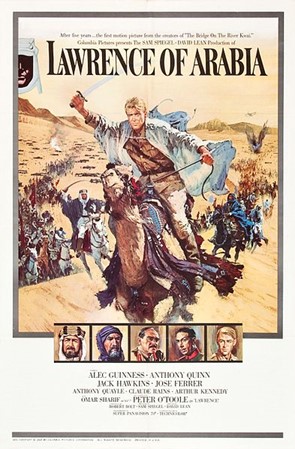
In the 1962 film Lawrence of Arabia, based on the life of T.E. Lawrence, there’s a short scene that influenced me significantly. Lawrence is doubting he can continue leading Arab tribes in battles against the Turks during World War I. Exhausted and emotionally troubled, Lawrence considers giving up the fight. Then the top general challenges him with words like these: ‘Many go through life with no awareness of a destiny. But it is a terrible thing to have a destiny, and not to fulfil it.’ Those words stir Lawrence, lift him from his depression and weariness, and he presses on to win significant battles.

The words in the film were probably the work of a script-writer and not original. Yet they captured Lawrence’s situation, and impacted me when I was worn down. I knew I had a calling, a destiny, and it hit me freshly that it would be terrible not to fulfil it.

My guess is that most people don’t think of having a ‘destiny’ for their lives. The word sounds grandiose. But many do have some sense of purpose or opportunity. There is something they could do and should do. It would be terrible to reach old age and suddenly realise they’ve left it too late to do what they’ve always believed they were in this world to do. A wise person thinks early on about their purpose and potential, and moves steadily towards that goal.

Starting and stopping

I’ve always been tempted to take on more things than I can handle. Giving in to that temptation inevitably leads to stress and incompetence – stress, because we’re overworked; incompetence, because there’s only so many things we can do well.

But most of us are under constant pressure: to join a committee, take on a task, support a good cause. I’ve been asked to lend a hand – it sounded so innocuous – ‘I just need a little help with a project…’ Before long I was doing the project and he’d gone fishing.

Perhaps the only way to have a quiet life is to be hopelessly incompetent, because then no-one asks you to do anything.

Incompetence, though, is a bad solution. Rather, the wise person considers whether a new thing is a right thing.

To be a right thing, three conditions have to be met, best done by asking ourselves questions:

  1.  Does this thing fit with the particular gifts or abilities I have? Most of us could do all sorts of things, but there are some things we’re particularly good at. Those things – which especially fit our skill-set – are likely to be the tasks we should take on.
  2. Should someone else be doing the new task? Many things can be done by many people, so this task doesn’t specifically require me. Just because I could do it doesn’t mean I should do it. Beware those who say, ‘You’re the only one I could ask’ because the real truth may be that ‘You’re the only one I have asked’. Some people don’t look far afield when enrolling help. Don’t be a soft touch.
  3. Can you stop doing other things in order to do the new thing? There’s a saying, ‘If you want something done, ask a busy person’ – because they’re the kind of person who’ll say ‘yes’ when asked to help. But that’s exploitation. They hate to say ‘no’, so soon become overloaded. Unless, that is, they let other things go. I wrote an earlier blog under the heading Necessary Endings (available in Archives, April 11, 2021). I’d been helped by a book with that title by Henry Cloud, a clinical psychologist. He sums up his message early on: ‘…the tomorrow that you desire and envision may never come to pass if you do not end some things you are doing today.’ Wise people limit their work so they can work well. And survive their workload.

Appreciation

One of our dog behaviour books tells us that far beyond any other kind of treat, the greatest motivator for a dog is praise. Lots of enthusiastic ‘Good boy’ ‘Good girl’ ‘Well done’ statements with gentle stroking is key to good dog behaviour. Humans need appreciation too.

I can think of a boss – not one I ever had, thankfully – who was never grateful for what any of his staff did. No recognition of excellence; no recognition of working all hours to get a project finished. Their work was taken for granted; no need for thanks. But if a project went wrong or was late, he flew into a temper and raged at his staff even if the problem had nothing to do with them. You can guess what that boss’s bullying and ungrateful behaviour did to his staff: how little they enjoyed their work; how much they dreaded what might lie ahead as they walked through the office door each morning; how demotivated they were about continuing in that employment.

A wise person is an appreciative person, someone who says ‘you did a great job’. If we can’t appreciate people we’re in the wrong job. Recognising worth and sharing praise is rarely dwelt on in management books, but, done sincerely, appreciation bonds a team and builds achievement.

The Old Testament book of Proverbs says ‘fools despise wisdom’ (ch.1:7). And the New Testament book of James says ‘If any of you is lacking in wisdom, ask God, who gives to all generously and ungrudgingly, and it will be given you’ (ch.1:5). So, fools reject wisdom. But those with a little wisdom can seek more, which God will give. I agree – I’d be a fool not to.


[1] Spoken by Lord Darlington, in Lady Windermere’s Fan, a play first performed in 1892. Wilde wrote the play while living in the English Lake District, hence the source of the name Windermere.

More wisdom

It’s hard to say exactly what wisdom is. Just as it’s hard to say what a chameleon is. ‘Surely it’s not difficult with a chameleon. Look, there’s one – that blue old-world kind of lizard. And another one – oh, oddly that one’s yellow. Maybe, then, yellow ones are not chameleons… Wait a minute, there’s something else that looks like a chameleon but it’s green. Too confusing. I’ll stick with the blue one. But hang on a minute. It’s not blue any more – it’s red.’

Of course, as most know, chameleons have a remarkable ability to change colour – using various combinations of pink, blue, red, orange, green, black, brown, light blue, yellow, turquoise, and purple. Sometimes they change to camouflage themselves, sometimes to regulate their temperature, sometimes to look aggressive to predators, and some may even use colour to signal to other chameleons. All that variety makes it hard to say what colour a chameleon is. But, of course, there’s something at the core – the DNA – that is always chameleon.

I think of wisdom like that. Dictionaries can use words like ‘experience’ or ‘knowledge’ about wisdom, but they just describe how wisdom appears, like blue or red is how a chameleon might appear.

When we’re talking about wisdom we have to be content with that. In the last blog I wrote that wisdom is something which is practised, in other words the way wisdom shows itself. We see attitudes and actions we recognise as wise. So, this time, I have listed five characteristics of wise people.

They use knowledge well

My son sent me a concise example of that: ‘Knowledge is knowing that a tomato is a fruit. Wisdom is knowing not to put it in a fruit salad.’ Hard to argue with that.

Knowledge is usually a wonderful thing to have, but wisdom happens when we do good with what we know.

So, I know my car could reach 100 mph, but I’m foolish if I go that fast. And I know I could simply pick up and cut down a (small) tree with my electric chainsaw, but I’m an idiot if I don’t put on protective gear before using the chainsaw. And, when the children were very young, I knew they’d go anywhere I took them, but I’d have been reckless to run across a busy road hoping they’d follow safely.

Wisdom is not simply about having knowledge, but about doing good with knowledge.

They have strong self-awareness

The Apostle Paul wrote this: ‘Do not think of yourself more highly than you ought, but rather think of yourself with sober judgment…’ (Romans 12:3)

Prince Charles Edward Stuart, 1720 – 1788
Portrait in Public Domain

If only Bonnie Prince Charlie had had such wisdom. In 1745 Charles Edward Stuart[1] crossed from France to Scotland believing he’d get massive support across Britain to restore the Stuart monarchy. He had early success, winning battles and taking troops into England as far south as Derby. But support in England was low, and Charlie withdrew his army back to Scotland. On 16 April, 1746, two armies confronted each other on a rugged moorland at Culloden, near Inverness: the Jacobite army of Bonnie Prince Charlie and the British government army under the leadership of the Duke of Cumberland. The day ended with a rout of the Jacobite army, Charles fleeing the battlefield, eventually escaping to the western highlands and islands, and then by ship back to France.

Why such a defeat? As with all battles, there were many factors and still many opinions. But one is that Charles wanted to prove his skills as commander rather than let his generals get the glory. But he took exhausted men into battle after a failed overnight mission, then waited while many were cut down by enemy artillery fire before hand-to-hand fighting had begun. His chosen battleground was boggy and unsuited to the ‘Highland charge’ which in other places had overwhelmed the enemy. The day was decisively lost, with many dead and wounded. Afterwards Jacobites were hunted throughout Scotland and many put to death. Bonnie Prince Charlie was welcomed back in France, but his later life was not good: he had several affairs, fathered illegitimate children, and became an alcoholic. He died in Rome in 1788, aged 67.

Forty two years earlier, at Culloden, he believed he was a better leader than he really was. It was disastrous for him and his supporters. Wise people exercise sober judgment.

They treat others well

One style of management centres on the willingness of a boss to perch himself on the edge of a colleague’s desk and simply talk. Not a business meeting; not a conversation with an agenda. Just a chance to get to know the staff member, who they are as well as what they do. Perhaps ground-level insights about the business will emerge, but the fundamental purpose is just to be interested. That style of leadership can be overdone, of course. An employee desperately trying to finish a project before a deadline won’t appreciate a chat about last Saturday’s football. But valuing people, knowing them, being interested in their views – that’s wisdom.

It’s even good for people’s health. Apparently research shows there’s great value in direct interaction with colleagues because it releases hormones which improve mood, trust and the ability to learn and remember. The same doesn’t happen via video, messages or emails.[2]

It makes sense that the more you know someone the more able you are to work together. My guess is that there would also be fewer fights between neighbours if they were friends rather than just ‘the people who live next door’.

They have good instincts

In the last blog I mentioned King Solomon’s prayer: ‘…give your servant a discerning heart to govern your people and to distinguish between right and wrong.’ (1 Kings 3:9) God answered that prayer, and from then until now Solomon has been thought of as one of the wisest people who ever lived.

Two parts of that prayer relate to good instincts. One is to have a discerning heart and the other the ability to distinguish between right and wrong.

To discern is to see something clearly, perhaps to have a sure grasp of facts, or perhaps what we call a ‘sixth sense’, an ability to know something without using the five ordinary senses.

To distinguish between right and wrong seems clear. Often it is. But not always. Situations can be ambiguous. Someone’s hurt and I’m driving them to the hospital. If I exceed the speed limit they’ll get help more quickly, but if I exceed the speed limit I might cause an accident, more injuries and possibly deaths. What do I do? Or, another example, a colleague’s language is borderline racist or misogynist. His words aren’t directed at me, but I’m offended and others could be seriously harmed. Do I report him? Do I try and correct him? Either of those will end my relationship with him, but if I do nothing his inappropriate language will continue and do real damage.

In both these examples I could argue the case for either course of action. I hope I’d end up doing whatever my instinct told me was right in the specific circumstances. Like Solomon I’d be praying for discernment and to know what would be right and what would be wrong. Wisdom is having an instinct for hard-to-resolve issues that occur constantly in our lives.

They have more than one speed

No-one should drive like my aunt whose top speed on all roads – all roads – was 25mph. She was dangerous.

But my meaning here isn’t about speed in that sense. Rather, they should be people who look before leaping, and leap after looking. I’ll explain.

There are foolish people who charge through life without taking time to think about what’s ahead. Ivor was like that. He’d have an idea for a new business, borrow money, buy equipment, and rent office space… But what he never did was research the business potential. Were there clients for his services? Were there customers for his products? Again and again he rushed headlong into ‘new opportunities’, but each business failed with serious financial consequences. Ivor had bright ideas, but constantly leapt without looking. (Jesus had words about that kind of folly – the person who began to build but wasn’t able to finish – see Luke 14:28-30.) Wise people look before they leap.

But I also said wise people leap after looking. Of course that statement depends on what you learn from looking. If you stand on the bank of a raging river, look carefully at how far it is to the other side, and realise it’s twice as far as an Olympic long-jumper could cover, then you’re an idiot to attempt even your best leap. You’ll be swept away.

Of course you can’t always leap. But it’s foolish to never leap.

When I left school I went straight into journalism with The Scotsman, which was considered the premier newspaper in Scotland. I was a good reporter, and after two or three years was trusted with being the only journalist on duty on a late shift or on Saturdays. The pay was good. The work was varied and interesting. I saw a great career path ahead. And then I left. I gave it all up. I sensed another direction would be right for my life, so spent many years studying, became a church minister and later headed up major Christian organisations. Like now, it was hard to get into journalism, especially on a national paper, and some of my colleagues in the newspaper office must have thought me mad to leave. Perhaps family and friends did too. But I knew what I was doing. I’d ‘looked’ and now it was time to ‘leap’. It was the right thing – the wise thing – to do.

I’ll finish here for this blog piece. There’s more to say about wisdom, and I’ll try to do that next time.

For now I’ll close with more wise words from the Bible:

Blessed are those who find wisdom,
    those who gain understanding,
 for she is more profitable than silver
    and yields better returns than gold.
 She is more precious than rubies;
    nothing you desire can compare with her. (Proverbs 3:13-15)


[1] Bonnie Prince Charlie’s full name was: Charles Edward Louis John Casimir Sylvester Severino Maria Stuart. Aren’t you glad you’ve never had to write anything like that on an official form?

[2] https://macaulay.cuny.edu/career-blog/the-importance-of-talking-to-your-coworkers/

Wisdom

In ancient times, when kings judged hard cases, two prostitutes stood before their king. I’ll call them Anna and Bella. Anna began their story. They shared a house, both became pregnant and in time gave birth to sons. One night, Bella’s baby died. Quietly Bella got up, took Anna’s baby and placed her dead child in his place. When morning came, Anna awoke and, to great distress, found her baby lifeless. But she looked closely, and realised it was not her baby. It was Bella’s.

Before the king could respond, Bella protested that Anna is lying – her baby is the one who died. The argument continued, but never got beyond ‘Her baby died; ‘No, her baby died’. There was no way to know who was telling the truth? Or was there?

The king had a large sword brought, and ordered that the living child should be cut in two so each woman could have half.

Anna wept. She loved her son and couldn’t let him die, so begged the king to give the child to Bella.

Bella, though, said the king was right that neither should have the child, so ‘Cut him in two!’

Then the king ruled: the child must go to Anna, the mother who so valued the child’s life she’d give him up in order that he would live. ‘Do not kill him; Anna is his mother’ he ordered.

Word of the ruling spread throughout the land. People were in awe of their king ‘because they saw that he had wisdom from God to administer justice’.

The king was Solomon, ruler of Israel for 40 years from 962 BC. The case of the two women and one baby is described in the Old Testament, 1 Kings 3:16-28 (my quotations from New International Version).

Early in his time as king, Solomon sensed God speak to him in a dream asking what he wanted God to give him. His reply had nothing to do with riches or power over his enemies, but: ‘…give your servant a discerning heart to govern your people and to distinguish between right and wrong’ (1 Kings 3:9). And God gave him what he asked for.

Ever since the dispute over the baby, Solomon was seen as having the wisdom of God. Even some 3000 years later, people wish they had ‘the wisdom of Solomon’.

The title of this blog site is ‘Occasionally Wise’. I’d never claim to be all-wise about anything, hence the word ‘occasionally’ in that title. Wisdom is important, very important. Yet I realised I’d never written about it. Until now.

The dictionary I consulted for a definition of ‘wisdom’ used these words: experience, knowledge, and good judgment. I checked several others, and mostly they used the same or similar words.

To me, it seems hard to define wisdom, if we’re thinking of a ‘quality’ someone can possess. Do I know anyone who is so imbued with wisdom they are wise for every circumstance on every occasion? I don’t think I do, and I’m very sure I’m not like that. But if we can’t possess wisdom, I believe we can become people who mostly practise wisdom – train our minds and hearts so that generally we act wisely.

But it’s best to get away from definitions and, in this blog, I’ll write about what wisdom is not.

The writers of dictionary definitions won’t like some of this!

Wisdom is not knowledge    Knowledge is a great tool, but no guarantee of right decisions. Josef Mengele was a doctor and a Nazi SS officer. He had both a medical degree and a doctorate in anthropology. So he was exceedingly knowledgeable – a clever man but also an extremely wicked man. The name he acquired in the Auschwitz concentration camp was Angel of Death. He was happy to assess victims to die in gas chambers, because it gave him opportunity to select those on whom he would perform appalling and deadly medical experiments, especially on identical twins. He knew much, but applied it in ways so unwise he is remembered only for infamy.[1]

Wisdom is not experience    It’s wise to learn from experience. No question about that. But the problem is that many don’t learn from experience. They hold the same beliefs, same assumptions, same values, same goals, and therefore make the same mistakes. That explains the oft-quoted trite saying: ‘If you always do what you’ve always done, you’ll always get what you’ve always got’. The sentence is simplistic, but often simply true.

I’ve counselled people on debt, who swore they’d change, and off they went to spend again because it made them feel better. I’ve counselled people on their marriages, about sharing, listening, nurturing, and each said they’d learned, but back they went to squabbling and hating each other, so much I thought they were happy that way. Except they weren’t. Experience had not brought them wisdom.

Wisdom is not authority    A strong leader – someone who points a clear way forward and motivates others to follow – is assumed to be wise. They know the direction to take. They know how to get there. They know how to take others with them. But authority by itself is not wisdom. Napoleon lacked nothing in the authority department, but in 1812  led almost half a million troops in an invasion of Russia. That campaign has been called one of the most lethal military operations in history. Within six weeks he’d lost half his men because of disease, hunger, and extreme weather. More followed when heavy snows fell. Only 120,000 survived, and Napoleon’s image of invincibility had gone.

Hitler – another heavily authoritarian leader – made a similar mistake. In 1941 he dispatched troops to conquer the Soviet Union. Battles lasted until 1945, by which time almost 40 per cent of all deaths in World War II had occurred on the Eastern Front. The battle for Stalingrad in the winter of 1942 trapped 300,000 German troops who froze and starved, and only 91,000 were left when they surrendered. Eighty per cent of all German military deaths occurred on the Eastern Front. It’s widely reported that Hitler thought himself a military genius and ignored his top generals. He used his authority, but his lack of wisdom cost millions of lives.

Wisdom is not taking the easy way    Perhaps one of the best known parables of Jesus is the story of two men and their house building. Probably they were equally good at designing houses. Both places were impressive. The issue that divided them was where they built. One took on the tough task of finding rock for his house’s foundation. The other took the easy way – there was plenty sand so ‘I’ll just build here,’ he decided. Then came the day of the Great Storm – rain fell for hours; the streams flooded; the wind was gale force. The house on the rock stood firm. The house on the sand collapsed with a great crash. That story of Jesus – recorded in Matthew 7:24-27 – is usually called the parable of the wise and foolish builders.

What was wise was the hard way – perhaps it cost more money, certainly it took more time. But the house lasted. The man who opted for the easy way – cheap and quick – lost everything. The easy way always looks… easy. And therefore attractive, because you can have it quickly and at little cost. But the easy way is nearly always the wrong way, not the way of wisdom.

I’ll stop here. After several long blogs, actually very long blogs, one of modest length may be particularly appreciated. A wise choice for me to make.

Next time I’ll write more positively about what it is to have wisdom. Hopefully I’ll find sufficient wisdom for that.

———————–

I realise there was a longer-than-usual gap before this blog appeared. My apologies for that, but I had another of these study pressure moments when my priorities temporarily had to shift. It was the right thing to do – the wise thing to do – but I’m still sorry for the delay. Thank you for your patience.


[1] When World War II ended, Mengele escaped to South America where he consistently eluded Nazi hunters. He eventually died in 1979 from drowning after suffering a stroke.