Christmas miscellany

There are only a few days to go before Christmas. In the UK, like many western countries, people seem geared towards an over-indulgent holiday season. Too much money will be spent on presents. Too much food and drink will be consumed. Too much effort will go into trying to ensure everyone has a wonderful time. Too much time will be spent watching special programmes on TV. And too few will reflect on the birthday of Jesus Christ, the event which should undergird everything we are celebrating.

But I’ve never believed in being a grumbler about Christmas. I enjoy Christmas though I admit that I don’t get close to crazy excited like I did when I was young. I’d wish more people thought about its origins, but even if they don’t it is still a wonderful season, including special time with family and giving and receiving presents.

For this last blog post before Christmas I’ve assembled a miscellany of things about Christmas. Some are serious, some less important. But I hope they’re all interesting. Enjoy reading.

Church or pub on Christmas Day

In the UK, only about 5 per cent of the population attend church regularly. That number may not be exact. Pollsters do not all use the same methods, and definitions of ‘regular church attendance’ aren’t all identical. Nevertheless, I suspect the 5 per cent figure is close to being right. My home nation is predominantly non-churched. Except, that is, at Christmas.

It’s not unusual to see full churches for Christmas Eve midnight services. I used to lead and preach at services like that. They could be eventful if some of those weaving their way home after an evening in the pub decided to join the service. All were welcome but not all were at peace with the world or church decorum.

Fewer attend church on Christmas Day. Other things capture attention, not least keeping children calm while they rip the paper wrappings off presents. Then there’s the massive task of preparing and serving a big meal for family and friends. Turkey is the traditional dish in the UK for a Christmas Day meal.

But ‘Statista’ asked people whether they plan to attend church on Christmas Day or spend their time and money in the pub. The answers they got surprised me. Take a look at the chart comparing church or pub attendance for the USA, UK and Germany.

Clearly the USA has the highest percentage of people who will attend church on Christmas Day – 19 per cent. To my surprise the UK trails by only 3 points at 16 per cent, but Germany scores only 12 per cent. However, what all three nations have in common is that church wins over pub. I don’t know why that happens. My guess is that, for some, there may be a long-observed family tradition of going to church on Christmas Day. Others may pass through church doors for a service of lessons and carols but that will be their one-time attendance until next Christmas. However, of course, most Christmas Day churchgoers are people with a real faith in Jesus. They make a priority of attending church to worship before other events overtake their day.  

The odd ancestry of Jesus

Some families have an unkempt uncle, an agonising aunt, or a grouchy grandparent, but Jesus had some really strange ancestors. Certainly Matthew, the writer of the first gospel in the New Testament, did not sanitise his list of Jesus’ forebears.

A few years ago I wrote two blog posts about those ancestors of Jesus. If you haven’t read those posts, I’d encourage you to do so now. I promise they’re interesting, challenging and encouraging. Here are the links:

Why is Christmas on December 25?

Why the 25th of December? Well, the first thing to say is that it’s unlikely that Jesus was born in late December. Scholars point out that shepherds wouldn’t have their flocks out in fields in mid-winter. It would also be a strange season  to travel with your heavily pregnant wife back to your hometown to be counted in a census (see the opening verses of Luke’s gospel, chapter 2, for mention of that census). For various reasons biblical scholars mostly consider that sometime between spring and summer is more likely for the time of Jesus’ birth.

What is also interesting is that the date of Jesus’ birth was not celebrated or even considered by the early Christians. Matthew’s and Luke’s gospels carry the story of his birth, but there’s no mention of a date. In fact the date of the Saviour’s birth was never discussed by the church until at least the 2nd century.

Two or three theories are put forward now for why December 25 was later made Jesus’ birthday.

A Roman and Christian historian called Sextus Julius Africanus dated a lot of things. (He was born around 180 and died around 250 AD.) For example, he calculated that creation was complete on March 25, 5499 BC. Sextus stuck with March 25 as the exact date when Jesus was conceived in Mary’s womb. That day had already been considered as the date of Jesus’ crucifixion, and perhaps Sextus thought it appropriate to date Jesus’ conception and death on exactly the same date (not in the same year, of course!). How does that affect the date of Christmas? Think: if Jesus was conceived on March 25, nine months later is December 25. Simple really. Well, it was for Sextus, so for him December 25 was the date Jesus was born.

But there could also be another reason for the date. In 274 AD, the Roman emperor Aurelian marked the rebirth of the Unconquered Sun (Sol Invictus) on December 25. Why then? The 25th was just after the winter solstice, and therefore the beginning of days that would gradually get longer. For Emperor Aurelian, December 25 was when the sun had been reborn so there should be a celebration. Move forward to the next century when Emperor Constantine ruled. He was a convert to Christianity who had made his faith the religion of the empire. In 336, and perhaps because he wanted to wean his empire away from pagan gods, he overlaid the Sol Invictus festival on December 25 by marking that date as the birth of Jesus. Thus December 25 became established in the western Roman empire as what we now call Christmas. January 6 was favoured in the east, and the modern Armenian church continues to mark the January date.

There is a popular, broader idea that the date of Christmas was fixed to replace a variety of pagan feasts held in mid winter. That suggestion was never made until the 12th century, and today’s scholars point out that the early Christians didn’t have any interest in borrowing dates from pagan religions. If anything, they distanced themselves from other faiths.

What we shouldn’t confuse here are two very different things. One is the idea of borrowing the date of Jesus’ birth from pagan religions. The other is adopting traditions for Christmas from those religions. The obvious example of the latter is the use of the Christmas tree, which does seem to have originated in the worship of the Druids. They were Celtic priests who decorated their temples with evergreens as a symbol of everlasting life.[1]

No-one can say with certainty why December 25 became the date for Jesus’ birth. Perhaps thinking of March 25 as Jesus’ conception in Mary’s womb, on the same date as his death during Passover, is what led people to the nine months later date for his birth, but there is no complete evidence to support any theory. Since Victorian times we’ve been bombarded at Christmas with wintry images of reindeer, snow flakes, snow covered trees, and children building snowmen. Then, from 1941, we’ve crooned along with Bing Crosby singing ‘I’m dreaming of a white Christmas’. Who would want to surrender all that for another date? I’d consider it. Australians don’t seem too sad about celebrating Christmas on the beach. I could get used to that too.

For more on the date of Christmas, you’ll find a well-written scholarly article – easily understood by non-scholars – here: https://www.biblicalarchaeology.org/daily/people-cultures-in-the-bible/jesus-historical-jesus/how-december-25-became-christmas/

Victoria, Albert and Christmas trees

Evergreen trees have always been popular because, well, they’re evergreen. Deciduous trees, like oak, chestnut and beech, flourish and then for half the year seem to lose their life. Evergreens are fully alive all the time.

So from the most ancient of times – long before Christianity – people collected evergreen branches to hang over doors and windows. In some cultures those evergreens were thought to shut out demons and other evil spirits, and even illness. During a long, hard winter the green branches were also a reminder that spring would come and plants and crops would grow again.

But how did that become the Christmas tree tradition?

There’s no single answer to that question, but there’s evidence that by the 16th century Christians in Germany were bringing evergreen trees into their homes and decorating them. There’s a story – possibly true – that the famous church reformer, Martin Luther, walked home on a dark but clear winter night feeling awestruck by the bright stars overhead. So he erected a tree in his home, and fastened lighted candles to its branches to recapture something of the magnificence he had seen outside.  

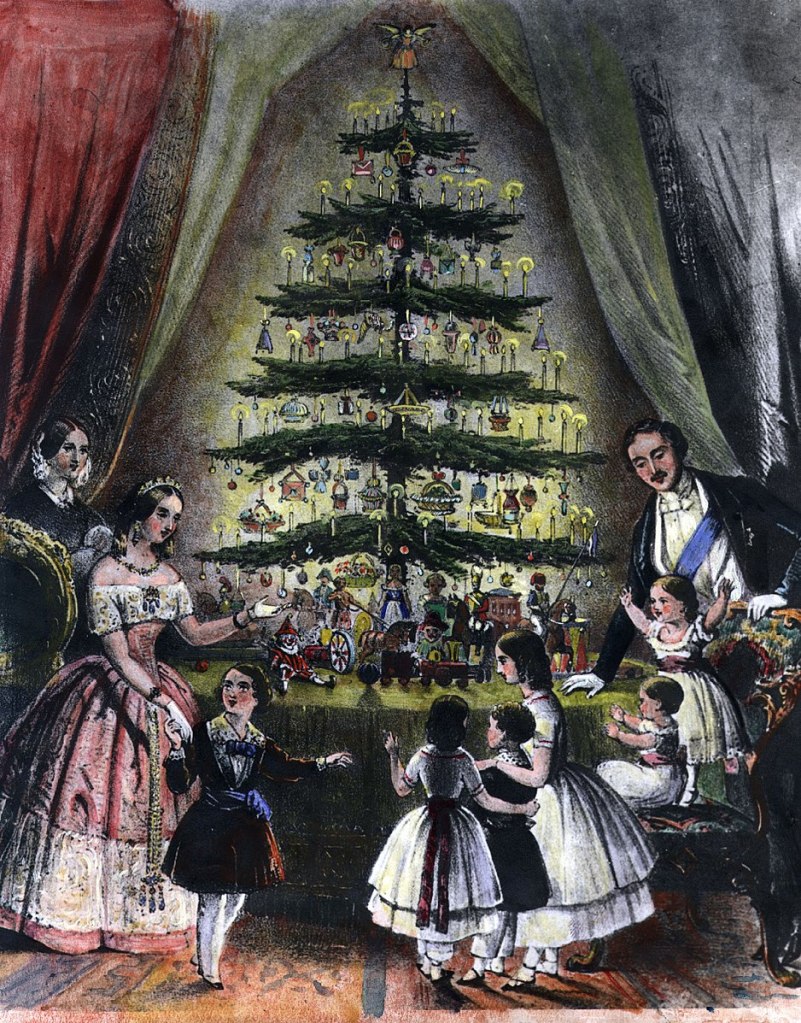
That German tradition slowly spread across Europe. But its popularity soared in the mid 1800s when Queen Victoria’s German husband, Albert, had trees erected in Windsor Castle and, in 1848, allowed a front cover painting to appear in The Illustrated London News showing the main tree covered in decorations and surrounded by the Royal Family. Other papers picked up on the story, and it massively influenced upper class customs in Britain and many other countries. Royal fever did its work.

Image in public domain

During the following decades and into the 20th century, the tradition of the Christmas tree spread quickly and widely. Across the western world almost all homes had Christmas trees. Local authorities mounted Christmas trees in public squares and on their buildings. Large stores placed trees on their balconies and in the main retail areas. Towns and cities publicised ceremonies of switching on the lights on large Christmas trees in prominent places. For example, since 1933 and continuing now, a large Norway spruce tree has been used for the Rockefeller Center Christmas Tree in New York. The 2024 tree is 74ft (22.5m) tall, 43 ft (13.1m) wide, and weighs about 11 tons (24,250 pounds, 11000kg). After the Christmas period, the tree will be donated to Habitat for Humanity and cut into lengths to help with building homes. In Washington DC the National Christmas Tree is erected near the White House, and its lights switched on by the President and First Lady. Trafalgar Square in London has had a Christmas tree donated by Oslo, Norway, every year since 1947. The 2024 tree is 20 metres (65.6ft) tall and has already been scaled by a protestor dressed as Santa Claus.

For a long time now Alison and I have had only artificial Christmas trees in our home, principally for three reasons: that means a real tree is still growing in the forest; artificial trees leave no mess; they can be used for many years. We follow a common tradition of laying presents around the base of the Christmas tree. When our children were young, those presents sparked curiosity which led to exploration. The children would secretly examine the size and weight of each neatly wrapped present, probably hoping the biggest and heaviest was for them. One thing we never have done or will do is sing around the Christmas tree. The TV series Downton Abbey portrays how the aristocratic family would sing along with their servants beside a giant Christmas tree. We have never done that. Maybe it’s because we don’t have servants. Or because we’re not very tuneful.

‘Once in Royal David’s City’

Every Christmas Eve millions in the UK and around the world tune in to a service of carols broadcast from King’s College, Cambridge. The first TV broadcast was in 1954, and then the service televised regularly from 1963. For over 100 years one tradition at the start of that service has not changed. Since 1919 the opening carol has been Once in Royal David’s City, with the first verse sung unaccompanied by a boy soprano. For that soprano, the thought of your solo being heard around the world must be terrifying. What must make it worse is that no-one knows who will be the soloist until the choirmaster selects one of the sopranos just as the service begins. A nod or pointed finger in your direction, and seconds later your voice penetrates the silence. And millions are listening.

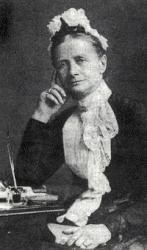
The writer of ‘Once in Royal David’s City’ was born Cecil Frances Humphries in 1818 in County Wicklow, Ireland. ‘Royal David’s City’ wasn’t her only famous hymn  – I’ll mention two more shortly. They may surprise you. Keep reading…

Cecil began writing poems in her school journal from an early age. They were beautifully composed in style and content, and that led to the publication of her first book of poetry called Verses for Seasons, a kind of ‘Christian Year’ of readings for children. That was only the beginning. Overall she wrote more than 400 hymns, basing them on subjects like the Apostles’ Creed, baptism, prayer, the Lord’s Supper and the Ten Commandments. All of them were written in simple language so children could understand and enjoy them.

When Cecil was 30, her book Hymns for Little Children was published. Each hymn was written to bring out the truth of some Christian teaching. Of course, without music the hymns read like poetry. But one year after publication a gifted English organist, Henry John Gauntlett, read Hymns for Little Children, and so loved ‘Once in Royal David’s City’ he composed music for it. As a hymn it was immensely popular and before long it was being sung far and wide.

Its origins as a children’s hymn show by the many direct lessons or references to children in the carol. For example, Cecil writes:

  • Christian children all must be / Mild, obedient, good as He.
  • For he is our childhood’s pattern; / Day by day, like us He grew;
  • And He leads His children on / To the place where He is gone.
  • Where like stars His children crowned / All in white shall wait around.

Cecil tells the story of Jesus in the carol, but also applies lessons and truths of the Christian faith for the children who would read or sing it. And that, after all, was her purpose. Hymns for Little Children carries a dedication by Cecil to her godsons, in which she hopes that the language of verse which children love “may help to impress on their minds what they are, what I have promised for them, and what they must seek to be”.

Two years later, in 1850, Cecil married Rev William Alexander (hence her hymns carry the name Cecil Frances Alexander). He eventually became the Anglican Primate of Ireland, a very senior role. Cecil poured her energies into writing hymns but also care for the very poor. The disastrous Irish potato famine – known as the Great Famine or Great Hunger – lasted from 1845-1852.[2] The parishes of Ireland were filled with masses of the disadvantaged. Cecil poured her heart and hands into care for them. Often she’d travel miles in difficult conditions to bring comfort to the sick and poor, and to give them food, medical supplies and warm clothes. Along with  her sister, she also founded a school for the deaf.

Cecil wrote many hymns before she died in 1895. One of those was the classic Easter hymn ‘There is a green hill far away’. Another was the hymn loved by children and adults ‘All things bright and beautiful’. Many have regarded Cecil Frances Alexander as one of the greatest hymn writers in the English language.

Eating mince pies at Christmas

There is every good reason to eat mince pies, but no special reason to eat them only at Christmas. They are just as enjoyable at any time of year.

Plate of freshly baked festive Christmas mince pies with decorated golden crusts and spicy fruit filling served sprinkled with sugar, one broken open to reveal the filling. By christmasstockimages.com – http://christmasstockimages.com/free/food-dining/slides/mince_pie_plate.htm, CC BY 3.0, https://commons.wikimedia.org/w/index.php?curid=97503821

Mince pies date from medieval times but back then they were shaped like a rectangular manger, with a pastry baby Jesus on top. I’d find it hard to bite into that. The round shape of mince pies came only after the Reformation in the 1500s.

People of old linked the ingredients of mince pies with the Christmas story:

  • meat (mostly lamb or mutton) represented the shepherds
  • dried fruit (raisins, prunes and figs), along with spices (cinnamon, cloves and nutmeg), all expensive items, symbolised the wise men’s gifts
  • the mince pies had 13 ingredients in total, equating to Jesus and his 12 disciples.

Eating a mince pie every day of the 12 days of Christmas was thought to bring happiness for the following 12 months.

Around the time of the Reformation, Puritans tried to ban everything associated with Catholicism. That included mince pies. The pies soon made a comeback.

We can all be glad that ban did not last. The popularity of mince pies today is immense. In the UK about 800 million are sold in the run up to Christmas. Add to that the very many which are made in the home. Assuming they’re all eaten, that’s a lot of mince pies and a lot of calories. Some eat none of course – they’re not food for babies, nor does my 102-year-old mother-in-law eat them now. And there are some strange people who don’t like mince pies. A reasonable guess, then, is that those who like mince pies consume an average of between 15 and 19 pies per person at Christmas. Personally I’m a fan of home made pies served warm, and I’m not admitting how many I eat each year.

Finally…

I can’t finish without saying that, for me, Christmas isn’t about carols, mince pies, or presents around a Christmas tree. It is about Jesus, God’s Son, entering this world. No other birth changed the world like his.

My hope and prayer every Christmas is that people will think carefully about the one whose birth began it all (whatever the precise date). I wish you the happiest of Christmases and a new year ahead with many reasons to be thankful.


[1] https://www.history.com/topics/christmas/history-of-christmas-trees

[2] History.com records the famine’s toll: “Before it ended in 1852, the Potato Famine resulted in the death of roughly one million Irish from starvation and related causes, with at least another million forced to leave their homeland as refugees.” For a fuller description of the famine, see: https://www.history.com/topics/immigration/irish-potato-famine

Why don’t we change when we know we should?

“Change? We don’t want to change!” I was told. The message couldn’t be clearer. Arguing would have been pointless. But what I thought was ‘If you won’t change, then your group will die’.

For more than a year I’d been hearing complaints from the church women’s group that the younger ladies wouldn’t come to their meetings. In the distant past that women’s group had been relatively large, perhaps 40 or 50 attending each week. Every meeting followed the same pattern. Notices at the beginning, then a speaker, and after that tea and cake. Frankly, what mattered most was the tea and cake time, not for the refreshments but because that’s when they could chat to each other. The main reason many ladies attended was for ‘fellowship’ – being friends, sharing news, giving encouragement, asking for advice, and, so some said, staying up to date with the gossip. But the years had passed, and the oldest members had either died or were no longer able to come out on dark nights. The headcount had declined, down to about 15 on a good week. But the numbers of women in the church had grown, in fact grown a lot. The newcomers were younger, most with ages ranging from early twenties to late forties. Many were studying or working, often with long hours. Some had families. Others belonged to organisations not related to the church, and several went with friends or husbands to neighbourhood home group meetings. The traditional women’s group held little attraction for them.

But their absence didn’t go down well with the leaders of the women’s group. So, as pastor of the church, I decided to meet with them. The leaders didn’t hold back. The younger generation of women were letting them down. They should come to the meetings and swell their numbers. So I was told. Tactfully, I tried to explain that the younger ones lived such busy lives they didn’t feel able to add another meeting into their schedules. “But they should come,” they said. “They are women who belong to this church, so they should support the women’s group.” Summoning up the courage to be more direct, I explained that if, say, 30 of the younger ladies joined the women’s group, they’d outnumber the existing members by two to one, and they’d almost certainly vote for change. Which is when they replied “Change? We don’t want to change!”. And so our meeting ended, and within two years the women’s group had its final speaker, last cups of tea and slices of cake, locked the doors, and never met again.

It was obvious that they needed to change, but they wouldn’t. In their case, they liked what they had and didn’t want anything different from that. It was a fatal attitude.

But not an unusual attitude. Whether we think about personal habits or organisational practices, it’s often the case that clearly things must change and yet they don’t. But why not? That’s what this blog post is about.

First, though, I should clarify that I won’t be trying to explain compulsive behaviour caused by addiction or mental illness. Alcoholics, for example, often know perfectly well that drinking is ruining their health, family life, and job performance. Yet they can’t resist that first drink which then leads to many more drinks. A young man told me a similar story, but in his case about a gambling addiction which had caused him financial ruin. Drug addicts may also be well aware that their ‘habit’ is killing them but they’re unable to refuse the next ‘hit’. The complexities of addiction and mental illness lie beyond the scope of this blog post. Here I’m writing about the more common experience described some 2000 years ago by the Apostle Paul: “I do not do the good I want to do, but the evil I do not want to do – this I keep on doing” (Romans 7:19).

What follows are seven reasons why we don’t change when we know we should, including when we wish we could. Most of these refer to personal change, but the first is about organisations.

Organisations have remarkably sticky cultures.  Management books describe how the appointment of a new CEO rarely brings about significant change in the way a company goes about its business. The CEO might put forward a new policy, but staff will react with “That’s not the way we do things around here”. They may never say those words publicly, but it’s how the employees feel, and therefore how they react to proposed change. Businesses have a culture – beliefs and customs – which reinforce the status quo. For the staff, the way things get done is the only way to get things done. Hence change is resisted.

In 1990 Peter Senge wrote a masterful book called ‘The Fifth Discipline’, with the subtitle ‘The Art & Practice of The Learning Organization’. His conviction is that businesses are rarely learning organisations, and since they don’t learn they don’t change. Senge writes: “What if even the most successful companies are poor learners – they survive but never live up to their potential?” He continues:

“It is no accident that most organizations learn poorly. The way they are designed and managed, the way people’s jobs are defined, and, most importantly, the way we have all been taught to think and interact (not only in organizations but more broadly) create fundamental learning disabilities. These disabilities operate despite the best efforts of bright, committed people”.[1]

Note Senge’s words about “the way we have all been taught to think and interact”. Our ideas have been conditioned and our brains trained to operate in certain ways, and it’s devilishly hard to change those patterns. Hence organisations keep doing what they’ve always done. Those ‘stuck in a rut’ ways of thinking and acting are huge barriers to change, even when such change would obviously be good.

Unwillingness to admit we’ve been doing things the wrong way.  Adopting a new way of thinking or working seems like an admission that what we had or did before was second-rate. Pills used to come in screw top containers; now those containers have child-proof tops. I typed a thesis of some 100,000 words on a typewriter, throwing away every page which needed more than the simplest correction. Now even the simplest laptop has software that makes writing easy, with nothing printed out until near perfect. My parallel parking in a tight space often used to involve getting out of the car to see exactly how much further back I could go. Now my car has a reversing camera, so judging how much space I’ve got left is easy. With each of these examples, what was mentioned first was clearly inferior to what I described second. Adopting the new was admitting the old wasn’t great.

Rather than accept that, some cling to what is old and familiar. I knew a finance director who so disliked computer spreadsheets that he longed for the large bound ledgers he’d used when an apprentice accountant. I’ve met car mechanics who agree that the technology of modern cars aids reliability, but they still long for the simple engines and fittings of a past era, because they loved taking them to bits and using their skills to make repairs.

Accepting that the old ways or old things were not very good, and occasionally really bad, is not easy for many. Hence they resist change.

Change requires time, effort and sometimes money.  Let’s never ignore a fundamental reason people dislike change – they need to learn the new thing. Not everyone enjoys learning new skills. Our moderately large organisation needed to adopt the most popular word processing software. Most of the staff were delighted, because it meant our word processors would easily and accurately incorporate the electronic documents sent by people outside our organisation. But there was a resistance movement. Some had mastered keyboard shortcuts in the old software, and they knew how to reveal hidden codes which helped with editing. Worse, they loved the DOS software[2] because of its clean screen and none of the myriad options via drop-down lists.  But, fundamentally, most who resisted simply didn’t want the effort of learning a new system. To surrender to laziness would have been short-sighted and foolish. The change was made. It required persuasion, time, effort and money, but all the staff eventually appreciated the new software.

Suggesting change is needed can offend.  Telling a spouse or partner that they drive badly is maritally dangerous! It certainly risks a furious row. There’s much the same risk when criticising a different kind of driving – that of a fellow golfer who keeps slicing the ball off the tee. I had the uncomfortable experience of playing alongside a couple when the husband constantly criticised his wife’s standard of play. He got angrier and angrier at her poor shots; she just went quiet. What she might have said – but wisely didn’t – is that he wasn’t much of a golfer either. I know of an organisation which provided parenting coaches to advise parents on how to bring up their children. The coaches were typically uninvited by the parents after two visits. No-one wanted to be told their child raising skills were lacking. Management gurus have the same problem when hired to help a struggling business. The company CEO may have brought in the consultant to fix his employees, and does not appreciate being told that what needs to improve is his leadership skills.

Without great sensitivity, advising people that they need to change can create a defensive, negative reaction. That just makes a bad situation worse.

Taking someone out of their comfort group.  At almost all golf clubs, groups of friends regularly play together. After the match, they’ll sit around enjoying a beer or a coffee. Their socialising after the game can last as long as their game because they enjoy each other’s company. Each of them feels they belong there. But what if one of them must leave the group? Perhaps he can’t afford all the drinks, or needs to give those hours to another activity. Surely he can just leave? Actually, he may feel he can’t. Over the years the group has transitioned from being casual friends to a place where everyone feels they belong, where they feel safe. They draw strength from each other as they share opinions, hopes, problems, challenging issues and get encouragement. The person who feels he should leave wonders how he can manage without the group.

What makes a close-knit group strong is what makes it hard to leave, or to disagree with the majority. That can be true in a workplace, where one person would struggle to differ on important issues like attitude to the boss, whether pay levels are fair, and how hard everyone should work. Group belonging is also strong in churches, where people share faith, pray together, get encouragement, and come away feeling more able to face hardships. It happens between people who have lived near to each other for a long time. My parents were close friends with all their neighbours. They talked at front doors, visited in each other’s homes, and got together on significant occasions such as midnight on Hogmanay (a Scottish custom at the start of a new year). In any of these cases, leaving or disagreeing with the group is difficult. My parents eventually moved to another part of town, but it robbed them of important friends. It would be the same for someone giving up on a golf fraternity. In the workplace, rejecting a group’s view can lead to being ostracised from the company of colleagues.

Even when people feel they should change, they may opt not to change if it means leaving a group which is important for them.

Fear of an unknown future.  Change creates something unfamiliar. In the late 1990s Alison and I moved hundreds of miles from Aberdeenshire in Scotland to Oxfordshire in England. Many things were different. Busier roads near London meant I learned to ask how long will my journey take, not how far is my journey. Affluent Oxfordshire had alternative values from those I’d grown up with in Scotland. All our friends and family were in the north, far distant from where we had moved to. Now I was heading up a large mission organisation, very different work from being a church pastor. And, instead of a normal routine of local journeys, now I travelled all over Britain and to literally dozens of other countries. People in Oxfordshire thought I spoke strangely, remarking “You have an accent”. I learned to reply, “So you think you don’t?”

The very word ‘change’ means things won’t be the same. Change takes us into a future we’ve never experienced, perhaps one we could never have imagined. And, for many, that prospect is daunting, so daunting they refuse to change and they stay with what they already have and know. Twelve years later, when we told family and friends we were leaving Oxfordshire to live and work across the Atlantic, several said “I couldn’t do that…”. They said they couldn’t. Actually they could, but what they meant was they wouldn’t do that. They’d choose the familiar over the uncertain.

Whatever the pluses or minuses of what we have already, the big positive is that it is known. We can cope with it. The future may not be like that. What if our hopes and dreams turn to dust? What if we quickly regret the change? We may never be able to go back to what we left. That can feel too big a risk to take. Therefore people resist change.

No decision is a decision.  This is my last note about change. Imagine a CEO has to decide whether to market his business in a completely different way. Or, more radically, the CEO has to decide whether the company should abandon its old merchandise for shiny new products. The old stuff is still selling but not as well as it once did. And new lines might bring new customers. He wishes he could sell both the old and new, but he can’t. To have the new he must let go of the old, and he’s not sure he can do that. In a dream which is close to a nightmare, he’s getting into a beautiful boat and sailing away from a safe pier, only to find the boat sinks. When he wakes, he fears that’s what might happen if he moves to a new product line. He’ll take his company from its safe place, only for it soon to sink. The CEO is paralysed with uncertainty, so in the end makes no decision at all.

But, of course, he has made a decision. Not to change is a decision, and, for that CEO, sticking with an old product line would be a bad one because market trends were moving on. Sometimes change is absolutely necessary. That’s how it feels for those threatened by war who abandon their homes and become refugees. Or, in a more ordinary situation, the change might be to another employer, one who treats staff more kindly. For the refugee, failure to change could result in death. For the employee, staying with a bad employer would mean years of overwork and exploitation. Some situations, of course, are not clear cut, but I’d argue that, in most circumstances, change must be an option. Yes, it has to be well thought through – all possibilities considered – then followed by a thoroughly positive decision. Not changing may be the right thing; it simply shouldn’t be for the wrong reasons.

I’ve listed seven reasons why change doesn’t happen even when we know it should. But none of those reasons are invincible barriers to change. We are not prisoners of the status quo. Down the years I’ve experienced change many times, and almost always change has been positive for me. It has not always been easy, and most times uncomfortable at first. But change has gifted me with new challenges and new experiences, the large majority of which have been positive and meaningful. Be brave!


[1] Page 18 in the 1990 edition. Peter Senge is a senior lecturer at the Sloan School of Management at MIT (the world-renowned Massachusetts Institute of Technology, located in Cambridge, just outside Boston). The Fifth Discipline is still published, now in a 2006 edition by Random House Business. The book has sold in the millions world-wide.

[2] DOS stands for Disk Operating System. Many web sites explain how DOS works, including this one: https://en.wikipedia.org/wiki/Disk_operating_system

Where are the good Samaritans?

I didn’t see the accident coming. I fell forward, my head hitting the ground hard. Everything went dark for a few seconds, then I became dimly aware that I must have tripped and fallen on a path of hard clay and stones. My head hurt, and my muddled brain knew I could have other injuries too. Very slowly I moved. No shooting pains. I knelt, and then stood. I was unsteady but okay except that my eyes wouldn’t focus. Everything was hazy. Then I realised my spectacles were gone; no wonder I couldn’t see clearly. I stumbled around, but searching for glasses without glasses is difficult. I found them, remarkably undamaged, and again I could see properly. I’d fallen because I’d tripped on a root from bushes I was squeezing between.

I still didn’t know how badly I was hurt. My knees and elbows were painful but probably just bruised. My head hurt the most. I was in hilly countryside near home, walking our two dogs, so, obviously, there were no mirrors to let me examine my injured head. Gently I touched where it was most tender. Blood on my fingers showed I’d damaged my forehead and the bridge of my nose. For a few minutes I rested. My body and head ached, but I felt I could see and think clearly enough. Perhaps my thinking wasn’t actually that clear, because I decided the dogs needed the rest of their walk, so off we went again.

I met two other people during that walk. One was a young lady who passed me going in the opposite direction, and we each said ‘Good morning’. I also met a middle aged man who glanced at me, said nothing, and walked on. Eventually I returned to my car, got the dogs inside, climbed into the driver’s seat and, using the rear view mirror, saw my face for the first time. My forehead and nose were bruised and cut, and blood had been trickling down my face. I looked dreadful. Both the people I passed would have seen I was streaked with blood and obviously hurt, yet neither asked if I needed help. They just kept going their own way.

Later, the fact that those folk did nothing to help reminded me of one of Jesus’ most famous parables, the one about the Good Samaritan. It’s best you read it for yourself – it’s in Luke’s gospel, chapter 10, verses 25-37. But here’s a quick summary. An expert in the Old Testament law quizzed Jesus about the command to ‘love your neighbour’. “Who is my neighbour?” he asked. Jesus answered by telling the story of a man travelling from Jerusalem to Jericho – journeying on a steeply downhill, twisty road notorious for robberies – who was attacked, and left half dead with nothing, not even his clothes. Two solo travellers came along. Both were religious leaders, one a priest and the other a Levite. Surely one of them would help. Neither did. Seeing the injured man, each crossed to the other side of the road and kept going. Perhaps they had pressing duties so no time to help. Perhaps the priest thought the man was dead, and touching him would defile him. Perhaps the Levite was afraid the man was a decoy and if he stopped to help, bandits would emerge and attack him. Whatever the explanation, both these men cared more for their personal agendas and safety than they did for the wounded man. But then along came a Samaritan. For the crowd listening to Jesus, a Samaritan would be the last person they’d expect to help. Jews considered Samaritans heretics because of their different beliefs, and because they did not fully observe ceremonial law. Jews and Samaritans did not get on with each other. But this third passer-by did not pass by. It was the Samaritan who took pity on the injured traveller, went to him, poured wine and oil on the his wounds and bandaged them, then, putting him on his donkey, took him to an inn and cared for him there. Next morning he gave the innkeeper a sum equal to two days’ wages to continue looking after the traveller, with a promise that when he returned he’d pay for any further treatment or accommodation the man had required. Such a level of care and generosity must have stunned Jesus’ audience. Then Jesus asked the legal expert: “Which of these three do you think was a neighbour to the man who fell into the hands of robbers?” The expert answered: “The one who had mercy on him”. It was the right answer. The priest and the Levite probably felt sorry for the man, but they did nothing. The Samaritan’s pity moved him to action which saved the man’s life. He did what a neighbour should.

So, where are the good Samaritans today?

Well, the obvious first thing to say is that in Jesus’ time someone stopping to help was exceptional, at least on the road from Jerusalem to Jericho. The Samaritan did what others would not do. Certainly Jesus was also highlighting that those you would expect to help didn’t, and someone unlikely to help did. But it wasn’t just one priest and one Levite who would have passed by. Most people would have kept going, perhaps muttering ‘Not my business’. The sad truth is that good people, willing to care for others, have always been rare.

But, these days, is human compassion not in a very sorry state if hardly anyone will help a person in dire need? My answer is ‘yes’. It’s tragic if few will set aside their own priorities and give time and money to help others.

Occasionally the media carry horror stories of failure to care. For example, neighbours of a reclusive man in County Cork in the south of Ireland didn’t see him out and about and assumed he had moved away to England. His house was derelict, so it was boarded up. Twenty years later council officers found the skeletal remains of a man in a bed inside that house. For two decades no-one had checked inside. In Lombardy, near Lake Como in Italy, people were concerned when an elderly neighbour’s tree fell and other trees in her garden seemed unsafe. They called the fire brigade and police who broke into the home. The homeowner was there, seated in a chair in her living room. But she had been dead for two years. Once again, no-one had checked on her wellbeing. Neighbours just assumed she’d moved away.

Why do we not take at least an interest in other people’s lives? Why don’t we help when there’s a clear need?

Of course there will be many reasons. I will list seven.

We’re too busy with our own lives  That was probably one of the problems for the priest and the Levite. With somewhere else to be and urgent business to do, they had no time for a dying wayfarer.

Now, if we were captaining an aircraft through a dangerous storm, it would be reasonable not to leave our controls to care for an airsick passenger. No-one would dispute that our duties at the controls should have priority.

The problem is that we think like that even when our priorities are not indisputably more important than someone else’s need. Our appointment is not more crucial than helping the person who has fallen in the street. Our daily affairs are not more urgent than checking on an elderly neighbour who has not been seen for days. Our favourite TV programme is not more vital than helping our child with his homework.

But we allow ourselves to believe our agenda always supersedes the needs of others. That’s selfish. It’s a mindset that elevates whatever we’re doing over what anyone else is doing, as if our needs matter and their needs do not. The Good Samaritan did not think like that. If he had, he’d have been the third passer-by to leave a wounded man to die.

We’re anxious about what getting involved might lead to  If we knew that nothing more was needed than lifting a fallen pedestrian back to their feet, of course we’d help. But suppose they’re hurt and need medical attention? Or lost, and they will have to be taken home? Or they’ll want you to call their daughter and wait with them until the daughter arrives? Even worse, what if that fallen pedestrian was mugged and going to their aid might mean giving evidence to the police, and perhaps being a witness in court?

Most of us think our lives are so full we’ve no time for anything other than a one-off moment or a one-time activity. So we’d certainly help someone back to their feet providing we’re sure that’s all that’s needed. But we’re not sure. Perhaps it’ll get more complicated. We can’t afford to get involved, so we do nothing. We pass by on the other side.

But we delude ourselves. Often the truth is that our lives are not as full as we imagine. Or they’re not full of things that matter more than helping that poor individual who’s collapsed. We like to believe everything we’re doing is important, and it’s vital we keep our focus. But everything is not vital. We could take time to help. But we use our imaginary full agenda as an excuse not to get involved at all.

We’re frightened that helping short-term will create an obligation long-term  My friend Gordon was moving away permanently to another part of the country. He explained to me that he’d been visiting two elderly sisters, Anne and Susan, who were residents of a council-owned care home. Since he was relocating, he asked if I’d pay them a visit. “Of course,” I said, thinking I had time on Sunday afternoon to make my one-time call on them. I’d no idea what to expect in a council care facility. I found wonderful staff who were genuinely warm-hearted towards their residents, but, staff aside, there was a scarcity of any other comfort for those who had been left to spend their final years there. I walked into a large hall filled with high-backed chairs, each occupied by an elderly lady, the vast majority of whom sat in that one place most of the day. In a corner was a TV tuned to channel that never got changed, watched by those nearby who stared blankly at the screen. Anne and Susan were side by side, nowhere near the TV. Susan nodded occasionally when I spoke directly to her, but otherwise had little ability to communicate. Anne was frail, but once she started speaking her delightfully lively personality emerged and she was a pleasure to talk to. They had only each other in the whole world. Gordon had been their only visitor. And now I’d come. My one-time visit became a nearly every Sunday afternoon visit. How could I not give them an hour or two of my time once a week? Besides, I grew to appreciate the wonderful people they were. Then Alison became a central part of my life, and the two of us went to see Anne and Susan on Sunday afternoons. On our wedding day, we left our guests after our wedding meal to visit Anne and Susan. Apparently every resident in the home had already toasted us during their lunch, and they clapped when we arrived. Some of our most special photos of that day are of us alongside Anne and Susan. Not long after, Anne died. There was no service of remembrance, just a council-organised funeral using a church minister next in line on a rota. Her burial took ten minutes. There were only two of us who attended.

It’s true that what we think of as a short-term action can become a long-term obligation. But why should that not happen? Why are we so afraid that we might have to care or support someone for weeks, months or years? Is that not what caring human beings do? Sadly, it’s what some human beings don’t want to do. Hence they choose never to get involved.

We don’t want our present activities disrupted  The previous section was about taking on a long-term commitment. The ‘fear’ I’m writing about here is more immediate. It concerns having to do something big right now. The Good Samaritan was faced with exactly that situation. If he delayed, the mugging victim would die. So the Samaritan didn’t wait. He treated him on the spot, then hoisted him onto his donkey, and took him to an inn where he could be cared for longer-term. None of that was simple or without effort and expense. But he didn’t hesitate to do what was needed right away to save the injured man.

But, dropping everything to help someone frightens many from helping at all. It’s easy to throw a few coins in a street beggar’s hat and walk on. But what if something more, something more demanding, is needed right now?

One evening – when I was about 18 – I went for an evening run. That was a rare event. By the time I’d jogged my way right round the parkland in Edinburgh called The Meadows, I was sweaty and exhausted. My flat was close by. I needed to get home, wash and rest. But just before I left my run, I saw a man hundreds of yards away stagger and fall. Maybe he was a drunk. But maybe he’d had a heart attack. I stopped, stared. The man didn’t get back to his feet. Should I go over and help? I really didn’t want to. I was tired and getting cold. But the man couldn’t just lie there. Yet, what was I going to do when I got to him? What would that mean for everything else I planned for that evening? Yet I couldn’t just walk away, so turned back in the fallen man’s direction. At exactly that moment I saw someone else hurry over to the stricken figure. Someone else was going to help. I went home. ‘Someone else’ would do the caring, which I’m sure he did. But, later, I couldn’t forget how unwilling I was to have my plans disturbed.

Nearly helping, or waiting for someone else to help, isn’t helping at all. The priest and Levite in Jesus’ parable could have claimed they got close to doing something, but in fact they did nothing. They were too concerned with moving on to other things. One time Jesus was on his way to save a dying girl when a woman with a serious medical condition interrupted him. Jesus stopped and dealt with her need. Only after she was healed, did Jesus return to and complete his previous mission. (It’s the story of a woman who had been bleeding for twelve years, who touched Jesus’ cloak while he was on the way to heal Jairus’ daughter – Mark’s gospel, chapter 5, verses 21-43.)

Nothing is more important than doing the right thing at the right time.

We shun getting involved with people we don’t know  I often hear people talk about ‘fear of the stranger’. They might be referring to immigrants, or people of a different colour, or simply those from another part of the country. For many, stopping to help someone who is a stranger to us is difficult. We know nothing about them: where they live; what they’ll want; whether they’ll be violent; even whether we’ll understand what they’re saying.

Recently, a friend told me of two young people who never hesitated. My friend’s nan (her grandmother) collapsed in the street. The only people who helped the old lady were two schoolboys. Mid-teens youngsters might be thought the least likely to assist an elderly person, but not these two. They helped the lady sit upright, then got her back onto her feet. She’d dropped her shopping bag, spilling its contents, but they gathered everything together. They offered to help her get home, and only left her when she insisted she was fine. That lady was a complete stranger to those boys, but she was a person in need, so they came to her aid.

Neglecting a stranger, just because they’re a stranger, is an unacceptable excuse for inaction.

We believe their problems are their own fault, so they don’t deserve help  Why should we support those we think have brought their troubles on themselves? Why is the person slumped in the shop doorway homeless? What kind of drugs has that young person been taking? Why is that malnourished lady begging for food? Our suspicions that they’ve brought their troubles on themselves allow us to walk away.

The Good Samaritan could have done that. The Jerusalem to Jericho road was infamous for solo travellers being robbed. That near-naked wounded man was a victim of his own folly by walking that road alone. He brought his problem on himself, so why help him now?

There are at least two reasons why that’s not an acceptable excuse for passing by. First, many experience troubles which might easily have been ours. Perhaps, during a recession, someone was laid off and could not get another job. That redundant person could have been us. Bad things can happen to anyone. Besides, the priest, the Levite, and the Good Samaritan, were also solo travellers. The wounded man was no more guilty of foolishness than they were. Second, it’ll be a sad day when assistance is dependent on deserving. Many of us bring troubles into our lives because of bad decisions, a poor lifestyle, or challenging relationships – and we’re grateful to those who help us no matter our level of blame. Loving our neighbours should never be conditional on how nice, good or wise they are.

We simply don’t care  I can’t prove it, but, sadly, I fear that not caring is the single biggest reason we don’t get involved with needy people. There could be several reasons for that. One might be compassion fatigue. We feel bombarded over and over with images of starving children and stories of innocents harmed by war. Our responsiveness to another cry for help diminishes because of that. Another reason could be our own sense of need. We experience cost of living hardships. We feel overwhelmed by work demands and family needs. We get sick. We have accidents. And so on. So we feel there’s no space for anything else that takes our time or money. A third reason could be simple self-centredness. We care for others, but not nearly as much as we care for ourselves. We don’t want our lives disrupted or diminished by getting involved with strangers. For these reasons and more, our care sensitivity is low. The result? We’re not open to helping, whether that’s our immediate neighbour, or starving or refugee families in far-off lands.

I believe not caring – doing nothing for the needy – is selfish. Apathy and inactivity  have terrible real life and death consequences. And how would we want others to respond if we were in trouble? Imagine you and your family have a terrible car crash on a lonely road. You skidded off the road, overturned in a ditch, and now you, your spouse and your children are trapped. One or two are unconscious. Others are screaming in pain. Your car is upside down and crushed; you can’t get out. But – wait – another car is coming along the road. It sees your skid marks, slows down and people look over. Help is here! No, it’s not. The car accelerates away. Its occupants don’t want to get involved. Another car comes, and drives away. And it’s the same with the next car that comes along, and the next, and the next.

Perhaps you find that last paragraph upsetting or offensive. But is it so different from what happens with people’s lives when no-one will stop and help them? Passing by on the other side is a luxury a suffering world cannot afford us to have.

One final story. Not more than a few months after my failure to help the man who collapsed in The Meadows (which I described earlier), I set off to save the ‘down and out’ rough sleepers of Edinburgh. I knew where to look for them. Back then many of those with nowhere to go would be in the Grassmarket, a wide street set below Edinburgh Castle. There was a hostel there where some got overnight beds. But not all the homeless could afford even its modest charge, and some were too drunk to be admitted. I set out to find those slumped at the side of the road or in doorways. It was 10.00 on a freezing November night when I walked the full length of the Grassmarket, then turned around and walked back on the other side of the road. No-one was lying in a gutter. No-one was sleeping in a doorway. All I noticed were students serving soup from a caravan. I did the circuit again. No-one in need. And again, and again. I almost felt cheated that here was I ready to save and no-one needed to be saved.

So, I abandoned my task, and started walking up the road away from the Grassmarket. That’s when I saw the body of a man lying on the cold, stone steps of a large church. I crouched down, not sure if he was alive or dead. There was faint breathing, accompanied by the strongest reek of alcohol. This man definitely came into the category of someone who had brought his trouble on himself. But that didn’t mean he deserved to die. Which he certainly would if left there.

I spoke to him. No reaction. I tried rocking him back and forth. Still nothing. I could never have picked him up to get him to safety, and everyone walking past kept walking past. They didn’t want any involvement. I had no idea what to do. Then, strolling up the same hill as I had ten minutes earlier, I saw two policemen. What a relief. They would take charge, and have the man transported to safety. When they were only 30 yards away, and clearly had seen me and the unconscious man, one officer whispered to the other, and they crossed to the other side of the road and walked on. I was so shocked I couldn’t speak. They’d seen a man lying still on stone steps and me bending over him, and decided they would do nothing. The man’s breathing had not improved. In fact his breath now sounded coarse. I did not know how I could save him. Then, at last, a passer-by did stop, and in the broadest of Edinburgh accents (which I cannot fully replicate!) said: “Are ye needin ony help, Jimmy?” (The name Jimmy could be given to any stranger.) The words were heavily slurred because the speaker was thoroughly drunk. He was so unsteady on his feet I feared he’d end up lying on the steps too. There was no way this man could help me lift the unconscious figure I knelt beside. But I replied: “There are students down the hill serving soup. Maybe you could get them to come.” “Ay, richt – I’ll see whit I can do” and off he staggered down towards the Grassmarket. ‘That’s the last I’ll see of him or his help,’ I thought.

I was wrong. Ten minutes later, two students appeared beside me. “We didn’t know whether to believe your drunk friend, but thought we should come and see,” they said. By now I had managed to stir the man on the steps. With the help of the students, we got him upright, and by putting his arms over our shoulders, we half-carried him down to the soup caravan. A little soup was drunk but the man was still hopelessly unable to tell us where he lived. Someone found a note in his pocket with an address, and off we set in one of the students’ cars with the drunk man propped up beside me. It was well after 11.00 when we rang the doorbell at the address on the note. A light went on, the door opened, and a woman peered out at three young men supporting an obviously drunk man. She clasped a hand to her shocked face, and stumbled out the words, “Bring him in”. We did, and she pointed to a bed to lay him on. Before we left, the lady said, “He’s my brother. He’s spent months in a drying-out unit, and today was his first day out on trust”. As we left she was full of tears. I have never forgotten that night, and especially two things. One is the look of complete horror and disappointment on that poor woman’s face. The other is that the fine citizens of Edinburgh, Scotland’s capital, would leave a man to die on the steps of a church rather than get involved and save him. We cannot, we must not, be those kind of people. There must be a new generation of Good Samaritans, people willing to give time, money, and compassion to save anyone who has fallen by the wayside.

The perils of being thoughtless

No-one is literally ‘thoughtless’. We all have thoughts, though not always the right ones at the right time.

I was only 14 when guilty of a serious moment of thoughtlessness. I was just a spoonful or two into my morning porridge when struck by a sudden, dreadful realisation. It was February 18th – my mum’s birthday – and I had neither wished her Happy Birthday, nor given her a card or gift. In tears I apologised over and over again to mum, and she assured me it didn’t matter. I think she was more upset about me being upset than she cared that I had forgotten her birthday. Later that day I did buy her a card and chocolates. But a late gift hardly made up for my thoughtlessness.

Thoughtlessness can be divided into roughly two kinds. The first is culpable forgetfulness,  the kind that’s blameworthy because it needn’t happen and can cause hurt. Forgetting your mother’s birthday comes into that category. The second kind of thoughtlessness is a failure to think clearly. It happens when we don’t consider the effect our words or actions will have, or we fail to prepare properly for something important.

I’ll give four causes and effects of thoughtlessness, and then hints on how we might do better.

Thoughtlessness is connected with being in a hurry. When I wrote about forgetfulness in a previous blog post (https://occasionallywise.com/2022/01/22/have-you-forgotten-something/), I described rushing five miles to get home after a Sunday evening church service to watch the conclusion of The Masters golf tournament on TV. No sooner had I settled down to watch the golf than the phone rang. The caller was still at church. She asked if I’d forgotten anything. I didn’t think so. ‘What about your daughter?’ Aagh! In my haste to get home, I’d completely forgotten I’d taken Rachel to the service with me. Being a good friend, my caller brought Rachel home for me.

When we’re in too much of a hurry to achieve something, we blank out other priorities from our minds, often things that matter much more than our main goal.

Thoughtlessness happens when we give something scant attention, and thus let others down. Imagine this. You delegate sections of a major project to staff who are fully competent for the task. But they don’t rate the work much of a priority, so when it is time for their feedback it becomes clear they’ve done very little. Their work was an essential element of a much larger project, so their neglect, their thoughtlessness, lets you down.

My Aunt Milla was also let down. She had agreed, with four others, to perform a short play at a big conference. Hundreds watched as the five came on stage. The play began well, but then three of the cast forgot their lines – not just one line but almost every line from that point on. They had given nothing like enough time to learn their parts, and the performance became an embarrassment for all five. It was an example of neglectful thoughtlessness.

Thoughtlessness lies behind a failure to realise how our words or actions will hurt others. I was in my late teens and a fairly new member of a church in Edinburgh. I made friends, and I was encouraged to take part in any church event. So I went to the church members’ (business) meeting, stood up and criticised the ‘dreary anthems’ the choir sang. There was a dreadful silence after I’d spoken. After the meeting the minister had a word with me! Quite a few words, in fact. Even if not all anthems were uplifting, the organist and choir leader, Mr Burnett, put in many hours each week finding music, rehearsing the choir, and playing at services. My words will have hurt him, and I should apologise. The minister was right, but sadly I don’t remember making that apology. Mr Burnett, however, was a gracious man, always friendly to me, and he very kindly agreed to play the organ when Alison and I got married several years later.

Words said can never be unsaid, as many thoughtless people have discovered to their cost. 

Thoughtlessness leads to mistaken assumptions and decisions. One of the worst examples of wrong assumptions relates to the World War II D-Day landings in France in early June 1944. The Nazis believed the landings would happen in the Pas-de-Calais region. That area of the French coastline is visible from the south of England, only about 21 miles across the English Channel. So that’s where Adolf Hitler put the bulk of his Panzer (tank) divisions. In contrast, Normandy, where the landings actually happened, was lightly defended, mainly by conscripts from Russia, Turkestan, and Mongolia who were badly equipped and not battle hardened. Finally, the poor weather of early June meant no-one expected landings anywhere soon, and Field Marshal Erwin Rommel, responsible for the Normandy section of the German coastal defences (Hitler’s Atlantic Wall), had taken leave. He was in southern Germany to celebrate his wife’s 50th birthday. Though many died or were wounded, the landings of Allied forces in Normandy were a success, the beginning of the end for Nazi occupation of western Europe. Without the mistaken assumptions – thoughtlessness – about where and when the landings would happen, history might tell a different story.

When we fail to think clearly, we act on assumptions that may be wildly inaccurate, and little good comes from that.

So, what can we do to erase thoughtlessness? Since ‘thoughtlessness’, by definition, is lacking thought, we can’t just tell ourselves to start being thoughtful because that would require a level of thought we simply aren’t exercising.

But there are background factors which help us stay in a thoughtful mode. Here are some.

Think before we speak or act

Spontaneity can be a good thing. But acting on impulse is usually a risky or bad thing. Too often we speak or act without considering the consequences, whether for ourselves or others.

When other kids had a rope swing across a river, my thought was ‘I can do that too’. But I had neither studied the technique nor considered the risks. The result? I not only failed to reach the other bank, I failed to swing back to my take-off point, and was left holding on to a near-motionless rope exactly half way across the river. I couldn’t do that for long, so I had no option but to drop. Thankfully, I managed to land on my feet, but in water up to my waist. I waded to dry ground, and walked home soaking wet. That river bath didn’t need to happen. If only I’d taken a moment to think through what I planned to do.

Nor did my unkind words about the choir’s anthems need to be said. Nor was forgetting my mum’s birthday inevitable.

If I had just taken time

  • to check what date it was
  • to consider what effect my comments about the choir would have
  • to think through what was needed to succeed before grabbing that rope swing

I would have acted differently.

Engaging our brains before we speak or act is an essential key to thoughtfulness.

Be better organised

I have no excuses now for missing any of my family’s birthdays. Alison has all their dates entered into our electronic calendar, with alerts several days in advance. That level of organisation is all it takes to prevent us forgetting an upcoming birthday.

Similarly, putting things away in their right place means I’m not stranded at the last minute without finding keys, or the right clothes to wear, or the report for the meeting I’m about to attend, or the new golf ball I mean to use, and so on. This is not rocket science.

Organisation takes time and effort, but often it saves time and effort. I’m not scurrying around searching for my car key. Or wondering where I put my favourite sweater. Or desperately scanning through a document I should have read days ago. Nor am I guiltily sending a ‘Sorry it’s late’ card the week after someone’s birthday. There’s no need to become obsessive. Just reasonable organisation promotes thoughtfulness, diminishes mistakes and enhances relationships.


Get enough sleep

I am no sleep expert, but, unfortunately, I know what it’s like to study all night and then find my brain befuddled during an exam next day. Or to find it hard to concentrate during a meeting when you just want to lean back and snooze. Or how difficult it is to organise my plans, my words, my work when I’m super-tired.

When we’re overtired our thinking slows, our words are not well chosen, and we’re unproductive with our activities. We’re thought-less, almost literally, unable to concentrate and organise our ideas.

Some people have medical conditions which rob them of sleep. But, for others, the art of getting enough sleep is the art of getting out of a comfortable chair, switching off the TV and the lights, and then putting our heads on our pillows. Our brain will thank us. And so will other people when we show much more thoughtfulness the next day.

Stop being self-centred

The root of thoughtlessness towards others may lie in being overly thoughtful about ourselves. Josh’s world was almost entirely centred on Josh. His work day had to be exactly as he planned. Anyone who wanted to meet with him, or even call him, had to fit with what Josh was doing. If Josh was meeting someone for a business meal, it would be at the time and restaurant Josh chose. Josh thought he had friends, but he treated them as servants who supported his life agenda. Josh had no time for neighbours, or voluntary work, and no money for charities serving the needy, because Josh saw himself as needy of all his time and all his income.

Of course, it’s right to care for ourselves. We have legitimate needs. But they’re not always as urgent or important as we think. And, more often than we may like, our highest priority is helping someone else. But we won’t ever recognise that as true, if ‘me’ is at the centre of our world.

Act quickly when we can

I am a long time sinner at letting emails that deserve a reply sink down my inbox, and once out of sight they’re also out of mind. My skills of apologising have been honed over many years, usually beginning with “I’m so sorry I didn’t reply to you until now…”.

But many texts or emails can be dealt with almost immediately. A ‘yes I can come’ or ‘sorry I can’t make that date’ kind of message may be all that’s needed. Likewise, making a phone call can be a one or two minute event; there’s no need for it to become a lengthy conversation. There’s an art to finishing a call (graciously) when the business that matters is done.

Many other things come into the ‘act now and it’s done’ category. Instead of taking off a sweater and leaving it on a chair, it takes me less than 30 seconds to fold and place it on its shelf. It doesn’t take much longer to tidy away papers on my desk. Just a few seconds stops disorganisation and untidiness ever developing. And the person who gets a quick email or phone response thinks I’m wonderfully thoughtful.

Don’t give yourself time to forget or lose something.


Finally, just ask one question One of the best guards against thoughtlessness is to pause and ask, ‘What would being thoughtful be like in this situation?’ Recognising what being thoughtful would mean holds you back from thoughtless words or actions. It takes very little time to define what being thoughtful would be like. Take that time, and you’ll be at least half way to thoughtfulness in what you say and do.

It’s complicated!

Deep brown eyes gaze at me, pleading that I’ll be quick. But I can’t go faster. The straps I’m winding round her are difficult.

This should be easy. Loop one strap around her front paw, reach beneath her neck for another strap, pull it round and fasten both straps with buckles to the main harness. Then Ciara will be ready for her walk. But our dog is not ready. The theory is easy, but fastening that harness is annoyingly complicated. I almost tip Ciara over getting that first loop round her paw. I fix that, then probe through the jungle of hair under her body for the long strap. I find it, pull it up and secure it. Done! Relief. Until I realise I’ve joined the neck straps to the body straps. That’s hopeless, far too tight. I got it wrong. Again. Because it’s complicated.

Many things in life are complicated. Some are trivial; some are serious.

For example, in my late teens I dated a great aunt. I really did. And I knew a young student whose father was older than her grandfather. Complicated? It was. But their situations are at the humorous end of the scale. Not at all humorous was the tragedy of the mum aged just 32 who died of cancer, leaving her 28-year-old husband to care for children both aged less than two years. His distress was immense. So was his fear about a wretchedly lonely and complicated future for him and his children.

Most of life is a mix of good and bad. Some things go well, others don’t. And the latter is often riddled with complications. I’ll describe three complicated areas, adding some ‘truths’ in hope they may be learning points.

Health

While Alison and I lived in the US, we tried attending a small home-based Bible study group. We were made welcome by about ten others. The Bible study went well enough. Then the leader said we’d pray for the needs of those present. Everyone should share their struggles. Ten of the twelve in the room talked about their hip or knee replacement surgery. Some were waiting for the operation; others were recovering from the operation. Alison and I were the only two never to have had or need hip or knee surgery. Clearly that wasn’t the group for us.

Bonnie, a work colleague, mentioned she’d recently been operated on for skin cancer. Several small incisions were done to remove damaged, cancerous skin. She seemed relaxed about the procedure. No wonder. It turned out that was the third time Bonnie had been treated for skin cancer. Soon she was planning to retire to one of America’s sun states. Would she be more careful? “Probably not,” she said. “I just love lying in the sun.”

There were lifestyle issues of weight and habits for all the people I’ve just mentioned. I won’t spell them out because ‘shaming’ people is hurtful and unproductive. However, I can list two truths.

First, almost everyone has health issues. My wife, Alison, studied health science at university. In a sociology of medicine class, she recalls the lecturer saying that most people think their health is poor while everyone else has good health. But, he said, most people don’t have good health. That’s the norm. And, since people now live longer, their older years will have an even more complicated health story. But they won’t be unique; almost everyone else will have illnesses too.

Second, it’s hard to maintain good health throughout our lives, but we’d probably be healthier when we’re old if we had looked after our minds and bodies when we were young. Philosophers describe that as our ‘moral responsibility to our future selves’. If we’d made different choices decades earlier, we’d be fitter and stronger in our older years. That’s not complicated to believe. It’s just hard for our younger selves to do.

Money

Imagine you open a bedroom drawer, and, hidden under clothes, you see a bundle of papers. You pull them out. They’re bills, and almost all are printed in red because these are final demand notices. Failure to pay will result in court action. That happened to Tammy. Husband Mike had been buying luxury goods, each time taking out credit but not keeping up with payments. “He handles all our finances. I had no idea we had any debt”, Tammy told me. That was a financial problem, but also a problem for their marriage. Complicated.

Others have faced equal or worse financial strain. Sol and Martha had bought and bought, and when a bank or company refused more credit they found alternative lending sources. Inside three years they racked up more than 20 separate debts. Now each bank, credit card company, and short term loan service was demanding payment. Some were far from polite. Debt collectors called Sol and Martha day and night. Representatives banged on their front door late in the evening, frightening their children. Bernie and Clara’s situation was similar, but matters had escalated. Now, not only did they have final demand letters, but legal notices appeared in local press announcing that their household goods would be sold to clear their debts unless payment was made within two weeks.

One of the members of the Bible study group I mentioned earlier didn’t just have hip troubles, he’d been so seriously in debt he’d gone bankrupt. But, he told the group, he was getting back on his feet with a new venture. As we left the meeting, he slipped his business card into my hand, saying he’d be happy to help me. I glanced at it. He was now a ‘Financial Advisor’. He was recovering from bankruptcy by becoming a financial advisor. If ‘complicated’ is not the right word for that, perhaps weird or even outrageous is. He did not become my advisor.

Kathleen was one of few who dealt with her spending. Her problem had been the ease of buying with her credit card. She had a generous credit limit, so she’d bought and bought and bought. She’d hand over her card, and give little or no thought to paying for her purchases later. When her credit card statement came, the amount she owed shocked Kathleen. Thankfully, instead of pretending there wasn’t a problem, she cut her credit card in two, refused all future cards, and paid off her debt month by month until she owed nothing.

Another two truths.

First, managing money is complicated, at least in part because credit is so easily available. It hasn’t always been like that. Most people in past generations lived in a largely cash society, and, though borrowing was possible, normally the weekly budget couldn’t stretch beyond the weekly income. That’s not how it is now. So we need to be careful.

Second, when finances are getting out of control, we need Kathleen’s ruthlessness. We cannot only be in love with the idea of being debt-free. We must be willing to sacrifice our desires in order to get there. Otherwise, only disaster lies ahead.

Parenting

Not many things in life are more complicated and more demanding than parenting. In the early years, you’re constantly exhausted as you struggle to get the baby to feed, to sleep, to stop crying, and all the time you wonder if what you’re doing is the right thing. So many uncertainties. So many worries. We’d heard stories of new parents who nudged their sleeping baby just to be sure the baby was alive. It seemed ridiculous. But we did it too (though only with our first). Parenthood was so complicated and concerning.

Looking back, we wonder how we survived some challenges. When our first two were four and nearly two years of age, they developed whooping cough. They had been vaccinated, but many others hadn’t so even vaccinated kids became infected. We hadn’t realised how serious whooping cough could be for babies and young children. We soon learned. Every time the whooping began we had to pick up the child, make sure they weren’t choking on their own sickness, and help them find another breath after every major whoop. To add to our own difficulty, Alison was more than eight months pregnant.

Late at night we’d go to bed. No sooner asleep, we’d waken because one of the children had begun whooping. I’d run first, Alison followed. After we’d tended to their needs, we’d get back to bed, but before long the whooping would begin with our other child. We got no consistent sleep. The children’s condition worsened, and one night we were wakened 17 times. Next morning our doctor decided enough was enough. This was dangerous for Alison and the baby she was carrying. He made phone calls, and told us to take the children that day to a hospital in the city where a special ward had been opened because of the whooping cough epidemic.

We walked into the ward, holding our children’s hands. We stopped, stunned by what we saw. The ward was large and old-fashioned with baby cots and small beds lining each wall. We saw nurses hurrying to toddlers who were whooping and running to pick up the babies. Someone told us later that not every baby survives whooping cough. We couldn’t turn around and go home. That would solve nothing, and physically we were spent. We had to leave our children there. It was heart-rending. We walked away with tears in our eyes.

Next morning Alison went into labour. That was a week before her due date, but babies don’t have calendars. Happily, a few hours later our third child, a little girl, was born in the local maternity hospital. We were thrilled, but her arrival meant the children already in the city hospital couldn’t come home. There had to be no danger of infecting our new-born before it would be safe to release them. So I drove 15 miles each day to the whooping cough ward to be with the children, while Alison stayed longer than usual in the maternity hospital because no-one was at home to give her support.

Nothing had changed by Christmas Day. Alison and I had agreed I should prioritise time with the children who were still very ill with whooping cough. So I headed into the city with bags of presents. Back in the maternity ward Alison sat on her bed with only our new daughter for company. Other mums and babies had family and friends celebrating Christmas with them. No-one visited Alison. People looked at her pityingly, wondering if she was single and abandoned with a baby. At 8.00 that evening the ward was quiet when, at last, I was able to get to the maternity hospital and spend time with Alison and our daughter. We were thankful for the care our older children were getting, and thrilled our new baby had been born safely. But it was a wretchedly difficult Christmas. Alison and baby came home soon after, but not yet the older children. They were five weeks in the whooping cough ward before doctors decided there was no danger from them to our new-born.

Even now, we wonder how we got through that time. Nothing – absolutely nothing – had prepared us mentally or physically for that experience. Parenting is no simple matter.

What was also complicated and stressful in the early years was the barrage of advice directed at us. People love to give their advice on parenting, but they never all give the same advice. Managing conflicting opinions, especially from parents and parents-in-law, can divide couples.

Anyone who’d raised children had strong opinions about feed times – some advised ‘make the baby wait until the next scheduled feed’ while others were ‘feed on demand’ advocates. Ideas were divided too on cloth nappies (diapers) versus disposables, how babies should be laid down for sleep, whether or not to wrap them up tight, how they should be carried, or dressed, or encouraged to stand instead of crawl. Some insisted babies should be weaned off breast feeding by six months; others told us to continue (with other foods too) until the baby was no longer interested. An aunt told Alison she shouldn’t talk too much to our baby son as it would be bad for him later (nonsense). During their earliest years, we chose not to give the children chocolate or sweets (candy). Family members didn’t like that, and told us our children were deprived. The issue of potty training saw the fiercest conflict. ‘Dangle the baby over the potty right from the beginning’ was one view; ‘no need to bother until the youngster can ask for the potty’ was the other. Neither side in that debate would compromise. It was their way or the wrong way.

With child number one, all that unsought advice unsettled us. We wanted to do things the right way, and conflicting advice bred uncertainty. Just having a baby was wearying, but we were being wearied even more trying to please others. After several months Alison and I had had enough. It was obvious there was not one ‘right way’ about most things. You could perfectly well look after babies using several methods. So, that day, we made a firm decision. We would not be driven by the opinions of others. Our children were our responsibility and, while of course we’d heed wise advice, we would do what we truly believed was best. We couldn’t be buffeted from side to side because someone thought their way was better.

The task of parenthood never ends. It just changes as the years go on. Alison and I don’t envy the modern issues of children and video games, social media, mobile phones. Today’s parents are ‘blessed’ with plenty of conflicting advice on all these complicated concerns.

Three truths.

First, after years of counselling people whose lives were still being negatively affected by their upbringing, I was left with the overwhelming certainty that the absolute priority for parents is to love their children unconditionally. To really love is, of course, to provide all the children really need, and also not to provide what is truly harmful for them. For us, that meant giving them a healthy diet, lots of exercise, and encouraging their interests without trying to direct their lives. And, above all, to tell them often they were loved entirely and always.

Second, be assured that children who are loved survive their parents very well. The complications of raising children breed fear of getting something wrong. But most of what worries us won’t ultimately matter. I’ve seen parents who didn’t dress their children too well, let them go places others wouldn’t, and weren’t great at keeping the home tidy. But the kids knew they were wanted and valued, and their parents’ strong love turned them into happy and mature adults.

Third, parenting may be complicated, but having children is a wonderful privilege, and a great blessing – including when they’ve grown up.

As I close, you’ll be relieved to know the great aunt I dated was not my great aunt. But Jenny really had been a great aunt from the age of nine. How could that be? Here’s how. Jenny was adopted by parents aged in their sixties (not possible now). They already had children in their forties (her sisters/brothers), who had children in their twenties (her nieces/nephews), who had children when Jenny was nine years old, making her a great aunt.

What about the student whose father was older than her grandfather? That makes sense when you know her father was older than her maternal grandfather. The student’s mother had married someone about 25 years her senior, a delightful man but older than her father. Hence their children, including the student, had a father older than their grandfather on their mother’s side.

Life is complicated? Yes, it’s complicated.