The Tay Bridge disaster

I can’t imagine what it’s like to design, construct and supervise a world leading structure, receive wide praise and recognition, and have it fail causing dozens of deaths 19 months later. Thomas Bouch knew exactly what that was like.

I learned about the Tay Bridge disaster when I was very young. I grew up in Fife, and to get to Dundee we went north by train crossing the River Tay estuary on the 2.75 mile long Tay Bridge.

Aged less than seven, I looked out the train window and down to the water, and asked ‘Why are there stone blocks in the water alongside our bridge?’

My mum explained, ‘Those large blocks held up the first bridge. But it fell down.’ That wasn’t an encouraging answer, but I wanted to know more. And I’m still interested today.

In this blog I’ll tell the story of what happened to the original Tay Bridge. This is a different kind of blog to most. It’s longer, because the story can’t be told properly without detail. And why things went so terribly wrong is a lesson or warning for all of us.

But if it’s too much, you’re about to be given a shortcut.

Construction

I’m about to provide considerable detail about the construction of the bridge, including failings that likely caused its downfall. Not everyone will have time or will wish to read this. If so, pick up the story again in the section headed ‘Collapse’.

The River Tay flows into the North Sea just east of Dundee. Its estuary is wide with fast flowing currents and strong winds. To bridge across the river near its mouth would be a massive engineering feat.

Thomas Bouch

Proposals were drawn up in 1854, but nothing done. In the 1860s, however, two rail companies rivalled each other for the route to the north east. The key to success was building a bridge over the River Tay. The North British Railway Company got approval to do that, and they appointed a noted civil engineer called Thomas Bouch. He was 49, and already experienced with major railway projects in both Scotland and England. The whole contract – design, construction and ongoing maintenance – went to him. In 1871 work began.

From earliest days Bouch’s design was criticised. The bridge would be only single track so traffic capacity would be low. The centre section needed to be built high above water to allow ships to pass underneath. Bouch’s tall and slim design appeared to lack stability.

Problems soon emerged once construction started. Bouch’s design specified piers (on which the bridge would rest) of solid masonry and brickwork. But 15 piers out from the south side, the borers who dug into the next part of the river bed found the underlying material insufficient to hold the weight of solid piers. They would shift or collapse. So Bouch redesigned these piers to be lighter and wider. Above water level, instead of masonry there would be slender cast-iron columns. He made another change: originally the centre of the bridge was to have fourteen 61-metre spans, but finally he settled on thirteen 65.5-metre spans (the gap between piers).

Three other issues are worth mentioning.

The foundry  Bouch built a foundry at Wormit, immediately beside the south end of the bridge. That was a good idea – hardly any distance was involved in transporting the iron. But numerous reports described low-quality iron emerging from that foundry – inconsistent in shape and inconsistent in quality.

The height necessary to allow vessels to pass  For most of the bridge, girders ran under the rails. But those low girders reduced the height of the bridge, far too low for ships to pass underneath. So, in the centre section the girders were constructed alongside and above the railway track, allowing trains to pass through a tunnel-like gap between the metalwork. Hence that section got the name of the High Girders.

Wind pressure  Modern standards for wind resistance did not exist in Bouch’s time, but engineers were well aware of the issue. He took advice about wind pressure. French and American engineers had already adopted 40-50 pounds per square foot for wind loading (and if a Tay Bridge was being built today that would be the design requirement). But the lowest recommendation Bouch was given was 10 pounds per square foot. He took that, believing that wind intensity at that level would not force the bolts upwards that secured the columns to their piers.

Throughout the project there was pressure on Bouch from his employers to work as fast as possible, and to keep costs down. The bridge took six years to build. The materials used included:

  • 10,000,000 bricks
  • 2,000,000 rivets
  • 87,000 cubic feet of timber
  • 15,000 casks of cement

Six hundred men were employed during the construction; 20 of them died in accidents. The bridge cost was £300,000 which was not a high amount at the time. It equates to approximately £20,000,000 today, though modern bridges cost many times that sum.

The bridge was more than two miles long. Some records say it was the longest bridge in the world; others that it was the longest iron bridge, or the longest rail bridge. It impressed many. General Ulysses Grant, who led the Union Armies to victory in the American Civil War, visited the construction in 1877 while he was President of the United States.

The Tay Bridge was opened officially on 31st May, 1878, with great celebrations. Directors were taken over the bridge in a special train. Passenger traffic commenced the next day. Profits for the rail company soared.

First Tay Bridge, viewed from the north. Note the High Girders section in the upper centre-left of the photo.

In June 1879 Queen Victoria crossed the bridge as she journeyed south from Balmoral Castle. A few days later Thomas Bouch was knighted by the Queen at Windsor Castle.

Collapse

It’s now Sunday evening of the 28th December, 1879. Winter nights in Scotland are cold. This night there are also howling winds. On a naval training ship moored at Dundee, the wind speed is measured as gusting to Force 10/11.

On the south side of the River Tay a train approaches the bridge. There’s the locomotive, its tender, five passenger carriages and a luggage van. The last passengers have boarded at St Fort Station and are likely locked in, thought of as a safety measure. At Wormit, on the southern edge of the river, the train slows to 3 or 4 mph as a safety baton is passed over. At 7.13 pm the train moves on to the Tay Bridge.

It’s only 19 months since the bridge was opened. Thousands of passengers have crossed, including Queen Victoria. But not on a night like this. Gale force winds sweep down the Tay river valley. Some say no train should be using the bridge over the estuary on such a night. But this train does.

From the south signal box, through wind and rain an observer watches the tail lamps of the train as it moves on to the bridge. When it reaches 200 yards he sees sparks at the wheels. Probably the wind is pushing the wheel flanges against the edge of the rail. Those sparks fly for almost three minutes. Now the train is in the High Girders central section. The observer later described what happened next: ‘there was a sudden bright flash of light, and in an instant there was total darkness, the tail lamps of the train, the sparks and the flash of light all … disappearing at the same instant’.

He tells the signalman, who until now has been busy with other duties. Neither of them can see anything through the darkness. To be sure all is well, the signalman uses a cable phone (which was attached to the bridge) to call the signal box at the north end. He can’t get through. They don’t know what to think.

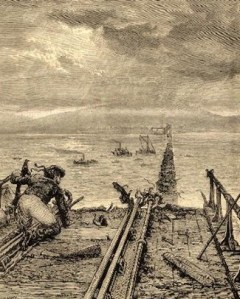
Newspaper illustration of railway officer crawling out during storm, finding central section of bridge gone.

Officials on the Dundee side expect the train to arrive. When it doesn’t, they wonder if it ever left the south bank. Still they wait, but see and hear nothing. Finally two men volunteer to go out on the bridge. Perhaps the train is stuck. Or something worse. What they’re doing is immensely risky. Many times they are almost blown off the bridge. One stops, but the other reaches the point where the high girder section starts. It’s gone. And the train is gone. Holding on to save his life, he peers out over the raging river, realising the bridge ahead, the train, the crew and the passengers have all plunged into the water.

At first light ships search the Tay. They find no survivors. To this day different numbers are given for how many died, but most agree it was around 75.

As news spreads there is nation-wide shock. Newspapers publish sensational drawings of the train plunging off the tracks into the Tay. The engineering world is stunned.

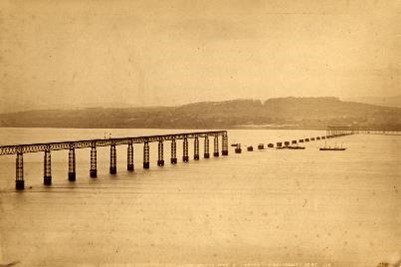
When the storm is over, divers go down to the wreck. They find the locomotive and its carriages still inside the girders. It had all come down together. Only 46 bodies are recovered.

One of the most remarkable feats of engineering now lies at the bottom of the river it spanned.

Bridge viewed from the south after the accident. The High Girders section has collapsed into the river along with the train.

Consequences

After a tragedy the two immediate questions are ‘How did it happen?’ and ‘Who should we blame?’ Answers came soon.

An official Court of Inquiry was set up immediately with three commissioners. The disaster occurred on 28th December, 1879, and evidence was taken as early as 3rd January, 1880, just six days later.

They gathered eye witness testimony from people who had seen something from shore, and appointed senior engineers to investigate the wrecked sections and the remainder of the bridge. Others considered the design and construction methods. Months were spent gathering and examining expert reports and interviewing key people.

None was more key than Sir Thomas Bouch, who argued that derailment and collision with the girders explained the tragedy. His view was considered to have little supporting evidence.

The Court of Inquiry’s report was published a few months later and presented to both the Commons and the Lords in the Houses of Parliament. All points were not agreed in the report. But there was reasonable unanimity in serious criticisms of the design, the poor ironwork produced by the Wormit foundry causing some parts to fail when under heavy load, mistakes made during construction, inadequate maintenance and remedial measures. And a failure to create a structure able to withstand the strength of winds which could occur in the Tay estuary.

Here are two damning comments in the official report: *

‘…can there be any doubt that, what caused the overthrow of the bridge, was the pressure of the wind, acting upon a structure badly built, and badly maintained.’ (p.41)

‘The conclusion then, to which we have come, is that this bridge was badly designed, badly constructed, and badly maintained, and that its downfall was due to inherent defects in the structure, which must sooner or later have brought it down. For these defects both in the design, the construction, and the maintenance, Sir Thomas Bouch is, in our opinion, mainly to blame. For the faults of design he is entirely responsible.’ (p.44)

Bouch was broken by the Inquiry’s findings. He became a recluse and died of ‘stress’ in October 1880, four months after the report was published. He was 58.

Down all the years, arguments persist about what caused the bridge to fall. Bouch continues to be blamed, though perhaps a little less severely than by the official inquiry. But if the ‘buck stops at the top’, he was, unquestionably, at the top with this project.

Here’s what I think happened. Almost all the factors mentioned earlier had their part to play. Parts failed that with proper workmanship and maintenance should have stayed strong. But, fatally, when the locomotive and all its carriages entered the high girders, they created what one website calls ‘a solid broadside resistance to the gale, which was blowing full on to them’.  A yacht is moved forcefully when the flat of the sail is presented to the wind. On that night, at the highest point of the bridge, that train plus the high girders were a heavy flat surface facing directly towards a powerful wind. It was too much. The whole central section was pushed sideways, tilting the girders over, snapping the cast-iron columns, and driving the high girders and the train into the Tay.**

Conclusions

From the story of the Tay Bridge disaster, I have three short conclusions for our lives today.

Too much dependence on one person is risky

I wouldn’t like to have been Thomas Bouch, even at the start of the bridge project. He was a brilliant civil engineer, but there are 20 or perhaps 50 different specialised areas involved in a major construction and he didn’t and couldn’t have knowledge and skills for all these areas.

When I led churches, the mission agency, the seminary, I was uncomfortable when too much about our work depended on one person. Sometimes I asked: ‘If you were run over by a bus, who could do your job?’ If no-one could, we were vulnerable.

Some people like feeling indispensable. But for an organisation, that’s not strength; it’s weakness.

A great vision isn’t enough. Implementation really matters

No-one had built a two-mile long iron bridge before. Bouch’s vision was great. But he was pressurised on time scale and on cost. Corners were cut, too much didn’t get designed well, built well, inspected well, maintained well. Bouch’s big ideas were really good, but many things during and just after construction were lacking. Hindsight is always 20/20, but it seems it was only a matter of time before the bridge failed.

Some of us look back to when we were given a great opportunity. A new job. A wonderful spouse. Good health. University entrance. A rare skill. And we didn’t make the most of it. We didn’t study, or develop our abilities, or got distracted on to far less important things. It’s one thing to get a great opportunity. It’s another to fulfil our potential with that opportunity. Implementation really matters.

What we do is always tested

The 28th of December, 1879 – the night of the terrible storm – was the ultimate test for the Tay Bridge. And it fell. When tested, it failed.

The sobering truth is that every life faces tests.

  • Politicians know re-election time is coming when what they’ve done will be scrutinised and voted on
  • Students will face assignments and exams, and what they know will be assessed
  • Workers will have appraisals. Their performance will be evaluated.
  • Relationships will go through hard times, a test of how strongly they hold together

Knowing that there will be times of testing should motivate us to prepare and live ready to face them.

My Aunt Milla drove really badly. Her top speed on all roads was 25 mph. She couldn’t parallel park on a deserted street. She was poor at judging traffic at junctions, and solved that by just going straight through. It was terrifying to be her passenger. Question: how did she ever pass a test when she drove like that? Answer: she didn’t pass a test. She’d begun to drive before there were any tests, so she simply applied for a licence and was given one. But because she’d never prepared for a test, she was forever a dreadful and dangerous driver.

We’re living well when we’re prepared for whatever test will come. Some tests are the ordinary challenges of this life. From my Christian perspective, there’s also the ultimate test of standing before God, and accounting for what we’ve done with all that’s been entrusted to us.

May we be ready for that, the greatest of tests, and all the others along the way.

—————————-

A special thanks and acknowledgment. The images in this blog are used with the permission of ‘Libraries, Leisure and Culture Dundee’. Their website is full of information, and their staff wonderfully helpful.

*  The official report can be found at: https://www.railwaysarchive.co.uk/documents/BoT_TayInquiry1880.pdf

** I’m grateful for this explanation from the Wonders of World Engineering website: https://wondersofworldengineering.com/tay-bridges.html

Thank you for persevering with this blog. If you’ve found it interesting or useful, pass it on to family and friends. You can use the ‘Share’ button, or just point them to www.occasionallywise.com

Three extra details:

The locomotive that plunged into the Tay was recovered, restored and put back in service. Its new nickname was ‘The Diver’.

Parts of the old bridge are still in use today – suitable girders were incorporated into the structure of the replacement Tay Rail Bridge.

The new bridge is twin track, opened in 1887 without any official ceremony.

Pouring your heart into what you do

In the last blog, I asked: ‘If we are to have a life well-lived, what are (at least some) of the principles we should live by?’ I used the story of building St Vitus Cathedral to illustrate three of those principles.

I’ll use another building project this time – a building so remarkable it’s one of the Seven Wonders of the World.

My work took me to India many times. Alison was able to come with me on one of those trips. While we were in Delhi, an affluent Indian friend offered to drive us to the Taj Mahal. That’s a 115 mile (185 km) journey, not far but likely to take a long time on a crowded road. It didn’t take a long time, not with my friend observing his rules of the road, which were not many.

The Taj Mahal is every bit as impressive as its reputation and its story.

It exists because of love and loss. In 1607 the 14-year-old Shah Jahan, soon to be Mughal emperor, glimpsed a girl selling silk and glass beads. She was Mumtaz Mahal, a Persian princess aged just 15. Jahan told his father he wanted to marry this girl. Five years later he did.

He had other wives as well, but his love was supremely for Mumtaz who travelled everywhere with him, and bore him many children. In 1631 she died giving birth to their 14th child. Jahan was distraught, and vowed to build the richest and finest of mausoleums over her grave.

He kept his word.

At the heart of the Taj Mahal complex is a tomb built of white marble brought from all over India and central Asia. Throughout the site 28 varieties of precious and semi-precious stones were used for inlay work. More than 1000 elephants transported construction materials. A 9.3 mile earth ramp was built to bring the heavy stone close to the building site, where an intricate post-and-beam pulley system placed the blocks exactly in position. Overall some 20,000 skilled artisans worked on the Taj – masons, stonecutters, dome-builders, inlayers, carvers, painters, embroiderers, calligraphers.

The tomb itself consists of a large square plinth on which stands a symmetrical building topped by a large dome and four lesser domes. Four minarets are built just outside the plinth, each tilted slightly away so that they could never collapse on to the tomb. Other magnificent buildings were constructed, and beautiful gardens with long pools, paths, fountains and ornamental trees. One of the breathtaking views is to see the Taj reflected in the water, the exact hue of the white marble varying according to the intensity of the sunlight or moonlight.

It took some 22 years until the whole site was complete. As well as being one of the Seven Wonders, the Taj Mahal is a UNESCO World Heritage Site. It draws between 7 and 8 million visitors each year (though less during Covid virus restrictions).

From its story, I draw these lessons for how to do our best with our lives.

Not to plan is to plan to fail

I’m not a fan of the sub-heading I’ve just used; it seems to denigrate spontaneity. But it has truth. Big enterprises require good planning and preparation. Without those, they do fail.

I’ll give two examples from my home country.

Above Oban – which sits on the west coast of Scotland – stands McCaig’s Tower. It’s also known as McCaig’s Folly. John Stuart McCaig was a wealthy banker who admired Greek and Roman architecture. So, for the hill overlooking his town, he designed an elaborate building based on the Colosseum in Rome. Inside its walls would be a museum, art gallery, and a central tower in which he’d place statues of McCaig and his family. Work began in 1897, and by 1902 the outer ring had been built. It was 200 metres in circumference, with two tiers of 94 arches. It was very impressive.

But that’s all there ever was. All work stopped in 1902 because McCaig died of a cardiac arrest, aged 78.

Personally I feel a Colosseum look-a-like above a Scottish coastal town is out of place. But I commend McCaig for being a man of vision. However, I can’t commend planning which doesn’t include funds to complete the project if the benefactor dies. McCaig’s Folly has never been finished.

Edinburgh has a monument with a similar story. In 1822 wealthy Edinburgh citizens raised money for a memorial to Scots soldiers who had died in the Napoleonic wars. They wanted to replicate the Parthenon in Athens stone for stone. It would be built on Calton Hill which overlooks the centre of the city.

The work began, and twelve columns were raised. The lintels were put in place, using the largest and heaviest stone ever quarried in Scotland. It took 12 horses and 70 men to get the stone up the hill.

In 1829 the money ran out. Only half the funds needed had been raised. The wealthy citizens had not put together an adequate ‘business plan’ to take the project to completion. Perhaps they blamed others for not being generous, but the folly of bad planning was theirs. What was intended as a National Monument is sometimes called a ‘national disgrace’.

Failure to plan or prepare adequately never works.

I have interviewed dozens of people for jobs. I’d ask: ‘What do you know about our organisation? Perhaps you’ve got information from our website?’ And about 50 per cent of the time, the answer would be, ‘No, I don’t really know anything. I didn’t look at your website.’ That was a bad answer. How could people think I’d appoint them to a senior position in a major organisation about which they hadn’t bothered to do the most basic research? It was a terrible failure of preparation for an interview.

Detailed and careful preparation went into the construction of the Taj Mahal. That building really mattered to the emperor, so he ensured everything was done right.

There is a timeless principle there. What we do should matter so much, we plan and prepare well.

If something is worth doing, it’s worth doing well

For a few years, Alison and I helped a small church in a run-down area of Edinburgh. We ran a children’s club, did pastoral visiting, and I did occasional preaching. There were many challenges for that church, including its building. It was small and inadequate for the work the leaders wished they could do. Why so small? Because it was never meant to be more than the hall alongside the main building, but the main building had never been built.

That’s not unique. On my preaching travels around the UK, several times I went to a church which began decades earlier meeting in a hall until its main worship building was erected. But they were still in the hall. Nothing more had ever been done.

Lack of money would be one reason for the incomplete work. But, sometimes, complacency. I imagine the first members found the hall met their needs because, in those days, there weren’t many people. As the years passed, only a few more joined them. There was always enough space. Unsurprisingly the motivation to give sacrificially to erect their main sanctuary building gradually faded. Their hall was ‘good enough’. And so it had stayed for a hundred  years.

I’m no fan of millions getting spent on large church buildings, but I am a great fan of doing everything needed for the mission of the church. Originally there was a big vision for those churches, but over the years it had dimmed and died. I can’t be glad about that.

I’d say the same about any enterprise. It’s about finishing what you start. Committing all the skills and resources that are needed. Believing that if a job is worth doing, it’s worth doing well.

The Taj Mahal teaches me that lesson. Of course the Taj is extravagant, but probably not outrageously extravagant for an emperor. And not for an emperor grieving for the princess he’d loved with all his heart. He longed to give her the best he could give. And he did.

Living life well always means giving the best we can give.

Pouring your heart into what you do

We enjoyed living in Aberdeen in the north east of Scotland. Summer was Alison’s favourite season, not for the weather but because she could work in the garden until after 11.00 each evening. Aberdeen is far enough north that night-time in mid-summer is truly dark for only two or three hours. Alison could probably have gardened until midnight, so 11.00 was no problem.

She loves gardening. It’s more of a passion than a hobby. She belongs to the local gardening group where experts give lectures. She joins webinars with top gardeners sharing their knowledge. She plans out her garden work, and keeps a journal of what she’s planted and how it’s prospered. A garden is never finished, always on the way, so Alison is never quite satisfied with her flowers or vegetables. But – as the principal beneficiary – I know she does a great job.

The simple truth is that we give our best to the things we love. In high school my best marks were in English and history because I enjoyed studying those subjects. My friend David excelled in all things scientific, and became a leading research scientist. Another of my school contemporaries was great at golf, poured his heart into it, became a professional and played in the Open Championship.

We strive for excellence in the things we love. What we love isn’t always related to our career. It can be family, or church, or our sport, or our hobby, or taking on civic responsibilities, or caring for the disadvantaged in our community, or rehoming abandoned dogs, or studying philosophy. We’re all unique, and so will be our passions. And where they lie, so we will direct our energy, our time, and our skill.

It’s good and right to bring passion to bear on all we do. Emperor Shah Jahan never dreamed of building a mausoleum for his wife. But then she died, and the love he’d had for her motivated him to build a supreme tribute to her that millions today admire. He poured his heart into the Taj Mahal. And it shows.

A life well-lived involves planning and preparing wisely. Doing everything well. Pouring our heart into all we do.

One more set of principles next time, again from a construction project. But this one is different. It fell down.

——————————

If you’ve found this blog post useful, you won’t be alone. Use the ‘Share’ button to send it on to a friend or family member. Or point them to www.occasionallywise.com  Thank you!

‘If only everyone thought like me, things would be much better.’ No, they wouldn’t.

During two weeks in an Aberdeen hospital I got to know most of my fellow patients. Further down the ward was the 25-year-old who’d been there for 12 weeks after smashing his leg by simply falling off his stationary bicycle. Across from me was the man whose wife visited each evening, after which he’d phone his girlfriend. Then there was the old fellow from a remote island off the north of Scotland. Until this illness, he’d never left his small island. Not once.

But the patient I never got to know was right next to me. We exchanged a few words, but that’s all because he had his own TV and watched soap operas all day. Since he had no earphones, I endured every episode too. Most evenings his wife drove a long way to see him, but they didn’t talk – they spent their hour watching one of the prime time soaps together.

I couldn’t do what he did. So much of his life spent on so little. I wanted out of that hospital to pour my energy and skills, such as they are, into things of importance. I wanted my life to matter. I wanted a life well-lived.

But perhaps I’m the odd person. Maybe more people are like the man in the next bed, thinking only about finding pleasurable ways to pass the time.

But, if we are to have a life well-lived, what are (at least some) of the principles we should live by?

Starting with the story of a building project, I’ll lay out some principles in this blog. In other blogs I’ll add some more.

Here we go.

After living in our current house for about nine years, Alison and I finally decided we had to enlarge the back of the property. We’d always disliked the smallness of our kitchen, particularly since it was also a passageway to another part of the house. It was time for a house extension.

An architect did the drawings, the necessary official permissions were granted, and we engaged a builder. He started work in February, and promised the project would be done by June. It wasn’t done by June. Not even nearly. The work continued through the summer, and finally he said it would be finished by Christmas. I almost asked him ‘Which Christmas?’ In the end, the builder kept his promise but only just – the last workman left on Christmas Eve.

It seems all building projects over-run. But our experience pales into insignificance compared to the story of building St Vitus Cathedral in Prague.

There were religious buildings on the same site from the year 960, some of which were enlarged after 1060. But I won’t include those.

We’ll start counting from when work started on the present building. It began, on the instruction of Charles IV, in 1344. Work slowed when the king diverted one of the early architects to other projects, such as the construction of the Charles Bridge. As the years ticked by, architect succeeded architect, each contributing their own features to the building.

Then the slow work became no work. In 1419 the Hussite Wars halted all construction. It wasn’t a short interruption. Little happened for a long time because of wars, a major fire, lack of funds, and probably apathy. The half-finished building stayed that way for over 400 years.

Then, mid-way through the 1800s, a society was formed with the purpose of completing the cathedral. They began by removing some elements of earlier design, repairing others, and in 1870 laid the foundation of a new nave. A whole new façade was built in the later years of the century, and a rose window created in the 1920s.

The cathedral was complete by the time of the St Wenceslas jubilee in 1929. I’ve visited it, and it is truly a remarkable building. It’s also a large building. I was told you could park a Boeing 747 Jumbo Jet inside (though there would be a problem getting it through the doors). The cathedral has a prominent location, sitting inside the boundaries of Prague Castle, towering high on the hill above the Vltava River.

So, construction began in 1344 and was completed in 1929. That’s a staggering 585 years. Don’t ever complain again that your building project is taking too long.

The construction story of St Vitus Cathedral gives us some principles of living well.

The best and most lasting of things take time

Nearly 600 years was a very long time to build a cathedral. But the end result is magnificent. In the 21st century, however, what we want we want now. Waiting isn’t in our vocabulary.

While living in America, my TV viewing was interrupted by ads for the P90X fitness system. I was shown how ‘Wayne’ had lost 43 lbs in 90 days. The trainer said: ‘Work out with me and you’ll be shocked by the results.’ I’m sure I would have been shocked, though not in the way the trainer meant.

What that ad was selling was quick-fix fitness. That’s much the same as ads telling us we can speak a foreign language in a week, or look ten years younger with an instant makeover, or pass your motorcycle test after one day’s training, or have a gorgeous garden after one visit to the garden centre.

We’d like to believe these messages. We want things now. Not next week, next month, next year. And we don’t want the effort of mastering a skill, or waiting until the right time, or allowing something to mature or develop.

But that’s not how the best things happen.

I like to remember that God put Jesus on this earth and then gave him 30 years before he started his ‘public ministry’. Time had to pass. The work was too important to rush.

For the important things we do, the same principle applies. Skills must be gained. Maturity and wisdom must develop. The right time must be reached. The right preparations made. The right care put into the work.

We need to be the best we can be. We need to do the best we can do. Those take more than 90 days.

We can’t be loners

Thousands of people, with hundreds of skills, were used to build St Vitus Cathedral – architects, foundation diggers, wall builders, roof builders, creators of stain glass windows, furniture makers, painters of fine art, and so on.

But the foundation diggers couldn’t have built the walls, nor could the stone masons have erected the complex roofs, and neither of them could have installed the beautiful windows.

The important things of this world need people with many different skills and insights.

But there are two problems with this principle.

One, it offends some people’s pride. ‘Are you saying I’m not competent to do this work?’ they’d say. To which I’d want to answer: ‘That’s exactly what I’m saying’. The task requires more wisdom and skill than any one person has.

The other problem is that people don’t like to hear alternative views. They might grudgingly agree there should be input from others, but they don’t want that input to challenge their already established opinion. It should line up behind what they already want to do. It’s annoying and awkward when someone puts forward another proposal. An angry voice eventually shouts: ‘Why can’t you see things the way I do?’

In other words, ‘if only everyone thought like me, …’ ‘if only everyone agreed with my ideas…’  if only everyone had my vision…’ then things would be much better.

No, they wouldn’t. They’d be much worse.

Important things require interaction and interdependency. Ideas and abilities generated by only ‘one brain power’ and ‘one skill set’ would be seriously limited. Good work needs others.

One challenge, then, is to overcome our pride, to accept our ideas may not be the best, and to really believe others have wisdom. Then comes the second challenge, to blend several visions into a cohesive and effective whole. There’s nothing easy about those challenges. But not to try is disastrous.

We must play our part in our day

Since it took so long to build St Vitus Cathedral there’s something peculiar about the experience of the workers. The first foundation diggers toiled generation after generation, and not one of them saw a wall go up. The same was true for the early wall builders, fathers and sons raising high walls, but never seeing a roof in place. And probably those who built the roofs never saw the marvellous art placed later inside the cathedral.

So, almost none of the tens of thousands who laboured on the cathedral during  585 years of construction ever saw the end result of their work: people gathering there to worship God. They never saw the whole thing complete.

But – and here’s the essential truth – each played their part in their day and each part was needed. The wall builders couldn’t have erected towering facades if the foundation labourers hadn’t done their work. Roofers couldn’t have built steep and complex roofs if the walls hadn’t been built.

Every generation who worked on that cathedral needed the one before to have toiled hard and well on their part of the building, because they were now (literally) standing on it. And every generation after them would stand (or fall) depending on how well they did their work now that it was their day.

For the same reasons it’s important we give our best in our day, wherever that’s needed: in our workplace, our family, our church, among our neighbours, in our town or city. We stand on the shoulders of our forebears, building on the work of those who came before us. Others after us will want to stand on our shoulders, the shoulders of people who have given their whole hearts to our tasks and responsibilities. We are the forebears of the next generation.

Put simply: just as we needed those who came before us, those after us will need us to have given our best.

Today is our moment, our time, our day. It’s when we influence lives for the best, shape the world around us, and build something strong that lasts and something magnificent for which others will be grateful. Others came before us, and others will come after us. But this is our day. We cannot fail in what we’re given to do.

You don’t know how much good you’re doing

‘You don’t know me,’ she began, ‘but my name’s Sandra and you changed my life!’

That’s not how most conversations began after I’d preached. I’d spoken to nearly 3000 at Spring Harvest, a very large Christian gathering, and afterwards several had taken their turn to thank me. I’d noticed a young lady standing off to one side, waiting until I was clear of the queue.

Sandra had stunned me with her opening sentence. ‘I need to hear how I could possibly have changed your life!’ I told her.

I listened to her story. In her late teens she’d sunk into a deep depression. Neither counselling nor medication had lifted her from a very dark place, and she’d become suicidal. Fearing for her life, doctors had committed her to a psychiatric hospital. Family and friends had visited, and her care was excellent, but nothing improved her mental health over the next two years.

Then a friend brought her a tape to listen to. ‘It was a tape of you preaching at a large gathering,’ she told me.

‘Really?’ I asked. ‘What was I talking about?’

‘You spoke about us being engraved on the palms of God’s hands, and you said that to God we are unforgettable.’

I remembered that address. I’d been asked to preach at the communion service of a national assembly, and had based my talk on verses from Isaiah chapter 49 which include these words from God: ‘See, I have engraved you on the palms of my hands’ (v. 16). I’d described running my hand over an engraved bowl, feeling how the words were cut right into the glass. Engraving was deep and permanent – it was unforgettable. And the image of us being engraved on God’s hands carried the message: we are unforgettable to him.

Sandra continued: ‘I believed my life was meaningless and insignificant. I didn’t matter – I was completely forgettable. I listened to what you said, played the tape again, and then again and again. And I began to believe what you said. God had not forgotten me.’

That was the turning point in her life. She took positive steps to improve her health and, with support from family, she was released from hospital. She found work, and she found faith. And that faith had brought her to Spring Harvest where I happened to be one of the main speakers.

Until then I hadn’t known there was anything special about that ‘engraved on the palms of God’s hands’ message. It had been appreciated by those present, but that was all. Except, it wasn’t all. Someone locked in a psychiatric ward got to hear it, and her life began to change.

It happened that I met Sandra and heard her story, but I might never have done.

I suspect that often we never get to know how much good our words and actions have done. It’s hard to know exactly how often that happens, because we can’t count what we don’t know!

I’ll describe some instances of significant things I might easily never have known about. I apologise that they’re all my stories, but, of course, how could others tell me stories of things they probably know nothing about?

Here are six instances when someone didn’t realise the significance of what they said or did.

One  As a young journalist I shared a room with two others at a residential conference. As we settled down to sleep, there was a short conversation about whether we believed in God. I said I did, to which John, one of my companions, responded: ‘I respect you believing in God, but what I can’t respect is that you don’t then do anything about it.’ (Described more fully in my earlier blog ‘Serious business’ 20.2.21) Those words hit me hard. He was right. It was nonsense that I believed God was real but didn’t do anything about it. John’s statement pushed me into a much deeper search for faith. John never knew his words had that effect.

Two  A few weeks after John’s tough words, I sat with other young adults asking questions about Christianity. All sorts of issues got raised. Should Christians be pacifists? Must a Christian marry only another Christian? Aren’t churches out of touch with society? Then Irene asked: ‘What do Christians mean when they say Christ died for them?’ It was Irene’s question, but also mine, except until that moment I hadn’t known it. What Christians meant when they said Christ died for them was exactly what I needed to understand. Just over 24 hours later, late into the night, I found the answer and gave my life to Christ. From that moment everything about my future changed. Later, Irene and I often talked about faith but she never knew how significant her question had been for me.

Three  In the run-up to Christmas, BMS World Mission sent hundreds of cards to supporters. I signed all of them personally because I wanted people to know how much we valued them. I never expected I’d get a reply. But I did. Every year a few would write: ‘I live alone, hardly see anyone, and yours is the only Christmas card I’ve received. I’m so grateful you thought of me.’ I’d never imagined our Christmas card would mean so much and nearly never knew it did.

Four  Probably all preachers know that some of their sermons die in mid air. The words never reach the congregation. The people show no signs of response. Twice – in two different churches – it was on the tip of my tongue to say: ‘I’m stopping now – this sermon is not helping – let’s just move to the closing hymn’. But I slogged on. The outcome was not what I expected. On both occasions, far more than usual thanked me for the sermon, and made it clear their words weren’t just politeness; they really were grateful. I could not escape the conclusion that message had done good. It had felt dreadful but only for the preacher, not for the congregation.

Five  Every sermon can’t be a ‘fireworks’ show, and my sermon didn’t feel bad, just ordinary. It was just a straightforward message about the Holy Spirit. I reached the end. Stopped. Normally people stir, but this time they were oddly quiet. Then Don stood. He’d been a Christian for only a year and was a quiet kind of man. He looked around at the others who were present, and said, ‘Alistair, on behalf of all of us, thank you for that message. It was so clear, so encouraging and so helpful’. People around him nodded their agreement. I wanted to say ‘Really?’ Instead I had the grace and good sense to thank him for his kind words. And when the service was over I went away once again amazed at how ignorant I’d been about the effect of my sermon.

These are all positive stories, but I must include one which is unfortunately negative.

Six  It was another major conference address, this one unhelpful for one person. (Included also in blog ‘Why quit while you’re ahead? 10.7.21) During my talk I described how one of my daughters nearly drowned when caught in a fast current. If someone hadn’t spotted her, she’d have been lost. Afterwards a lady came to me. She was angry and distraught. Why? Because her son had been murdered by drowning, and what I had described about my daughter had stirred her grief enormously. Part of me thought ‘I couldn’t have known that’ but I apologised profusely for upsetting her and promised to think more carefully about stories I included in my talks. She accepted my words, but was still distressed when she left.

Truly, we don’t know the effect of our words, or, if we do, only later.

I’ve reached these conclusions.

We are not the best judges of ourselves.    We may think we’re acting rightly, or speaking profoundly, but the real judge is the person on the receiving end. And their reaction may be very different to what we expect. Our words may be ordinary but hugely significant in the life of a person facing special circumstances. Or the finest oratory, or most generous of actions, may mean nothing to them because of problems they’re facing. Our skills and abilities are not what determine the responses of those around us. Often their responses are far better than our efforts deserve. We just don’t know what effect our words or actions will have.

We’re not in control of what’s significant for someone.    As I’ve greeted those leaving church after the service, I’ve been told, ‘Thank you, Alistair. That was such a special service for me.’ So I’ve asked what part of the sermon meant so much to them. ‘No, not the sermon,’ they’ve replied. ‘It was the phrase you used near the beginning that it’s good for us all to be together. That’s such an important thing and I’m glad you reminded me.’ I nod positively, but inside I’m thinking ‘I slaved for hours preparing my sermon, but what meant so much was an unscripted, unrehearsed phrase. Frustrating!’ It is frustrating, but actually rather wonderful. Someone was helped and encouraged; that’s the only thing that matters.

If you want to know how much you’re appreciated, leave.    That’s been my not-too-serious advice to pastors and other leaders. Farewell gatherings are full of speeches expressing gratitude for the many wonderful things done by the departing colleague, and how much they meant as a friend and fellow-worker. Mostly those statements are true, but they’d never have known if they hadn’t been leaving.

We need reasonable caution about what we say.    I learned that from the lady I upset with one story in my address. It was an innocent mistake, but in the future I did my best to imagine how listeners might react to illustrations used in my talks. We can’t shy away from recounting real life experiences, but can take sensible steps to minimise any upset.

If someone doesn’t know what they should know, tell them.    At some funerals, an opportunity is given to share a good memory about the deceased person. I’ve listened as story after story was told of the good effect that person had on people’s lives, and wondered, ‘Did they ever know this?’ Probably they didn’t. When my dad was in his mid-70s I wrote him a letter thanking him for being a great father to me. From my youngest I’d known he loved me, supported me, believed in me, and taken delight in my achievements. I was privileged. So I wrote down what all that had meant for me, and thanked him from the bottom of my heart, then sealed the letter and posted it. Several days later I saw Dad. He wasn’t a man who talked about feelings, but he thanked me for the letter and then said it was the best letter he’d ever received in his whole life. He died just a few years later. I was glad I’d been able to tell him before then how much he’d meant in my life.

The overall message of this blog is simply its title: you don’t know how much good you’re doing. You really are doing good. Shyness or circumstances may have stopped people telling you. But, I promise, if you act kindly and speak wisely people are being helped. Sometimes you’ve simply encouraged them along life’s way. And sometimes what you’ve said or done was life-changing for them. Take that to heart. It’s true. It’s remarkable. It’s something worth knowing. You should feel good about it.

———————————

Perhaps the next thing you should do is tell someone what they’ve meant in your life. But another thing – if this blog has been helpful – is to share it with others. Use the ‘Share’ button, or point them to www.occasionallywise.com. That might be life-changing for them!

Will life always be this way?

A central character in Ken Follett’s novel ‘The Eye of the Needle’ is hurt and weak, but rouses himself with this thought: ‘It was important not to permit oneself the psychological attitudes of the invalid’.

I read that sentence twice. And then a third time. It meant something to me personally.

I suspect all Follett had in mind was that the injured character galvanised himself into readiness to fight. He wasn’t thinking that all ‘invalids’ have the same psychological attitudes.

But what he wrote took me back to a critical moment in my mid-thirties.

I’ll begin my story when I was 18. I was a trainee journalist working in Edinburgh, when one day I felt back pain and by the next day could hardly move. My doctor prescribed pain killers and bed rest. Two days later my parents arrived to persuade me that I couldn’t just lie in my one room bed-sitter, unable to shop or prepare meals, and they’d take me home with them.  I agreed, but I might not if I’d realised their plan was that my bed would have a wooden board over the mattress. Back then, that was the accepted wisdom for people with bad backs. Drugged and desperate I lay on that board, but it made my pain much worse. Eventually they had mercy and removed the board, and slowly I got better.

That was only the beginning. I had similar struggles through my twenties. Some chronic pain was always there, then every few years it would become severe and everything would stop for a few weeks. Mostly I kept going through university studies and church ministry, and even played scrum half in my college’s rugby team.

Then came my mid-thirties. By then I had been a full-time pastor for some years, and Alison and I had four young children. We’d had a wonderful experience planting a new church in Livingston, not far from Edinburgh. Now I’d been called to become pastor in the north east Scotland city of Aberdeen. Getting ready for that change involved long journeys, extra meetings, and final get-togethers. Life was busier than I ever imagined it could be.

A week before our move my back gave in. The pain was immense. Any movement was agony. It didn’t matter if I stood, sat or lay down; every position was bad. My doctor prescribed strong medication which dulled all my senses. Friends gave up their bedroom for me. Not just to let me lie there day and night, but so Alison with her friend Kathy could pack up the home we were leaving. One evening I was eased into our car, the seat reclined, and with kids in the back Alison drove us 130 miles to Aberdeen. There I lay on a thin mattress on the floor. Somehow I managed to attend the service where I was inducted as minister of the church, and even preached. Then I went home, and lay again on the floor. A few days later the top orthopaedic surgeon from the hospital arrived to examine me, and promptly admitted me to hospital. I was put on traction, and for two weeks I just lay there.

Then, with pain slightly eased, I was sent home and my back slowly improved. About two months later than scheduled I began my ministry properly at the Aberdeen church. Good things happened during the following weeks. But my back was not stable. Pain worsened, and again I was taken into hospital. This time they carried out a diagnostic imaging test – a myelogram – which involved a contrast dye injected into my spinal column. That allowed the medics a much clearer view of what was happening around my spinal canal than standard X-rays could give. But my body reacted negatively to the dye, causing more pain and keeping me in hospital for another two weeks. During that time I was measured and fitted for an upper body harness – metal bars sheathed in leather with tight straps to hold my body in the right posture. The idea, I was told, was that I’d be unable to move in unhelpful ways, and thus let my back heal. I felt almost unable to move in any way, except by making penguin-like rigid motions. But at least I could go home.

That was two days before I was to conduct a wedding. The couple had sat by my hospital bed while I prepared them for the service. On the wedding day I unbuckled and removed my harness almost as the wedding march was being played, and put it back on as soon as the service was over.

Over the following months and for a couple of years I was better. Life was good. The ministry was being appreciated.

But the debilitating pain was just hiding. It returned with a vengeance. This time I met with a neurosurgeon who recommended an intriguing operation called, I believe, ‘Chemonucleolysis of Lumbar Disc Herniation’. An enzyme would be injected into my bulging disc which would dissolve disc material and thus release pressure on the spinal nerve. Only a needle would be used, no scalpels. It all sounded good. I went into hospital the day before the operation. The neurosurgeon came to explain that my body would never have encountered the enzyme before, so its reaction couldn’t be exactly known. My body could go into shock which, in rare cases, would be fatal. That wasn’t comforting. Before the operation a small access port was inserted into my arm, ‘in case we have to give you urgent treatment later’. I knew what that meant. The procedure was done while I was conscious but face down on a special operating table. When they were finished no-one moved. I had to lie still, and the medical team stood around me for ten minutes. No-one said they were waiting to see if I would die, but I suspect they were.

Did it work? For about six to nine months I did feel better. But not significantly after that. I found out that they stopped performing the operation two years later, perhaps because of risks associated with it, but mainly because the long-term results weren’t great. Which, unfortunately, was my experience.

Something like normal life kept happening around these hospital stays and operations. Congregation numbers grew so much we had to move to a larger building. Our children were growing up. Alison began studies towards a health science degree.

What I didn’t care for was that I’d become known as the pastor who began his ministry in Aberdeen as a hospital patient. Whenever I met people they asked ‘How’s your back these days?’ I appreciated their concern but wished for anything else as the opening line of conversation.

Then a deeply unwelcome possibility intensified in my mind. ‘Here I am, aged in my late thirties, constantly immobilised by back problems. Doctors and well-wishers can do no more than urge me to protect myself. Maybe this is how life is always going to be.’

That last thought – that this might be how my life is always going to be – was deeply distressing. I’d always believed I’d get better. Perhaps my back pain would simply go away. If not, then surely there was some more or less invasive treatment that would cure it. No other kind of illness in my life had been permanent. I always got well. And I’d assumed that would happen with my back pain. I wasn’t yet 40-years-old. Life couldn’t always be like this.

But it could. Well-meaning friends and medical professionals (surgeons, general practitioners, physiotherapists) were telling me to manage my back carefully. They were urging a defensive strategy – a ‘do no harm to yourself’ way of living. I mustn’t exhaust myself, or work too hard, or sit too long at my desk or in meetings, or lift anything heavy, or drive long distances. I should always insist on comfortable seating, and avoid strenuous sports or hobbies. While never having to dig the garden sounded good, the implications of the rest were dire. But perhaps it had to happen. I’d have to accept my life ahead would be significantly limited.

I can’t explain why, but I woke up one day knowing I wouldn’t accept it. I couldn’t be that person if there was any option not to be that person. There were still many directions in which my life could go. Was I supposed to delete half the options, leaving only what was ‘safe’ and undemanding? Were outdoor sports like hill climbing and golf – good not just for my physical health but also my mental health – just to be abandoned? Would I never throw a frisbee or play tennis with my children? Would I not lift them up and hug them? Would I consign Alison to carry all the shopping, or take luggage out of the car, or move  the furniture around? I wouldn’t. That day I decided that as long as possible and as much as possible, I’d live life to the full.

And, as best I can, I’ve done that. As a family we’ve climbed Ben Nevis and Snowdon, the highest mountains in Britain. I became a single-figure handicap golfer. I’ve travelled and preached from the Shetland Islands (110 miles north of the Scottish mainland) to churches along the south coast of England. I’ve been in dozens of countries including Ecuador, Peru, Brazil, Congo, Angola, Uganda, Pakistan, Nepal, Bangladesh, Thailand, North Korea and Indonesia. I wasn’t supposed to take long plane rides. I wasn’t supposed to journey over arduous terrain. I wasn’t supposed to hike up steep mountains, sleep in rough quarters in remote and dangerous places, and sit on the floor of jungle huts listening to stories of persecution and hardship. But I have done these things, and consider each one an immense privilege. I’ve tried to be a help and a blessing to those I’ve met, but have received back twofold anything I was able to give.

None of that would have happened if – using Follett’s line – I’d permitted myself the psychological attitudes of the invalid. If I’d settled for a highly protected, uneventful life, everything would have been different.

So, has the pain gone away over those years? No, not at all. It’s still the same pattern, manageable most of the time but then critical for periods of several weeks.

But now I do have a better understanding of why it happens.

One of the very painful phases occurred while we lived in America. My doctor prescribed powerful painkillers and directed me towards one of the most eminent orthopaedic surgeons in the Chicago area. He and I met, and before deciding on a course of treatment he sent me for MRI scans. Afterwards I consulted with him again. He put the images on screen and began: ‘Have you spent your whole working life doing manual labour?’ I laughed, and explained I hadn’t spent any of it doing manual labour. He apologised, but said, ‘When we see a back like this, it’s almost always someone whose life has involved heavy physical work over many years.’ He took me through the images and pointed out three herniated discs (commonly called slipped discs). Their pressure on spinal nerves would cause severe pain. And that wasn’t all. He added: ‘You can’t have a back like this and not have arthritis throughout’. I waited for some good news, perhaps a surgical option that would put me right. But there wasn’t one because, he said, no operation would give meaningful benefit. All he could do was recommend physiotherapy and a sensible use of pain medication.

Everything that doctor told me had been true about my back throughout my adult life. No accident had caused it, he said. It was just how my back was. And, in a sense, I’m okay with that. I’d never before really understood why I had ongoing chronic pain with bouts of acute pain. The new knowledge was helpful, and I’d continue to be positive and do everything I should and could.

Is that realistic for everyone? After all, what does a ‘positive approach’ mean for someone severely disabled, such as a soldier who’s lost his legs? That’s a very different situation to mine. I could live life close to what would be normal for someone without a wrecked back. The person who’s lost both legs has much greater challenges to overcome. But that doesn’t mean life must then be lived under a permanent shadow.  Good and positive things can still be done.

As a child I read and re-read the story of Douglas Bader. He’d become an RAF pilot but crashed doing aerobatics, almost died, and had both his legs amputated. He fought hard to regain his strength and with artificial legs regained his flying qualifications. But the RAF forced him to retire on medical grounds. Then World War II began. Experienced fighter pilots were in short supply so even Bader with his tin legs was accepted. He won air battles above the Dunkirk beaches and in the Battle of Britain. In 1941 he was shot down over German-occupied France, and made a POW. Several times he escaped but was recaptured and eventually sent to Colditz Castle. After the war he held senior posts in the oil industry, played golf to a high standard, and was awarded a knighthood by the Queen.

Very few can be like Bader. A biography was written about him, followed by the film Reach for the Sky. Why? Because his story is exceptional. But his positive approach to life doesn’t have to be exceptional.

Every blog piece I write is intended to have at least a little wisdom. What’s the wisdom here?

I hope it’s this. I don’t actually like Follett’s reference to ‘the psychological attitudes of the invalid’. It’s far too sweeping. But I came close to permitting myself to think all ambitions had to go, that I could do nothing of significance, and life would have to be lived defensively and dependent on others. If I’d surrendered to those ‘psychological attitudes’ then, in some sense, I would have become an invalid.

That surrender doesn’t have to happen. There is another way of living. I know people who’ve done great things despite great challenges, and I’m privileged that some of them are my friends.

If, in any way, this account of my health journey helps you lift your eyes to better horizons, to greater possibilities, then there will have been wisdom here after all.

————————————-

If this blog has been helpful for you, it’ll be helpful for someone you know. Please send it on, either by using the ‘Share’ button or forwarding the link www.occasionallywise.com. Thank you!