Christmas Quiz part 1

I was asked to preach in our church on a Sunday morning just before Christmas. All ages would be present, so I didn’t preach. Instead I created a multiple choice style Christmas Quiz, and asked people to vote for right answers, including a few questions especially for children. Some possible answers were deliberately funny or odd, but giving out the right answers allowed truth to be communicated. Thankfully, everyone got involved. No-one fell asleep. And the feedback afterwards was positive.

I hope the quiz will also be a positive experience for readers here. What follows is the first part of the quiz presented in three parts. First, the questions. Second, the answers including extra details. Third, a reflection related to the main subject in that quiz. I don’t usually get ‘preachy’ in my posts, but the reflections were a core part of how I presented the quiz in church and they belong here too.

Here goes. Don’t cheat by looking ahead to the answers before you commit to your own answers to the questions. Above all, learn and enjoy!

Part 1  Questions related to the birth of Jesus

Q1 Matthew chapter 1 lists ancestors of Jesus. One of the following would not normally be wanted in an Israelite’s family line. Which one?

  1. Rahab
  2. Ruth
  3. Zerubbabel

Q2 Joseph and Mary travelled from Nazareth to Bethlehem just before Jesus was born. Why go there?

  1. Because there were better maternity services in Bethlehem
  2. Because Bethlehem was nearer to the holy city of Jerusalem
  3. Because the Romans required everyone to be counted in their own city

Q3 It was about 80 miles (129 km) from Nazareth to Bethlehem. Did Mary:

  1. Walk?
  2. Ride on a donkey?
  3. Ride on a camel?
  4. Ride on Joseph’s shoulders?

Q4 There was no accommodation available for Joseph and Mary in Bethlehem. So where was Jesus born?

  1. In the basement of a house
  2. In a stable
  3. In a cow shed
  4. In a cave

Q5 A manger is where food was put for animals to eat. In Jesus’ time, what was a manger made from?

  1. Masonry (such as bricks)
  2. Stone
  3. Wood

Q6 An angel told Joseph that, when Mary gave birth to a son, he was to give him the name Jesus. Why that name?

  1. Because it was the most popular boys’ name at the time
  2. Because the angels in heaven had voted for that name
  3. Because the name Jesus had special meaning

Part 2  Answers to Quiz 1 questions

Question 1 asked which ancestor an Israelite would not want in their family line. The answer is Ruth. Why not the others? Rahab, after all,had an unsavoury occupation in Jericho, but she hid the Israeli spies so was accepted after Jericho fell. Zerubbabel would have been a popular ancestor – he was the descendant of David who was appointed to be leader of the first group of Jews who returned to Jerusalem after captivity in Babylon.

Why not want Ruth as your ancestor? The answer lies in Ruth’s background. Ruth came from Moab, a nation regarded as immoral, idolatrous, and so great an enemy of Israel that Deuteronomy contains a ban on Moabites entering the assembly of the Lord (23:3). But Ruth was excused because of her marriage to Boaz and her loyalty to her mother-in-law, Naomi, which included this remarkable declaration: “Where you go I will go, and where you stay I will stay. Your people will be my people and your God my God. Where you die I will die, and there I will be buried” (Ruth 1: 16-17).

Question 2 was about why Joseph and Mary went to Bethlehem. There weren’t better maternity services – Bethlehem was a village, with, at most, one woman who delivered babies. Yes, it was closer to Jerusalem, just 6 miles (9 km) south of the city. But the reason Joseph and Mary went to Bethlehem is that the Roman authorities had given them no choice because their census required everyone to go to their home city, which, for Joseph, meant taking his family to Bethlehem. Luke described that this way in his gospel: “In those days Caesar Augustus issued a decree that a census should be taken of the entire Roman world.(This was the first census that took place while Quirinius was governor of Syria.) And everyone went to their own town to register. So Joseph also went up from the town of Nazareth in Galilee to Judea, to Bethlehem the town of David, because he belonged to the house and line of David. He went there to register with Mary, who was pledged to be married to him and was expecting a child (Luke 2: 1-5).”

Question 3 asked how Mary travelled during the 80 mile journey from Nazareth to Bethlehem.Being nearly full-term pregnant, she would not have ridden on Joseph’s shoulders (though I did tell the church the experience Alison and I had like that – check this footnote for details.[1])Nor, since it’s very likely Joseph and Mary were poor, could they have afforded a camel for her to ride. So, the only realistic options were for her to walk or ride on a donkey. Though no donkey is mentioned in the Bible’s birth story, the most likely answer is that she sat on a donkey for 80 gruelling miles.

Question 4 raises the issue of where they stayed in Bethlehem. This can seem complicated. If it’s not interesting for you, skip to the end of this explanation.

The traditional story is that the inn was full because so many were in the village for the census count. That may be right, but not necessarily. Much depends on how the Greek word kataluma (κατάλυμα) is translated, because it can mean ‘inn’ or ‘guest room’. Kataluma is the word used in Luke 2:7 where most translations (but not the New International Version) say there was no place for the family in the inn. But Luke also uses the word kataluma in 22:11 when Jesus sends his disciples ahead to enquire about the ‘guest room’ where they can observe the Passover. So, using the same word, did Luke mean ‘inn’ or ‘guest room’ when he was explaining where there was no accommodation for Mary and Joseph?

A clue to the answer might lie in the fact that Luke uses a completely different word pandocheion (πανδοχεῖον) when he describes how the Good Samaritan left the wounded traveller to be cared for at an inn (Luke 10:34). That may suggest that in chapter 2 Luke was not referring to an inn being full, but that the guest room in a house was already full, hence Joseph and Mary had to settle in a place where animals were fed. Where would that have been for them? When I travelled in rural parts of Asia, I saw families keep animals below their living area. Preparing one lunch involved choosing a hen from those scuttling around below the floor where we sat. Similarly, in a Judean village in ancient times, the lowest area of the house often provided overnight shelter for animals. If not there, they might get night-time shelter in a cave near the main house.

Since we don’t have precise information, the best answers for question 4 are either ‘a basement area’ or ‘a cave’.

There could be one more answer, not listed in the question, if we are thinking only of where Jesus was born. People of those times were very hospitable, and especially so with a young woman close to giving birth. Therefore, when Mary went into labour, it’s likely she was brought into the main area of the house and helped to give birth there, and only after Mary and Jesus were safe and settled was the newborn laid in a manger downstairs.

Question 5 asks what a manger[2] was made from. The traditional image of the manger is of a wooden construction raised up above the ground. That is near-certainly wrong. Wood was necessary for many things, but not to contain animal feed. Nor were shaped bricks required. A manger was no more than a box-shaped area capable of containing animal food and accessible for the animals eating it. So – with stones plentiful all over the countryside – building a manger involved no more than creating a shape, perhaps rectangular, with stones laid on the ground. Therefore the right answer is that a manger was made from stone, and that’s where the baby Jesus was laid.[3]

Question 6 says Joseph was told by an angel that the baby to be born should be named ‘Jesus’ and asks why that name. Apart from one or two rebels, no-one in the church voted that the reason was because Jesus was the most popular boys’ name at the time, or that the angels had chosen it by a vote. So that left only the right answer: the name Jesus had special meaning. According to Matthew (in his gospel, chapter 1:21), long before Jesus was born, an angel told Joseph he must take Mary to be his wife, then added these significant words: “She will give birth to a son, and you are to give him the name Jesus, because he will save his people from their sins.” Why did the name Jesus carry that that meaning? The answer is because Jesus is the Greek form of Joshua, and Joshua means ‘the Lord saves’. In other words, the baby carried by Mary should be called Jesus because the Son of God would be born on earth in order to save people from their sins. His name described his mission.

Part 3  Reflection

In modern times, we’ve wrapped up Christmas in tinsel, lights, winter scenes, heart-tugging romantic films, family gatherings, plentiful food, and the happy story of a new baby being visited by shepherds and brought gifts by wise men.[4] But what happened 2000 plus years ago is rugged, raw and very different from our homely stories. The reality was a tortuous 80 mile journey, a woman suffering all the usual pains of labour, probably giving birth in a basement or cave, and laying her new-born in an animal feeding trough. That woman was, in fact, a girl in her mid teens, a baby born into poverty, then hunted by a jealous monarch’s kill squad, and becoming a refugee with his parents as they fled to safety in another land.

There was nothing ‘tinsely’ about all that. But this was God coming into the world as a human being. In his gospel, describing Jesus as ‘the Word’, the apostle John wrote: “The Word became flesh and made his dwelling among us” (John 1:14). God came to where we are. He had to; there was no other way to save us.

In the early hours of 7th September, 1838, the paddle steamer Forfarshire was shipwrecked on rocks near the Farne Islands, off the NE coast of England. The larger part of the vessel sank quickly taking more than 50 people to their death. From a nearby island, 22-year-old Grace Darling saw the wreck from her upstairs bedroom in the lighthouse where her father, William, was keeper. She spotted survivors clinging to rocks, but certain to die soon as waves pounded the area. The weather was too rough for a lifeboat to launch, but Grace and her father pushed a 21 foot (6.5 metre) rowing boat into the water. Normally that boat required four oarsmen, but Grace and William together rowed their boat through treacherous seas for over a mile to reach the stranded survivors. Nine people were saved. Grace became famous once the rescue story became known, and she and her father were awarded medals for bravery. Sadly Grace died from tuberculosis just four years later.

Painting by Thomas Musgrave Joy. In Public Domain

But Grace’s courage, strength and determination meant lives were saved. She could not merely watch from the comfort and safety of her lighthouse bedroom. Nor could she wait on the shore, hoping that somehow these people would save themselves. She, and her father, did the only thing that could rescue them – they left the safety of the shore, went into the raging sea, rowed to where the eight sailors and one passenger were, and by going to them saved them.

And that is what Christmas is about. God did not lament a lost world from a distance. He loved the world so much that that he came down from heaven’s glory to be alongside us and save us. It was hard, cruel and painful. But had Jesus not come we would be lost.

Look out for the second part of the Christmas Quiz – coming soon!


[1] The imminent arrival of a new baby often motivates parents to decorate or rearrange the home. For Alison and me, that meant we rushed to finish painting our very small shower room. It was so small, no ladder would fit inside, so we could not reach the very top of the shower space. So – with baby due any day – Alison sat on top of my shoulders, paint pot in one hand and brush in the other, and painted the previously unreachable area. Our son was born the same week.  

[2] The word ‘manger’ comes from the Old French word mangier (now manger) = to eat.

[3] In an article I read recently, the writer said Jesus was born in a manger. I shudder to picture that. He should have said Jesus was laid in a manger.

[4] The next quiz will be about the visit of the wise men.

It would have been easier if I’d been drunk

A young couple asked me, their minister, to conduct their wedding. “Delighted!” I replied. They added, “It will take place in Shetland,” apparently because the bride came from there. But that was no problem. Shetland is a long way north, but an easy flight from my base in Aberdeen.[1]

So, in mid summer I flew to the furthest place north of mainland Scotland where some of the 100 islands in the Shetland archipelago are closer to Norway than to major cities in the south. That far north, summer days are long and nights have very little darkness.[2] I had time to explore. Since then I have visited dozens of other countries, but Shetland is still the most awesomely beautiful place I have ever seen.[3]

The wedding service went well, after which the couple stood in warm sunshine for photographs and to greet their guests. Then came the reception, with plenty to eat and to drink. It was a great time.

I had a flight to catch back to Aberdeen that evening. But, just before I started on the 25 mile journey south from Lerwick to Sumburgh airport, I heard that a thick sea mist meant all flights were cancelled. Not to worry, because the airline had booked all passengers on the overnight sea ferry from Lerwick which would arrive in Aberdeen at breakfast time. ‘That will be fine,’ I thought.

It was very far from fine. The problem wasn’t the cabin, which I would be sharing with a Christian friend who’d also attended the wedding, and with two oil-rig workers going on leave. Nor was the problem lack of food on board, especially since I’d eaten well earlier and wasn’t hungry. And the oil workers weren’t the problem; they disappeared for hours to the bar.

The problem was everything to do with the ferry journey. Once out of the harbour and into the North Sea, the ship pitched up and down as strong waves lifted and dropped the vessel. My stomach began to heave in sync with those waves. Then the ferry got far enough south to escape the shelter of Shetland, and waves from the Atlantic competed with waves from the North Sea. The ship’s up/down movement was matched by an all around movement in my inner parts. I could not have been more miserable. Lying flat on my bunk was the worst so I went to the middle of the ferry where people were stretched out on seats and the floor. Apparently, so the gift shop assistant told me, they did that because the central area pitched less than the bow or stern. Maybe it did ‘less’ but still a lot. “Never mind,” the assistant tried to comfort me, “trawlermen also get sick on the ferry because it doesn’t pitch enough.” I was not comforted.

Back in my cabin, and foolishly lying down again, my stomach churned. Suddenly I knew I was about to bring up my delightful wedding reception meal. I rushed to the small ensuite bathroom, but the door was locked. My Christian friend was emptying everything he’d eaten that day. Now desperate, I ran into the corridor where there were toilets for passengers without ensuite facilities. I saw the word ‘toilet’, went straight in, and was sick on an almighty scale into a sink. Only after I got back to my cabin did I realise I hadn’t checked whether I’d entered the toilet for men or the toilet for women.

The rest of that night I lay sleepless on my bunk except when I was being sick. Around 1.30 in the morning, the two oil workers returned from the bar. Both were clearly very drunk. So drunk, they collapsed on their bunks, immediately fell asleep and stayed asleep until the ship docked in Aberdeen harbour. The oil men that morning were bright and cheery. I was not. Alison met me from the ferry, and said she’d never seen me look so ill. All I could reply was, “It would have been easier if I’d been drunk”.

I didn’t actually wish I’d been drunk, but I couldn’t escape the thought that my non-drinking friend and I had no reward for our righteousness. The oil men had a peaceful night. Our night was a horror story. It didn’t seem fair.

The hard truth is that doing what’s right doesn’t guarantee an easier life.

The writer of Psalm 73 in the Bible didn’t hesitate to complain to God that the wicked “have no struggles; their bodies are healthy and strong.They are free from common human burdens; they are not plagued by human ills” (vs. 4-5). While he has kept his heart pure, the wicked have amassed great wealth (vs. 12-13). Later in his psalm, he does recognise that the final destiny of the wicked will be ruinous, but his earlier words are comfortingly honest, that those who live to please themselves may have an easy life, with none of the sacrifices faced by those who try to do what’s right.

So, let’s recognise a few realities.

First, this world often seems unfair. People cheat – such as some students at school or university with assignments or exams – and too many are not found out. Applicants for top jobs submit their résumé or CV (curriculum vitae) claiming qualifications they have never earned. Mistakes at work are covered up. Tax claims are falsified or earnings hidden. The owner of a garage told me I would be entitled to a big discount on my car repairs if I paid with cash rather than cheque. Naïvely I asked how that could be. “It’s simple” the garage owner said. “If you pay with cash we can avoid the value added tax.” I quickly replied that I couldn’t do that since I was a church minister. “Yes, I know you’re a minister,” he said. “That’s why I thought you might appreciate a discount.” I smiled, but he was proposing fraud. I paid by cheque.

There is a cost – sometimes literally – from being honest, truthful and virtuous. It has always been like that, and it’s never likely to change.

Second, short-term advantage can, however, lead to long-term disaster. I recall being asked to check if someone had actually held the university posts he claimed on a job application. I did find out – he had never held any of those posts. Not only was that applicant not appointed to the position he now sought, news of his deceit inevitably spread far and wide. His dishonesty meant he’d never be employed at a senior level.

Cheating can reach the level of bizarre. One of the most flagrant and now notorious cases concerns George Santos who was elected to the US House of Representatives from a New York congressional district in 2023. News reporters then researched Santos’ background. What they found differed significantly from his own story. He had lied about his education, past employment, business activities, earnings and wealth, and not disclosed his criminal history, nor that he was facing lawsuits. Just before the end of 2023 the House of Representatives voted 311 to 114 to expel Santos. In August the next year, he pleaded guilty to identity theft and wire fraud, and was sentenced to 87 months in prison. On the day of his sentence, John J. Durham, United States Attorney for the Eastern District of New York, said this: “Today, George Santos was finally held accountable for the mountain of lies, theft, and fraud he perpetrated. For the defendant, it was judgment day, and for his many victims including campaign donors, political parties, government agencies, elected bodies, his own family members, and his constituents, it is justice.”[4] Santos was jailed but a few months later President Donald Trump commuted his sentence and he was released. He had freedom from prison, but no freedom from a ruined reputation.

Another reputation – that of David, King over Israel and Judah – was ruined around 1000 years BC. While walking on the roof of his palace late one evening, David saw a beautiful woman called Bathsheba bathing in her nearby home. Her husband, Uriah, had been gone for some time, fighting in David’s army. Filled with desire, David sent for Bathsheba and they had sex. Later she discovered that she was pregnant and let David know. The King’s secret affair would soon not be a secret. Trying to cover his tracks, David had Uriah brought back from the front line, supposedly to report on the progress of the fighting but actually so he would go home and have sex with his wife. But Uriah’s sense of honour would not let him make love to his wife while his fellow soldiers were camped on a battle field. David was now desperate. He gave Uriah a sealed letter to take back to the army commander. That letter was Uriah’s death sentence, because it ordered the commander to put Uriah where the upcoming battle would be fiercest, and then withdraw support from him so Uriah was stranded and killed. It happened: Uriah was abandoned during the battle and died. David, an adulterer and now a murderer, breathed a sigh of relief. But not for long. Through a prophet, David’s sin became known, resulting in great trouble during the rest of his reign. His sin was also recorded in the Jewish scriptures and then in the whole Bible, where we can read about it today (in 2 Samuel, ch.s 11-12). David indulged his lust for Bathsheba, but one night of pleasure led to one of the world’s worst stories of illicit sex and murder being read everywhere for some three millennia.

Doing something wrong for short-term gain rarely ends well.

Third, honouring your beliefs and principles is always right. In a previous blog post I described a personal experience.


The UK runs a national census in every year that ends in a ‘1’. The census is done now by answering questions online but in earlier years everyone filled out census forms. In one of those past ‘1’ years, I was a student looking for summer employment and got hired to help deal with the millions of census forms. My job was in a very large warehouse, almost entirely filled with shelving holding boxes of forms. A small team of ‘experts’ sat at one end coding each answer for entry into the rudimentary computer system used back then. I was a much more lowly file-picker. All I did every day was take an order for a batch of files, find their boxes among the shelves, and transport them by push-trolley to the coders. When the coders were finished with them, I put them back on the shelves. It was brain-numbingly boring work. But they paid me to do it, so I was grateful to have the job.

A fellow file-picker told me one day that when he was given an order to bring a batch of files, he was told not to use a trolley, just bring them one box at a time and walk slowly. He thought it hilarious that he was ordered to take as long as possible to do his job. I didn’t think it funny, just strange, perhaps too strange to be true. Until one of the bosses gave me virtually the same instruction: to fetch files but not to use a trolley and to take my time.

Eventually the explanation dawned on me. It wasn’t just the file-pickers who were temps; so were the coders and so were many of the bosses. Almost everyone working in that warehouse had a financial interest in their job lasting as long as possible, hence a secret ‘go-slow’ policy.

That first time I carried the files one by one to the coders and back to the shelves. And I did it the next day. But then I couldn’t do it any more. This was wrong, just wrong. Deliberately slow work cheated the top officers who needed census results processed promptly, cheated the tax payers who were paying my wages, and, for me as a Christian, I felt I was cheating God by not giving my best. I didn’t sleep well that night; I knew what I had to do next morning. I got my first order for files, went to the shelves, offloaded the boxes on to a trolley, and wheeled it to the coders. Later I did the same in reverse to put them back on the shelves. I kept doing that through the day. No-one said anything.

But they did the day after. I got an order for files, and found my way to their location in the centre of the ‘stacks’. Two file-picker colleagues were waiting there for me. One pinned me against the shelving, while both of them made their views very clear. ‘You do what you want to do, but you’d better not show us up by how you do it.’ I can’t reproduce the hostile tone they used, and I haven’t included the words beginning with ‘f’ and ‘b’ that littered their warning. With a last shove they let me go, and disappeared. It was a moment of decision. But the only decision I could make was to be true to myself. I had to live what I believed, and that was to do the job right. Which I did, day after day. And, as with most bullies, the file-pickers didn’t go through with their threats.

Living with a clear conscience, living as you believe you should – it’s the only way to feel good about yourself, to honour others and God, and to get a good night’s sleep.  [From https://occasionallywise.com/2021/03/27/be-true-to-yourself/]

That was a trial-of-principles moment for me. It was hard at the time but it strengthened my determination to always be true to what I believe is right.

But no trial of mine can be compared to the choice which faced Polycarp.[5]

Polycarp was Bishop of the church in Smyrna, a city in Asia Minor (modern Izmir in Turkey), around 160 AD, a time when Christians were distrusted and hated in the Roman Empire. They would not submit to the rule of the emperor as a divine figure, nor would they sacrifice to the Roman gods, so Christians were considered guilty of disloyalty and treason. Many died for their faith.

Bishop Polycarp was an old man, old enough to have known and followed the Apostle John. His age did not save him from persecution. He was told to burn incense to the Roman emperor or he would die. He refused and he was arrested. Polycarp knew what lay ahead for him, but said: “86 years have I have served him, and he has done me no wrong. How can I blaspheme my King and my Saviour?”[6]

Dragged into an arena, the Proconsul warned Polycarp he would be torn by wild animals if he would not recant his faith. Polycarp was unmoved. Then, the Proconsul said, you will be burned at the stake. Wood and bundles of sticks were heaped up. Soldiers stood ready to nail Polycarp to the stake so he could not flee when the fire was lit. Polycarp stopped them: “Leave me as I am, for he that gives me strength to endure the fire, will enable me not to struggle, without the help of your nails.” The fire was lit and blazed furiously. Polycarp stood still, and somehow – by a miracle observers said – the flames burned around Polycarp but did him no harm. But he could not be allowed to live, so an executioner was ordered to stab Polycarp to death, which he did, and his dead body was later burned by the Roman authorities.

Not many have been as true to their beliefs as Polycarp was. His remarkable example is of someone determined to be firm in his faith, no matter how dreadful the consequences.

In conclusion, then, it’s easy to opt for the easy life, doing what everyone else does. You don’t upset anyone. You don’t get into trouble. But can you live with yourself doing that? Suppressing the truth deep in your soul? Abandoning your principles just to be safe, just to be comfortable? It’s not right, and the benefits don’t last.

Dietrich Bonhoeffer, a German pastor, could not accept Nazi ideology, could not go along with the crowd as many others did. Alexei Navalny could not keep quiet about the way his beloved Russia was being governed. Both dared to oppose their nation’s rulers, knowing that might mean paying the ultimate price. Bonhoeffer was hanged only a few months before World War II ended. Navalny died in a remote Arctic prison colony in February 2024. Neither saw their dreams fulfilled, but their example, their refusal to abandon their beliefs, has inspired thousands, probably millions.

Jesus said: “… wide is the gate and broad is the road that leads to destruction, and many enter through it” (Matthew 7:13). Don’t be part of the crowd on that road.


[1] There are more than 790 islands off the mainland of Scotland, but only 93 of these are inhabited. The islands can be grouped into four main clusters: the Inner Hebrides and the Outer Hebrides to the north west, the Orkney Islands and the Shetland Islands to the north.

[2] In midsummer, after 19 hours of daylight, Shetland experiences the ‘simmer dim’ – described this way: “Simmer dim refers to the time around midsummer, when after the sun has set, light lingers. It is neither daylight or darkness, but an uncanny in-between time, an extended twilight blurring the boundaries between day and night.” https://www.shetland.org/blog/midsummer-in-shetland

[3] For more information about Shetland, I recommend this website: https://www.shetland.org/about

[4] U.S. Attorney’s Office, Eastern District of New York: https://www.justice.gov/usao-edny/pr/ex-congressman-george-santos-sentenced-87-months-prison-wire-fraud-and-aggravated

[5] The details which follow about the death of Polycarp were in a letter called The Martyrdom of Polycarp sent by eye-witnesses of the martyrdom to churches in the surrounding area.

[6] It is hard to be sure if Polycarp meant he was 86 years old, or that 86 years had passed since his conversion to follow Christ.

When Jesus was a refugee

The hand on the woman’s shoulder was gentle, yet firm enough to stir her from deep sleep. “Mary,” the man said, “please wake up”. The room was in complete darkness. Only the familiar voice quelled Mary’s instinct to panic.

“Joseph, why are you awake? What’s happening? It must be the middle of the night,” she said.

“It is, and we need to pack what we can, take our son, and leave right now.”

“Joseph, you’re scaring me. What’s wrong? Where are we going and why must we leave now? Just come back to bed. We can talk this through in the morning.”

Joseph’s voice did not waver. “No, Mary. Please trust me. We must gather our things and be well on our way before daylight. If not, our son’s life will be at risk.”

There was no more argument. Mary rose, and by nothing more than the light of one candle, she and Joseph gathered clothes, blanket, food, and their few special possessions. Finally, they lifted Jesus from his bed, made soothing noises to keep him quiet, left the first home they’d known as a family, and set off into the cold night air.

Joseph, of course, will have given Mary further details as they trekked through the darkness, explaining what had happened to move him to such urgent action. The gospel writer Matthew describes it this way: “an angel of the Lord appeared to Joseph in a dream. ‘Get up,’ he said, ‘take the child and his mother and escape to Egypt. Stay there until I tell you, for Herod is going to search for the child to kill him.’” (2: 13)

Mary was startled. Who wouldn’t be? To set off by night on a long and dangerous journey because of a dream? Going to another country with no definite destination? Yet, so much in recent years for Mary had been strange, especially her own encounter with an angel who told her she’d bear God’s child. (Luke 1: 26-38)

But this? A sudden rush into the night? Fleeing the country? Hiding their child from soldiers ordered to kill him? Questions, many questions. But no refusal by Mary. Out into the night they went as a family, and headed for safety in Egypt.

The courage, faith and resilience of both these parents is remarkable. Down the centuries, Mary has rightly been recognised for her submission to God. “I am the Lord’s servant… May your word to me be fulfilled,” she answered the angel who spoke to her. (Luke 1: 38) Mary was a woman of faith. And so was Joseph. His obedience in marrying Mary must have damaged his reputation. Yet he didn’t hesitate. Nor does he hesitate now, as he gets Mary and Jesus on the road to safety in another country.

Taking turns to carry Jesus, Joseph and Mary walked and walked. Step after weary step they trudged south. Even the shortest distance to the border was about 40 miles (64 km). But they needed to go further than that, probably at least 50 or 60 miles to reach a city where they wouldn’t be noticed among the throng. With just two carrying the essentials of three, they couldn’t have covered more than 10 miles a day. Nor, while still in Judea, could they risk staying at an inn because someone might tell Herod’s soldiers that a family from Bethlehem with a young boy was there. So, each night, the three likely huddled under a blanket at the side of the road. It would be cold, uncomfortable and very dangerous. Travellers were favourite targets for wayside robbers, and they could be as vicious as Herod’s men.

Day after day they put one foot in front of the other, always weary on dusty, uneven roads, always uncertain about what lay ahead. They were doing exactly what they’d been told to do, but that didn’t ease aching feet or quell anxious thoughts. God’s will is rarely easy. Hardship is a frequent landmark on the road of discipleship.

Becoming refugees seemed so wrong, yet it was also significant. Egypt was the convenient and safe refuge for a Judean family in danger. Crossing the border put them beyond Herod’s reach. But genuine refugees – then and now – are vulnerable: often penniless, often homeless, often unfamiliar with the local language, often unable to find work.

But Joseph, Mary and Jesus had one advantage. The road to Egypt has been walked by many Jews before them, often for similar reasons to theirs. At that time, the Egyptian city of Alexandria had over a million Jews; others were elsewhere. So, wherever the little family settled, they would find fellow countrymen, people with similar backgrounds who understood what they were experiencing. Speaking the same language, they would explain customs and laws, and help with accommodation and employment.

But, along with all the practical issues, Joseph and Mary had one troubling thought. They knew Jesus was no ordinary child. Joseph had been told to name him Jesus “because he will save his people from their sins”. (Matt. 1: 21) And Mary was told: “He will be great and will be called the Son of the Most High. The Lord God will give him the throne of his father David, and he will reign over Jacob’s descendants forever; his kingdom will never end… the holy one to be born will be called the Son of God.” (Luke 1:32-33, 35) Both believed those words were from God, and everything that happened at the time of Jesus’ birth and in the months after confirmed their truth. In their care was the Son of God, and they had fled to Egypt to keep him alive.

But, they must have wondered, how can these amazing promises about Jesus be fulfilled if he is in Egypt? Surely God could have protected him back in Judea, but they had been told to flee. Joseph and Mary wanted their son to grow up and fulfil all the prophecies about him. But he couldn’t fulfil them if he was in Egypt.

What the couple could not know was how long they would stay in Egypt, and what reasons, other than physical safety, God had for them being there. They may have assumed there was a straight line for Jesus from his birth through his youth and then to saving people from their sins and reigning over a new kingdom. But God never promises straight lines. When we find our lives in strange places, it may be because our route needed to change so skills could be learned, character developed, wisdom gained, and bad times endured.

Matthew saw one other reason for this strange period in Jesus’ life. A prophecy would be fulfilled when the family finally left Egypt and returned to Judea. He wrote: “And so was fulfilled what the Lord had said through the prophet: ‘Out of Egypt I called my son.’” (2: 15) That prophecy first appears in the Old Testament book of Hosea (11: 1) where it refers to God bringing his son, the nation Israel, out of its captivity in Egypt (the Exodus story). Matthew saw how that prophecy also applies to Jesus. God’s Son will come out of Egypt. But, of course, with Jesus it has a greater significance: Israel was the redeemed people God called out of Egypt, but Jesus is the redeemer called out of Egypt.

Then it was time to go home, but that was fraught with danger too. King Herod died. The tyrant who thought nothing of killing babies and toddlers in Bethlehem went to meet his maker. It’s hard to imagine that was a happy meeting.

Now the ruler who wanted to kill Jesus was gone. Again Joseph was spoken to by an angel in a dream. “Get up, take the child and his mother and go…” It was time to return to the land of Israel, “for those who were trying to take the child’s life are dead.” (2: 20)

Joseph could have argued. The family had settled in Egypt. They had blended in well to the Jewish and Egyptian communities. He had carpentry work. Joseph and Mary had made friends. Jesus had playmates. To live there for longer – perhaps for ever – wasn’t a bad idea.

But it would have been the wrong idea. So Joseph did not debate with the angel. The family sorted out their possessions, and set off north. This time they could travel in daylight, but they knew the journey would still be demanding and dangerous. Though nervous, tired, and uncertain they were also obedient. They had been told to return, so they would. Joseph assumed they’d resettle in Bethlehem in Judea. It was where they’d lived after Jesus was born, and, being a royal city, it was a place appropriate for God’s Messiah.

But there was something Joseph didn’t know. He had assumed that with Herod dead, life in Bethlehem would surely be better and safer now. It wasn’t. It was worse.

Herod had ruled over a sizeable country, but he knew the Romans would not let a successor have so much power. So he had written a will which divided the land after his death between three sons. Herod Philip got the northern region called Trachonitis, Antipas was given Galilee, and the largest area, which included Idumaea, Judea, and Samaria, went to Archelaus. What sent shivers through Joseph was the last of these appointments – that Archelaus now ruled Judea. Why was that a problem? Bethlehem was in Judea. And, if Herod had been evil, Archelaus was twice as evil and twice as vindictive as his father. He wanted no rivals and no contrary voices, so he began his reign by killing 3000 of the most influential people in the land. If Archelaus would eliminate them, and now learned that the child his father had wanted dead was back in Bethlehem, he’d have no scruples about dispatching a murder squad to kill Jesus and probably Joseph and Mary too. Archelaus’ rulership over Judea made it impossible for the family to settle there.

In another dream Joseph was told to take the family even further north. This time their goal was Nazareth in Galilee. That was an extra 90 miles (145 km) over hills and through areas made dangerous by wild animals and thieves. But Nazareth was a familiar place for Joseph and Mary because it’s where they had grown up. And the important point was that Archelaus did not rule there.[1] Nazareth was in Galilee where Antipas was in charge. Though another of Herod’s sons, Antipas was a peaceful and good ruler. In Nazareth, the family were safe.[2] It was the right place for them to raise Jesus to be the man, the Saviour, the Lord he was always meant to be.

Here we (nearly) end the two-part story of the events which occurred after Jesus was born. Part one was the previous blog post about the visit of the wise men, and this one has described how Jesus became a refugee in Egypt, and then returned to his homeland. If you have not read part one, you’ll still find it helpful. You can access it at https://occasionallywise.com/?s=wise+men

From both parts of the story, and from my Christian perspective, I draw several lessons, including these seven.

It is remarkable but important that people from another land came and worshipped Jesus soon after his birth. The divine purpose may have been to show that one day every knee will bow before him (as Paul wrote in his letter to the Philippians, 2: 10).

The wise men risked their lives for Jesus by disobeying Herod’s command to reveal his location. Many have done the same since, with some making the ultimate sacrifice for their loyalty.

There  is no shortage of cruelty in the world. The evil of Herod, who had Bethlehem children murdered in an attempt to eliminate Jesus, and later the even greater ruthlessness of his son Archelaus as ruler over Judea, shows just how cold-hearted and brutal human beings can be to harmless and innocent people.

Guidance from God can come in strange, unexpected ways. But, for Joseph, it was always there when he needed it. At no point was the whole plan given to Joseph in advance, but he was always told in time what to do next.

Paths through life have frequent twists and turns. We get scared when plans are forced to change. That’s because we can’t see round corners, but God can and knows exactly what he is doing with our lives.

There’s no guarantee that, even in the centre of God’s will, life will be comfortable. The night when Joseph woke Mary and told her they had to flee, the couple had two choices. One was to stay in Bethlehem where they had settled – but then their little child would be murdered. The other was to get started while it was still dark, take almost nothing with them, and flee for their lives to a foreign land where they had no friends, no place to live, no means of support and did not know the language.

Of course the right choice was to flee. They did that one hundred percent in the middle of God’s will. But, that meant letting go of every shred of comfort and security, and becoming refugees. It’s a myth that doing what God wants will leave us feeling cosy and comfortable. But choosing what’s right, even when it’s tough, is always for the best.

God’s ultimate purposes do get fulfilled. Think how the story from the beginning of the gospel to now could have gone:

  • Mary: stoned to death for getting pregnant outside marriage
  • Joseph, to whom she was engaged, abandoning Mary because he knew he was not the father of her child
  • While they were travelling from Nazareth to Bethlehem, the couple could have been robbed or murdered, or Mary might have gone into labour on a remote hillside
  • Mary and Jesus could have died while she gave birth in a far-from-clinically-clean stable
  • Herod’s murder squad could have found and killed Jesus before they’d had time to escape
  • After they set off at night for Egypt, evil people or wild animals could have killed them and left their bodies at the side of the road
  • When they were settled in Egypt, Joseph might have felt secure, grown weary with moving about, and decided they should stay rather than return to Israel
  • If they had gone back to Judea, the seriously wicked son of Herod – Archelaus – might have murdered the whole family.

But none of that happened. God had a plan for his Son’s life and nothing was going to stop it. That is true also for everyone who belongs to God. Probably our paths through life will not be so dramatic as the path was for Jesus’ family, but we will be every bit as safe in the hands of God.


[1] Unfortunately for Archelaus he had one other flaw – he was hopelessly incompetent, and the Romans deposed and replaced him after just two years.

[2] Nazareth was not a tiny village, but also not a place of great note. It is never mentioned in the Old Testament.

Doubly wise men

If I was writing a novel about the birth of God’s Son, I would not have him born in a stable, laid in an animals’ food trough, make his first visitors people with low status like shepherds, and later have him worshipped by people with uncertain beliefs who arrived from a foreign land. But that is the Christmas story as given in the Bible.

Today we call the people from another land ‘wise men’ or ‘kings’. They were wise men but almost certainly not kings. The New Testament story of the wise men comes from the gospel writer Matthew (chapter 2). He wrote in Greek, and he describe the visitors as magi, the plural form of the word magos. A lexicon (dictionary) will give the meaning of magos as sage, magician or sorcerer. Those definitions are not wrong, but that doesn’t mean each is appropriate for the men who visited Jesus. I will explain.

The Magi were a Median tribe, part of the Persian empire. They were people with great learning and understanding, so much so that as priests they became advisors to Persian kings. Hence it’s right to describe them as ‘wise men’. Part of their wisdom came from study of old disciplines such as philosophy, medicine and the natural world. The natural world included the stars which at least some magi observed very carefully.

These were the magi who travelled many miles to worship Jesus. They likely held ideas many of us would regard as strange, but they were good men, holy men. Decades or centuries later, the word magos also became used for less worthy people: sorcerers, fortune-tellers, magicians. (In fact, our word ‘magic’ comes from magos.) But there is no sign at all that the magi Matthew writes about were sorcerers or magicians. They were men who studied the stars, and one night they saw a star rise in the sky. We don’t know how, but they understood that star meant God had sent a new-born baby to be King of the Jews.

Where did the Magi[1] come from?

We know only that they came from the east. There has been no shortage of speculation about where exactly they travelled from. If you look on a modern map, then east of Israel are countries such as Iraq, Iran, Afghanistan, and eventually China. But ancient Persia – modern day Iran – is a very likely host country for magi such as the visitors to Jesus. In the centuries before Christ, Persia was vast in size. Its borders stretched from countries like those we now call Bulgaria, Romania, and Ukraine right across to parts of India, and also south into Egypt. By the time of Christ it was smaller, but still large. And a natural home for magi.

How far did they travel to find Jesus?

Since no-one knows precisely where these Magi made their home, the guesses of how far they journeyed to Jerusalem and then Bethlehem range from 500 miles up to 1200 miles. Starting from homes anywhere between those numbers meant they had a very long journey. And, in those days, there were no cars, no trains, no planes, and no motorway standard roads.

How long did the journey take to get to Jesus and then back home?

We are not told, but we can assume that the wise men rode on camels. It’s highly likely, though, that they travelled as part of a larger party, and their attendants will have walked. Given the terrain, sometimes difficult weather, and the need of rest stops for both people and camels, it’s unlikely they could average more than 3 mph. Even if they travelled for 10 hours per day, they’d cover only 30 miles from dawn to dusk. Assume 30 miles a day and a trek of 1000 miles, and their pilgrimage will have taken approximately 330 days. That’s more than ten months. And they had it all to do again in reverse to get home.

So, the time involved to go and return may have been 20 months or more. The expenses (camels, servants, supplies) would be high. The risk – for there were many bandits dedicated to robbing rich travellers – was immense.

Put all this together, and it’s clear that these Magi made a major commitment of their lives for this journey. They saw a sign in the night sky, and they went. All so they could kneel and give gifts to a very special child.

How many Magi were there?

Down the centuries, people have imagined there were three wise men. Paintings have always portrayed three, and later legend gave them names: Gaspar (or Caspar), Melchior, and Balthasar. Some have thought they represented the three continents recognised in ancient times, Europe, Asia, and Africa.

There may have been three wise men, but the gospel writer Matthew either did not know or was not interested in details of that kind. So their names, their origins, and even their number are all much later speculation. So, why has it been traditional to believe there were three wise men? Simply because three gifts are mentioned: gold, frankincense, and myrrh. But three gifts doesn’t prove there were three givers. Perhaps six, or eight, or ten magi all contributed to these gifts. We simply don’t know how many wise men there were.

Did they kneel before the manger to worship Jesus?

Works of art usually show these wise and wealthy men bowing humbly before Jesus in the manger. It’s a moving scene.

But they didn’t. and they didn’t because Jesus was no longer in a manger in a stable. We know that for two reasons. One is that Matthew (2: 11) wrote that the wise men visited Jesus in a house. The word Matthew used was the Greek oikos and oikos always means a dwelling, a place of human habitation. It would never be used for a cave or stable.

The second reason we know the wise men never went to the stable is that by the time the wise men could have arrived to worship Jesus he would be several months old. Joseph and Mary with Jesus will have continued to live in Bethlehem, but, understandably, not in a stable. Two factors indicate the time lapse before the visit of these Magi.

First, the time it took for them to travel. the wise men told Herod they had seen the star rise “of the one who has been born king of the Jews”. (2: 1-2) The child from God had been born, and they must pay him homage. So, after Jesus’ birth, they prepared for their journey, and then rode or walked many months to reach Jerusalem and then Bethlehem.

Second, the age of the children Herod ordered to be killed. What the wise men told King Herod had troubled him deeply. He hated the idea that another king had been born. So, when the Magi never returned to his palace to report Jesus’ exact whereabouts, Herod ordered his troops to slaughter all the boys born in or near Bethlehem “who were two years old and under, in accordance with the time he had learned from the Magi”. (2: 16) Matthew is quite specific that Herod targeted the boys born in Bethlehem within the time frame the wise men had given. That included those born up to two years previously.

Given these factors, the evidence is that considerable time elapsed before the wise men arrived. They were not visiting a newborn baby.

Is it not odd that holy men with generally contrary beliefs came to worship Jesus?

Yes, it does seem strange. In fact, it is also surprising that shepherds were the first to visit after Jesus’ birth. In those times, shepherds were not held in high regard. Spending day and night guarding their flocks meant they often failed to observe the ceremonial laws. But, in their favour, they were Jews, members of God’s ancient people.

The wise men were not Jews. We know they had high rank and considerable wealth because their gifts were expensive. But they observed no Jewish laws and had no part in Jewish heritage. They came, honoured Jesus, and then they disappear completely from the story. There is no suggestion they became Jesus’ disciples. Our only information is that these were magi from another land, from a wholly different belief system, who saw a sign in the heavenlies which they rightly interpreted as indicating the birth of the child who would become king of the Jews, and they came to worship him. It is remarkable that God revealed such news to them, and also remarkable that they made a long, arduous and risky journey to find Jesus and when “they saw the child with his mother Mary… they bowed down and worshipped him.” (2: 11)

Now, none of that could have happened unless these Magi already believed in God. Their ideas will have been mixed with other beliefs that didn’t belong with either Judaism or (what became) Christianity, but they had sufficient faith in God to understand he was speaking to them by a special star in the sky. When that happened, they didn’t just stand back in amazement; they knew God wanted them to find this special child, and when they did they worshipped him. These were men who sought God, and God brought them nearer to himself by leading them to his Son so they could worship him. The lessons I take from that is that God can and will do whatever he wants with whomever he wants, and does remarkable things to draw people to himself.

But didn’t the wise men put Jesus at risk because of their visit?

Yes, looked at from a human perspective, they did put Jesus at risk. It’s a curious case of doing what was right by going to find Jesus, but in doing so they triggered Herod’s jealousy and murderous actions.

Let us be very clear: at no point did these Magi do wrong. They were right to make their long journey to worship Jesus, and, with the little they knew, it was understandable they went first to the royal palace to inquire about the birth of a new king of the Jews. They could not have known how alarming that would be to King Herod. And it was Herod who decided he must eliminate this risk to his throne. When he couldn’t find Jesus, he ordered (what we now call) the ‘slaughter of the innocents’ around Bethlehem.

Someone making a harsh judgment could say those two things – their visit and contact with Herod – cost the lives of many children. That person might say it would have been better if the wise men had never come.

However, the obvious truth is that the wise men did not motivate Herod to murder Jesus, nor his eventual decision to kill the young male children of Bethlehem. Herod, and Herod alone, is responsible for these dreadful deeds.

The horrific truth about King Herod is that these deaths in Bethlehem were not the greatest evil of his reign. All his life he’d done terrible things. Early in his rule he’d killed off half the Jewish Sanhedrin (the ruling court for the Jews). Later he’d had 300 of his court officers put to death. He also murdered his mother-in-law, his wife, and three of his sons. Finally, when he lay dying, he gave orders that one member of each family in Israel was to be killed. Why? To guarantee the nation would be mourning at the time he died. (Thankfully, with Herod dead, that last order was never carried out.) Herod has been described as “a man of ruthless cruelty…”. He certainly was.

This world has always had Herods, people with great power but few morals, people who will do anything to promote their interests, people who think nothing of sacrificing others to benefit themselves. That was true in the ancient world, true in the Middle Ages, true in modern times. Terrible people have always done terrible things to innocents who have done nothing to deserve it. In King Herod’s case his fear and jealousy were aroused by the visit of the Magi, but the wicked crimes that followed were Herod’s doing and Herod’s alone.

Did the wise men put their lives at risk by failing to return to Herod?

Yes, they certainly did. The Magi and their whole party might have been put to death by Herod’s soldiers.

After finding Jesus, the Magi were supposed to return to King Herod and reveal Jesus’ precise location in Bethlehem. He was very clear: “Report to me!” There was no option to refuse. This was a tyrant’s command, and failure to obey would cost them their lives.

The Magi had little time to consider their options. Bethlehem is only six miles from Jerusalem. That was only half a day’s walk, and Herod knew they could go one day and be back in his palace the next. Even if they’d stayed in Bethlehem for a couple of days, it needn’t be long before they stood in front of Herod again, this time with details of where the special baby could be found.

Herod, of course, had lied about why he wanted that information. He’d said he wanted to go and worship the child too. (2: 8) But the Magi got another divine message, this time a warning in a dream not to return to the palace, so they avoided Jerusalem and Herod, and took a back road to get out of the country.

That took great courage. First, they knew that Herod was a viciously cruel ruler who never tolerated disobedience. Second, he would certainly have them put to death if he caught them. Third, the wise men and their party could not journey inconspicuously. Herod’s soldiers would be hunting for them, and the local people might get a reward for revealing their whereabouts. There was a strong likelihood they’d be seen, reported, captured, and executed. Despite the risk, they took another route and headed home. It was a choice others would not have made.

So the wise men return to the east. But Jesus, of course, was still Herod’s target, and next time we’ll see how Joseph, Mary and Jesus became refugees who fled for their lives.

Last word on the wise men I think of these Magi as doubly wise men. First, they recognised God’s sign in the stars, and made an arduous and hazardous journey to worship a young child. They had the wisdom to obey a heavenly authority. Second, they then had the wisdom to disobey an earthly authority, accepting that decision could cost them their lives. But God’s priority was always their priority. You can never be wiser than that.


[1] I am giving an initial capital to Magi when referring directly to ‘the Magi’ of Matthew’s gospel, but using the lower case magi when referring to these priestly people more generally.

Christmas miscellany

There are only a few days to go before Christmas. In the UK, like many western countries, people seem geared towards an over-indulgent holiday season. Too much money will be spent on presents. Too much food and drink will be consumed. Too much effort will go into trying to ensure everyone has a wonderful time. Too much time will be spent watching special programmes on TV. And too few will reflect on the birthday of Jesus Christ, the event which should undergird everything we are celebrating.

But I’ve never believed in being a grumbler about Christmas. I enjoy Christmas though I admit that I don’t get close to crazy excited like I did when I was young. I’d wish more people thought about its origins, but even if they don’t it is still a wonderful season, including special time with family and giving and receiving presents.

For this last blog post before Christmas I’ve assembled a miscellany of things about Christmas. Some are serious, some less important. But I hope they’re all interesting. Enjoy reading.

Church or pub on Christmas Day

In the UK, only about 5 per cent of the population attend church regularly. That number may not be exact. Pollsters do not all use the same methods, and definitions of ‘regular church attendance’ aren’t all identical. Nevertheless, I suspect the 5 per cent figure is close to being right. My home nation is predominantly non-churched. Except, that is, at Christmas.

It’s not unusual to see full churches for Christmas Eve midnight services. I used to lead and preach at services like that. They could be eventful if some of those weaving their way home after an evening in the pub decided to join the service. All were welcome but not all were at peace with the world or church decorum.

Fewer attend church on Christmas Day. Other things capture attention, not least keeping children calm while they rip the paper wrappings off presents. Then there’s the massive task of preparing and serving a big meal for family and friends. Turkey is the traditional dish in the UK for a Christmas Day meal.

But ‘Statista’ asked people whether they plan to attend church on Christmas Day or spend their time and money in the pub. The answers they got surprised me. Take a look at the chart comparing church or pub attendance for the USA, UK and Germany.

Clearly the USA has the highest percentage of people who will attend church on Christmas Day – 19 per cent. To my surprise the UK trails by only 3 points at 16 per cent, but Germany scores only 12 per cent. However, what all three nations have in common is that church wins over pub. I don’t know why that happens. My guess is that, for some, there may be a long-observed family tradition of going to church on Christmas Day. Others may pass through church doors for a service of lessons and carols but that will be their one-time attendance until next Christmas. However, of course, most Christmas Day churchgoers are people with a real faith in Jesus. They make a priority of attending church to worship before other events overtake their day.  

The odd ancestry of Jesus

Some families have an unkempt uncle, an agonising aunt, or a grouchy grandparent, but Jesus had some really strange ancestors. Certainly Matthew, the writer of the first gospel in the New Testament, did not sanitise his list of Jesus’ forebears.

A few years ago I wrote two blog posts about those ancestors of Jesus. If you haven’t read those posts, I’d encourage you to do so now. I promise they’re interesting, challenging and encouraging. Here are the links:

Why is Christmas on December 25?

Why the 25th of December? Well, the first thing to say is that it’s unlikely that Jesus was born in late December. Scholars point out that shepherds wouldn’t have their flocks out in fields in mid-winter. It would also be a strange season  to travel with your heavily pregnant wife back to your hometown to be counted in a census (see the opening verses of Luke’s gospel, chapter 2, for mention of that census). For various reasons biblical scholars mostly consider that sometime between spring and summer is more likely for the time of Jesus’ birth.

What is also interesting is that the date of Jesus’ birth was not celebrated or even considered by the early Christians. Matthew’s and Luke’s gospels carry the story of his birth, but there’s no mention of a date. In fact the date of the Saviour’s birth was never discussed by the church until at least the 2nd century.

Two or three theories are put forward now for why December 25 was later made Jesus’ birthday.

A Roman and Christian historian called Sextus Julius Africanus dated a lot of things. (He was born around 180 and died around 250 AD.) For example, he calculated that creation was complete on March 25, 5499 BC. Sextus stuck with March 25 as the exact date when Jesus was conceived in Mary’s womb. That day had already been considered as the date of Jesus’ crucifixion, and perhaps Sextus thought it appropriate to date Jesus’ conception and death on exactly the same date (not in the same year, of course!). How does that affect the date of Christmas? Think: if Jesus was conceived on March 25, nine months later is December 25. Simple really. Well, it was for Sextus, so for him December 25 was the date Jesus was born.

But there could also be another reason for the date. In 274 AD, the Roman emperor Aurelian marked the rebirth of the Unconquered Sun (Sol Invictus) on December 25. Why then? The 25th was just after the winter solstice, and therefore the beginning of days that would gradually get longer. For Emperor Aurelian, December 25 was when the sun had been reborn so there should be a celebration. Move forward to the next century when Emperor Constantine ruled. He was a convert to Christianity who had made his faith the religion of the empire. In 336, and perhaps because he wanted to wean his empire away from pagan gods, he overlaid the Sol Invictus festival on December 25 by marking that date as the birth of Jesus. Thus December 25 became established in the western Roman empire as what we now call Christmas. January 6 was favoured in the east, and the modern Armenian church continues to mark the January date.

There is a popular, broader idea that the date of Christmas was fixed to replace a variety of pagan feasts held in mid winter. That suggestion was never made until the 12th century, and today’s scholars point out that the early Christians didn’t have any interest in borrowing dates from pagan religions. If anything, they distanced themselves from other faiths.

What we shouldn’t confuse here are two very different things. One is the idea of borrowing the date of Jesus’ birth from pagan religions. The other is adopting traditions for Christmas from those religions. The obvious example of the latter is the use of the Christmas tree, which does seem to have originated in the worship of the Druids. They were Celtic priests who decorated their temples with evergreens as a symbol of everlasting life.[1]

No-one can say with certainty why December 25 became the date for Jesus’ birth. Perhaps thinking of March 25 as Jesus’ conception in Mary’s womb, on the same date as his death during Passover, is what led people to the nine months later date for his birth, but there is no complete evidence to support any theory. Since Victorian times we’ve been bombarded at Christmas with wintry images of reindeer, snow flakes, snow covered trees, and children building snowmen. Then, from 1941, we’ve crooned along with Bing Crosby singing ‘I’m dreaming of a white Christmas’. Who would want to surrender all that for another date? I’d consider it. Australians don’t seem too sad about celebrating Christmas on the beach. I could get used to that too.

For more on the date of Christmas, you’ll find a well-written scholarly article – easily understood by non-scholars – here: https://www.biblicalarchaeology.org/daily/people-cultures-in-the-bible/jesus-historical-jesus/how-december-25-became-christmas/

Victoria, Albert and Christmas trees

Evergreen trees have always been popular because, well, they’re evergreen. Deciduous trees, like oak, chestnut and beech, flourish and then for half the year seem to lose their life. Evergreens are fully alive all the time.

So from the most ancient of times – long before Christianity – people collected evergreen branches to hang over doors and windows. In some cultures those evergreens were thought to shut out demons and other evil spirits, and even illness. During a long, hard winter the green branches were also a reminder that spring would come and plants and crops would grow again.

But how did that become the Christmas tree tradition?

There’s no single answer to that question, but there’s evidence that by the 16th century Christians in Germany were bringing evergreen trees into their homes and decorating them. There’s a story – possibly true – that the famous church reformer, Martin Luther, walked home on a dark but clear winter night feeling awestruck by the bright stars overhead. So he erected a tree in his home, and fastened lighted candles to its branches to recapture something of the magnificence he had seen outside.  

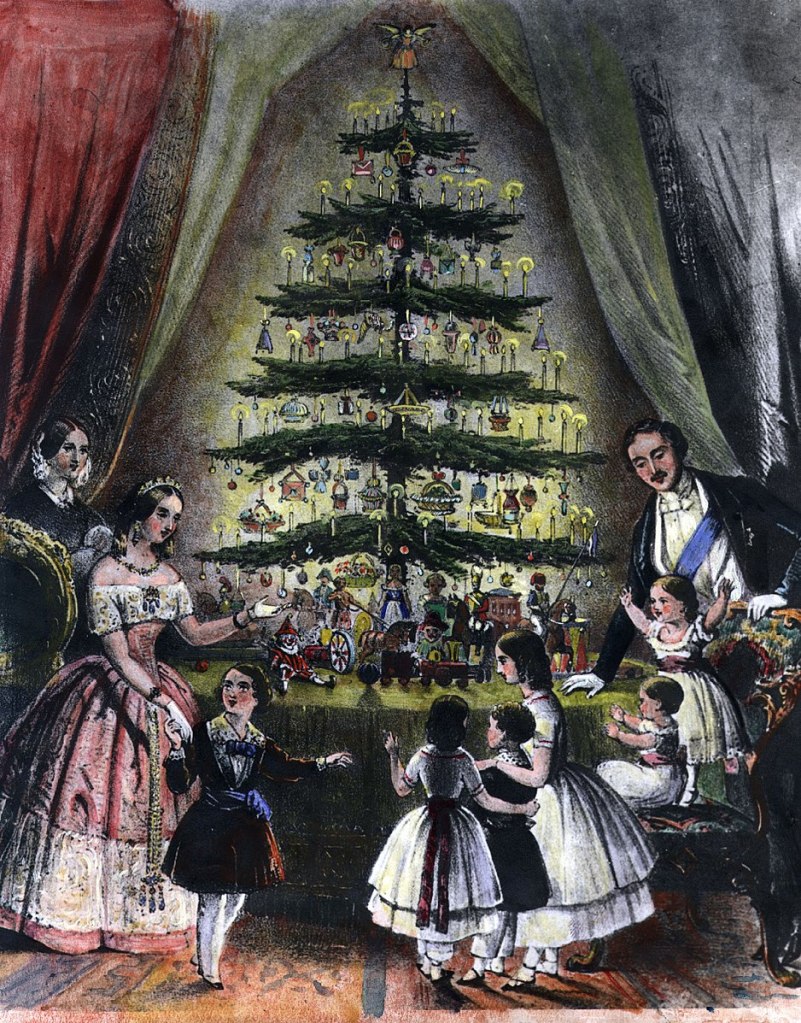
That German tradition slowly spread across Europe. But its popularity soared in the mid 1800s when Queen Victoria’s German husband, Albert, had trees erected in Windsor Castle and, in 1848, allowed a front cover painting to appear in The Illustrated London News showing the main tree covered in decorations and surrounded by the Royal Family. Other papers picked up on the story, and it massively influenced upper class customs in Britain and many other countries. Royal fever did its work.

Image in public domain

During the following decades and into the 20th century, the tradition of the Christmas tree spread quickly and widely. Across the western world almost all homes had Christmas trees. Local authorities mounted Christmas trees in public squares and on their buildings. Large stores placed trees on their balconies and in the main retail areas. Towns and cities publicised ceremonies of switching on the lights on large Christmas trees in prominent places. For example, since 1933 and continuing now, a large Norway spruce tree has been used for the Rockefeller Center Christmas Tree in New York. The 2024 tree is 74ft (22.5m) tall, 43 ft (13.1m) wide, and weighs about 11 tons (24,250 pounds, 11000kg). After the Christmas period, the tree will be donated to Habitat for Humanity and cut into lengths to help with building homes. In Washington DC the National Christmas Tree is erected near the White House, and its lights switched on by the President and First Lady. Trafalgar Square in London has had a Christmas tree donated by Oslo, Norway, every year since 1947. The 2024 tree is 20 metres (65.6ft) tall and has already been scaled by a protestor dressed as Santa Claus.

For a long time now Alison and I have had only artificial Christmas trees in our home, principally for three reasons: that means a real tree is still growing in the forest; artificial trees leave no mess; they can be used for many years. We follow a common tradition of laying presents around the base of the Christmas tree. When our children were young, those presents sparked curiosity which led to exploration. The children would secretly examine the size and weight of each neatly wrapped present, probably hoping the biggest and heaviest was for them. One thing we never have done or will do is sing around the Christmas tree. The TV series Downton Abbey portrays how the aristocratic family would sing along with their servants beside a giant Christmas tree. We have never done that. Maybe it’s because we don’t have servants. Or because we’re not very tuneful.

‘Once in Royal David’s City’

Every Christmas Eve millions in the UK and around the world tune in to a service of carols broadcast from King’s College, Cambridge. The first TV broadcast was in 1954, and then the service televised regularly from 1963. For over 100 years one tradition at the start of that service has not changed. Since 1919 the opening carol has been Once in Royal David’s City, with the first verse sung unaccompanied by a boy soprano. For that soprano, the thought of your solo being heard around the world must be terrifying. What must make it worse is that no-one knows who will be the soloist until the choirmaster selects one of the sopranos just as the service begins. A nod or pointed finger in your direction, and seconds later your voice penetrates the silence. And millions are listening.

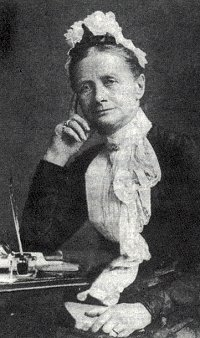
The writer of ‘Once in Royal David’s City’ was born Cecil Frances Humphries in 1818 in County Wicklow, Ireland. ‘Royal David’s City’ wasn’t her only famous hymn  – I’ll mention two more shortly. They may surprise you. Keep reading…

Cecil began writing poems in her school journal from an early age. They were beautifully composed in style and content, and that led to the publication of her first book of poetry called Verses for Seasons, a kind of ‘Christian Year’ of readings for children. That was only the beginning. Overall she wrote more than 400 hymns, basing them on subjects like the Apostles’ Creed, baptism, prayer, the Lord’s Supper and the Ten Commandments. All of them were written in simple language so children could understand and enjoy them.

When Cecil was 30, her book Hymns for Little Children was published. Each hymn was written to bring out the truth of some Christian teaching. Of course, without music the hymns read like poetry. But one year after publication a gifted English organist, Henry John Gauntlett, read Hymns for Little Children, and so loved ‘Once in Royal David’s City’ he composed music for it. As a hymn it was immensely popular and before long it was being sung far and wide.

Its origins as a children’s hymn show by the many direct lessons or references to children in the carol. For example, Cecil writes:

  • Christian children all must be / Mild, obedient, good as He.
  • For he is our childhood’s pattern; / Day by day, like us He grew;
  • And He leads His children on / To the place where He is gone.
  • Where like stars His children crowned / All in white shall wait around.

Cecil tells the story of Jesus in the carol, but also applies lessons and truths of the Christian faith for the children who would read or sing it. And that, after all, was her purpose. Hymns for Little Children carries a dedication by Cecil to her godsons, in which she hopes that the language of verse which children love “may help to impress on their minds what they are, what I have promised for them, and what they must seek to be”.

Two years later, in 1850, Cecil married Rev William Alexander (hence her hymns carry the name Cecil Frances Alexander). He eventually became the Anglican Primate of Ireland, a very senior role. Cecil poured her energies into writing hymns but also care for the very poor. The disastrous Irish potato famine – known as the Great Famine or Great Hunger – lasted from 1845-1852.[2] The parishes of Ireland were filled with masses of the disadvantaged. Cecil poured her heart and hands into care for them. Often she’d travel miles in difficult conditions to bring comfort to the sick and poor, and to give them food, medical supplies and warm clothes. Along with  her sister, she also founded a school for the deaf.

Cecil wrote many hymns before she died in 1895. One of those was the classic Easter hymn ‘There is a green hill far away’. Another was the hymn loved by children and adults ‘All things bright and beautiful’. Many have regarded Cecil Frances Alexander as one of the greatest hymn writers in the English language.

Eating mince pies at Christmas

There is every good reason to eat mince pies, but no special reason to eat them only at Christmas. They are just as enjoyable at any time of year.

Plate of freshly baked festive Christmas mince pies with decorated golden crusts and spicy fruit filling served sprinkled with sugar, one broken open to reveal the filling. By christmasstockimages.com – http://christmasstockimages.com/free/food-dining/slides/mince_pie_plate.htm, CC BY 3.0, https://commons.wikimedia.org/w/index.php?curid=97503821

Mince pies date from medieval times but back then they were shaped like a rectangular manger, with a pastry baby Jesus on top. I’d find it hard to bite into that. The round shape of mince pies came only after the Reformation in the 1500s.

People of old linked the ingredients of mince pies with the Christmas story:

  • meat (mostly lamb or mutton) represented the shepherds
  • dried fruit (raisins, prunes and figs), along with spices (cinnamon, cloves and nutmeg), all expensive items, symbolised the wise men’s gifts
  • the mince pies had 13 ingredients in total, equating to Jesus and his 12 disciples.

Eating a mince pie every day of the 12 days of Christmas was thought to bring happiness for the following 12 months.

Around the time of the Reformation, Puritans tried to ban everything associated with Catholicism. That included mince pies. The pies soon made a comeback.

We can all be glad that ban did not last. The popularity of mince pies today is immense. In the UK about 800 million are sold in the run up to Christmas. Add to that the very many which are made in the home. Assuming they’re all eaten, that’s a lot of mince pies and a lot of calories. Some eat none of course – they’re not food for babies, nor does my 102-year-old mother-in-law eat them now. And there are some strange people who don’t like mince pies. A reasonable guess, then, is that those who like mince pies consume an average of between 15 and 19 pies per person at Christmas. Personally I’m a fan of home made pies served warm, and I’m not admitting how many I eat each year.

Finally…

I can’t finish without saying that, for me, Christmas isn’t about carols, mince pies, or presents around a Christmas tree. It is about Jesus, God’s Son, entering this world. No other birth changed the world like his.

My hope and prayer every Christmas is that people will think carefully about the one whose birth began it all (whatever the precise date). I wish you the happiest of Christmases and a new year ahead with many reasons to be thankful.


[1] https://www.history.com/topics/christmas/history-of-christmas-trees

[2] History.com records the famine’s toll: “Before it ended in 1852, the Potato Famine resulted in the death of roughly one million Irish from starvation and related causes, with at least another million forced to leave their homeland as refugees.” For a fuller description of the famine, see: https://www.history.com/topics/immigration/irish-potato-famine