One spark, and fire consumes a city

Just one spark. Probably the embers in the baker’s oven aren’t fully extinguished, the spark sets fire to nearby kindling material, and flames spread to wooden furniture and walls. Within minutes the whole ground floor is alight.

It’s 1.00 am and upstairs from the bakery Thomas Farriner is sound asleep. Thankfully his son is not. He smells smoke, and runs to wake his father. For a moment Farriner is disoriented. He cannot understand what his son his saying. Then he too smells the smoke. He leaps from his bed and runs downstairs, but is met by a wall of smoke and flame. There is nothing he can do to halt the fire. The house has two storeys above the ground-level bakery. Farriner’s wife Hanna died in 1665, and his daughter Mary is married. But his other two children, Thomas and Hanna, are in the house. He gathers them and the maidservant. Their only hope is to go up.

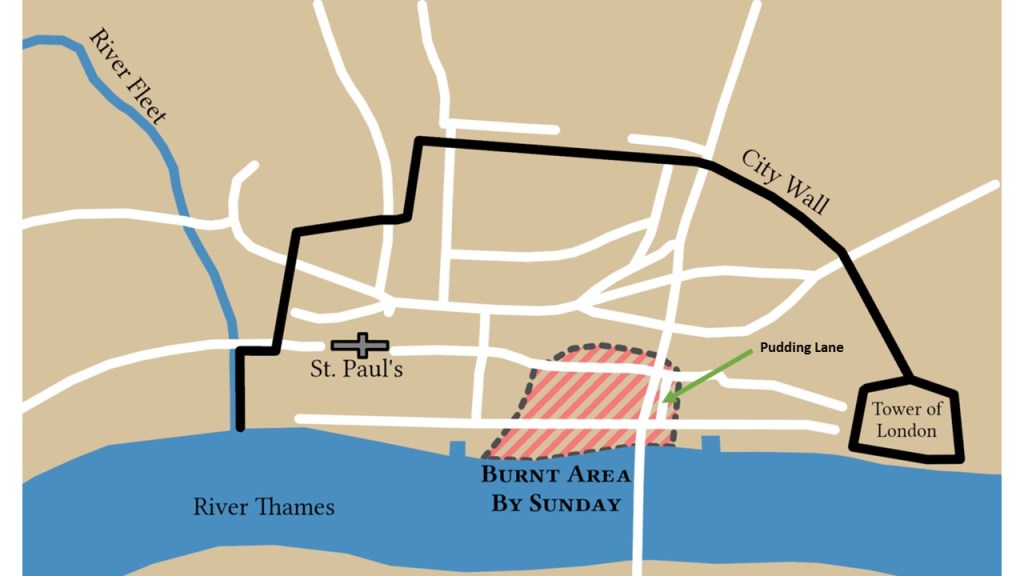
It’s September 2nd, 1666, the bakery is in Pudding Lane, and the blaze there is the beginning of the Great Fire of London.

Farriner’s house – as almost every home in mediaeval London – is made entirely of wood. The late summer has been warm with no rain. The dried out wood is perfect fuel for the fire which is spreading fast. If the family don’t escape quickly, they’ll die when the flames reach them or the house collapses.

Farriner forces open an attic window. He climbs out onto the thatched roof, reaches back and pulls his children after him. He crawls to the edge of the roof, but he’s now in great danger of falling to his death on the street below. At upper levels, houses in Pudding Lane extend over the street, almost touching the houses opposite. Farriner can reach across to the butcher’s home across the street, gets his attention, and with his help Farriner and his children clamber over to safety. But not their maid. She’s still in the attic, terrified by the fire below yet too frightened of falling to climb out the window. Farriner’s maid is the first to die in the Great Fire.

This is part one of a multi-episode account of the Great Fire of London. We’ll see why fire in one house spread quickly to others, why fire-fighting attempts proved futile, how city leaders failed, and later how prejudice led to severe violence against immigrant Londoners, why the fire finally stopped, and how the building of a new London began. And much more.

Before picking up the story of the fire again, there are six background facts worth knowing in order to understand why and how events unfolded as they did.

First, London was a very large city. The population in the 1660s is estimated between 350,000 and 500,000. That’s immense for its time, around ten to fifteen times the size of other British cities. It made London likely the largest city in Europe and the third largest in the western world. Behind the old Roman walls, in the mediaeval city, a huge population lived in overcrowded streets, their houses virtually touching each other. A ring of suburbs surrounded the old city, including the independent City of Westminster.[1] A fire could spread easily and widely.

London as it was drawn by Claes Visscher in 1616. The old St Paul’s Cathedral is left of centre. London Bridge over the River Thames is in the lower right. The bridge is covered in tenement housing, much of which was destroyed in a 1633 fire. The only reason the 1666 fire did not cross the bridge was because that housing had not been rebuilt.

Second, because homes were made of wood, thatch, and doused in flammable pitch, they could catch fire easily and be completely consumed by flames within minutes. Many also stored highly flammable hay and straw. And the ‘jetties’ – the overhanging upper storeys – meant fire in one easily spread to others. But the houses were built like that because wood was a relatively cheap building material, and tax was paid only on the ground level footprint of a home, not its overall size. Officially that kind of structure was banned, but the law was not enforced by local officials, so oversized wooden homes continued to be built.

Third, fire-fighting methods were primitive by modern standards. There were essentially two techniques.

  • The first was water. There was plenty of water since the River Thames was close to Pudding Lane, but the ordinary citizens had only leather buckets which held little water and took time to get to a fire. There was no modern-style fire brigade, but London had ‘fire engines’. However, they were little more than large barrels mounted on sleds with a spout to spray water towards flames – that is, if the heat even allowed you to get close. Only some sleds had wheels, and, being immensely heavy, they were hard to haul through the streets, and doubly difficult among panicking crowds. During the Great Fire several toppled into the Thames while refilling and were lost.
  • The second technique involved partial or total demolition of homes to create firebreaks. Firehooks could pull burning thatch off a roof, and even tear down a wall. They were relatively effective. More extreme but also useful was gunpowder. Blowing up houses completely could create a larger firebreak, successful unless the fire found some way to jump across.

Buckets of water, axes, ladders, water squirts and firehooks were stored in local churches. But access to them was difficult in the early hours of the morning, and these tools were inadequate once the fire had spread.

Fourth, the Great Fire spread rapidly because of a persistent strong wind blowing east to west. Those who fought the fire couldn’t keep pace with the rapid progress caused by that wind. It also explains why burning embers drifted across firebreaks.

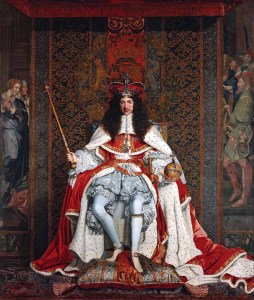
Charles II at his coronation in 1661, painted by John Michael Wright

Fifth, the governance of London failed its people when the fire erupted. London, like most English cities and towns, was managed by aldermen and a Lord Mayor. London, though, was also the location of Parliament and of the king, and that complicated matters. Here’s the super-short background. The English King Charles I was beheaded in 1649 during a period of civil wars between monarchists and parliamentarians (republicans). Under the leadership of Oliver Cromwell, reforms had taken place, but he died in 1658 and his son Richard who followed was significantly less able. Another king was needed, and Charles II came to the throne in 1660. Thus began what was called the ‘Restoration’, a period of social change which included reopening theatres (closed under the puritanism of Cromwell) and flourishing of literature. Charles II was relatively popular, and was nicknamed the ‘Merry Monarch’.[2] However, not all welcomed the restoration of the monarchy. That was particularly true in predominantly parliamentarian London, and resistance to rulership or interference by the king played its part in mismanagement of the Great Fire.

Sixth, England and the Dutch Republic were in conflict over extracting precious minerals and gold from West Africa, and that had worsened into a mainly naval war. Foreigners in London from European countries were increasingly distrusted. As we shall see, they became prime suspects for starting and spreading the fire.

But it’s in Farriner’s bakery in Pudding Lane that the fire starts in the early hours of Sunday 2nd September, 1666. Farriner is sometimes described as the king’s baker, but that’s correct only because he supplied baked biscuits to the Royal Navy. The street name Pudding Lane sounds odd in modern ears, especially for those who use the word ‘pudding’ as a near-equivalent to ‘dessert’. But pudding in those times was offal, the entrails and internal organs of an animal, material often discarded and eaten by birds or dumped into rivers like the Thames. Pudding Lane acquired its name because a great number of butchers’ shops were located there. In fact many trades were in Pudding Lane, so it was a street in which people stored tar, rope, oil, brandy and other goods that burned easily. It was the worst place  for a fire to start.

With the word ‘Fire!’ shouted loudly, parish constables arrive. In the first hour, the flames consume only a few shops and houses. But it must not be allowed to spread further, especially to warehouses alongside the nearby River Thames because they store highly dangerous materials, including lamp oil, tallow[3], spirits, and gunpowder.

The constables decide that homes on either side of those burning must be torn down to create a firebreak. But they lack the authority to demolish private property. The Lord Mayor, Sir Thomas Bloodworth,[4] does have that authority and he is soon on the scene. But he makes two fateful decisions. First, he will not allow soldiers to help. The aldermen to whom he answers were parliamentarians in the civil war, and he knows they will not tolerate the king’s army acting within city walls. Second, Bloodworth massively underestimates the danger. He thinks the fire insignificant, that it’ll die out soon. In his diary Samuel Pepys records Bloodworth’s rude and inappropriate comment that the fire is so small a woman’s piss could put it out. With that judgment, Bloodworth returns home and goes back to his bed.[5]

The fire does not die out. More and more buildings are added to the blaze. The thatch and dry wood are perfect fuel for the fire. Locals form lines to pass buckets of water taken from the Thames, but their efforts cannot keep pace with the spread of this fire. They do tear down some buildings, but the strong wind carries embers across firebreaks and the fire spreads to adjoining streets. Soon, many are no longer thinking about fighting the fire. Instead they’re gathering their families and whatever possessions they can carry, and trying to find a place of safety.

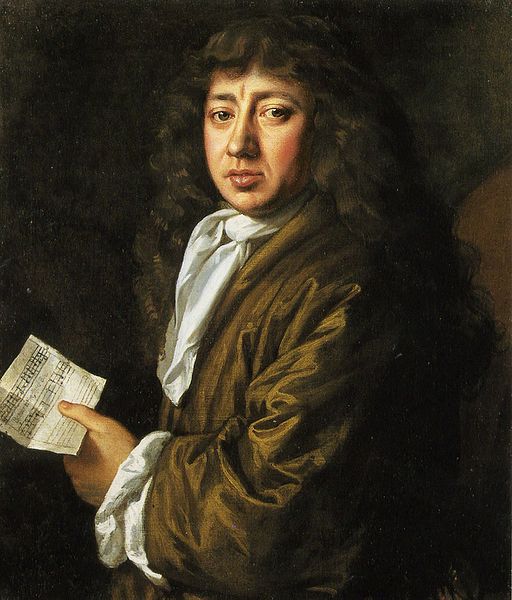
Samuel Pepys
John Hayls, Public domain, via Wikimedia Commons

Not far away Samuel Pepys[6] is wakened by a servant. Pepys is a remarkable man. He’s described as a diarist and naval administrator, but that underplays his significance. Under Charles II (and his successor James II) he became Chief Secretary to the Admiralty. He had no sea-going experience, but implemented essential reforms which organised and professionalised the navy. Additionally, he wrote down all that was happening around him during the years 1660 to 1669. His diary writings – more than a million words – were published much later and not only give invaluable insights into that decade, but especially its great events which include the Great Fire of London.

It is still the middle of the night, and 33-year-old Pepys is as reluctant as anyone to leave his bed. But the maid insists. He steps over to his bedroom window, and sees fire and smoke rising only one-third of a mile away. But he’s not especially perturbed. It’s just another London fire, and he’s suffering constant pain from bladder stones, so he returns to his bed.

He wakens again at 7.00 am. He looks out his window. The fire is now much larger. Pepys has access to the king, and thinks the monarch should be informed. First he goes to the Tower of London from where he can get a better view of the fire. He sees how fast the strong wind is pushing the flames. At the Thames he clambers onto a boat from where he has a view towards Pudding Lane. People are running from the fire with their possessions, some throwing themselves and their property into the river, and others stacking their goods on boats.

He uses his boat to reach Whitehall where the royal palace is located. King Charles is alarmed, and instructs Pepys to return to the old city, find the Lord Mayor, instruct Bloodworth to tear down houses, and tell him that the king will send soldiers to help. These are sensible measures, but the mayor will not care to be instructed by the king nor want his soldiers.

By mid-morning Pepys is touring streets by coach but has yet to find Bloodworth. The fire is widening its reach minute by minute, pushed along by an ever-stronger wind. The lanes are crammed with an odd mix of citizens. Some are dressed smartly and on their way to church. Others are covered in soot, and hurrying away from the fire carrying children and possessions. Flames reach into the sky. Dark clouds billow up over the city.

Pepys continues to search, by now on foot. The crowds have made coach travel slower than walking. At St Paul’s Cathedral he watches people pushing to gain entry, not for Sunday worship but bringing their clothes, furniture, and other goods inside. Many take them down to the crypt. St Paul’s is large and made of stone. It will not burn. It is a safe place. Or so they think.

Where is Bloodworth? Pepys heads towards the fire. People rush past him, some trying to stem the flames and others getting as far as possible from the flames. One man tells Pepys the mayor might be anywhere, and that 300 homes are burning now. He presses on, forcing his way through the throngs. He rounds a corner and for the first time feels the heat from the fire on his face. In front of him are not homes, but what looks like a giant bonfire. ‘It made me weep to see it’, writes Pepys. One writer describes his reaction: ‘This is no longer the few burning streets he’d told the king about. This is a vision of hell.’[7]

As well as what Pepys sees and feels, what he hears is terrifying. Burning wood is not silent. It breaks apart with loud bangs, like the firing of pistol shots. Everywhere fires roar. Pepys steps away, moves down alleys not yet ablaze, and finally finds Lord Mayor Bloodworth in Cannon Street surrounded by constables and locals. To Pepys he looks defeated and near to collapse. He had a chance to extinguish this fire, but now it’s too late.

Pepys tells Bloodworth he brings orders from the king. Houses in the path of the fire must be demolished. Despite the awful reality of a fire out of control, the mayor stubbornly refuses. The two men argue. For Pepys whatever can be done to save the city must be done. Bloodworth, though, will not give up his control and take commands from the king. Though the mayor has no idea what to do he will not let King Charles tell him what to do. He protests that he has been up all night, he now needs to go. And he does go, leaving his city to burn. Lord Mayor Bloodworth is never seen again while the Great Fire rages.

It’s now not even midday on Sunday, only the first day of the fire, and already hope of saving much of London is gone. And here we will pause our narrative. This has been only the introduction to our story. The worst of the Great Fire is yet to come. Details to follow in the next blog posts.

In closing, though, is there any wisdom to be gleaned from the beginning of the Great Fire of 1666? There is. Very briefly, I’ve noted four lessons.

  1. There was clearly a failure to imagine the unimaginable. London often had fires, but they were small, and their primitive fire-fighting measures were adequate. Those in authority had never imagined a fire which quickly became an inferno and then spread further and further across the city driven by a near gale force wind. But, actually, that was not ‘unimaginable’. It was simply not imagined. Very strong winds happened, often in early autumn. If only they’d planned and prepared for a fire breaking out at such a time.
  2. Laws were not enforced and that had consequences. Foolish practices, while not illegal, were allowed. There were laws about the size and overhang of houses which no-one enforced. Highly inflammable and even explosive materials were stored in wooden houses and sheds and no-one intervened. This was madness, a classic case of nothing being done until there’s a disaster. There was indeed a disaster, one that claimed lives and destroyed a large part of London.
  3. Dogma took priority over effective action. As we will see, once soldiers were organised and deployed, more effective firefighting took place. But for crucial hours the king’s men were refused. Many of London’s leaders had not wanted another king, so they certainly didn’t want his soldiers. That decision had devastating consequences.
  4. Those who should have taken decisive action failed. Most historians condemn Lord Mayor Bloodworth for his inaction. But some believe he faced impossible pressures politically, and was simply out of his depth when faced with a massive fire. Both hard judgments and soft judgments can reasonably be made about Bloodworth. But the bottom line is that he did little in the early hours, and removed himself when firm and effective action was most needed. He was the city’s leader, but he wasn’t a leader in a major crisis.

The Great Fire of London lasted four days. So far we have seen only its beginning. There is much more to come.


I have used several sources for the information in this series on the Great Fire. A special thanks is due to the podcast, Short History of the Great Fire of London. It not only gives more information than most web sources, it tells the story. I have used my own words, but, with gratitude, I’ve followed the podcast’s story line to unfold information and events on a day by day basis. I also want to warmly commend all the episodes of the ‘Short History of…’ podcast. The team cover a wide range of subjects. It is one of my most favourite podcasts – important subjects, brilliantly told, easily followed, fair interpretations. The link to its website is just below.

Here are my major web sources:

Short History of the Great Fire of London podcast. It can be found in two places:

The Monument, erected between 1671 and 1677 to commemorate the fire, and still accessible today, has a website which describes the fire at: https://www.themonument.org.uk/history

Of course Wikipedia has a wealth of information on the Great Fire and, via other pages, on many of the main characters mentioned in its story. The Great Fire entry is at: https://en.wikipedia.org/wiki/Great_Fire_of_London

London Fire Brigade can trace the inspiration for its founding back to the Great Fire. It gives its account of the fire at: https://www.london-fire.gov.uk/museum/history-and-stories/the-great-fire-of-london/#:~:text=In%201666%2C%20a%20devastating%20fire,Paul’s%20Cathedral

Inside History tells the Great Fire story in two parts.

The Museum of London has many resources related to the Great Fire. Its web pages are here: https://www.museumoflondon.org.uk/discover/great-fire-london-1666


[1] Now the location of the UK Parliament.

[2] His merriness included fathering at least 12 illegitimate children with mistresses, but he left no legitimate heir. He was succeeded on the throne by his brother James.

[3] Tallow is rendered animal fat, more commonly called ‘dripping’ in the UK. In the 17th century, one of its uses was for candles.

[4] His last name also appears as Bludwoth.

[5] Bloodworth is blamed for allowing the fire to spread in its early stages. But tearing down private property, if later deemed unnecessary, could have left him personally liable for damages unless the king had authorized his actions. But his aldermen – parliamentarians – would not have allowed the king to decide on firefighting measures in the city.

[6] The pronunciation of his last name sounds like ‘peeps’.

[7] John Hopkins & Danny Marshall, ‘Short History of the Great Fire of London’ podcast, 22’18”.


Monkey Business

Probably less than five times in my life I’ve read something that stunned me, which made me realise I’d uncovered an insight into a problem I’d wrestled with for years. One of those five times was with the delightfully titled book The One Minute Manager Meets the Monkey.[1]

I believe there are now 18 books in the One Minute Manager series. I read the original, The One Minute Manager, soon after it first appeared in 1982. I was thrilled by its simplicity, insight, and practicality. So were many others. It has sold over 15 million copies, been translated into 47 languages, and described by Time magazine as one of the 25 Most Influential Business Management Books.

The One Minute Manager books typically involve dialogue between a storyteller and a perhaps fictitious leader that everyone called the ‘One Minute Manager’ because he got great results from his people with apparently little time and effort on his part. The books are littered with smart sayings or questions, such as this one early on in The One Minute Manager Meets the Monkey: ‘Why is that some managers are typically running out of time while their staffs are typically running out of work?’ When I read that, it landed with a thud in my thinking. Yes, why is that true? It made me read on.

The book begins with a description of the storyteller’s frustration that even when he worked extra hours every weekday and all weekend, he could never get on top of all his work. It seemed he was doing more but accomplishing less. Getting desperate, he attended a time management seminar, which made him more efficient, but that increased efficiency merely made room for more work. His staff always seemed to need something from him before they could move on further with their work.

When the storyteller met with the One Minute Manager and poured out his troubles, he was soon made aware that he was the problem. Or, more specifically, his problem was MONKEYS! These are not monkeys who live in a jungle or zoo. Rather, the One Minute Manager’s definition of a ‘monkey’ was ‘The Next Move’. To explain what that means, the One Minute Manager gave the example of walking down a hall, and being stopped by one of his staff who wanted his input on a problem. He likes solving problems, but that discussion lasted for half an hour. Now the One Minute Manager is late for a meeting, so promises to think about his colleague’s problem and get back to him later. So, what happened there? Until the hall meeting, the monkey (next move) was on his staff member’s back. During the discussion the monkey was on both backs. By the time they parted, the monkey had moved from the subordinate’s back to the manager’s back. No longer was the next move the subordinate’s problem, it was his boss’s problem.

The One Minute Manager points out that two things can be assumed: 1) the matter being considered was part of the staff member’s job; 2) the staff member could and should have offered solutions to the problem. Thus, what the manager allowed during the hall conversation was for him to do two things his subordinate was expected to do: 1) accept responsibility for the problem; 2) promise to bring forward a progress report, in his case to his subordinate. In other words, they had switched roles: the manager took on the worker’s role, and the worker took on the supervisor’s role. Unsurprisingly, the worker now follows up on his boss to see if he’s made progress, and thus pressurises him to do more on what was actually his job.

The example of role-reversal triggered several examples from the storyteller of how he had acquired ‘monkeys’ from his staff – tasks he’d taken off their shoulders and put on his own. Some were straightforward, such as Maria who enlisted her boss’s help because he had a better understanding of certain problems. Maybe he did, but he was now doing her work. He also described ricochet monkeys, for example criticisms from staff about Maria’s work and style because these things caused problems for them. They complained to the storyteller who promised to follow up and report back to them.

Then there was Ben, who was very creative, always generating new ideas, but poor at turning them into finished products. So Ben would submit proposal after proposal, many of which had potential, which he, the boss, would then try to do the work of turning them into viable projects.

These – and many more – should have been handled by the staff themselves. But in each case the storyteller manager had allowed the monkey to climb onto his back. The biggest part of his work overload were those monkeys. Because he was doing large parts of his staff’s work as well as his own, he’d begun to steal time from his personal life: exercise, hobbies, family, church, etc.

Eventually he had run out of time completely, yet monkeys kept coming his way. All he could do was delay, promising he’d eventually get to every task. He was procrastinating; his staff were waiting. Which meant no-one was progressing the monkeys.

What surprised the storyteller was what the One Minute Manager said next – that he had once had the same problem of overwork, except much worse. But then – out of desperation – he attended a time-management seminar. And there, thankfully, he learned about monkey management.

The seminar leader was Bill Oncken, and he told a remarkable story that paralleled the One Minute Manager’s situation near exactly. And what follows is the story that astounded me.

Oncken described working long hours but never keeping up. Early one Saturday morning he got ready again to head for his office, telling his disappointed wife and children that he was sacrificing himself for their sakes. The office was gloriously quiet, no-one else there, and he poured into his work. Finally he paused. His office window looked across to the neighbouring golf course, and there he saw his staff getting ready to start their round. Oncken said: ‘They were teeing up, and I was teed off!’ He looked down at all the work on his desk, and gasped. These papers were not his work; it was their work he was about to do. With a jolt as if struck by lightning, it hit him: ‘They’re not working for me; I’m working for them!’ And with four of his staff producing work but passing it up to him, he’d never get caught up. The more he did, the more they would give him to do. He wasn’t behind with his work.  He was behind with their work.

Oncken finished his story by relating how, after realising whose work he was doing, he fled from his office, drove home and spent the rest of the weekend with his family. That Saturday night he slept so deeply that twice during the night his wife thought he was dead.

By now, you’ll have grasped the core theme of The One Minute Manager Meets the Monkey. I’ll stop summarising now, though I’ve given you only the highlights of just over one quarter of the book. I encourage you to get a copy and read it all.[2] It’s full of thoughtful insights and much wise guidance.

This blog post is the follow-up to my previous one on delegation. (See https://occasionallywise.com/?s=delegation) So, in what remains, I’ll add further comments on that subject, including some arising from points raised above.

Bosses must resist the temptation to go back to doing the fun work    The best managers are often people who’ve worked their way up through the ranks. They understand the issues at ground level, the place where the company’s work interacts with the concerns and wants of its customers. When they did that work, they performed well, so they were promoted and began overseeing the next generation of ground level workers. That is exactly as it should be, but it often leads to two problems.

  1. The leaders loved the down-in-the-trenches challenges of aligning products or services with customers’ needs and problems. It was tough but stimulating, and when it all went well generated a wonderful sense of achievement. Then they moved up the company hierarchy, and they lost that satisfaction. They’re sent reports of successes, but reports don’t generate gratification like they felt when they handled those contracts themselves. Therefore, managers face a massive temptation to dive back into the detail work their staff member should be handling. Such leaders tell themselves they’re just lending a hand, but their motives are suspect, and hijacking their subordinates’ jobs keeps them from their own work and deprives their staff of the experience and satisfaction which rightly belongs to them.
  2. The leaders I’m describing won their promotion to management by being good – really good – at their work. Perhaps they were the best sales person, or highest achieving accountant, or best machinist on the factory floor. Now, as managers, they see the workmanship of their staff and think, ‘I know the best approach’ or ‘I could do this so much better myself’ and, next thing, they’ve taken over the work. Again the result is that they’re neglecting their management-level work, and robbing staff members of the experience that comes only from trial and error learning moments.

It’s very hard for leaders to concentrate only on their own work, but they must.

There’s a real danger that a leader becomes a rescuer    The One Minute Manager Meets the Monkey book defines a rescuer as ‘someone who was doing for others what they could do for themselves’. That has all the dangers I’ve just mentioned above, but also delivers a negative psychological verdict on their staff member’s work. When I rescued my two-year-old daughter who was out of her depth in a swimming pool, I did that because otherwise she’d have drowned. I had to save her because she couldn’t have saved herself. That’s exactly right. But what’s not right is taking over work someone is capable of doing. As the storyteller in the book says, when we do that we send the message to them they are ‘not okay’, that they’re so unable to handle a problem you have to take care of it for them.

They may not yet be as capable as their boss, but they’ll never have equal ability if the boss does their work.

 What if the staff member can’t handle the task you set?    In the last blog post I said delegation can happen only when someone is available and suitable. Here the issue is about suitability – a subordinate having the skills and experience necessary to do a job. If they don’t, and you still delegate to them, several questions are raised:

  1. Why are you delegating the job to someone who can’t do it?  If the task is outside someone’s skill set, they don’t fail. You do. Requiring them to do what you knew they couldn’t do is bad management. You have one less job in your in-tray, but the botched work of an inexperienced colleague will make everything worse. The badly done job won’t please you, or your boss, or your client. In fact, the client may move their work elsewhere, and you may soon be working elsewhere too.
  2. Why didn’t you know what your staff member was capable of doing?  Let me be charitable that you didn’t intentionally cause your colleague to fail. I’ve seen that done in order to have a reason to fire that person. It was not only wrong but also cruel. But, let’s assume you simply didn’t know the person’s capabilities. Well, you should have. If there’s a good reason why you can’t know their skills – such as when someone has only just joined the company – then either don’t delegate to them yet, or delegate only light tasks and gradually make them more substantial as you discover what they can do.
  3. What if they are capable but simply didn’t do the task or turned in sloppy work?  A case like that needs care. What if there’s some crisis at home for that employee? Or they’ve just been diagnosed with a serious medical condition? Or this poor piece of work is a complete exception, and everything else they’ve done has been very good? We need to think about Issues like these before we react. But let’s assume you have every reason to believe your staff member didn’t care, or gave scant attention to the task, or pretends they didn’t understand what they were supposed to do. I’ve known employees like that, guilty of culpable ignorance or culpable inability. Given the position they held, they should have known what to do and be able to do it. So, when work is either not done or done badly, that’s not a time to pretend it doesn’t matter, nor should we avoid confrontation by taking the job back and doing it ourself. One of the other One Minute Manager books makes it clear that if it takes two people to do what should be done by one, then someone is unnecessary. With your incompetent employee, you may wish to give another chance; you may be required to issue an official warning; you may be allowed and deem it necessary to bring their employment to an end. Whatever is appropriate, do it. Avoiding the issue is the worst of outcomes.

So, to finish, three last quick statements about delegation:

Anyone who tells you that delegation is simple doesn’t know much about delegation.

Done well, delegation puts the right work in front of the right people, which is good for job satisfaction and excellent workmanship.

Never feel guilty at giving work away, but you are guilty if you take work away from the person who should be doing it. That’s not good for you, nor productive for your business.

I wish you well in delegating wisely and often.


[1] Blanchard K, Oncken Wm, Burrows H (1990), The One Minute Manager Meets the Monkey, London: Harper Collins Publishers.

[2] At the time of writing, it’s available in paperback for £6.99 in the UK, and used from $4.39 in the USA where the paperback version no longer appears to be for sale.

Delegation

Every department head, manager, director, or CEO experiences workload pressures. Sometimes my wife, Alison, would arrive at the office with a sandwich to keep me going while I worked late. The uninvited advice on workload various people gave me was: delegate more. They made it sound so easy.

Those advice-givers were well-meaning, and delegation is certainly good management practice. But those who said ‘delegate more’ had little knowledge of my work situation, were almost never leaders themselves, and spoke as if delegation is a simple and effortless way to offload work. In fact, delegation is neither simple nor effortless.

In what follows I’ll describe obstacles to delegation, but also suggest ways in which it can be done effectively.

First, you can delegate only to people who are available and suitable. I’ll explain why I use these two terms one at a time.

The availability issue is at its most obvious if we picture someone running a one-person business. That boss can’t delegate because there’s no-one to give the work to! They could out-source some tasks, which is often a good idea but only when the work can be done equally well by someone outside the business. Most work, though, requires in-house knowledge, and that can’t be delegated to non-existent colleagues.

And even when there are colleagues we can’t assume anyone is available. Let’s imagine Josh started his business alone, but now employs six others because the there’s plenty work. Josh’s phone rings constantly, electronic orders pour in, the despatch team keeps shipping out products. It’s all good; the business is flourishing. But it’s not all good. Josh is exhausted, and, like him, his team often work late to meet demand. Then someone, seeing how tired Josh is, whispers in his ear: ‘You should delegate more’. Really? Who can he give his work to? There is no-one in his six-person team who’s employed full-time but has only a part-time workload. Josh would love to delegate, but there is simply no-one available who has spare capacity. (Should Josh hire more staff? Ideally that’s exactly what he should do, but for many small businesses payroll costs are their most expensive overhead, and employing even one more person would eradicate his profit and jeopardise the company’s viability.)

Suitability is the other essential for delegation. Let’s imagine that Jerry – who has a small construction company – also has six employees. Jerry’s team do excellent work, so previous customers generate new clients by word of mouth recommendations. Every new client, though, means a site visit followed by preparing and sending a cost estimate, and, when the estimate is accepted, every job involves background work such as securing building approvals, scheduling the work, ordering materials, and hiring specialist equipment. And of course records must be kept, which must be made ready for tax payments and audit. Jerry handles all that. Why doesn’t he delegate some of it to one of his six colleagues? They’re fine workers, but they’re builders and none has the skills necessary for preparing estimates, accounting for finances on spreadsheets, or any of the other background work Jerry does. They’re highly skilled at what they do, but not at all skilled at what he does. Even if one or more was available, they wouldn’t be suitable. And, no matter the size of business, the suitability issue is always relevant for delegation.

These two problems – availability and suitability – are real. I know of the demoralisation that followed when a boss dumped his work onto a colleague who was already over-worked. Within six months the overloaded employee was an ex-employee of that company. And I know of the consequences when work was given to someone untrained and therefore unable to handle the task. They didn’t resign, but the work was done poorly. The employee was blamed for doing a bad job, but the blame really belonged with the unfair and unwise delegator.

One – almost amusing – final comment on the availability and suitability matter. I’ve read accounts from management gurus who’ve discovered real competence and authority at the top of a company – except not right at the top. The Personal Assistant (Executive Assistant) to the Chief Executive managed her boss’s calendar, decided which meetings he’d attend, controlled staff access to him, selected the business papers he would read, wrote his speeches, and drafted important documents for the Board. The management gurus remarked that you wondered who was really running the company. Almost always the boss was male, and the assistant female, but she had the greater knowledge and expertise. Management culture is changing – albeit slowly – and hopefully such competent assistants will increasingly become the CEOs.

Second, delegation without supervision or accountability is particularly dangerous. One department leader told me: ‘I’ve given out tasks to my staff, and I don’t want to know anything more about the things they’re now handling’. Gently I informed him that was not an acceptable approach to delegation. Why not? After all, isn’t delegation about letting go of work to others? It is, but what you can’t delegate is your responsibility for what’s done. You’re responsible to ensure the project goes in the right direction. You’re responsible for the standard of work being satisfactory. And you’re responsible that the deadline is met, for the conclusions reached, and so on. Hence my department head – not the staff working under him – was accountable for all these things, and a completely hands-off approach was an invitation to chaos. Delegation of work is good, but delegation has limits.

Third, here are four further guidelines for good practice with delegation.

Clear expectations    No-one should be given a task without clarity on key points like these:

  1. What exactly do you want done?
  2. When is the work due?
  3. Do I show you this work when complete, or do you want to see drafts at earlier stages?
  4. What is the budget for this?
  5. What extra resources or support will be available to me?
  6. Are there special factors, such as keeping this work confidential?

And even:

7. What work would you like me to stop doing in order to take on this new task?

As a boss, I learned to be clear on all these things, and especially numbers 3 and 7. With 3, I discovered that staff liked to surprise me by submitting what they considered a finished product. Sometimes they virtually said, ‘Don’t ask me to change anything now!’ To prevent that I found I had to be crystal clear from the beginning that I wanted to know the direction their work was going long before they finished. With number 7, I realised that at the outset I had to discuss with my staff member what work they could set aside in order to do the new thing. Perhaps there were no existing tasks the employee could completely postpone, in which case there were only three options: a) get another person to take on the employee’s existing work; b) scale back the timetable for the new work; c) delegate to someone else whose existing work could wait.

Sensible and sensitive supervision    I’ve touched on supervision earlier, so here my emphasis is on the words ‘sensible and sensitive’. Sensible supervision means constructive support as they do the work. What it’s not is doing the work for your colleague. If you have to do the thinking, the research, the calculations (or similar tasks) then you’ve not delegated to the right person (or you, the boss, don’t understand delegation). Sensitive supervision is knowing when to check on progress and how to comment on progress. It’s finding the right stages or time intervals for updates – never repeatedly looking over your colleague’s shoulder, and never being too busy to give them time.

Having a reserve plan    If the delegated work is ‘mission critical’ – a task the company must have done – then the boss needs a plan in case the person handling the work falls sick or leaves. Since this is essential work, it can’t be abandoned, so either it can be passed to another staff member or the boss must take it on. In an emergency, either of those options requires a clear idea of what’s already done and what’s still to be done. The wise boss already knows that, and the perfect boss has kept a record. If the person who was handling the work has taken seriously ill or left the company, that record may be the only guide to what’s still to be done by whoever picks up the project.

Your delegation is someone else’s preparation    I got two reactions from colleagues when I delegated work to them. Some disliked it, either because they felt busy enough already or because they didn’t welcome unfamiliar work. Other colleagues jumped at the chance, even if their workload increased. They enjoyed the challenge and the new work would broaden their experience. After all, their hopes of a more senior position might depend on the importance and extent of their previous work. A foolish and weak leader is threatened by preparing those under him for leadership. Perhaps they’ll perform better than their boss. A wise and strong leader actively mentors colleagues, develops their careers, and trusts them with responsibility. That’s good for both the employee and for the company.

I’ll leave this post on delegation at this point. But I’ll return to the subject in the next post when I’ll describe the odd but not uncommon phenomenon of delegation in reverse.

The Tay Bridge disaster

I can’t imagine what it’s like to design, construct and supervise a world leading structure, receive wide praise and recognition, and have it fail causing dozens of deaths 19 months later. Thomas Bouch knew exactly what that was like.

I learned about the Tay Bridge disaster when I was very young. I grew up in Fife, and to get to Dundee we went north by train crossing the River Tay estuary on the 2.75 mile long Tay Bridge.

Aged less than seven, I looked out the train window and down to the water, and asked ‘Why are there stone blocks in the water alongside our bridge?’

My mum explained, ‘Those large blocks held up the first bridge. But it fell down.’ That wasn’t an encouraging answer, but I wanted to know more. And I’m still interested today.

In this blog I’ll tell the story of what happened to the original Tay Bridge. This is a different kind of blog to most. It’s longer, because the story can’t be told properly without detail. And why things went so terribly wrong is a lesson or warning for all of us.

But if it’s too much, you’re about to be given a shortcut.

Construction

I’m about to provide considerable detail about the construction of the bridge, including failings that likely caused its downfall. Not everyone will have time or will wish to read this. If so, pick up the story again in the section headed ‘Collapse’.

The River Tay flows into the North Sea just east of Dundee. Its estuary is wide with fast flowing currents and strong winds. To bridge across the river near its mouth would be a massive engineering feat.

Thomas Bouch

Proposals were drawn up in 1854, but nothing done. In the 1860s, however, two rail companies rivalled each other for the route to the north east. The key to success was building a bridge over the River Tay. The North British Railway Company got approval to do that, and they appointed a noted civil engineer called Thomas Bouch. He was 49, and already experienced with major railway projects in both Scotland and England. The whole contract – design, construction and ongoing maintenance – went to him. In 1871 work began.

From earliest days Bouch’s design was criticised. The bridge would be only single track so traffic capacity would be low. The centre section needed to be built high above water to allow ships to pass underneath. Bouch’s tall and slim design appeared to lack stability.

Problems soon emerged once construction started. Bouch’s design specified piers (on which the bridge would rest) of solid masonry and brickwork. But 15 piers out from the south side, the borers who dug into the next part of the river bed found the underlying material insufficient to hold the weight of solid piers. They would shift or collapse. So Bouch redesigned these piers to be lighter and wider. Above water level, instead of masonry there would be slender cast-iron columns. He made another change: originally the centre of the bridge was to have fourteen 61-metre spans, but finally he settled on thirteen 65.5-metre spans (the gap between piers).

Three other issues are worth mentioning.

The foundry  Bouch built a foundry at Wormit, immediately beside the south end of the bridge. That was a good idea – hardly any distance was involved in transporting the iron. But numerous reports described low-quality iron emerging from that foundry – inconsistent in shape and inconsistent in quality.

The height necessary to allow vessels to pass  For most of the bridge, girders ran under the rails. But those low girders reduced the height of the bridge, far too low for ships to pass underneath. So, in the centre section the girders were constructed alongside and above the railway track, allowing trains to pass through a tunnel-like gap between the metalwork. Hence that section got the name of the High Girders.

Wind pressure  Modern standards for wind resistance did not exist in Bouch’s time, but engineers were well aware of the issue. He took advice about wind pressure. French and American engineers had already adopted 40-50 pounds per square foot for wind loading (and if a Tay Bridge was being built today that would be the design requirement). But the lowest recommendation Bouch was given was 10 pounds per square foot. He took that, believing that wind intensity at that level would not force the bolts upwards that secured the columns to their piers.

Throughout the project there was pressure on Bouch from his employers to work as fast as possible, and to keep costs down. The bridge took six years to build. The materials used included:

  • 10,000,000 bricks
  • 2,000,000 rivets
  • 87,000 cubic feet of timber
  • 15,000 casks of cement

Six hundred men were employed during the construction; 20 of them died in accidents. The bridge cost was £300,000 which was not a high amount at the time. It equates to approximately £20,000,000 today, though modern bridges cost many times that sum.

The bridge was more than two miles long. Some records say it was the longest bridge in the world; others that it was the longest iron bridge, or the longest rail bridge. It impressed many. General Ulysses Grant, who led the Union Armies to victory in the American Civil War, visited the construction in 1877 while he was President of the United States.

The Tay Bridge was opened officially on 31st May, 1878, with great celebrations. Directors were taken over the bridge in a special train. Passenger traffic commenced the next day. Profits for the rail company soared.

First Tay Bridge, viewed from the north. Note the High Girders section in the upper centre-left of the photo.

In June 1879 Queen Victoria crossed the bridge as she journeyed south from Balmoral Castle. A few days later Thomas Bouch was knighted by the Queen at Windsor Castle.

Collapse

It’s now Sunday evening of the 28th December, 1879. Winter nights in Scotland are cold. This night there are also howling winds. On a naval training ship moored at Dundee, the wind speed is measured as gusting to Force 10/11.

On the south side of the River Tay a train approaches the bridge. There’s the locomotive, its tender, five passenger carriages and a luggage van. The last passengers have boarded at St Fort Station and are likely locked in, thought of as a safety measure. At Wormit, on the southern edge of the river, the train slows to 3 or 4 mph as a safety baton is passed over. At 7.13 pm the train moves on to the Tay Bridge.

It’s only 19 months since the bridge was opened. Thousands of passengers have crossed, including Queen Victoria. But not on a night like this. Gale force winds sweep down the Tay river valley. Some say no train should be using the bridge over the estuary on such a night. But this train does.

From the south signal box, through wind and rain an observer watches the tail lamps of the train as it moves on to the bridge. When it reaches 200 yards he sees sparks at the wheels. Probably the wind is pushing the wheel flanges against the edge of the rail. Those sparks fly for almost three minutes. Now the train is in the High Girders central section. The observer later described what happened next: ‘there was a sudden bright flash of light, and in an instant there was total darkness, the tail lamps of the train, the sparks and the flash of light all … disappearing at the same instant’.

He tells the signalman, who until now has been busy with other duties. Neither of them can see anything through the darkness. To be sure all is well, the signalman uses a cable phone (which was attached to the bridge) to call the signal box at the north end. He can’t get through. They don’t know what to think.

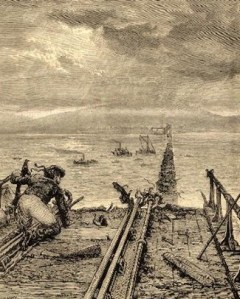
Newspaper illustration of railway officer crawling out during storm, finding central section of bridge gone.

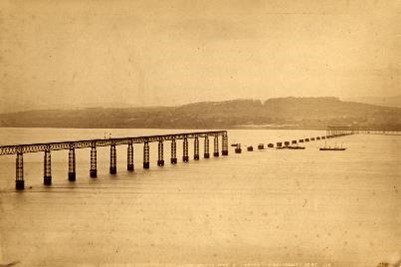
Officials on the Dundee side expect the train to arrive. When it doesn’t, they wonder if it ever left the south bank. Still they wait, but see and hear nothing. Finally two men volunteer to go out on the bridge. Perhaps the train is stuck. Or something worse. What they’re doing is immensely risky. Many times they are almost blown off the bridge. One stops, but the other reaches the point where the high girder section starts. It’s gone. And the train is gone. Holding on to save his life, he peers out over the raging river, realising the bridge ahead, the train, the crew and the passengers have all plunged into the water.

At first light ships search the Tay. They find no survivors. To this day different numbers are given for how many died, but most agree it was around 75.

As news spreads there is nation-wide shock. Newspapers publish sensational drawings of the train plunging off the tracks into the Tay. The engineering world is stunned.

When the storm is over, divers go down to the wreck. They find the locomotive and its carriages still inside the girders. It had all come down together. Only 46 bodies are recovered.

One of the most remarkable feats of engineering now lies at the bottom of the river it spanned.

Bridge viewed from the south after the accident. The High Girders section has collapsed into the river along with the train.

Consequences

After a tragedy the two immediate questions are ‘How did it happen?’ and ‘Who should we blame?’ Answers came soon.

An official Court of Inquiry was set up immediately with three commissioners. The disaster occurred on 28th December, 1879, and evidence was taken as early as 3rd January, 1880, just six days later.

They gathered eye witness testimony from people who had seen something from shore, and appointed senior engineers to investigate the wrecked sections and the remainder of the bridge. Others considered the design and construction methods. Months were spent gathering and examining expert reports and interviewing key people.

None was more key than Sir Thomas Bouch, who argued that derailment and collision with the girders explained the tragedy. His view was considered to have little supporting evidence.

The Court of Inquiry’s report was published a few months later and presented to both the Commons and the Lords in the Houses of Parliament. All points were not agreed in the report. But there was reasonable unanimity in serious criticisms of the design, the poor ironwork produced by the Wormit foundry causing some parts to fail when under heavy load, mistakes made during construction, inadequate maintenance and remedial measures. And a failure to create a structure able to withstand the strength of winds which could occur in the Tay estuary.

Here are two damning comments in the official report: *

‘…can there be any doubt that, what caused the overthrow of the bridge, was the pressure of the wind, acting upon a structure badly built, and badly maintained.’ (p.41)

‘The conclusion then, to which we have come, is that this bridge was badly designed, badly constructed, and badly maintained, and that its downfall was due to inherent defects in the structure, which must sooner or later have brought it down. For these defects both in the design, the construction, and the maintenance, Sir Thomas Bouch is, in our opinion, mainly to blame. For the faults of design he is entirely responsible.’ (p.44)

Bouch was broken by the Inquiry’s findings. He became a recluse and died of ‘stress’ in October 1880, four months after the report was published. He was 58.

Down all the years, arguments persist about what caused the bridge to fall. Bouch continues to be blamed, though perhaps a little less severely than by the official inquiry. But if the ‘buck stops at the top’, he was, unquestionably, at the top with this project.

Here’s what I think happened. Almost all the factors mentioned earlier had their part to play. Parts failed that with proper workmanship and maintenance should have stayed strong. But, fatally, when the locomotive and all its carriages entered the high girders, they created what one website calls ‘a solid broadside resistance to the gale, which was blowing full on to them’.  A yacht is moved forcefully when the flat of the sail is presented to the wind. On that night, at the highest point of the bridge, that train plus the high girders were a heavy flat surface facing directly towards a powerful wind. It was too much. The whole central section was pushed sideways, tilting the girders over, snapping the cast-iron columns, and driving the high girders and the train into the Tay.**

Conclusions

From the story of the Tay Bridge disaster, I have three short conclusions for our lives today.

Too much dependence on one person is risky

I wouldn’t like to have been Thomas Bouch, even at the start of the bridge project. He was a brilliant civil engineer, but there are 20 or perhaps 50 different specialised areas involved in a major construction and he didn’t and couldn’t have knowledge and skills for all these areas.

When I led churches, the mission agency, the seminary, I was uncomfortable when too much about our work depended on one person. Sometimes I asked: ‘If you were run over by a bus, who could do your job?’ If no-one could, we were vulnerable.

Some people like feeling indispensable. But for an organisation, that’s not strength; it’s weakness.

A great vision isn’t enough. Implementation really matters

No-one had built a two-mile long iron bridge before. Bouch’s vision was great. But he was pressurised on time scale and on cost. Corners were cut, too much didn’t get designed well, built well, inspected well, maintained well. Bouch’s big ideas were really good, but many things during and just after construction were lacking. Hindsight is always 20/20, but it seems it was only a matter of time before the bridge failed.

Some of us look back to when we were given a great opportunity. A new job. A wonderful spouse. Good health. University entrance. A rare skill. And we didn’t make the most of it. We didn’t study, or develop our abilities, or got distracted on to far less important things. It’s one thing to get a great opportunity. It’s another to fulfil our potential with that opportunity. Implementation really matters.

What we do is always tested

The 28th of December, 1879 – the night of the terrible storm – was the ultimate test for the Tay Bridge. And it fell. When tested, it failed.

The sobering truth is that every life faces tests.

  • Politicians know re-election time is coming when what they’ve done will be scrutinised and voted on
  • Students will face assignments and exams, and what they know will be assessed
  • Workers will have appraisals. Their performance will be evaluated.
  • Relationships will go through hard times, a test of how strongly they hold together

Knowing that there will be times of testing should motivate us to prepare and live ready to face them.

My Aunt Milla drove really badly. Her top speed on all roads was 25 mph. She couldn’t parallel park on a deserted street. She was poor at judging traffic at junctions, and solved that by just going straight through. It was terrifying to be her passenger. Question: how did she ever pass a test when she drove like that? Answer: she didn’t pass a test. She’d begun to drive before there were any tests, so she simply applied for a licence and was given one. But because she’d never prepared for a test, she was forever a dreadful and dangerous driver.

We’re living well when we’re prepared for whatever test will come. Some tests are the ordinary challenges of this life. From my Christian perspective, there’s also the ultimate test of standing before God, and accounting for what we’ve done with all that’s been entrusted to us.

May we be ready for that, the greatest of tests, and all the others along the way.

—————————-

A special thanks and acknowledgment. The images in this blog are used with the permission of ‘Libraries, Leisure and Culture Dundee’. Their website is full of information, and their staff wonderfully helpful.

*  The official report can be found at: https://www.railwaysarchive.co.uk/documents/BoT_TayInquiry1880.pdf

** I’m grateful for this explanation from the Wonders of World Engineering website: https://wondersofworldengineering.com/tay-bridges.html

Thank you for persevering with this blog. If you’ve found it interesting or useful, pass it on to family and friends. You can use the ‘Share’ button, or just point them to www.occasionallywise.com

Three extra details:

The locomotive that plunged into the Tay was recovered, restored and put back in service. Its new nickname was ‘The Diver’.

Parts of the old bridge are still in use today – suitable girders were incorporated into the structure of the replacement Tay Rail Bridge.

The new bridge is twin track, opened in 1887 without any official ceremony.

Pouring your heart into what you do

In the last blog, I asked: ‘If we are to have a life well-lived, what are (at least some) of the principles we should live by?’ I used the story of building St Vitus Cathedral to illustrate three of those principles.

I’ll use another building project this time – a building so remarkable it’s one of the Seven Wonders of the World.

My work took me to India many times. Alison was able to come with me on one of those trips. While we were in Delhi, an affluent Indian friend offered to drive us to the Taj Mahal. That’s a 115 mile (185 km) journey, not far but likely to take a long time on a crowded road. It didn’t take a long time, not with my friend observing his rules of the road, which were not many.

The Taj Mahal is every bit as impressive as its reputation and its story.

It exists because of love and loss. In 1607 the 14-year-old Shah Jahan, soon to be Mughal emperor, glimpsed a girl selling silk and glass beads. She was Mumtaz Mahal, a Persian princess aged just 15. Jahan told his father he wanted to marry this girl. Five years later he did.

He had other wives as well, but his love was supremely for Mumtaz who travelled everywhere with him, and bore him many children. In 1631 she died giving birth to their 14th child. Jahan was distraught, and vowed to build the richest and finest of mausoleums over her grave.

He kept his word.

At the heart of the Taj Mahal complex is a tomb built of white marble brought from all over India and central Asia. Throughout the site 28 varieties of precious and semi-precious stones were used for inlay work. More than 1000 elephants transported construction materials. A 9.3 mile earth ramp was built to bring the heavy stone close to the building site, where an intricate post-and-beam pulley system placed the blocks exactly in position. Overall some 20,000 skilled artisans worked on the Taj – masons, stonecutters, dome-builders, inlayers, carvers, painters, embroiderers, calligraphers.

The tomb itself consists of a large square plinth on which stands a symmetrical building topped by a large dome and four lesser domes. Four minarets are built just outside the plinth, each tilted slightly away so that they could never collapse on to the tomb. Other magnificent buildings were constructed, and beautiful gardens with long pools, paths, fountains and ornamental trees. One of the breathtaking views is to see the Taj reflected in the water, the exact hue of the white marble varying according to the intensity of the sunlight or moonlight.

It took some 22 years until the whole site was complete. As well as being one of the Seven Wonders, the Taj Mahal is a UNESCO World Heritage Site. It draws between 7 and 8 million visitors each year (though less during Covid virus restrictions).

From its story, I draw these lessons for how to do our best with our lives.

Not to plan is to plan to fail

I’m not a fan of the sub-heading I’ve just used; it seems to denigrate spontaneity. But it has truth. Big enterprises require good planning and preparation. Without those, they do fail.

I’ll give two examples from my home country.

Above Oban – which sits on the west coast of Scotland – stands McCaig’s Tower. It’s also known as McCaig’s Folly. John Stuart McCaig was a wealthy banker who admired Greek and Roman architecture. So, for the hill overlooking his town, he designed an elaborate building based on the Colosseum in Rome. Inside its walls would be a museum, art gallery, and a central tower in which he’d place statues of McCaig and his family. Work began in 1897, and by 1902 the outer ring had been built. It was 200 metres in circumference, with two tiers of 94 arches. It was very impressive.

But that’s all there ever was. All work stopped in 1902 because McCaig died of a cardiac arrest, aged 78.

Personally I feel a Colosseum look-a-like above a Scottish coastal town is out of place. But I commend McCaig for being a man of vision. However, I can’t commend planning which doesn’t include funds to complete the project if the benefactor dies. McCaig’s Folly has never been finished.

Edinburgh has a monument with a similar story. In 1822 wealthy Edinburgh citizens raised money for a memorial to Scots soldiers who had died in the Napoleonic wars. They wanted to replicate the Parthenon in Athens stone for stone. It would be built on Calton Hill which overlooks the centre of the city.

The work began, and twelve columns were raised. The lintels were put in place, using the largest and heaviest stone ever quarried in Scotland. It took 12 horses and 70 men to get the stone up the hill.

In 1829 the money ran out. Only half the funds needed had been raised. The wealthy citizens had not put together an adequate ‘business plan’ to take the project to completion. Perhaps they blamed others for not being generous, but the folly of bad planning was theirs. What was intended as a National Monument is sometimes called a ‘national disgrace’.

Failure to plan or prepare adequately never works.

I have interviewed dozens of people for jobs. I’d ask: ‘What do you know about our organisation? Perhaps you’ve got information from our website?’ And about 50 per cent of the time, the answer would be, ‘No, I don’t really know anything. I didn’t look at your website.’ That was a bad answer. How could people think I’d appoint them to a senior position in a major organisation about which they hadn’t bothered to do the most basic research? It was a terrible failure of preparation for an interview.

Detailed and careful preparation went into the construction of the Taj Mahal. That building really mattered to the emperor, so he ensured everything was done right.

There is a timeless principle there. What we do should matter so much, we plan and prepare well.

If something is worth doing, it’s worth doing well

For a few years, Alison and I helped a small church in a run-down area of Edinburgh. We ran a children’s club, did pastoral visiting, and I did occasional preaching. There were many challenges for that church, including its building. It was small and inadequate for the work the leaders wished they could do. Why so small? Because it was never meant to be more than the hall alongside the main building, but the main building had never been built.

That’s not unique. On my preaching travels around the UK, several times I went to a church which began decades earlier meeting in a hall until its main worship building was erected. But they were still in the hall. Nothing more had ever been done.

Lack of money would be one reason for the incomplete work. But, sometimes, complacency. I imagine the first members found the hall met their needs because, in those days, there weren’t many people. As the years passed, only a few more joined them. There was always enough space. Unsurprisingly the motivation to give sacrificially to erect their main sanctuary building gradually faded. Their hall was ‘good enough’. And so it had stayed for a hundred  years.

I’m no fan of millions getting spent on large church buildings, but I am a great fan of doing everything needed for the mission of the church. Originally there was a big vision for those churches, but over the years it had dimmed and died. I can’t be glad about that.

I’d say the same about any enterprise. It’s about finishing what you start. Committing all the skills and resources that are needed. Believing that if a job is worth doing, it’s worth doing well.

The Taj Mahal teaches me that lesson. Of course the Taj is extravagant, but probably not outrageously extravagant for an emperor. And not for an emperor grieving for the princess he’d loved with all his heart. He longed to give her the best he could give. And he did.

Living life well always means giving the best we can give.

Pouring your heart into what you do

We enjoyed living in Aberdeen in the north east of Scotland. Summer was Alison’s favourite season, not for the weather but because she could work in the garden until after 11.00 each evening. Aberdeen is far enough north that night-time in mid-summer is truly dark for only two or three hours. Alison could probably have gardened until midnight, so 11.00 was no problem.

She loves gardening. It’s more of a passion than a hobby. She belongs to the local gardening group where experts give lectures. She joins webinars with top gardeners sharing their knowledge. She plans out her garden work, and keeps a journal of what she’s planted and how it’s prospered. A garden is never finished, always on the way, so Alison is never quite satisfied with her flowers or vegetables. But – as the principal beneficiary – I know she does a great job.

The simple truth is that we give our best to the things we love. In high school my best marks were in English and history because I enjoyed studying those subjects. My friend David excelled in all things scientific, and became a leading research scientist. Another of my school contemporaries was great at golf, poured his heart into it, became a professional and played in the Open Championship.

We strive for excellence in the things we love. What we love isn’t always related to our career. It can be family, or church, or our sport, or our hobby, or taking on civic responsibilities, or caring for the disadvantaged in our community, or rehoming abandoned dogs, or studying philosophy. We’re all unique, and so will be our passions. And where they lie, so we will direct our energy, our time, and our skill.

It’s good and right to bring passion to bear on all we do. Emperor Shah Jahan never dreamed of building a mausoleum for his wife. But then she died, and the love he’d had for her motivated him to build a supreme tribute to her that millions today admire. He poured his heart into the Taj Mahal. And it shows.

A life well-lived involves planning and preparing wisely. Doing everything well. Pouring our heart into all we do.

One more set of principles next time, again from a construction project. But this one is different. It fell down.

——————————

If you’ve found this blog post useful, you won’t be alone. Use the ‘Share’ button to send it on to a friend or family member. Or point them to www.occasionallywise.com  Thank you!