How we caused a plague of frogs

My wife, Alison, could be called a batrachophile, or a ranidaphile or, more comprehensibly, a frogophile. They’re all terms (somewhat made-up) for a lover of frogs. Alison doesn’t quite love frogs. She’s not into kissing them hoping they’ll change into a handsome prince. But she likes them enough that if we’re out for a late evening walk and she sees a frog sitting on the footpath or the road, she’ll hurry over to pick it up and make it safe before it’s flattened. (Then she’ll expect me to hold her hand again. That’s a test of love.)

So, when I dug the beginnings of a pond in our back garden, and it rained, and our clay soil didn’t let the water drain, and the frogs filled it with frog spawn, Alison called a halt on my construction work. ‘You can’t do any more for now. You mustn’t disturb the frogs.’ Therefore I began work on a second pond, so that eventually I could move the frogs to a new home and finish the first pond.

Finally both ponds were built and the frogs and Alison were happy. Except we now had a lot of frogs. So much so that when Alison mowed our grass I had to walk in front of the lawnmower and shuffle my feet from side to side in case the whirling blades decapitated a frog. However, most frogs weren’t hiding in the grass waiting to die. They went roaming. One evening our doorbell rang. I answered, and one of our neighbours stood there holding two bulging plastic bags. He held out the bags, saying ‘I believe these are yours’, and walked off. I looked inside. Each bag was filled with wriggling frogs. So, you know you have a plague of frogs when special measures are needed before cutting the grass, and when neighbours carry bags of frogs back to your door.

That’s when I suggested we should have fish in our larger pond. I thought gazing at fish swimming lazily in our pond would be relaxing. But my frog-loving Alison saw a problem: ‘Fish will eat the tadpoles’.

I’m not someone who takes every statement for granted. ‘Maybe fish actually don’t eat tadpoles’, I thought. So I searched the internet and found there were several organisations dedicated to preserving frogs. I called one of them, and explained I wanted fish for our pond but my wife said they’d eat the tadpoles, but surely that wasn’t true. The delightful lady who’d answered the phone hesitated, perhaps deciding if I needed marriage advice or frog advice.

Then she uttered the words I didn’t want to hear: ‘Your wife is right. In general, fish will eat any food they can get in their mouths, which will certainly include tadpoles.’

‘Really?’ I said, ‘But lots of people have fish…’

‘Yes, but then they don’t have tadpoles.’

Thwarted. But my frog-preserving-advisor wasn’t quite finished.

‘I don’t know if I should be telling you this…’ she continued slowly. ‘But, out in the wild, only about ten out of every thousand tadpoles ever survive to become frogs. If you protect tadpoles from all predators, you’ll be overrun with frogs.’

Yes! I reported back to Alison what I’d heard from an official source, and the idea of fish with very small mouths got onto the agenda. (I’ll report on the outcome later.)

It was only later that I grasped a principle illustrated by our plague of frogs: What you don’t control may soon control you. What you don’t get on top of may one day get on top of you.

Here are some examples I’ve seen.

Clutter    I’ve visited people whose homes were hard to navigate. There was ‘stuff’ everywhere. In Fred’s house, newspapers and magazines were heaped on almost every flat surface: on counter tops, tables, ledges, chairs, sofas, and, of course, on the floor. Fred lifted a pile off a chair for me, and I followed a narrow path between the heaps of paper to reach it. In Willie’s home, years of paper and no-longer used objects were stacked on free-standing shelves. When one set of shelves was filled, another set was installed. They stuck out into the room at right angles, so I had to weave this way and that to reach a seat. I visited a lawyer whose office was a little better than those homes, but only a little. All his ‘briefs’ (legal paper work, not underwear!) were on the floor. To get to the chair in front of his desk required exaggerated steps to clear small mountains. I felt I was treading between land mines.

These folks may have seen their heaps as organisation. But it was out of control. They’d kept buying new things without getting rid of old things. More came in; nothing went out. Clutter now controlled them.

Addictions    We could talk about many things under this heading, all of them sensitive issues. I’m not competent to write about addictive medications. My only advice is do what your doctor says, no more and no less.

But the problem for the addicted young man with whom I was having coffee was not about medications. He was 25, hoping to get married, have children, own a house – all delightful things. But he was tens of thousands of pounds in debt because of gambling. He’d begun using online gambling sites as amusement. But as he lost money he gambled more than he could afford to try and recoup his losses. He just lost more. On he went, month after month until he’d emptied his bank account and maxed out every source of credit. Now his hopes and dreams were all jeopardised by the need to pay off a huge debt. He’d failed to control minor gambling so it became major gambling and now controlled him.

About ten years ago, the United States’ FBI and equivalent agencies in other countries conducted a major international investigation into online child pornography. They prosecuted people who’d used the ‘dark web’, evil sites with illegal and disgusting images of young children. The users thought they could never be identified, a remarkably naïve and stupid idea since many used their personal credit cards to pay for access. Many held prominent roles in business and civic life, and some in their churches. They became known to their families and communities only when they were arrested and went to prison. I’m guessing, but I imagine they never thought their habit would take them so deep into the dark world of child exploitation. It was a habit that should never have begun, but once begun gripped them. Only being arrested and jailed stopped it.

Workload    I’ve written before about the friend who could never break away from the office until so late into the evening that he wouldn’t get home until half way through the meal with friends he’d invited for dinner. And, when it was family vacation time, he wouldn’t join his wife and children until midway through the first week. He couldn’t, likely wouldn’t, control his workload; so it controlled him.

Tidiness    In a sense this is the opposite of the ‘clutter’ problem with which I began this list. But tidiness has to be controlled as much as clutter does.

Alison and I visited our friend Noreen. She showed us round her modest-sized home. Everything was neat and clean, very neat and very clean. There were no stray cups or plates lying around the kitchen; in the bedroom no clothes strewn over a chair and no overcrowding of the wardrobe; no cushions out of place on the sofa in the lounge. We had to ask: ‘How do you keep everything so perfectly in place like this?’ Noreen’s answer was simple: ‘If I buy something new, I remove something old.’ That’s why her wardrobe and chest of drawers would never overflow. It was hard not to admire Noreen’s ruthlessness but, over time, it wore down her mental health. Her tidiness was out of control.

At their invitation, we visited Chris and Sally just one day after they moved into a new home. I’d protested we shouldn’t visit so soon, but had been assured it would be fine. It wasn’t just fine; the place looked like a show home. Nothing was out of place. At a quiet moment Sally gave away the secret. At the old house, Chris hadn’t allowed a single item to be packed for removal without it being labelled exactly where it was to go in the new place. On arrival, the removers opened the boxes, and laid each item down where prescribed. That’s why, when we visited next day, there were no unpacked boxes, no unhung pictures, nothing lacking a location. It was all perfect. Wasn’t that wonderful? No, it really wasn’t. Time showed that the obsession with tidiness had got out of hand, with serious consequences for our friends.

Something very different had got out of hand for George beside whom I worked in a government office. He spent the first 45 minutes of each day decorating his ‘to-do’ list with fancy calligraphy writing. Impressive, but it wasn’t what he was being paid for, and most of us wished he’d just get on with his work.

Alison and I have been tidy enough but well short of obsessive about it. When the children were small, we hung a plaque on the wall in our kitchen. It read: ‘Our home is clean enough to be healthy and dirty enough to be happy’. That was our philosophy. And our children thrived.

Who’d have thought tidiness could ever be a problem? But uncontrolled tidiness can end up controlling us. It had sad outcomes for most of those I’ve mentioned.

I could list more examples, but I think the point is clear. What you don’t control may soon control you. Some impulses are good, but when uncontrolled they take us to bad places. Self-control isn’t easy. It often runs counter to our desires. But where would the sheep be who graze on land close to a clifftop if there was no fence? Healthy self-control is our fence, saving us from the disaster that uncontrolled impulses would wreak on our lives.

So, did we end up with fish in our pond? The answer is ‘yes’ but only for a short time. We bought minnows because their mouths were so small a good number of tadpoles could hide and survive among the plants we’d put in the pond. And that worked. But we hadn’t allowed for other factors. One, after only a few weeks I gazed at shoals of tiny minnows in our pond. I’d bought only a few, so where did all the rest come from? I hadn’t known that minnows reproduce every four to five days, and some lay up to 700 eggs per spawn. Two, we didn’t have running water or enough oxygen in our pond, which is especially bad for minnows. Three, wading birds feasting at the edge of our pond had a good time; the minnows didn’t. Four, some kinds of minnows eat their own young. I call that incestuous cannibalism.

The minnows disappeared, and have never been replaced. But other vertebrates have moved in: newts. They’re fascinating little creatures who live in and out of water. We didn’t import them; they imported themselves into our pond. They’re welcome to stay.
Being true to your word (and suspicious of your car nav system)

I’m sure you’ve been told not to rely too much on your SatNav (your car GPS system). That’s not just true; it’s very true. But it’s a lesson you learn only from experience, in our case bitter experience.

I’d preached on the Sunday night to a large congregation in the south of Illinois. Alison and I stayed in a local hotel overnight, and set off in good spirits first thing on Monday morning. There had been rainstorms in the early part of the weekend, but the new week had begun dry and sunny.

Part of my role as seminary president was to cultivate ‘contacts’, new and old, so ahead of time we’d arranged to make two visits on our way back north. We’d plenty time to arrive at the first in early afternoon and be at the second by late afternoon.

It didn’t happen. Not then.

Our first mistake was not realising for the first half hour that we were going the wrong way. The car GPS had been trying to direct us, but we weren’t paying attention. We stopped, thought about turning back, but then I uttered the fateful words, ‘Let’s just follow the GPS from here. It’ll know the best way’. That was the second mistake: not realising the GPS’s definition of ‘best way’ wouldn’t be ours.

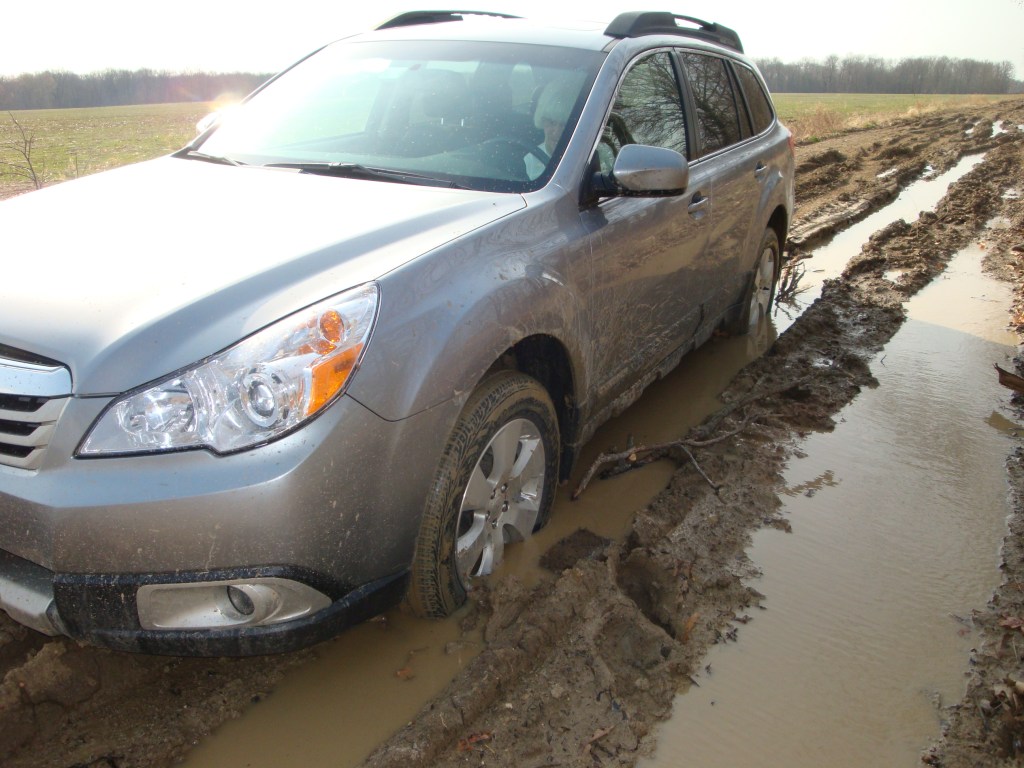
We started well, but then got directed on to more minor roads. And then on to a particularly narrow road. We stopped, thought, and made our third mistake. I saw a sign saying this road was a ‘County Road’. That sounded important. It must soon get wider. It didn’t. It got narrower, and flooded, and very, very muddy. I couldn’t see potholes but we certainly felt them.

Alison wanted me to turn the car around. The road wasn’t wide enough to allow that, but I could have reversed. Then my fourth mistake. I told Alison, ‘We’re in a Subaru which has 4-wheel drive. We’ll be fine.’ And we were, almost. We bounced, banged and splashed along until only three hundred yards from a better road surface, and then the car lurched into a super-deep pothole and all forward progress stopped. I quickly tried to reverse. The car did not budge. I tried forward again, reverse again. No movement at all. Blame was equally attributed to the GPS and to my stubbornness.

I sat thinking but my only idea was to wedge branches from the nearby hedge under the wheels. I swung open the car door, stepped down and sank in mud right over my shoes. I waded across, got some branches, and pushed them under the wheels as best I could. Then I paddled to the rear of the car, ready to push as Alison drove. She put the car in gear and gently accelerated. The wheels turned, but the car stayed exactly where it was, and I got muddier than ever.

After an hour of failed attempts, we phoned a rescue service. ‘They’ll be with you in two hours’ I was told. Two hours! I managed to call the folks we were due to visit, and both assured us not to worry and we should just come another day. ‘No, we’ll be there, just later than we said.’ I’m not sure they believed we’d ever make it.

Two hours later and we saw movement in the distance back down the road. A truck was offloading a strange looking smaller vehicle which moved slowly through the mud towards us. As it got nearer I could see one person inside a continuous tread (a caterpillar tread) vehicle. Clearly the perfect transport for Illinois county roads.

Our friendly rescuer told us he’d already pulled three others out of mud that day. I was almost encouraged that we were not alone in our folly. He hitched a chain to our car, and we were dragged the remaining three hundred yards to a decently paved and dry road. With a friendly ‘hope the rest of your journey goes well’ he was off, perhaps to save some more.

It was now afternoon. I phoned our contacts, said we were still coming, just several hours late. They sounded sceptical. There were still many miles to cover, and we’d mostly be on minor roads.

Thankfully we soon reached a town with a row of car washes. An elderly man was supervising, took one look at our mud-covered car, and said, ‘You’ll be wanting the premium wash’. It was definitely a statement, not a question. Thankfully the premium wash was only $4 – prices aren’t high in rural Illinois. So the jets sprayed and the brushes whirred, but when I drove the car out, the supervisor said, ‘That won’t do. Go through again.’ Jets sprayed, brushes whirred, but again I was told, ‘Take it through another time’. Really? Really. Jets and brushes did their work a third time. The wash supervisor was still not happy. ‘I’ll give it a manual jet wash as well.’ So, he picked up a jet hose, and directed it into every corner and under every wheel arch. I think we were his project of the day.

‘How much do I owe you now?’ I asked.

He looked puzzled. ‘It’s $4’, he said. We had just had the best investment possible for $4.

One other stop was necessary. It was at a ‘gas station’, not really for the petrol we put in the car but so I could wash my shoes in the toilet. I mean ‘wash’. They were caked in mud, and all I could do was run them under the tap, over and over again, and then use paper towels to try and get them clean. I was very unsuccessful. They still looked dreadful. But we had to get moving, so I pushed my feet into sodden shoes, apologised to the counter attendant that I’d left his toilet ‘in a bit of a mess’ and on we went.

Finally, in late afternoon, we got to Ralph’s door. Only once before had I even said ‘hello’ to Ralph, so I’d no idea how we’d be received. He opened the door, gave a wide smile, and said ‘Come on in.’

‘I’d better leave my shoes outside,’ I said.

‘No need…’ he began to say, but then looked down and saw my shoes. ‘Yes, that would be a good idea.’

So, with my not-very-dry socks on full display, we sat talking to Ralph. His wife had died just three weeks before, and he seemed grateful for our company and concern.

After an hour we were on the road again, reaching Ray’s home about 7.00 in the evening. He was a graduate of the seminary from about 1950, and seemed honoured that the president was visiting him, no matter how late the hour. We had a great conversation before finally getting on to the Interstate road north. We reached home just before midnight.

The tailpiece to this tale is that Ralph and Ray became firm friends of both the seminary and of us personally. There were many more visits, each of which was a truly enjoyable experience. And what came up in conversation several times with each of these men? That first visit. The stuck-in-the-mud occasion. And the phrase used by both Ralph and Ray was: ‘After all that happened, I couldn’t believe you still came’. That meant so much to them. We’d said we’d visit, and we’d kept our word. They never forgot that.

In my experience, being true to your word matters for at least three reasons.

First, for our own integrity. We all know stories of people who promise but don’t deliver. It might be at the level of ‘the cheque’s in the post’ or ‘you’ll have your delivery on Monday’ but the cheque hasn’t been written, and the customer may get their order on some Monday but not next Monday. I’ll never understand how people can lie like that.

Then there’s another level, such as the character in one of Jeffrey Archer’s novels who proposes marriage, says the engagement announcement will be in the Times next day, and he’s about to pick up the ring, all to persuade the girl into bed before he goes off to war. There’s no engagement, no newspaper announcement and no ring. Just a broken heart and an unintended consequence… That’s callous selfishness, words that speak of love but come from a cruel heart, promises made that will never be kept. Whatever the short-term gain for the liar, there’s long-term loss for everyone else.

I don’t know how people who do that can live with themselves. They have a serious integrity deficit.

Second, people depend on us keeping our word.  We invited friends to come for dinner at 6 p.m. They said that would be lovely. Six o’clock came but our friends didn’t. Alison began a rescue plan for the meal. Surely they must arrive soon, but no-one appeared. The food rescue plan became one of life support. Not a sign of our friends at 6.30, not at 7.00, not at 7.30. Finally they arrived at 8.00, bright and cheery. There was no apology, other than from Alison that the food wasn’t quite as good as she’d hoped. It’s possible they got mixed up about the time to arrive, but the invitation was crystal clear. If they were unsure, they could have called.

Our friends’ late appearance happened literally decades ago, but I’ve never forgotten. You wouldn’t either if you’d carefully prepared a beautiful meal and experienced the stress and disappointment of trying to keep the food edible two hours longer than planned. (I should be clear, Alison was the cook. But we shared the stress and disappointment.)

When a delivery is promised by a certain date, people believe it and depend on it. It might be a cake for a birthday party, or a gold watch for a long-serving staff member’s retirement event. That cake and that watch matter. For those kinds of occasions, these are not small things. And when a cake or a watch don’t come because someone made false promises, it causes deep disappointment. People depend on us keeping our word, and there are sad and serious consequences when we don’t.

Third, being true to our word builds lasting relationships.  That’s what happened with Ralph and Ray. If the car had been wrecked or we’d been hurt, of course they’d have understood that plans had to change. But the bad time we’d been through just made things difficult, and made us late, but we still prioritised these two elderly men. Because of that, they decided we were people worth knowing, people who could be trusted, people who cared about them, people who would do what they said they’d do. And the friendship begun that day lasted until each of them died several years later.

You can’t buy relationships like that with slogans, or slick advertising, or gifts. It takes commitment, and a big part of commitment is being true to your word.

Therefore I should end with a warning. Be careful what you promise, because you’d better deliver on what you promise. Your words represent who you are, so when your words fail people believe you’ve failed. And there’s no way back after that.

Be true to your word. That’s my wisdom for this blog. Oh, and be careful about believing what your car nav system tells you.

Equal, utterly equal

At the airport in Dhaka, Bangladesh, I’d gone through most of the official preliminaries before departure: passport and boarding pass examined, hold baggage handed over. Next came security. The line at the security desk was long. But I’m British, so I queued patiently.

And then I saw the security officer wave. It was one of those times you wonder ‘Who’s he waving at?’ Then I heard him shout, ‘Sir, sir, come to the desk’. He was talking to me.

So I squeezed past the twenty or more Bangladeshis ahead of me, wondering what I’d done or was carrying that a security officer was summoning me. He asked for my documents and then he smiled. Then and only then, I realised I was being given priority. If I’d been flying business class, I’d have been at a different desk, so that wasn’t the explanation. Was the officer hoping for a ‘gift’ from me? That had happened in several countries, but not this time. I’d been promoted up the queue simply because I was a white westerner. For a moment I thought of protesting and retreating back down the line. But I couldn’t. For one thing the officer had my documents and was well through processing them. For another, I’d likely have offended or embarrassed the officer. So, a minute later, I thanked him and moved on to the departure lounge, feeling ten per cent grateful for avoiding a long wait and ninety per cent guilty for being privileged.

In colonial times deference was demanded for white people. It became normative, and lasted for a while even after independence. Now it’s mostly gone, though not at Dhaka airport when I passed through. I wish preference based on skin colour or background was entirely gone. I no more deserve honour because of my colour than someone else deserves dishonour because of their colour. We’re equal, utterly equal.

That’s how I was brought up, though I admit my youngest years may have been innocent of colour prejudice because our town had hardly any non-white people. A small place near the east coast of Scotland wasn’t a destination for immigrants from the West Indies or anywhere. I still have class photos from my earliest school years and every face is white. About once a year a black family would attend our church while they were visiting relatives. They had two children, and I played with them just like any other children. No-one ever suggested I shouldn’t.

When I was 18 I worked in Glasgow for seven months, and I rented a room in the west end of the city. The population mix could not have been  more different from my small-town. I was surrounded by Pakistanis. Not all spoke English, and occasionally I couldn’t make out what was being said by those who could, because the accent was so different. I felt guilty about that, but, there again, I had the same problem with native-born Glaswegians. I loved being there: the brightness of the ladies’ clothes; the smells of food from shops and cafés; the cheerful greetings I was given. But, sadly, I soon learned others didn’t share my positive views. The usual resentments and prejudices about immigrants were freely shared on buses and underground.

I was reminded of my Glasgow experience about 25 years later when I was guest preacher at a church in the north of England. The area where the church had met for a century was now Muslim-majority. After the service there was a lunch in the church hall, and I sat talking with some of the older members. In fact there were almost no younger members; membership had declined a long way. So, casually, I asked, ‘What’s been the biggest problem you’ve faced over the years?’ The answer was immediate. ‘The Pakistanis. They’re the problem’. Politely, I challenged that answer. But talking about the ‘new neighbours’ as an opportunity and not a problem didn’t get me far. Everything was different from how it used to be – too different for their comfort – and that was ‘the problem’.

I’m no scholar when it comes to racism, and especially in a blog piece I could neither explain nor solve such a difficult problem. But I’ll share three things I’ve thought about often.

Racism is not new    The last few chapters of the book of Genesis in the Old Testament tell the story of Joseph being sold by his brothers to traders, made a slave in Egypt, but soon becoming Pharaoh’s right-hand man and governor of the whole land. Eventually his whole family are brought to Egypt to save them from famine. They’re welcomed and given the best land on which to settle. Sadly, it didn’t last. The opening of Exodus describes how new rulers came to power in Egypt, conspiracy theories were spread about the Israelites, and they were made slaves and given hard labour. Why pick on the Israelites? First, they weren’t Egyptians. Second, their culture wasn’t the same. Third, they had another religion. In other words, they were from another race and lived differently. So they were oppressed.

That was a very long time ago, but racism existed before then, and has continued down through every century since.

The caste system – primarily a feature of cultures related to the Indian sub-continent – is not the same as racism. (For example, different castes can exist within one racial group.) But race and caste issues both involve prejudice and discrimination. The origins of the system are ancient, but formalised later and then incorporated by the British Raj from the 1860s into their form of administration. In Pakistan I had tea in a café where the low-caste customers were forced to use cups different from those used by higher-caste people. Christians in rural areas debated whether all castes could sit together when lunch was served after the church service. Some would, some wouldn’t. In south east India, I visited aid projects set up after the devastating 2004 tsunami. Many of the lowest-caste people, the Dalits, had suffered badly because they lived close to the sea. My colleagues and I spent time with them, and one evening invited their leaders to eat with us in a hotel restaurant. We were all seated when the management asked the Dalits to leave. They’d had complaints from other guests. We protested, but our Dalit friends immediately asked us to stop and let them leave. We did, realising that we wouldn’t suffer later but they might.

In Thailand I was puzzled to see that labourers repairing roads were wearing balaclava masks (ski-type masks), even though they were working in the blazing sun. I asked a local ‘Why do they wear them? They must be unbearably hot’. I was told they wanted to stop their skin darkening, because the blacker their skin the lower their status. In north west Africa I came across the same prejudice. One darker-skinned tribe were treated as slaves by those with lighter skin.

Racism is centuries and even millennia old, and exists across almost the whole world. That’s no comfort as we seek solutions in our own cultures. We could think the cause hopeless, but it’s only hopeless if we give up. Racism may be old but it doesn’t have to live forever.

Racism is not a black/white colour prejudice   In the western world we tend to see it that way, but often it has nothing to do with skin colour. In the 1840s, Ireland experienced deadly famine. Two million Irish emigrated to America, but were met with prejudice and sometimes violence for being foreigners and, especially, for being Catholics. They looked much the same as the large numbers of Germans also arriving in the US, but their treatment was very different. Every now and again in the UK, I hear strong invective against immigrants from Eastern Europe. There’s no colour difference. Just difference.

There are several reasons why people fear immigrants. The one that makes me grimace but want to smile is that ‘immigrants will change our culture’. I’d like to ask, ‘When did the UK have just one culture?’ Don’t the ‘nations’ have very distinctive cultures? Even within England, aren’t the Geordies of the north east very culturally different from the Cornish of the south west, and both very different from the Cockneys of London? We’re not all the same, and never have been. Nor has the UK been surrounded by a 50 metre high wall for centuries so we couldn’t leave and others couldn’t enter. People have come and gone, settled and left, for ever.

Just above I described prejudice against Irish immigrants arriving in the USA 150 years ago. Now their descendants are a celebrated part of the ‘melting pot’ that makes up the nation. In fact many people told me ‘I’m Irish’ or ‘I’m Swedish’ or ‘I’m Italian’, and I’d have offended them if I’d said, ‘No you’re not, you’re American’. They’re proud, very proud, of their ethnic background, now all together in a new land. There is, of course, resistance to new waves of immigrants, the old pattern repeating, so it’s not a nation singing in perfect harmony, but, for many, diversity is their strength.

No-one is born racist    I wrote earlier that through all my childhood I never encountered racism. It just wasn’t part of my world.

Not everyone has so privileged a background except this part: no-one comes into this world prejudiced against others. There isn’t a racist neuron in the brain that gets switched on as we’re born.

So, where does racism come from? I believe it’s either taught or caught. It’s taught when a parent, or a friend, or a teacher, or a political leader, spouts racist views, and a young mind adopts their prejudices. Racism can be caught when, without words, actions and attitudes convey the message: black neighbours are shunned, violence against non-whites is accepted, support is given for policies that discriminate. What young people see around them as normal and acceptable becomes part of their thinking from early years, long before their intellects are mature enough to question what’s going on.

I’m aware of the view that a fear reflex is hard-wired in our brains, a protective reaction against the unknown or different, because what we don’t yet know to be safe may be unsafe. It could harm us, so we reject it. I’m no geneticist, but I can’t see why a fear reflex would be racist. ‘Difference’ isn’t only about nationality or colour. I’m not suspicious of people who are tall or short, thin or fat, nor do I care about social status, or accent, or educational attainment, no matter how different any of those are from me. My fear reflex doesn’t shun them. So why would I shun someone because he’s a different colour or from a different culture?

I’m also familiar with the ‘nature or nurture’ debate about childhood behaviour. Two kids from the same background may turn out very different, and likely their unique genetic mix and young experiences both contributed. But no baby was born racist. It’s not a ‘given’ at birth. Racism may come later, but it’s never inevitable.

Well, forgive me please if anything I’ve written this time is insensitive or simplistic. I wrote about racism because I hear it expressed, see terrible examples on the news, and because I think it’s one of the worst sins people can commit. As usual, if you find any wisdom, that’s great. If you don’t, move on and be at peace.

Lastly, thank you for patience while I had a major study project to complete before an immovable deadline. I didn’t finish with a lot of time to spare, but it was done. Now I need two things. One, to catch up on missed sleep. Two, for my assignment markers to be having such a good day they’re incredibly generous!

When Alistair met Eve

I phoned home and Alison listened carefully as I explained the situation. Then silence. For a little too long. Then, slowly, Alison said, ‘So last week you climbed Lochnagar, got lost in the mist, and nearly died. This week you climbed Lochnagar, found a woman, and you’re bringing her home.’

‘Yes, that sums it up,’ I replied.

Seems like I need to explain what led up to that conversation, and what followed from that conversation.

If you’ve read the last two blogs, you’ll know that I climbed Lochnagar, a 1155 metres (3789 ft) mountain not too far from our Aberdeen home. I should never have gone all the way to the mist-shrouded summit because visibility was no more than two or three metres. But I got up. What I couldn’t do was find a safe way down. I’d no compass to plot a path between cliffs one side and a large and dangerous wilderness on the other side. Amazingly, and some would say miraculously, at my third attempt a footprint between rocks pointed me in the right direction and I escaped the mountain.

Afterwards I was angry at my foolishness. I’d told no-one where I was going; I had no equipment for the climb, nor emergency provisions like a whistle or survival blanket; I should never have attempted to reach the top through the mist. Now my anger made me determined to do the climb again, this time properly prepared.

So I went shopping. I already had a good jacket, boots and map, but there was plenty more to buy: warm gloves, mid layer fleece, windproof hat, compass, book on how to use compass and map together, survival blanket, decent small rucksack to carry it all. I was ready for my next venture one week after the first.

This time Alison was well-informed where I was going. When I parked the car, I wrote a note of the route I’d take up the mountain, the time I was setting off, contact details, and placed the note in an ‘emergency box’. Then off I went along the track, over the stream, and up the first stage of Lochnagar.

Again it was a beautiful, sunny day. The views were majestic across the heather to distant hills. Deer roamed freely, paying me no attention whatsoever. This was their mountain.

Just short of the ‘shoulder’ between Lochnagar and its neighbouring mountain, I saw another climber ahead. I was walking quicker so we met at the point overlooking the small loch below Lochnagar’s cliffs. We exchanged friendly greetings. Her name was Eve, an American from about as far away as you can get in mainland USA, Washington State, in the northwest corner of the country. She’d climbed a few other Scottish mountains but never Lochnagar. I, of course, was a veteran. So I pointed up to Lochnagar’s peak which, thankfully, was perfectly clear against a background of blue sky. That’s where we were both going.

Understandably, then, we set off together up the rocky slope, an area I’d hardly seen the previous week because of thick mist. Now I realised just how steep it was. Slip, and you might not stop for a long time. Both of us were soon out of breath, so conversation was limited.

But once on the stone-covered plateau at the top, and we’d each caught our breath, the going was easier and conversation resumed. Eve was a doctor, not long fully qualified, working somewhere not far from Seattle. I explained I was a Baptist minister from Aberdeen and a Scot born and bred.

We made our way slowly towards the summit, occasionally peering carefully over the cliffs. Eve wanted me to take her photo standing on the edge, so she walked out on a protruding rock while I retreated to a place where I could picture her and the sheer drop beneath where she stood. I much preferred where I was to where she was.

We moved on and reached the peak. Both of us had brought something to eat and drink, and in the near-warmth of the sunshine, we sat on stones admiring the view and eating our lunches.

Of course we talked. I told her about my wife and children, about my work as a pastor in the city. Eve talked about her trip across the Atlantic, which she was happy to be doing alone. She’d seen other parts of Scotland, and now the climb up Lochnagar was the last event of her great adventure. She’d pitched her one-person tent on the campsite at nearby Ballater, and planned to pack up and catch a country bus to Aberdeen around 6.00 next morning. Less than a half hour after reaching the city, she’d get on a coach for the 550-mile journey to London, and a few hours after that she’d be on the plane back to the USA.

The plan was perfect in principle, but not so perfect in the real world. I explained that country buses in the Scottish Highlands didn’t always run exactly to stated timetables, and there was a risk she might not be in Aberdeen bus station before the London bus left. Eve didn’t say much. She had to catch that long-distance coach and the country bus was her only way of getting there early in the morning.

I gave her another choice. ‘You’d be welcome to come back to our home, sleep overnight, and I’ll take you to the bus station in the morning.’

I don’t recall Eve saying anything at that point. Which was not surprising, since we’d only met on the mountain and I might be telling all sorts of lies to lure her into danger. I don’t think I looked like an axe-murderer, but, there again, what does an axe-murderer look like?

We talked some more about other things, finished eating, and began our descent. This time the first part was a simple stroll because I could see where I was going, which would be neither over the cliffs, nor a drift away into ‘no man’s land’.

As we walked Eve said, ‘Your wife really wouldn’t mind having an unexpected overnight guest?’

‘No, not at all. She’d be delighted,’ I replied with super-confidence.

‘Well, if you’re sure…’

‘I’m sure.’

‘Thank you. I’m very grateful.’

So, down the rocky slope and then the gentle track we went back to my car. We drove to Ballater, found a phone box, and I called Alison. The conversation I quoted at the beginning of this blog post really happened, but it’s only fair to say there was a hint of amusement in Alison’s voice. Over the years she’d grown used to surprises, including handkerchiefs returning in the post from women I’d reduced to tears. (The tears were because they’d become upset during counselling and I’d given them my handkerchief.)

Alison was genuinely okay that I should bring Eve back with me, and said she’d adjust her plan for our evening meal with the family.

I took Eve to the campsite where she collapsed her tent, gathered her possessions, and off to Aberdeen we went. Eve was delightful company that evening, and very appreciative of a home-cooked meal.

She slept well, and I made sure next morning that she reached the bus station in plenty time for her London-bound coach. A few weeks later we received a letter from Eve, thanking us, and enclosing a photo of her standing on a rock above the cliffs. (We didn’t keep contact. I hope she’s still climbing mountains and is having the brilliant medical career she deserves in Washington State or wherever else she’s gone.)

Looking for wisdom in this tale could come by asking some questions of ourselves.

How well do we cope when circumstances change?  I am blessed with a wife who adjusts to new situations. For example, while I was a pastor in Aberdeen we never knew how many would be with us for Sunday lunch. After the church service, we’d find students looking lost or looking hopeful, and invite them back for a meal and to spend the rest of the afternoon with the family if they wanted. So, Alison would get home, raid the freezer, and prepare food for somewhere between six and sixteen people. Jesus fed five thousand. Alison can’t do that, but has remarkable abilities to stretch resources so that everyone enjoys a great meal.

It’s not everyone who has the ability to do that, and the attitude to cope with needing to do that. The ability isn’t much use without the attitude, because people soon pick up when they’re not welcome or putting you to a lot of trouble.

Those who must have control need to know what’s happening and when it’s happening. They require order. There’s strength in that, but also weakness. So, a gentle challenge: how well do we cope when circumstances change?

How open are we to helping complete strangers?  We didn’t know Eve before that day. But she came to our home, ate a meal with the family, slept overnight, and was taken to the bus station next morning. Why do that for Eve? Because she needed help. Her plan to get an early bus to the city might have worked out, but there was more than a fair chance it wouldn’t. That would have caused huge problems for the last part of her stay in the UK. So we helped. It really was as simple as that.

Being helpful and hospitable is good. Hospitality, in fact, is commanded in the New Testament (Romans 12:13). But it’s a command not always noticed or practised. Which is a shame, not just for those who miss out on our kindness but for us who miss meeting wonderful people. How open are we to helping complete strangers?

Why do some people behave rashly?  That’s not a question about why I invited Eve to stay the night with my family. It’s a question about why my whole Lochnagar adventures happened at all. Why would someone considered sensible and trustworthy set off so appallingly unprepared to climb a mountain? Not telling anyone where he was going? Choosing to keep going to a summit blanketed in mist? Why?

The answer is that I was depressed. I was hardly sleeping at night, couldn’t think straight, didn’t believe my life was useful or that I mattered, and much more. My doctor had ‘signed me off work’ two months before I headed for Lochnagar. On that day I didn’t deliberately tell no-one where I was going, nor intend to get lost in the mist, and of course I tried desperately to get off the mountain. I wasn’t trying to die. But I was being stupidly reckless. And that was because I was depressed.

Not everyone who behaves rashly is depressed. Of course not. But out-of-character behaviour often has a back-story, something deeply troubling but not told or obvious. Before we condemn their behaviour, we might stop and wonder if something unknown is giving rise to that behaviour. Instead of judgment, they may need compassion.

Three last footnotes.

First, thank you for bearing with a certain amount of indulgence in my writing about these Lochnagar experiences. Although it’s ancient history now, the feelings of that day are remarkably fresh. And, perhaps, there’s been something therapeutic in telling the story. Your patience and interest is appreciated.

Second, my congregation knew why I was away from my normal church duties. I hadn’t believed I could have depression until my doctor very firmly gave me that diagnosis, and said I wouldn’t get well unless I stepped away from work. I preached the following Sunday, and then told the congregation I had depression and needed to be off work for a while. I was met with nothing but kindness, understanding and sympathy. I thought my absence would be for two weeks, but it was five months, and the depression lasted much longer than that. One day I’ll write more about those times.

Third, I have a large project to complete and less than two weeks to do it, so I won’t try and write a blog right in the middle. Hopefully the next one will appear around the end of this month. Again, your patience is appreciated.

Escape from Lochnagar

I’m in trouble. The last blog post included an unfinished account of being lost up a mountain in mist, trapped between steep cliffs on one side and miles of wilderness on the other. One of my daughters said, ‘You can’t leave us with a cliff-hanger like that!’ (Very ‘punny’.)

With a son and three daughters I’ve long since learned to refuse their pleadings. But this time it’s fair to make me complete the story. I don’t often explain how I got down the mountain because it’s always seemed strange. So please accept that while I can explain what happened, I can’t explain why it happened.

First, a quick recap to set the scene. Without telling anyone where I was going, I set off one bright morning to climb Lochnagar, a 1155 metres (3789 ft) mountain, about 50 miles from our home in Aberdeen. I was stupidly unprepared. Apart from boots and a jacket, the only sensible thing I had with me was a map. Without a compass, the map had limited use. I should never have gone to Lochnagar’s summit because, from lower down, I’d seen that it was shrouded in mist. But I hadn’t come that far to turn back, and I made it to the top. Getting down was the problem. Visibility was only two or three metres at best, and I knew from the map there were deadly cliffs off to my left, and miles of wilderness off to my right. Lochnagar’s summit perches on top of a plateau of rock, so there was no trail to follow. Twice I set off, was quickly lost, and sensibly didn’t keep going but returned to the top. (A summit is always ‘up’ so I knew which way to go.) My third attempt at a descent was worse. Again I was lost within minutes, then walked into a boulder, and fell over it hurting my leg. I knew that if I’d broken my leg I’d have died. No-one knew I was there; no-one was coming to rescue me.

This is the point when I stopped last week’s story. So, what happened next?

I was wet, cold and hurting. All these would only get worse if I stayed still. I had to move. Very carefully I took some steps, pausing after each one. The mist was so impenetrable I knew that if I walked at any pace I’d fall over the cliff edge before I could stop. Step by step I eased forward, with no idea at all which way I was going. The plateau of rock was near flat, so I didn’t even know for sure I was going down. And, if I was, going where? Towards the cliffs, or into miles of barren land?

That thought triggered my memory of an old hymn. No-one else was going to hear, so I sang out loud the opening lines.

Guide me O thou Great Jehovah,

Pilgrim through this barren land;

I am weak, but thou art mighty;

Hold me with thy powerful hand.

Exactly as I sang those words I glanced down and saw a footprint. I couldn’t believe it. I’d been walking on rock where there were no footprints. But right here – in one tiny patch of ground between rocks – was earth with a boot-sized footprint.

The tread of that climber’s boot pointed partly left from the line I’d been on (as if towards 10 on a clock). Surely whoever left that tread mark was also going down this mountain. I turned in the direction the footprint pointed and walked. After only two minutes something moderately large loomed out of the mist. I edged closer. It was a cairn, a triangular pile of stones. Cairns are built at the summit of mountains, but also beside trails so walkers can find their way in blizzard or misty conditions. Seeing that cairn was the best possible thing that could happen. I was going the right way.

I knew there would be more cairns, but the mist was unrelentingly impenetrable and other cairns would be at least ten metres away, further than I could see. I’d have to leave one cairn to find the next. But staying where I was wasn’t an option. I took about three steps, looked back and my cairn was gone. Another step, and another, another, another. Had I gone the wrong way? Then, through the mist, I saw a shape, got closer and found another cairn. So the descent began, leaving one cairn behind in the mist in hope that the next cairn would appear through the mist. As I moved off the plateau, the cairns stopped but now I could see a faint trail. I edged my way very cautiously because I was now on a severely steep slope and a fall would propel me over rocky ground down the side of the mountain. The result would be at least broken bones and unconsciousness. I’d be unlikely to survive.

But I made it down that slope. I stepped out of the wall of mist into sunlight. Over to my left I could see the cliffs and the loch below them, and to my right the track I needed to follow down the rest of the mountain. It was all the same as when I arrived, the highest third of Lochnagar blanketed with mist, but clear skies and good visibility below. Back on the main path, I made easy progress down the hill, back to my car, drove to nearby Ballater and called home to Alison. She was amazingly calm. ‘I was wondering how to tell the police my husband hadn’t returned from a walk. They’d have asked where he’d gone, and all I could have told them was somewhere west, and they’d have pointed out that everything inland from the Aberdeen coastline is west. They wouldn’t have known where to start looking for you.’

I returned home, penitent, relieved and angry. Penitent about my utter foolishness, making Alison worry whether I was hurt or lost, and not knowing how she could help. Relieved, of course, because I hadn’t died and had come back to my family. And angry for the utter mess I’d made of climbing Lochnagar. I was so angry that within a couple of days I decided I had to climb it again – which I did exactly one week after the first expedition. And that ascent also ended in a wholly unexpected way, but that story is for the next blog post.

So, what wisdom comes out of this story?

First, know when to cut your losses. My near-death experience on Lochnagar was completely avoidable. I’d told no-one where I was going. I didn’t have the experience or the equipment to climb a high mountain. And I should never have gone to the summit.

On that last point, there was a moment of decision when I made the wrong decision. I stood on ground overlooking the loch and gazed up towards a summit I couldn’t see because everything above me was in thick mist. I thought, ‘I’ve come this far. I’m not turning back now’. That thought could have killed me.

There’s a name for a mistake like that: it’s called the ‘sunk cost fallacy’. A cost is ‘sunk’ when it’s already been spent. The ‘fallacy’ is when it’s clear that stopping the plan or project at mid-point is best, but you carry on because of the large investment already made.

Close to where I grew up large amounts of money were spent creating a new mine. The talk was of 100 years of coal being dug out of the ground. A major ‘new town’ was built close by to provide homes for the workers. But miners from other local pits warned that a colliery in that place would flood. But a huge investment had already been made, so construction went ahead. The mine did flood, and production ceased after only five years. Those in charge had moments when they could have stopped, but they didn’t. So much had already been invested.

I should have stopped, and walked back down Lochnagar as soon as I saw that the summit was shrouded in mist. Determination to keep going was not my friend. It could have killed me. Wisdom lies in knowing when to stop, when to cut your losses. Danger lies ahead for those who won’t rethink their plans.

Second, we can’t always explain or define our experiences. What exactly happened that allowed me to live? The obvious facts are easy: I tried to descend twice and got lost; I tried a third time and got lost again, but started singing a hymn about God’s guidance, suddenly saw a boot print, followed its direction, found cairns, and got on the trail that took me to safety. At one level that’s what happened.

But at another level I don’t know what happened. Many Christians would say I experienced a miracle. God heard me, and in his mercy gave me a sign that pointed me to safety. I believe in miracles, so that could be true.

But I hesitate to claim that. Why? I have two reasons.

First, my escape felt miraculous but I’ve never been sure if that’s the right word for what happened. There were certainly remarkable factors: singing that hymn, and immediately seeing a highly unlikely boot print which pointed me to a cairn which led me to other cairns and to safety. Each of these is ordinary, but what’s extraordinary is how they came together at my moment of greatest need. Was that just a coincidence? I can’t say it was, yet I still hold back from calling it a miracle. I didn’t see a vision. I didn’t hear a voice telling me which direction to take. If I had, I’d be thinking in ‘miracle’ terms. I’d have no other explanation. But there are other explanations for a boot print in earth and a cairn on the mountain. So – without in any way denying God’s mercy to me – I want to be cautious in my language about the experience.

Second, many others who climb Scotland’s mountains get into trouble but no miracle saves them. They slip and fall, or get buried in an avalanche, or get lost and die from hyperthermia. But I didn’t die, and I can’t think of any reason why I should be saved by a miracle and they weren’t. I didn’t deserve it, for if miracles are a matter of deserving, there’d be none. No-one is good enough. And I wasn’t especially spiritual or trusting that day. I was frightened – the most likely outcome was death. In short, there’s no reason why God should show me any special favour more than others, so I’m slow to use the word ‘miracle’ about my escape.

These thoughts also remain with me:

I am immensely grateful to have lived that day. We should be thankful for every good thing whether we understand it or not.

I lived, and that allowed me to do more with my life. The next day is never guaranteed to anyone, so the time we have should be lived well and used well.

Bad experiences teach us important lessons. I’ve climbed many mountains since, but never again without letting others know where I was going and carrying the right equipment. (I even bought an ice axe – that’s taking things seriously!) The old saying that the one thing we learn from history is that no-one learns from history doesn’t have to be true at the personal level. We can learn, and we probably learn more from tough times than easy times.

Next week the final story about Lochnagar and what (or who?) I brought home to Alison.