I saw the sign in my photo on a nearby golf course. One arrow pointed left to the 13th teeing ground. The other arrow pointed right to the 13th teeing ground. “Which is it?” I asked myself. Both directions couldn’t be correct. Or could they? Intrigued, I took the photo. (An explanation of the sign is in a footnote.[1])
It’s not unusual to be uncertain which choice to make, which way to go, which option to prioritise. Sometimes the decision is trivial. Do we watch this film or that film? Do I have a latte or cappuccino? Do I go shopping today or tomorrow? Sometimes the alternatives are much more serious. Who do I share my life with? Do I study law or accountancy? Should we move abroad or stay here? With life changing decisions, the stakes are super high. It’s difficult and often stressful when we could go one way or another, and it’s not obvious which way is right. So much rides on the choice we make.
No-one has a perfect method for making the uncertain certain. But here are three guiding principles.
Rationality can’t always tell us what’s right
We should be careful about making choices based on hunches or emotions. One couple were convinced a house they couldn’t really afford was perfect for them, so they bought it, but within months had to sell it because they couldn’t make the payments. That was foolish.
However, not every decision can be resolved by calculation. We can’t always weigh the merits and demerits of one option over another. Jeff decided he needed a wife, so he wrote out a wife-specification: age, looks, family background, education, career expectations, role-of-wife assumptions. He found Julia, an attractive young lady who ticked every box on his list, dated her, and they got engaged. And then they broke up. Jeff and Julia were well matched, except for one essential: they weren’t in love. Emotion had been left out of the calculation.
As Jeff and Julia’s story shows, the rightness of every important decision can’t be defined by rational analysis. Top executives have been quizzed about their strategic decision making. Often they had folders or files full of data, but when the crunch came their final choice was based on a hunch. Some wouldn’t call it a hunch. They preferred ‘instinct’, or ‘intuition’, or claimed ‘inspired guesses’. However they described it, their final decisions were not data driven.
Faced with a ‘this’ or ‘that’ decision, rationality may not give us a clear answer. But, deep down, we may know what’s right. That inner voice shouldn’t be ignored.
Alternatives are not always the problem we think they are When I’m making a long journey, I use digital mapping to plan my route. Usually I’m offered more than one way to the destination. One option may take me via a motorway, and the other a more direct route but on minor roads. I can’t go both ways. Which is right? I could spend ages making a decision. But I don’t. Because often there’s no more than five minutes difference or a couple of miles in distance between the two. The simple fact is that I could go either way. The choice doesn’t really matter.
The same can be true with matters more serious than route selection.
When I’ve interviewed candidates for jobs, the final stage has often been a choice between two people, either of whom could do the job well. The significant point then is what I’ve just stated: ‘either could do the job well’. I can only employ one, so I must choose. But that choice is between good and good; neither is bad. Whoever I pick, I’ll be getting a great employee.
The same applies when I’ve got several things to do. Which should come first? Several clammer for my attention, but all that matters at that moment is that I start on one. Which one isn’t really important since all of them have to be done.
I’ve seen people in a restaurant almost unable to decide on their main course, asking their server to give them another two minutes, and even after that needing ‘a little longer’. What’s their problem? They can’t choose between the beef or the lamb. Do they dislike one? No, the problem is that they love both. They’ll enjoy either. Unable to decide, I’ve been asked to choose for them. So I do, and they’re delighted – as they would have been if I’d chosen the other dish.
So there are two truths there:
We too easily think every choice is between good/bad or right/wrong. But alternatives can both be good. Either option will be fine.
Because we’re frightened of making a bad choice, fear paralyses us. We’re stuck between option A or option B, terrified of getting it wrong. That paralysis leads to option C which is no decision at all. And that’s usually the worst option of all.
Sometimes there’s no big difference which choice we make.
Consider how urgent any decision is
There are decisions which must be made right now. You can’t tell applicants for a job you need another month to make up your mind. Or, if you know you want to buy a house, you’d better not put off making an offer.
But other decisions are not like that. I felt the time had come to buy another car. I read up on several models, took test drives, studied finance deals, talked to salespeople. Rather than narrowing down my options, that process so enlarged my thinking I was confused. Several models seemed equally good, and I’d likely be happy with any of them. But, with a significant sum of money involved, I struggled to make a decision. Then I realised I didn’t need to buy any of them. Not at that time. The car I had already was old with high mileage, but it was running okay, still doing what it had always done. Since I had a functional car, I could wait. (Which is what I did, and two years later, with clearer thinking, I bought a car that delighted me and gave good service for many years.)
Here’s the lesson. We shouldn’t put off a decision that needs to be made now. But not every decision has to be made now. Not everything is urgent. And when we don’t know which option is right, it’s legitimate to wait. That isn’t procrastination; it’s simply saying ‘not now’. With time, the fog of uncertainty may have cleared, or you may have found an option you’d never considered before. Now you can make a wise choice, and that’s the time to act.
So, in conclusion, we may wish every decision to be clear cut. No confusion. Make the choice and move forward. But the hard reality is that some choices are not plain and obvious. We could go this way or that way. It’s not easy, but I’ve given some clues for how to move forward. Decisions may involve instincts rather than analysis. The differences between options may not matter too much. And perhaps that urgent decision isn’t actually urgent at all.
[1] The left arrow pointed to the white and yellow teeing areas of the 13th hole. The right arrow pointed to the red teeing area, also of the 13th hole.
Near the start of a book I found a curious entry among the ‘Acknowledgements’. Having named those to whom the author was grateful, he then writes: ‘On this particular volume I received no help from Josiah S. Carberry. For that too I am grateful.’
It’s a joke. Josiah S. Carberry is, in fact, a fictional character[1], the name standing for someone we might describe as a crackpot. The author I was reading, Joel Feinberg[2], is humorously saying that none of those who helped him were crazy.
However, I suspect many authors could identify people whose help would be thoroughly unhelpful. And most of us could list folk like that too.
I’ve been grateful for supportive, gifted, positive friends and colleagues, and I’ve valued their backing and input. But a few have been ‘Josiah S. Carberry’ types. Some have discouraged, some misguided, some wasted my time. They were unhelpful people.
By ‘unhelpful’ I don’t only mean ‘annoying’. We all encounter folk who annoy us:
Those who are repeatedly late. I recall someone calling such people ‘thieves’ because they stole everyone else’s time waiting for them.
Those who won’t switch off their phones during meetings (or on the golf course!). One speaker, at a very large conference, not only failed to switch off his phone, he took a call midway through his talk. That’s so bad.
Those who constantly try to impress with their successes. Their achievements usually aren’t special. Most of us have the good sense not to brag about ours.
Those who boast constantly about their children’s successes. That might be their youngsters’ progress at reading, or their older ones’ exam achievements, or their grown up kids’ careers.
Those who take 500 words to say what deserved only 50. Long-windedness is not a quality.
Taking a hint from that last sentence, I won’t list more ‘annoyances’. My point is that annoying people do no more than annoy; usually they don’t stop us doing what we need to do. But unhelpful people are a real hindrance.
I’ll describe some unhelpful people who’ve crossed my path, partly from my time as a pastor but also from when I was leading major organisations.
Those who are excessive time-consumers Ann made an appointment to speak with me. “What’s on your mind?” I asked. “Well,” she said, “sometimes I’m just not very happy”. My inner reaction was that I wasn’t always happy either. But there might be something much deeper troubling Ann, so we talked. And another time we talked. And another time we talked. At no point did Ann describe anything as seriously wrong, other than that she wasn’t always happy. We talked about expectations, and I left things there.
Ann may have wanted to talk more. Perhaps she was lonely, and enjoyed conversation. But I couldn’t be her talk-buddy long-term. To give Ann more time would have been at the expense of other people and other tasks which were in greater need of that time. That would not be right.
Some people demand attention which takes more than our time. Gordon MacDonald describes Very Draining People – he calls them VDPs – who sap the passion of leaders. Their demands keep increasing, they take but don’t give, and leaders who indulge them pay a massive bill in inner exhaustion.[3]
People who consume an inordinate amount of our time are unhelpful.
Those in love with their own opinion Martin accosted me. He wanted me to know that people were saying that in our church services we should return to singing traditional hymns, and have far fewer modern worship songs. I had learned to be suspicious when someone used the phrase ‘people are saying’, so I asked Martin “How many are saying that?” He answered: “Everyone I’ve spoken to”. Exactly, those he’d hand-picked to be on the receiving end of his opinion. In fact, I’d heard already that Martin was cornering certain church members, pushing his passion for traditional hymns on them, and when they nodded, he considered they agreed with him and added them to his list of ‘people are saying’. But some of them had told me what was happening, and that they didn’t agree with Martin. However, he was a forceful personality, a man who believed strongly in the rightness of his own ideas, so partly out of politeness and partly out of fear they had just nodded in order to get him to stop.
I saw the same happen with departmental heads who pushed for more funding or more prominence for their area of work, sometimes going direct to trustees to win their support. I saw it too with people who thought they knew exactly what was needed for our organisation to grow, then sowed their opinions among other staff members, but they had neither complete understanding of the facts nor the ability to bring growth about.
People in love with their own opinions are often unhelpful.
Those who are perpetually negative Faced with problems I’ve been reassured when someone says, “Don’t worry; every cloud has a silver lining”. I like that positivity, looking for how something bad might also turn into something good.
But Charlie never reassured me. He was near 100 per cent consistent in seeing only insurmountable problems. His gift for gloom and doom depressed everyone around him. One colleague summed up Charlie this way: “Charlie is convinced every silver lining has a cloud – and it’s a black cloud”.
The negative Charlies of this world don’t see themselves as difficult. They believe they’re helping by pointing out the hard challenges to which we have no answer. But that’s not helpful. It tempts people to give up without trying. The truth is that virtually every project has tough challenges, but often those challenges are resolved by moving forward carefully and constructively. When running a marathon, you feel pain – cramps, blisters, weariness – and finishing the race seems impossible, but careful self-management before or after that point can still get you over the finishing line. Problems are usually not reasons to give up.
Negative Charlies are unhelpful people.
Those who oppose The Old Testament book of Nehemiah records the rebuilding of the wall of Jerusalem. Decades before, the Israelites had been transported from their own land and made slaves. While they were gone, Jerusalem fell into disrepair and was occupied by other peoples. But then Nehemiah, cup bearer to his overlord, King Artaxerxes, got permission to return with others to rebuild Jerusalem’s walls. He succeeded, and Nehemiah 12 describes a lavish dedication ceremony for the new walls.
However, what happened between permission to rebuild and celebrating the completed walls is far from a story of straightforward success. In places it reads like a thriller novel.
Right from the start the project was opposed by other tribes and peoples. As soon as Nehemiah returned to Jerusalem and surveyed the damage, Horonite and Ammonite officials spread stories that Nehemiah was rebelling against the king (chapter 2). Once work on the walls began, Samaritans – backed by a large army – ridiculed what he was doing. But Nehemiah and his fellow Jews kept building. So his opponents, who’d enlisted even more support, plotted to kill the wall builders. Nehemiah posted guards and later assigned half the men to work on the walls while the other half held weapons ready to defend them. Eventually the order became: ‘Work with one hand and hold your sword ready in the other’ (chapter 4).
Nehemiah’s enemies got more subtle. They invited him to a meeting. That sounded reasonable, even friendly, but what they intended was neither reasonable nor friendly. They wanted Nehemiah alone to murder him. He sent a reply that he was doing a great work, and had no time to meet with them. Frustrated, his foes spread more stories: ‘Nehemiah is leading a revolt, and he’s planning to install a king in Jerusalem’. It was a rumour of insurrection, which could get Nehemiah killed. But the work went on. His enemies decided enough was enough. They appointed assassins who would creep into the Jewish camp in the dead of night and dispose of Nehemiah for good. Nehemiah learned of the plot, but despite the intimidation and danger he would not be stopped, and the new wall was completed in a little over seven weeks (chapter 6).
Nehemiah’s opponents were clearly the worst of unhelpful people. Few of us work with constant life-ending threats from people who want us to fail.
But we do face challenges in ways like these:
Head on We can experience direct opposition from senior colleagues. They may be honest – they disagree on some matter. But it’s awkward, unsettling and, even when we have the authority to press ahead anyway, their opposition leaves us distressed.
Non-cooperation Management gurus describe the covert way staff can halt new initiatives – they simply don’t implement them. They like the culture they have, the ways of working with which they’re familiar, the colleagues they work beside, so they don’t make the changes they should.
Campaigns Opponents seek support from others for their point of view. They enlist sympathisers, who in turn enrol more. It all builds until there are sufficient numbers to obstruct a policy change.
Leaders must listen when people hold alternative views. But often it’s right to press forward despite opposition. That’s part of the job.
Those you can never please There’s a common saying: ‘You can’t please all the people all of the time’. I don’t agree. Here’s my saying: ‘You can’t please all the people any of the time’.
The culture in my Christian tradition is to find unanimity. “We can’t move forward until we all agree,” someone says. Now, if we’re talking about a group of less than six people, we might get total agreement, especially if the matter is a small one. But complete unity of heart and mind is rare with greater numbers and bigger issues.
In fact, a call for unanimity can be a stalling tactic. When change can’t happen until everyone agrees on every detail, at the least it’ll be a long way off or, very possibly, it will never happen. That’s an intolerable situation. It’s a case of the perfect being the enemy of the best.
Those who demand agreement from all are mostly unhelpful people.
Finally, three more – briefly!
Those who are all talk and no action I’ve had colleagues and friends who argued powerfully for policies or positions, but did very little after getting those positions. Terry was keen to head up maintenance work, and great at listing repair and development tasks. But he didn’t do any of them, nor delegate the jobs to others. People complained about facilities not working. I encouraged Terry, and was assured matters were getting his attention. But they weren’t, and more and more people grumbled to me about uneven paths, broken equipment, peeling plaster, and much more. I went again to Terry, and was very straightforward that he wasn’t doing the job. “I guess I should resign then?” he asked. I didn’t talk him out of it. Soon after, we appointed Gary who boasted no special skills, but made sure every task brought to his attention was completed promptly. No more complaints.
Unhelpful people talk a good game, but have little to show for it.
Those who don’t keep their promises Some failed promises are relatively minor: the student who didn’t read a set book before class; the fellow actor who didn’t learn their lines; the Board member who, before the meeting, didn’t even glance at the papers staff had slaved to prepare. Such things matter, but they’re not at the level of other forms of promise-breaking:
After a lengthy and expensive hiring process, Josh is offered the job and immediately accepts. One week later – after other candidates have all been told they are not being appointed – Josh sends a one sentence email saying he’s changed his mind and won’t be taking up the post.
After two years of marriage, Katy tells Bert she no longer loves him and she’s leaving. He pleads; others counsel; but Katy just keeps saying she doesn’t want this marriage any more.
Cedric has elevated himself above all his colleagues, and is rewarded with responsibility for the firm’s biggest client. There’s talk of massive amounts of new business. Cedric assures his CEO he’s working day and night on a business plan that will delight the client. The deadline agreed with the client is 20 days away. No plan yet from Cedric, but he guarantees his boss it’ll be ready in time. When it’s down to the last ten days and then five days Cedric promises he’s making the final edits. Deadline day arrives, but Cedric’s plan doesn’t. He’s been doing everything but the plan. The client is furious and withdraws all business from the firm.
I can understand that some people aren’t successful at a task they promised to do. But they tried. What I can’t understand is how people make promises – often solemn promises – and simply walk away from them. ‘Unhelpful’ is far too weak a word for them.
Those who criticise behind your back It’s those last three words ‘behind your back’ that trouble me most. I have never minded when people raise concerns with me. We can talk, understand each other better, and often resolve issues. But if people have criticisms, and take their complaints straight to others, then two things are wrong: a) I’ve had no chance to resolve anything; b) those to whom they speak are being given only one side of a story. I wish the complainers would be asked by those they talk to: ‘Have you spoken with Alistair about this?’ and, when the answer is ‘no’, they then refused to hear any more until the grievances had been brought to me.
I do understand that people find it difficult to speak to someone in line management over them. Yet, it’s far from fair to go straight to others, without giving the subject of their complaints the chance to resolve a problem. Secret complainers are unhelpful.
Finally, then, how do you deal with unhelpful people? I can’t give specific answers because each case is unique. However, I learned that the only way to deal with unhelpful people is by actually dealing with them.
What I mean is this. When we don’t face up to the unhelpful:
we let the negative person go on being negative
we try to sidestep the opponent
we tolerate the person who promises much but never delivers
we just wait for the critic to get fed up and shut up
But the problem with all these inaction strategies is that, almost always, the unhelpful person keeps on being unhelpful.
So, my policy has been to speak kindly but directly to those causing difficulty. That doesn’t guarantee success. Those who oppose your ideas won’t instantly change their minds. But they might tone down their efforts. And, with others, I’ve seen a realisation that they’re being difficult, and they appreciate the insight they’ve been given.
Take courage. Be gentle but speak honestly. Almost always the end result will be better than leaving unhelpful behaviour unchallenged.
I’ve known many restless people. They’re sad, disappointed. Often they believe they’ve been dealt a bad hand. The great work they do is never recognised. The best opportunities never come their way. They’re dissatisfied, rarely thankful, and constantly striving but never arriving.
However, I also know people who are deeply content, happy with their lot, fulfilled, pleased with what they’ve done, what they have, and relaxed about what the future holds. They have inner peace.
What characterises that second group, those who are at peace, who feel content and fulfilled? The answers aren’t the same for everyone, but there are distinct features in the lives of content people.
Contentment is a decision they make
Much of the time we attach satisfaction, sufficiency, fulfilment to achievement. We think, ‘I’ll be content if I get this promotion, or buy that house, or have everything I want’. Bill took pride in his photography. Rightly so, for he was good, occasionally paid to do a photo shoot. “Of course,” he told me, “to do exceptional work I’d need the very best lenses”. But Bill couldn’t afford them. Each lens would cost thousands of dollars, money he did not have. So Bill was restless. I’m fairly clued up on photography, and I knew the lenses he used already were excellent. But they were not the very best. And Bill could not be content with that. His problem? His inner feelings depended on achieving external things, such as the ‘best lenses’. Even if he’d had the money to buy them, he’d soon be discontent again. Why? Because in a year or two there would certainly be ‘better still’ lenses. Similarly, those who think they’ll be satisfied if only they get a promotion or live in a dream house, they’d soon long for an even higher promotion, or an even more dreamy house. Such folk are endlessly restless because they imagine the route to contentment involves getting all they want.
Those with inner peace don’t connect their satisfaction to achievement. They choose to be content with what they have. That doesn’t mean they never strive for something better, but even if everything stays just as it is, they’re okay. Contentment for them is a choice, not something that exists only if everything falls into place. While he was a prisoner in jail, the Apostle Paul wrote: ‘I have learned to be content whatever the circumstances’ (Philippians 4:11). Those are wise words.
Being at peace with our Maker
Just once, I rashly attempted to do pottery. Even more rashly, I had a go at wheel throwing a bowl. That involved shaping the clay into a bowl while the clay was spinning on a wheel. I was spectacularly unsuccessful. I didn’t use the right amount of water and didn’t place my hands correctly to shape the clay. But my fundamental problem was that I didn’t get my clay centred. The wheel turned but the clay was off-centre, so it wobbled around and then collapsed. If the wheel had been spinning any faster, my clay might have ended up on the far side of the room. Trust me, you could get everything else right but failure to centre the clay will doom your pottery to disaster.
My perspective, as a Christian, is that our lives need to find their centre in God. Perhaps the most famous statement of that truth was written more than 1620 years ago by Augustine of Hippo[1]: ‘you have made us and drawn us to yourself, and our heart is restless until it rests in you’ (St Augustine, Confessions[2]). Augustine’s restlessness about how he was living was resolved only when he made peace with God.
I’ve talked with many restless people. Some could not let go of past sins. Some could not forgive those who had wronged them. Some could not shake off their parents’ disappointment in them. Some couldn’t come to terms with their own failed ambitions. Some felt they’d missed life-changing opportunities. Some couldn’t cure unhealthy or unacceptable habits.
With those restless people, I never suggested that a quick prayer could sort out their struggles. But I did talk with them about who made them and what their lives were for. Some found a new centre for their lives in knowing God, finding forgiveness for themselves and others, and a new sense of purpose for the future. Others coped with their off-centred lives, but were not at peace.
Contentment isn’t about getting more but being satisfied with what we have
In October 2022, I wrote this in a blog post: Many years ago, when the Glasgow area called the Gorbals had the worst of tenement slums, I visited a young Christian worker who lived in the most troubled area of the Gorbals. Not only were these tenements in dangerously poor condition, gangs and drugs dominated the streets. That young man’s small flat was over-run with local kids, who ate his food, watched his TV, lounged on his sofa, and sometimes stole his property. No matter how tough his life was, that Christian didn’t leave. He kept right on befriending youth, helping them and forgiving them. (https://occasionallywise.com/2022/10/05/a-good-tree-bears-good-fruit/)
I talked for some time with that Christian worker in his tenement flat. He had very little, partly because his more valuable things had been stolen. “God knows where they are,” he told me with a wry smile, “so they’re not really lost, are they?”. He was at peace. He didn’t long for what he didn’t have; he didn’t wish to live anywhere safer or more pleasant; he didn’t long for any other kind of work. He was in the right place doing the right thing, and therefore at peace.
I admit there have been times when I’ve thought ‘If only I had this or that, then life would be good’. But now, thankfully, I’m usually content with what I have. Recently my laptop died. It wouldn’t boot up. I got expert advice, but the final verdict was ‘Buy a new laptop’. Thankfully all my essential files were backed up to the ‘cloud’, so letting go of the old laptop was no more than saying goodbye to a faithful friend. Here’s my point: I had used that laptop for ten years (which is probably why it suddenly expired!). Why not change it after three years, or five? My answer: because it kept on doing everything I needed. There was nothing of significance that a shiny, new laptop would have given me. Until it passed away, that old laptop was quite sufficient.
Recognising the sufficiency of almost everything we have, and not longing for more, brings contentment.
Change what you can, accept what you can’t
One of the world’s most famous prayers is commonly called the ‘Serenity Prayer’:
God, grant me the serenity to accept the things I cannot change, the courage to change the things I can, and the wisdom to know the difference.[3]
All three parts of the prayer are difficult to do:
Accepting calmly what we can’t change
Acting boldly to bring about changes which are possible
Knowing whether acceptance or action is the right choice
Faced with an impossible situation, most of us survive through gritted teeth, hating the experience. Or, knowing something must change, we struggle to find the drive or determination to take on the challenge. Or, through indecision, we do nothing and feel miserable about our inactivity.
Inner peace belongs to those who overcome these challenges, whether that means living with an unpleasant truth or risking all to make things better for ourselves or others.
Recently I talked with a man who was diagnosed with cancer three years ago. It began in his vital organs but then spread to his brain. He went through major medical interventions. That was a hard experience, but those treatments have made a huge difference and his cancer has stopped spreading. But he knows it could restart. He is scanned every three months in case there are new growths. What impressed me is his attitude: “You learn to live with things as they are, while always still fighting the enemy you fear.” He has his dark days, but mostly he’s at peace. Brave man.
That’s a tranquillity not everyone finds. I feel for them. But the truth remains, that inner peace comes from changing what you can and accepting what you can’t.
I have four more principles for inner peace. I will describe them briefly.
Be right with the important people in your life For many years my professional life took me all over the world. Sometimes I was in isolated locations, such as rural Bangladesh, the Congo jungle, or North Korea, places where I was out of touch with the rest of the world. But, in less-remote places, I’d buy postcards, sit up late at night writing them, and next day find somewhere to buy stamps and post them to each of my four children. Postcards don’t have space for significant news sharing, but at least my children knew I was thinking about them. I still do. And we continue to have a great relationship, for which I’m deeply grateful. They are a source of great peace and joy for me. Be right with those you love.
Accept your limits One of my boyhood heroes was David Rollo, a Fife farmer. He had attended my school and later I watched him play international rugby for Scotland. The legendary radio and TV rugby commentator Bill McLaren remembered Rollo’s international debut in a match against England:
“That 1959 match, at which I shared the radio commentary was quite distinctive for the courage shown by the Fife farmer, David Rollo who was gaining his first cap out of the Howe of Fife club. Soon after the start David suffered a broken nose, but after a brief absence for repairs, he returned to play prop with undiminished fire. After that debut it hardly was surprising that David went on to gain 40 caps.“[4]
I wanted to play rugby for Scotland like Dave Rollo did. In the school team I played front row prop in the scrum, just like Rollo did. I tried to tackle like he did, pass the ball like he did, do everything on the rugby field like he did. Except I couldn’t. I didn’t have Rollo’s skill or fitness, and before I’d reached the ripe old age of 14 I realised I’d never be like Dave Rollo and never play rugby for Scotland. And I accepted that. I might do other significant things, but they wouldn’t be related to rugby.
Being at peace means recognising and accepting your limits.
Invest your life in things that matter
In an earlier blog post I described an experience during a two week stay in hospital.[5] The man in the next bed to mine had his own TV, and watched television soap operas all day. I couldn’t see his TV but I heard every word of those annoying dramas since my neighbour didn’t have earphones. When his wife visited each evening, their whole time was spent watching an evening soap episode together. This was clearly normal life for them. ‘Do they have nothing better to do with their lives?’ I wondered.
On the whole, inner peace is related to doing things that matter. Our lives have significance, so should be used in some way, perhaps only a small way, to make the world around us a better place. We won’t all be doctors, or aid workers, or civil rights activists, or campaigners for the poor. We don’t need to be. Margaret was well-educated and could have had a great career, but she poured her life into bringing up her four boys. It was the role she believed was uniquely hers. “People criticised me for that choice,” she said, “but I knew what I did for my boys would be important.” She was right. Two of her sons had world-wide influence through their leadership, speaking, and writing. The other two were never prominent people, but quietly did a great deal of good in their communities, helping and healing lives, as well as bringing up their own families to be good people.
Having peace flows from knowing your life has significance.
Be kind
I’m not sure if having inner peace causes people to act kindly, or if acting kindly creates inner peace. Probably both are true, and there’s a virtuous circle: being at peace leads to kindness which, in turn, generates an even greater sense of inner peace.
For about 15 months I worked in a local government office, and often dealt directly with the public. Many people were polite and reasonable. But not everyone. Right from their opening sentence, some were angry and hostile. The nasty customers often had weak arguments, and tried to compensate for that with shouts or threats. It seemed to me that’s how they were wired, their approach to everything, and I often thought, ‘I wonder what it’s like to be married to him or her?’ Not a happy experience, I concluded. These people were not at all at peace in their inner selves.
But I’ve also known folk who were wired with kindness, thoughtfulness, and graciousness. They wanted to help, to please, to make my life better. There was no drama, no seeking advantage, just a quiet desire to bless others. Out of a good heart, love flowed.
Jesus said: “every good tree bears good fruit, but a bad tree bears bad fruit” (Matthew 7:17). In other words, what’s true about our inner lives is shown in our outer lives. Let kindness, peace and joy reign.
To finish, one final thought. Inner peace can’t be had instantaneously. It’s not as if people who have been troubled and angry for decades go to bed, and wake up next morning magically transformed into people who feel calm and peaceful about life.
Rather, I see it this way. There’s a road we travel through life. Along that road lies positive events and experiences which help us feel good. But along that road are also problems, conflicts, disappointments, and frustrations. More than anything else, what determines a troubled or peaceful inner self is how we respond to the challenges, the hard things strewn in our path. I urge you, whether your way is easy or hard, make the choices which bring you inner peace. You will never regret it.
[1] Hippo is now the modern city of Annaba, on the coast of Algeria, North Africa.
[2] The full reference to Augustine’s words: Lib 1,1-2,2.5,5: CSEL 33, 1-5.The Confessions were written around 400 AD.
[3] The prayer first appeared in print in the 1930s. Scholars debate its authorship. It has appeared in various forms, though always with the same main ideas.
We don’t make many really big decisions during our lives. But we do make some. Whether we’ll share our life with someone, and who that will be. Which career we’ll follow. What we believe. Our lifestyle choices. Whether we’ll have children. How we care for our health.
Matters like these are not the routine decisions of life. They’re not about choosing coffee or tea, or whether to call a friend for a chat, or if we’ll take the afternoon off to play golf, or should we take home a Pepperoni pizza or a Hawaiian pizza. We’ll probably make ordinary decisions 20 or 30 times every day, but in the whole of our lifetimes we’ll likely make less than ten major, life-changing decisions. Mostly our routine choices don’t matter significantly, but our big decisions affect everything about our lives, and maybe the lives of others too.
Here are eight principles I’ve kept in mind when making such decisions.
Principle 1 You have more time than you think
Alison and I have been house buyers several times. Early on in most of our searches we’ve found a dream house, only to be told other buyers are interested, and we need to make an immediate offer. We’ve wished we could. There can never be another house as good as this one. But circumstances prevented us acting quickly. The perfect house was sold to someone else. However, happily, later on we’ve found another house, far more perfect for us, and we were able to buy that. Those later choices were great homes for us and our family.
That’s just one kind of circumstance when people feel they must decide quickly but the early choice wouldn’t have been the right choice. There are moments for fast action, but they’re unusual. Mostly the biggest of decisions rarely need to be rushed.
Add to that an obvious truth: the bigger the decision, the greater the catastrophe if we get it wrong. The more important something is, the more time and consideration it deserves. Don’t ne hasty.
Principle 2 Don’t confuse small decisions with big decisions
Your new friends, Mary and Joe, are coming for dinner. ‘Should I serve steak?’ you ask yourself. ‘Or how about a casserole?’ Next day: ‘Perhaps they’d like fish?’ Next day: ‘What about lamb chops?’ Eventually there are ten different options, but finally one is chosen. But is it really the right one? As the day gets nearer the stress level rises, tempers get frayed, and you wish you’d never invited Joe and Mary for dinner.
What’s gone wrong here? Put simply, all the options were good. There was no ‘right one’. Mary and Joe are thrilled you’ve invited them for dinner, and as long as you don’t poison them they’ll go away believing they’ve had a lovely evening. That’s all that really mattered.
Too easily we promote ordinary decisions into matters of high importance. Alison and I now resolve a lot of things by simply asking one question: ‘Is this decision life-changing?’ Ninety nine per cent of the time what we’re considering isn’t a big deal at all. So, we make the best decision we can and get on with the things that matter much more. That works well for us.
So, second principle: Be realistic about what’s really important.
Principle 3 Think whether your decision is based on facts or feelings
If we’re making decisions about people, then of course feelings will greatly affect our choice. That’s entirely appropriate.
But emotions can intrude where they don’t belong, or at least shouldn’t dominate our decision-making. Here are two imaginary examples.
If we had rushed to buy a house, we’d have done it on superficial impressions and emotional reactions, such as ‘How wonderful it looks’ or ‘What a pretty area it’s in’ or ‘I’ve fallen in love with this property’. But, after moving in, we might have found roof problems, drainage problems, boiler problems, flooding problems. In fact, there could have been so many problems we’d have realised the real value of the house was about half of what we’d paid. Falling in love with a property can mean we skip the research a responsible house-buyer should always do.
A job is advertised I’d long to have. The post would give me a fifty per cent salary boost, a shorter commute, and an array of fringe benefits. I’m great at interviews, and I exaggerate my skills and experience. Wonderful – I get the job. What I never studied is what the work would entail: much longer hours; boring tasks; complex issues I don’t know how to resolve. Within weeks it’s obvious to me and to my bosses I’m out of my depth. I hate the job, and with encouragement from management I resign. Longing and ambition propelled me into that job, but I never assessed what doing that work would be like. A costly, painful mistake.
The bigger the decision, the greater the need to think through all relevant issues. Emotions or longings can be like a tide that sweeps us along, not necessarily in the right direction.
Principle 4 Push doors gently
I’ve known many people so driven by desire or ambition, they don’t probe opportunities carefully. They rush forward headlong. Instead of pushing doors gently, they kick them down and march through. Almost always that’s unwise.
There are two opposite temptations when faced with a big decision. One is to be so nervous we never act. The other is to be so determined, we plough forward ignoring any dangers. Determination is a quality, except when it controls all our thinking.
I read the story of Sally who got into serious financial trouble with an unwise investment. She’d been told that if she’d buy shares immediately in a new start-up, within weeks she’d be a wealthy woman. She cashed in all her savings and then borrowed even more, and bought the shares. For a few days they soared in value, so Sally took out another loan and invested that as well. Two weeks later the start-up failed. It declared bankruptcy. Sally’s shares were worthless, her money completely gone. All Sally was left with was a debt it would take many years to clear. A friend asked Sally why she had not sought advice from a qualified financial advisor. Sally’s answer: “I was so sure I was investing in a winner, I didn’t want anyone to talk me out of it”. That was a very expensive mistake.
At times the temptation to fulfil an ambition is so high we won’t let anything stand in our way. Frankly, that’s about as sensible as imagining that running fast through a minefield lessens the chances of being blown up.
Move forward, but don’t rush.
Principle 5 Where you excel may be a guide to what you should do
What I’m about to write under this heading is an imperfect guide to rightness, but should nevertheless have a place in our thinking.
In short, I’d encourage you to consider what you can do that most others can’t, because, at least in part, that’ll guide you towards a right decision.
Here’s a little of my story. My career beginnings were in journalism. After training – including shorthand and typing(!) – I was a reporter for The Scotsman and a sub-editor for its Edinburgh daytime paper the Evening News. I was a good journalist, reporting on important stories and trusted to cover late-breaking news just before the presses rolled. I enjoyed the work, and imagined a wonderful career in journalism.
Then Christian faith came alive in me in a way it had never been real before. I handed my life and my career over to God. It seemed to me that being a Christian in the world of journalism was important. But before too long I realised it wasn’t right for me.
Two factors helped me see that. The first, and certainly the most important, was a growing sense of calling into Christian ministry. How I sensed that is complicated and personal. Put simply, I felt that calling was God’s will for my life. And the one thing you can’t say to God is ‘No, I won’t do that!’
The other factor is more mundane but not unimportant. I was a good journalist, but alongside me were some great journalists. Not all my colleagues were great, of course, but a few were truly brilliant writers. By then, I’d begun to do some preaching and found a gift I’d never imagined I had. I worked hard at preparing sermons, and then words flowed in front of a congregation. People were challenged and helped. Churches asked me to return and preach again. I’d found that I didn’t have a unique contribution to make to journalism, but did have one to make to Christian ministry. And that’s what I dedicated my life to doing.
I’m cautious about saying ‘Do what you’re best at’ because it’s possible to be very good at doing something very wrong. History has plenty examples of bad people doing bad things brilliantly.
So, finding what you’re near-uniquely gifted at doing isn’t an infallible guide, but it can be a pointer in the right direction.
Principle 6 Take account of how others are affected by your decisions
For many years the city of Aberdeen, in the north east of Scotland, has been the European capital of the oil industry. The city is not large but its airport is one of the busiest in the whole UK, its numbers boosted by dozens of helicopter flights to and from North Sea oil rigs. Among the employed members of the Aberdeen church where I was senior pastor, about two-thirds owed their jobs to oil.
One consequence was that many who joined the church moved on after about three years. They didn’t leave for another church; they were sent elsewhere by their oil-related employer. Management would be moved to another administrative office and engineers to a new location of oil exploration. All of them made it clear to me that they couldn’t refuse. Following their careers meant being at the disposal of their companies. They could be sent anywhere, even to the other side of the world. (Years later I was in Indonesia and visited former church members by then living in Jakarta.)
But here’s my point. These changes didn’t affect only the employee. They had a profound effect also on spouses and children. Each transition meant ending relationships not long formed. They’d form new bonds somewhere else, yet always knowing they’d soon have to let those go too. I felt especially for the children who constantly changed schools and lost friends.
Alison and I made only one major move while our children were young. It was challenging for them. There were times of tears. Thankfully we stayed in the new place for many years, which did allow them to form long-term friendships.
Faced with major decisions, it’s thoughtful and loving to ask: ‘Who will pay the biggest price for this choice?’ Often the cost will not be borne by the one making that choice.
Principle 7 Let trusted friends advise you
In November 2021 I wrote this in a blog post on ‘Friendships’:
I took a deep breath, then asked a question no friend expects. Tom’s answer could affect the rest of my life. ‘I’m planning to ask Alison to marry me. You know both of us well. Am I doing the right thing?’
Tom looked startled. He’d never imagined being asked such a question. But he didn’t hesitate. ‘Of course you’re doing the right thing. You should have asked her ages ago.’
I laughed, feeling grateful and relieved in equal measure. I wasn’t inviting Tom to make my marriage decision for me, but as a deep and close friend his support meant a lot.
Thankfully Alison said ‘yes’ and, as well as being my wife, she’s been the closest friend of my whole life. But Tom probably came next. Sadly, Tom died several years ago but he knew me through and through, and I’d have trusted him with my life. (https://occasionallywise.com/2021/11/06/a-question-no-friend-expects/)
A real friend, someone you’d trust through and through, is a wonderful resource when faced with a major decision. A truth I’ve learned is this: ‘Someone who loves you only a little will tell you what you want to hear; someone who loves you a lot will risk telling you what you don’t want to hear’.
Principle 8 Stay true to your ultimate values and goals
This principle should underpin all the others. What matters, what really matters, the most for us? When we know the answer to that – our values and goals – we have a guide for all our big decisions.
Is this how I should be spending a large sum of money?
Is this relationship one that I’ll always value?
Is this choice taking me toward or away from my life goals?
Does this behaviour fit with my deepest values?
An old idea is that all of us have a certain amount of treasure, and we should spend it wisely. Once it’s gone, it’s gone. What we’ve spent will never be replaced. It would be sad to get near to life’s end and to realise we’d frittered away our treasure on things that haven’t had value.
Every time we make a big decision we spend treasure. Each decision, therefore, should fit with our very most important values and goals.
Closing
My last word here is that we should realise it’s a privilege to have choices at all. Many people in the world have few choices other than to work in the fields or sell in the market in hope of earning enough money to buy food for just that day. If we have options far greater than those, that’s an enormous privilege. May our biggest decisions be made thoughtfully, wisely, and bring great benefit to us and to others.
Was the death toll from the Great Fire four or four thousand? Did the blaze end the Great Plague? Who or what emerged hairless but alive from the heart of the inferno? How long was it before the bakers of London apologised that one of their own had started the fire? Did someone commit suicide by falsely confessing he set London alight?
Answers to these questions and much more will follow.
There were both serious and less serious consequences from the Great Fire of London. This is the fourth and final part of the story of the 1666 Great Fire, and I’ll explore a variety of outcomes here. Episode 1 of this series describes the beginnings of the Great Fire in a bakehouse in Pudding Lane, and explains why it spread quickly.[1] Episode 2 shows how the fire intensified, with residents fleeing the city and leadership failing.[2] Episode 3 records the fire’s relentless spread; St Paul’s Cathedral is lost but the Tower of London is saved.[3] The footnote links in this paragraph will take you quickly to those earlier episodes.
The Great Fire began in the early hours of Sunday, September 2nd, 1666. Most consider that the destruction was over by the end of Wednesday 5th, four full days later.[4] But, of course, the consequences of the fire lasted far longer than the blaze.
In this final episode, I’ve summarised some of the major effects of the Great Fire under several headings. A few oddities I’ve uncovered along the way are mentioned under ‘Eleven curious details’ near the end.
I’m aware this section is lengthy. I hope you’re willing to read it all, but if time or energy fails you, I’ll admit the parts that most interested me have the headings: ‘Death toll’, ‘The plague’, ‘The lust for vengeance’ and ‘Eleven curious details’. You may especially appreciate those sections too. I’d like to believe you would also find my final summing up under ‘Lessons from the Great Fire’ important.
Extent of damage
All reports of the physical damage done by the Great Fire are not identical. However, the figures below are commonly cited.
Property and land destroyed:
Houses: 13,200-13,500, leaving 130,000 people homeless
Churches: 87
Significant buildings: St Paul’s Cathedral, Baynard’s Castle, The Royal Exchange, the Custom House, Bridewell Palace, The Guildhall, 52 livery company halls and three city gates.
Acreage: approximately 436 acres, equal to more than four fifths of London. Some quote the figure as 86% of the city.
Total financial loss of the damage was approximately £10 million (equivalent to £1.79 billion in 2021). To put the £10 million in perspective, the annual income of the city was only £12,000.
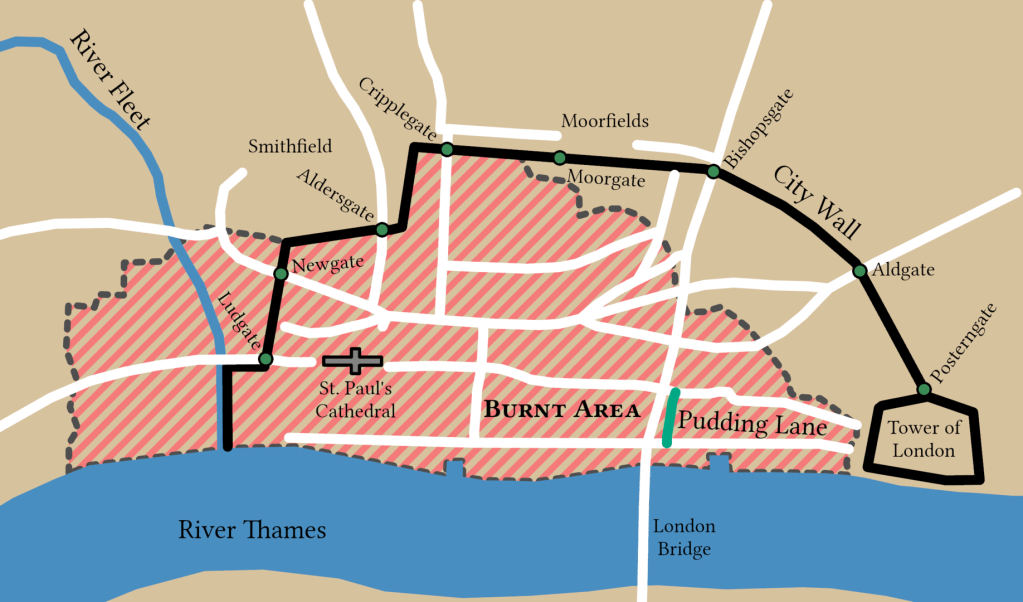
The map shows the final spread of the Great Fire across London. The area surrounded by a bold black line is the city surrounded by the ancient Roman-built walls. The locations of the various gates are marked. The fire originated in Pudding Lane indicated by a green line. The fire mostly drifted westward, driven by the wind, and spread to areas outside the walls. But – inside those walls – the greatest part of London was destroyed.
People:
Bald statistics do not, of course, tell the human story. In addition to loss of life (to which we’ll come next), the loss of homes was devastating. The majority of those forced to camp outside the city walls in fields, or living in primitive shelters among the ruins inside the city, really were homeless. They had no immediate means of rescuing their situation. There was virtually no such thing as house insurance. Besides, the large majority were renters. They didn’t know if their landlords had the finances to rebuild homes, if they’d wish to rebuild homes, and, even if they did, whether those homes would be leased to them. Meanwhile the refugees’ employment was largely gone. Some would be engaged in rebuilding projects, but for the foreseeable future the ordinary factory worker or tradesperson had lost their livelihood. Tens of thousands, then, were now utterly insecure with no idea how they’d survive.
Death toll
There are very varying ideas of how many died in the Great Fire. Numbers extend from a handful to a large multitude.
Official accounts written soon after the fire put the death toll in single figures. Some say four, others six or perhaps eight. And there are modern writers who would argue that people had time to escape so these numbers may well be accurate.
However, there are several reasons to be cautious about a very modest death toll:
We should ask, ‘Were there reasons to understate the death toll?’ For example, perhaps the largely absent Lord Mayor Bloodworth[5] wished to play down the consequences of his failure of leadership. Other civic leaders – thinking of future investment in England’s foremost city – may have wanted to minimise the devastating consequences of the fire.
The late 1660s was an age without anything like modern forensic science. No-one picked their way carefully through the ruins of thousands of fire-ravaged homes for skeletal remains. Perhaps, in any case, there would be virtually no remains. Those who choked and collapsed because of smoke or intense heat may well have been cremated by the intensity of the flames which swept through their property.
Attributing deaths to any disaster is not simple. Issues of how, where and when someone died arise. To illustrate, think about a large battle during a war. When a death toll is stated, are we being told the number who died during the battle? Or does the death toll include those who were wounded, lived for several days or even a few months and then died of wounds sustained during the battle? Then what about those so severely scarred mentally by what they went through they later took their own lives? Defining one number for casualties is complicated. So it is with the death toll of the Great Fire. Are very low numbers of deaths referring only to those who died in the flames? If so, is it not better, for example, to include the large number who perished later because they were still camped outside the city walls when winter fell? Those poor people didn’t die in the fire, but they did die because of the fire.
So, how many deaths can really be attributed to the Great Fire?
Some modern historians still support a death toll in single figures, albeit accepting that some deaths would have been unrecorded, and that refugees also died later camped in fields. Another historian supports a number greater than the lowest figures but thinks it likely the total would not run into the hundreds. Neil Hanson draws attention to known deaths because of hunger and exposure during the cold winter after the fire. He also believes that while some foreigners and Catholics were rescued from mob-lynching, many violent deaths went unrecorded. Hanson also supports the theory that the heat at the heart of the firestorms was much more intense than an ordinary house fire, and thus able to near fully consume bodies. He believes that instead of four, six or eight the death toll was “several hundred and quite possibly several thousand times that number”.[6]
The writers of the Short History of the Great Fire of London podcast researched parish records for deaths before the fire, for the year of the fire, and then for a short time after the fire. They find anomalies in those figures, perhaps suggesting that the recording of deaths was unreliable. What I find even more enlightening is a comparison they make with deaths linked to the Great Fire of Chicago. The Chicago fire was not until 1871, but there are similarities with London’s 1666 fire – population size, density of wooden buildings, time of year, and presence of a strong wind. Deaths were more properly recorded in the late 1800s, and between 200 and 300 are attributed to the Chicago fire. Thus, the writers conclude, the London fire likely also resulted in several hundred deaths but probably not thousands.[7]
Given all the limitations of a major disaster in the 17th century, we will never know an exact number of deaths because of the Great Fire of London. My own view is that the low numbers are unlikely, but so are the extremely high guesses.
Planning a new London
Before the fire, the writer John Evelyn compared London to the grandeur of Paris and described Britain’s largest city as a “wooden, northern, and inartificial congestion of houses”. That’s a confusing mix of words, but he’s trying to describe how poorly designed and built London was. For Evelyn, the city was an unorganised sprawl of unattractive streets and homes.
Within days of the Great Fire ending, many – including King Charles II – determined the rebuilt London would be much better. The city would be redesigned, and homes built to a much higher standard.
Work began almost immediately to clear massive heaps of debris, almost all of it unusable. A special Fire Court[8] was set up to decide property disputes. Many of those were arguments between tenants and landlords about who should pay for rebuilding. Cases were decided quickly with verdicts based on ability to pay. Without the Fire Court legal issues could have lasted years and seriously delayed rebuilding.
Right from the start drawings of a new London flooded in. Many of the submissions were sent direct to the King. Some came from ordinary citizens with radical ideas, and some came from people with planning experience, including Christopher Wren. Most proposals involved a grid system of streets, a significantly different pattern to how London had evolved. There were also plans for boulevards and piazzas similar to those in French and Italian cities. Along with the drawings came bold and romantic statements of rebirth, that a marvellous new London would emerge from the ashes.
But almost none of that ever happened.
Wren’s plan, for example, failed because a very large number of property titles would have had to be redefined, an almost impossible task because land in London was owned by many people. Besides, no-one was willing to wait for complex plans to be assessed. With little building control, work had already started on building new homes on the scorched earth. People needed houses simply to survive. So London was rebuilt much as before.
However, some new regulations were imposed.
One of the reasons the fire had spread so easily and quickly was the density of the housing. There were almost no gaps between houses. Streets were very narrow, and roofs overhung so far they virtually joined with adjoining homes, even those on the opposite side of the road. Another reason the fire took such a strong hold was that most houses were made of wood which, when dry, was perfect fuel for the fire. So, the new construction regulations required all buildings to have at least a stone or brick facing. Streets must be widened and new pavements[9] built. Two new streets were created. No houses must obstruct access to the River Thames, and better wharves must be built there. The cost of building materials was regulated, as were the wages of workers. A deadline of three years for rebuilding was set; if not met, land could be sold. In the end most private rebuilding was done by 1671.
Supervision of much of the reconstruction was entrusted to a six-person committee, with Christopher Wren as the ‘Commissioner for Rebuilding’. Wren was born in October 1632, therefore still just 33 at the time of the Great Fire. Though his general plans for a new London were mostly rejected, he did design 51 new city churches and The Monument (more on which shortly). His most famous achievement was designing and overseeing the rebuilding of St Paul’s Cathedral. The excellence of Wren’s work was recognised with a knighthood on 14th November, 1673 (hence he had the title ‘Sir’ after that date).
Overall it took almost 50 years before the fire-ravaged area of London was rebuilt. It was 1711 until the reconstruction of St Paul’s was complete.
The Monument
Because the Great Fire of London was so momentous, a decision was made by the King to build a commemorative monument close to where the fire started. Some attribute the design work of a monument to Christopher Wren, others to surveyor Robert Hooke – very likely they combined their skills. Work began on a Doric column in 1671 and it was completed in 1677. Known simply as The Monument, it stands 202 feet tall (61.5 metres) and is located exactly 202 feet from where the fire began in the Pudding Lane bakery. At the very top is a drum and copper urn from which flames emerged, symbolizing the Great Fire.[10]
On the column were sculptures and engravings telling the story of the fire. In 1681 a plaque was added attributing blame for the fire. An official enquiry determined the Great Fire was due to “the hand of God, a great wind, and a very dry season”, but, with anti-Catholic feeling running high, the inscription on The Monument put the blame on the ”treachery and malice of the Popish faction”. The inscription was removed in 1830.
Fire Insurance and Fire Brigade
The Great Fire made people think more seriously about better fire safety and the cost of repairs. In 1680 Nicholas Barbon set up the ‘Fire Office’, an insurance company.[11] Other similar companies were soon established.
By 1700, those fledgling companies had the common sense to realise it was probably cheaper to extinguish fires than pay for repairs. They set up their own fire brigades, and had plates fastened to houses naming which company insured that property. If a fire brigade of another company put out the fire, the insurers had reciprocal arrangements so the correct insurer would cover the cost.
Eventually even more common sense prevailed. The most efficient fire-fighting system would be one unified force covering the whole of London. So, in 1833 the London Fire Engine Establishment was founded. There were numerous fire stations across the city, each providing 24/7 coverage. Floating engines were built for The Thames to tackle fires in the docks.
Now known as The London Fire Brigade, it has become one of the largest firefighting and rescue organisations in the world. It employs more than 5000 people, and in 2022 dealt with 125,390 incidents, of which 19,297 were fires.
The plague
The Great Plague (or Black Plague) began to spread in early 1665. It was deadly, and the number of victims rose quickly. In London about 15 per cent of the population died in the plague’s first year. That could be as many as 75,000 deaths, a huge number.
There were plague victims also in 1666, then in September the city was consumed by the Great Fire. And afterwards the Great Plague faded away. Why? The obvious conclusion is that the insanitary houses – overrun with rats and fleas which spread the plague – were gone, so the epidemic was halted. The tragedy of the Great Fire eradicated the tragedy of the Great Plague.
Except it didn’t. Sometimes an obvious conclusion is a wrong conclusion.
The Museum of London says that the idea that the Great Fire stopped the Great Plague is the most talked about myth they hear.[12] It’s nice to think there was a silver lining to the Great Fire. But the idea isn’t true. The Museum lists five reasons:
The Great Fire burned only about a quarter of the overall London metropolis. It could not have killed off the plague for the whole ‘Greater London’ area.
Houses built after the fire had stone or brick-faced walls, but hygiene and sanitation did not significantly improve.
Areas where the plague was worst – Whitechapel, Clerkenwell, Southwark – were not affected by the fire.
The number of plague-related deaths was already declining long before the fire.
People in London still died from the plague after the Great Fire was over.
The Great Plague’s major death toll occurred during 1665-66, and the Great Fire broke out in September 1666. So it’s not surprising that the second is assumed to have eradicated the first. But that is a wrong assumption. The Museum says: “We are still not sure why the plague did not return to our shores after it faded out in the 1670s but it wasn’t due to London’s 1666 fire”.
The lust for vengeance
During the Great Fire, anger became rage and rage became a lust for vengeance. In the minds of many, the destruction of London could not be an accident. Farriner protested long and hard that the fire did not start in his bakery. He had double checked his ovens before he went to bed. Many were willing to believe him. A fire like this had to be a deliberate attack. A Parliamentary investigation blamed the fire on the hand of God, the strong wind, and the dry season, but those reasons were not enough. Enemies of London and of England were surely responsible. Blame was directed at Catholics and foreigners.
The anger was fed by homelessness and near starvation. Camped outside London while autumn temperatures dropped, people were dying. Evelyn wrote: “Many (were) without a rag or any necessary utensils, bed or board… reduced to extremest misery and poverty”. The King, Charles II, was so afraid these refugees would rise against the monarchy, he ordered daily supplies of bread to be brought to the city and new markets created.
Charles went even further, encouraging people to move away from London and ordering neighbouring towns and cities to permit incomers to engage in their trades in these new locations.
These were good measures, but still thousands suffered. The mood was volatile. For those living in and around London there was an overwhelming longing to hit back at those responsible for their misery. Before the fire had even been fully extinguished, a rumour spread that French and Dutch troops were approaching. Londoners would not wait to be slaughtered, so mobs rushed through the streets attacking foreigners. Soldiers had to intervene to stop the violence.
In the months following, the lust for vengeance was undiminished. It was inexcusable to attack people simply because they were foreigners, but Londoners were traumatised and panicked. As still happens today, the general population didn’t entirely trust official statements from central authority, in their case from the King. And – with no press or TV or internet – they were fed a strong diet of rumours. And since the only rumours worth spreading are those which are frightening or threatening, people became terrified and angry.
As well as rumours there was (what we now call) ‘fake news’. The official parliamentary enquiry into the fire[13] heard evidence from many people, including those who suspected the Dutch or French or Catholics. The committee recorded everything that was said, but rejected the suspicions of arson and ruled that the fire was an accident made worse by the strong wind and dry season. But someone collated the testimonies of those who blamed foreigners, made those statements into a pamphlet, and leaked it to the public. By now it was obvious there was no Dutch or French invasion, so the story spread that shadowy Catholic agents had started the fire.[14]
In fact, a man who swore he was Catholic had already been arrested, tried and executed. His name was Robert Hubert.
Hubert was a watchmaker who originated from Rouen in France. He had come to London, but, as he headed later for east coast ports, he was stopped just outside the city. Authorities questioned him. Hubert admitted he was a member of a gang, that the fire was a French plot, and he had started the fire. He was charged, and imprisoned in one of the unburned jails.
There are several reports that Hubert was not fully able to explain himself. Some have said he was simple-minded, and may not have realised the implications of his confession, or had imagined the story he told. It’s also possible he was tortured.
Hubert’s story was inconsistent. Originally he said the French gang was 24, but then he dropped the number to just four. He stated that he started the fire in Westminster, but then learned no fire had ever reached there. Where the fire actually began was mentioned to him, so his story changed to how he had thrown a fire grenade through an open window of the Pudding Lane bakery.
He was brought to trial in October 1666 at the Old Bailey courts. There were doubts about his evidence. Some said he had not even been in London when the fire started. He insisted he was a Catholic, but those who knew him said he was Protestant and a Hugeunot.[15] His story of throwing a grenade through a window was nonsense, because the bakery in Pudding Lane had no windows. Besides, Hubert was crippled and incapable of throwing a grenade. The Lord Chief Justice, who presided over the trial, said Hubert’s confession was so disjointed he couldn’t possibly believe him guilty. But Hubert insisted he was guilty. McRobbie says that put officials in the strange position of trying to prove he hadn’t done what he said he did. But Hubert was adamant that he had started the fire, so was found guilty and hanged at Tyburn on 29th October, 1666.
Hubert was innocent. Evidence soon emerged from the captain of a Swedish ship that he had been on that ship in the North Sea when the Great Fire started. He did not arrive in London until two days after that. He was not a Catholic, not a member of a French gang, and certainly had not started the fire.
Perhaps the strength of his confession meant a guilty verdict had to be given. Perhaps people thought that convicting Hubert would end the rage of the crowds. Perhaps Hubert wanted to die. Apparently his life had been miserable, and he wanted to end it. In that case, to use a phrase of McRobbie’s, Hubert committed ‘suicide by confession’.
Anti-Catholic sentiment and suspicion of foreigners continued for many years. Negative feelings do not change quickly, as many today would still testify.
Eleven curious details
One In 1681 a plaque was placed in Pudding Lane blaming ‘Papists’ for the Great Fire. In the mid-1700s it was removed. Why? Had people realised Catholics were not to blame? No. It was taken down because people stopped to read the wording and that caused a traffic hazard.
Two The Monument was designed with a 311 step internal staircase leading to a viewing platform, so Londoners could see their city being rebuilt. A mesh cage was added to the viewing platform in the mid-19th century because people had committed suicide by jumping. Some 100,000 people each year continue to climb to the viewing platform.
Three In 1986 – 320 years after the Great Fire – the London members of the Worshipful Company of Bakers apologised to the Lord Mayor for the fire. They placed a plaque in Pudding Lane acknowledging that one of their own, Thomas Farriner, was in fact guilty for causing the Great Fire.
Four Sir Christopher Wren’s range of professional interests included astronomy, optics, cosmology, mechanics, microscopy, surveying, medicine, meteorology. He was also an inventor of scientific instruments.
Five Wren began studying architecture in Paris in 1665. By the next year he was back in London, where he drew his first design to improve the rapidly decaying (Old) St Paul’s Cathedral. One week later the Great Fire began in Pudding Lane on Sunday 2nd September. On the evening of Tuesday 4th September embers landed on St Paul’s and before morning the building was gone. Wren’s masterpiece, the new St Paul’s Cathedral, was completed in 1710.
Six Sir Christopher married twice. Though neither wife lived long there were two children from each marriage. Wren died aged 90 years, and of these years was married for only nine.[16]
Seven Though Wren’s designs for a new-look London were never implemented, he was honoured in 2016 (the 350th anniversary of the Great Fire) with a Royal Mail stamp illustrating him presenting his plan.
Eight A central shaft in The Monument was created as a scientific instrument for the Royal Society. It included a telescope and a space to enable experiments on gravity. However, the vibrations of nearby heavy traffic spoiled those experiments which were soon discontinued.
Nine On Wednesday 5th September, 1666 – the fourth day of the Great Fire – the diarist Samuel Pepys witnessed a cat being rescued from the ruins of the fire ravaged Royal Exchange. He wrote: ‘I also did see a poor cat taken out of a hole in the chimney… with the hair all burned off the body, and yet alive’.[17]
Ten St Paul’s Cathedral famously survived the ‘Second Great Fire of London’, the World War II London blitz with incendiary bombs.
Eleven John Evelyn summed up what the Great Fire had done to his city in six words: ‘London was, but is no more’.
Lessons from the Great Fire
There have been many lessons as the story has unfolded:
Something small, such as one spark, can have massive consequences
The unimaginable should have been imagined, and preparations made
Clear and decisive leadership is vital to deal with a catastrophe
How ready people are to find someone to blame, and take the law into their own hands. The sad truth is that people want villains and want vengeance.
Sometimes you can’t wait for permission; you must act now. That’s what happened when the garrison at the Tower of London used gunpowder to demolish houses between the fire and the Tower. They’d waited for help which never came. So, before it was too late they took responsibility for halting the flames, and thus saved the Tower.
Nowhere is immune from harm. Many thought the stone-built St Paul’s Cathedral was safe so they put all their possessions inside. That was a bad decision. The Great Fire was greater than the resistance of the cathedral, and the building and everything inside was lost.
Often you can’t control an outcome. The best firefighting efforts did not stop the Great Fire. What halted its spread was that the easterly wind subsided. The flames were no longer driven westward, thus providing an opportunity to extinguish fires.
Here’s my final lesson. I began this series by saying one spark from a fire left smouldering under an oven caused the Great Fire. Just one spark cost vast amounts of property to be destroyed, many lives lost, and a huge financial cost to rebuilt London.
We neglect the small or ordinary things of life at great peril. Those seemingly small things can be personal, like time with family or looking after our health. They can be the background factors when running a business, like getting to know colleagues or being careful about contracts. They can be the affairs of state or global relationships, such as misunderstanding or neglecting an issue, or threat, or contrary voice.
There’s a saying that large doors swing on small hinges. Extremely large consequences flow from small, seemingly unimportant matters.
Bad things will always happen. But some can be avoided by careful attention to details, by preparation for worst case scenarios, by wise and decisive leadership, and the other lessons taught to us by the Great Fire.