A life that is centred

‘Edith was a little country bounded on the north, south, east, and west by Edith’.[1] That short sentence perfectly describes people who are egocentric, self-focused, or self-obsessed. I’ve known some like that: in love with themselves, and all too sure their wants are more important than anyone else’s needs.

Of course self-focused people have their lives centred, just very badly centred. Everything is about them. Others exist, but they’re useful only to serve number one’s desires. The self-focused are like cats, because, as the old saying goes, ‘You don’t own a cat – it owns you, and your only role is to serve the cat.’ I don’t mind that cats think like that; I’m deeply troubled when people do.

So, what is an alternative way of thinking about a life that is centred other than on self?

My answers will relate to questions like these: Who am I? Why am I here? What is my value? How should I live? How should I treat others? Those deep questions have been discussed and debated by very wise people for more years than history has recorded. I can’t match history’s greatest sages but here are my short answers to those questions.

Who am I?

I am created and loved by God; brought to birth in this world; given health and strength; privileged with education, relationship and work opportunities; helped to survive dark times; forgiven for my foolishness; surrounded by people who love and support me; blessed with a positive spirit; and grateful that I can still do good for myself and others.

That is my personal summary. I will have overstated some things, and likely left out important other things. But it’s how I see myself. Because I am a unique individual, someone else is bound to summarise their life differently.

What this happy and secure life has given me is a solid foundation. How I think of everything around me is infused with promise. The world is full of possibilities. People have potential. Change brings opportunities. The future can be better than the past. Misfortunes can be turned to advantage.

Most of the time, that positive view of my life means I am not focused inwardly but outwardly. I have been blessed, not just for my sake but so I can use my energy, gifts and opportunities to help this world become more like the world it was meant to be. I have no excuses for failing.

Why am I here?

I hear interviewers ask people ‘What do you most want in life?’ and a typical answer is ‘I just want to be happy’. That’s what ‘Edith’ would say, because personal happiness is a self-serving goal, as if everything and everyone should bring the interviewee pleasure and prosperity.

I’ve never believed that I exist to serve myself. At least, I hope not. Yes, I’ve had ambitions. I left home aged 16 to train as a journalist in Edinburgh, convinced that I would become one of the nation’s most brilliant reporters and broadcasters. Modesty was not my highest virtue. But the dream was never about my fame. The passion was to report news, share truth, give perspective, and perhaps to influence government and society. A few years later my career choice changed, and life went in a wholly different direction because I felt God wanted me in Christian ministry. I studied for many years, and then my roles became church ministry to hundreds of people, then heading up a mission agency bringing hope and help to tens of thousands, then being President of a seminary preparing gifted people to serve in caring and pastoral work right across America. Whatever the role, I consistently focused on serving others, not myself. That was my aim and I hope it still is.

So, why am I here? Not for myself, nor for any of the ordinary things people covet for themselves like fame, money, prestige, comfort or pleasure. If I’d continued in journalism – where I was doing well – I could have had these things. But they are superficial and fleeting possessions. You can’t take them with you beyond the grave. I chose to spend my time, energy and gifts on others.

What is my value?

If you enter ‘How to assess someone’s value?’ into a search engine, most of the answers you get will relate to what a person does – the career they’re following, the positions in business or politics they hold, the changes they are bringing to their community, how they visit the sick or campaign for human rights. Or any other of many activities.

But what we do should not be the primary answer about our value. Utility – usefulness – is an inadequate way of measuring any kind of value. The most expensive painting in the world is considered to be Salvator Mundi by Leonardo da Vinci – it sold for US $450.3 million in 2017. It is truly magnificent but also a completely inanimate object. Do people admire it? Yes. But ask what the painting does? The answer is nothing, absolutely nothing. Yet it’s considered to be of high value.

My point is that value should not be assessed only in terms of usefulness or productivity. In particular, a person’s worth should never be calculated that way. We have value independent of our work, our social standing, educational qualifications, achievements, race or gender. That truth lies behind Article 1 of the Universal Declaration of Human Rights: “All human beings are born free and equal in dignity and rights”.[2] I have value. You have value. Simply because of who you are, you have value.

From my Christian perspective, that value is ultimately because I am made by God. These verses in the Bible from Psalm 139 are very special:

For you created my inmost being;
    you knit me together in my mother’s womb.
14 I praise you because I am fearfully and wonderfully made;
    your works are wonderful,
    I know that full well.
15 My frame was not hidden from you
    when I was made in the secret place,
    when I was woven together in the depths of the earth.
16 Your eyes saw my unformed body;
    all the days ordained for me were written in your book
    before one of them came to be. (vs.13-16)

What remarkable imagery: God knitting us in our mother’s wombs and weaving us together in the depths of the earth. And awesome to be described as ‘fearfully and wonderfully made’. How could I ever imagine I lacked value?

How should I live?

This is a tricky question, but only if we try to answer it with one moral theory supposedly applicable to everyone, no matter their background, culture, beliefs and context. Instead, it’s reasonable to suppose most people know instinctively what’s right and what’s wrong.

From ancient to modern times there have been many lists of right actions. Here are two, one from a philosopher and the other from an apostle.

In 1930 philosopher David Ross wrote down seven prima facie duties – things which he believed were self-evidently right to do. Here’s his list with explanations of what he meant:

  1. Fidelity – keeping a promise; not misrepresenting history.
  2. Reparation – putting right what you did wrong in your past.
  3. Gratitude – appreciating and expressing thanks for what others have done for you.
  4. Justice – making sure people get what they deserve.
  5. Beneficence – Using our skills or resources to give others a better life.
  6. Self-improvement – improving our character, learning, or skills to fulfil our potential.
  7. Non-maleficence – not injuring others, such as by violent acts, or verbal assaults like unfairly criticising or shaming. [3]

Ross’s list made good sense, but he was criticised because he believed all these were knowable simply by intuition. His critics pointed out that intuitions vary depending on past experience, beliefs, outlook, and values. And that’s true. But what’s also true is that all moral judgments – however they arise – vary based on background and experience.

I like Ross’s list, and I admire his courage in publishing it. But I’d probably add a few other virtues such as humility, peace-making and courage.

In a letter which now appears in the New Testament, the Apostle Paul wrote a list of the fruits of the Spirit. These nine ‘fruits‘ are also a wonderful guide to the kind of people we should be:

22…the fruit of the Spirit is love, joy, peace, patience, kindness, generosity, faithfulness, 23 gentleness, and self-control.  (Galatians, 5: 22-23)

Live so these ‘fruits of the Spirit’ control your thoughts and actions, and you will not only bless others but know inner peace too.

As I said, there are other lists of virtues or commandments. The fact is that there’s no great mystery about knowing what’s right. There is, I admit, a great difficulty in consistently doing what’s right.

How should I treat others?

My father had a very long career with the Post Office, but only a very short time serving customers at Post Office counters. He hated that job intensely. The work was not difficult, but the customers were. Many of those who stood before Dad imagined one or both of two things: 1) that somehow they’d be cheated during their transaction; 2) that by being angry and aggressive they’d get prompt and better service. Dad experienced insult, abuse and distrust every day, so he would trudge home after work feeling miserable. Before long, though, he moved upwards in Post Office management, which meant relocating to backroom offices. Now he was at peace because no longer was he made miserable by miserable customers.

Wuthering Heights is the only novel by the English author Emily Brontë.[4] For me it was a hard read. I kept waiting for happy stories, but happiness is not common in Wuthering Heights. Much of the misery surrounds the main character, Heathcliff. Here is how Brontë describes Heathcliff:

“… his naturally reserved disposition was exaggerated into an almost idiotic excess of unsociable moroseness; and he took a grim pleasure, apparently, in exciting the aversion rather than the esteem of his few acquaintances.”

That does not describe a person anyone would want to know. Brontë said Heathcliff’s character had an excess of ‘moroseness’. My dictionary defines moroseness as “the state or quality of being ill-tempered, gloomy, and unwilling to speak or smile. It describes a sullen, moody, and resentful disposition.”

Heathcliff bathed in misery, bloody-mindedness, and contentiousness, freely spreading his gloom to all around, contributing almost nothing to the happiness of others.

The lives of people like that are centred very badly. Their disposition is firmly ill-natured and ill-humoured, primed by resentment, distrust, and hostility. They assume their luck is always bad, that they are constantly treated unfairly, and that their future will be one of disappointment. Bitterness and anger have moved their thinking, expectation, and experience into a dark and hostile place, and they now interpret every word spoken and every action taken as opposition or antagonism towards them. What a sad way to live.

Their lives do not have to be like that.

The first step to wholeness and happiness begins with recognising your view of the world is distorted. You see everyone and everything as hostile, unreasonable, and difficult. The second step is believing, or at least hoping, it may not always be like that. The third step is identifying things and people who are lovely, kind and good. Start with recognising the beauty of a flower, a sunset, or the adoration of a dog. Or appreciating that someone accepts you unconditionally, helping you without seeking anything in return, Or acknowledging that your life has had advantages, good events, and what lies ahead could be wonderful. The fourth step is determining to live positively, believing that good can happen, and finding happiness and contentment whatever your circumstances. Take all four steps, and your life will have been re-centred in a way that brings joy to self and others.

I’ll finish by describing a recent event. I heard the sound of running. Someone was coming up fast from behind. Before I could turn, a figure raced past me and careered on down the side of the hill. Thankfully I recognised my friend Mac, almost off his feet as he raced down the steep slope. He didn’t stop, maybe couldn’t stop, but ran and ran until the slope eased and he slowed and finally came to a halt. Then, out of breath, Mac looked from side to side, as if wondering ‘What am I doing down here?’ or ‘Where am I now?’ A bit late to be asking those questions, I thought to myself.

But Mac – my dog – isn’t brilliant at planning.[5] I often wonder what Mac is thinking, or even if he’s thinking at all. Perhaps his only ambition that day had been to run down the hill. Where would that take him? What would he do next? Not questions Mac had considered. I would advise all of us to know our answers to those questions, along with the five I’ve posed here: Who am I? Why am I here? What is my value? How should I live? How should I treat others? Find the answers, live in the light of them, and your life will be well centred.


[1] The words are quoted by H.E. Fosdick, 1943, On Being a Real Person. The description of Edith comes from novelist Martha Ostenso, “Gardenias in Her Hair,” Pictorial Review 38 (September 1937): 84. Fosdick was a famous American pastor and writer. He died in 1969, aged 91.

[2] The full Declaration can be read here: https://www.un.org/en/udhrbook/pdf/udhr_booklet_en_web.pdf

[3] These prima facie duties are to be found on pages 21-22 in Ross, W. David. 1930. ‘The Right and the Good’. Oxford: Clarendon Press.

[4] Wuthering Heights was initially published in 1847. To hide female authorship it appeared under Brontë’s pen name “Ellis Bell”.

[5] I wrote about Mac before when describing ‘unconditional love’: https://occasionallywise.com/2021/01/23/unconditional-love/


My girlfriend asked for flowers; I didn’t marry her

Alice was lovely. Attractive. A vivacious personality. Very able at performing or speaking before audiences. Great voice for radio broadcasting. Always curious, always seeking the truth. Clever. Christian faith. And – of high importance – enthusiastic about me.

But I didn’t marry Alice. Our romance lasted for one year, but I suspect we both knew after eight or nine months that it wasn’t going to be forever.

Alice and I met when we found ourselves on the same ‘summer mission’ team, organising games and activities for youngsters, hoping that through friendship and fun we’d communicate Christian faith. Alice wasn’t just good at almost everything the team did, she was very good. She could sing, perform drama, give an address, play sport, counsel troubled youngsters. It was easy to be attracted to her.

I had no idea she was attracted to me. Until one day when Alice got upset during a team gathering, and asked for people to leave so she could resolve something one way or the other. I headed for the door with everyone else, only to be told by a team member: “Don’t be an idiot. Sit down. You’re the one Alice needs to talk to”. Turned out she needed to know if I had feelings for her. Oh! How oblivious had I been? But I must have answered her question by saying something positive, and so we became a couple.

We were both in the early years of university study. We’d sit together in the library poring over our books or writing our assignments. We’d go for walks along Edinburgh’s broad streets, perhaps stopping for coffee in a café. Occasionally Alice would accompany me on a Sunday morning if I was preaching in a nearby church, and I’d find a part for her to play in the service. She was brilliant at reading or doing a solo drama. Congregations loved her.

For a while I thought I loved her too. Alice was interesting, fun, bright, spontaneous, creative, with bags of ambition. We had so many good times it was hard not to think that she and I could share life together.

Just once – after about six months – we talked about a long-term future. And Alice said, “I’m more in love with the idea of being engaged than being engaged to you”. Wow. Ten out of ten for honesty, Alice, but not in the least encouraging.

That moment should have been a huge red flag about the prospects for our relationship. But we’d got used to being together, studying together, going together to parties or to events where either of us was taking part. So the relationship continued.

Two things finally made me realise Alice and I would not have a shared future.

I’d borrowed a car so Alice and I could spend the day together away from the city. It was a good day. But, as I drove back to Edinburgh where both of us lived, I became aware that I was having to think up subjects for us to talk about. No longer were we having easy conversations, nor were we comfortable with silence. It seemed we were no longer happy just to be together.

Then we came near to the date of Alice’s birthday. With an apology, I told her that I needed to be away at that time. Alice wasn’t too upset because, after all, “you can still buy flowers and have them sent to me”. That thought had never entered my head. Not only did I not have money to send Alice flowers, I had never imagined that she’d expect flowers. I’d assumed I would give her a modest gift, but flowers? As well? Really? Yes, really.

At that moment, I realised we were people with many different expectations. We enjoyed being a couple but our lives weren’t meshing. We were not a great fit. The real issue wasn’t about flowers or no flowers. But that difference of expectations and uncomfortable conversations revealed that we were not close in the areas of life where the deepest intimacy and bonding really, really matter.

Alice and I were still a couple for a few more weeks, and then, exactly one year from the day we began our relationship, we talked honestly about how we felt, and the romance ended there and then.

No two relationships are the same because people are different. They differ in their values, expectations, desires, ambitions. We are all unique, so what fulfils, pleases, satisfies or makes me happy may be wholly unlike what you want.

However, what follows are seven snippets of advice which I believe are important for any strong relationship. I have not included ‘being in love’ as one of them. That’s for several reasons: 1) Not all cultures prioritise love the way we do in the westernised world; 2) What ‘being in love’ means is not as simple as novels and films suggest; 3) For me, true love reveals itself in what someone does, and much of what I’ve written below is exactly about that.

Attraction matters, but attraction isn’t always what we think it is. Alice was attractive, and amazingly she was attracted to me too. But good looks were never the highest priority for me. I’d felt drawn to other girls who were simply lovely to know, people with warm hearts, kind actions, bright ideas, an inner energy, and especially those who cared far more about others than themselves. Someone with deep inner qualities was always ‘attractive’ to me.

It takes time to recognise values but that’s never wasted time. For me a sizeable outlay on flowers didn’t make sense. Nor would I shop in high-end stores, or eat in expensive restaurants. I’d also have struggled to be close to someone who didn’t value reading, or friendships, or family. I was always interested too in a person’s goals or deepest desires. Were those about a great career? Or earning lots of money? Or going on luxury holidays each year? Did they value their neighbours and friends? Would they want children who enjoyed books, played sport or took other exercise, and appreciated nature? Not for a moment do I imagine anyone should set out on a first date armed with a check-list about the other person’s life goals. What a romance killer that would be. But as a couple grow closer, they will discover each other’s values. Are those values compatible? Or are they in a relationship where differences are suppressed? Misaligned values don’t just go away.

Long term relationships are built on a foundation of commitment Of course there should be attraction. And of course there should be strong feelings. I remember Bill, at one time my Australian landlord, telling me how he’d drive every morning past his fiancé’s  house just to see her smile and wave. But excitement and enthusiasm were not enough. They married, but 15 years later they were divorced. We’re persuaded by Hollywood films and romantic novels that John and Janet fall in love at first sight, and live happily ever after. What those stories miss out is the hard graft of building a strong bond, one that doesn’t fail when hard times come (which they always do). If all each of us has is a strong attraction then, when the years pass and we turn into old ‘wrinklies’, who will still love us?

A Don Francisco song describes feelings that have gone like a river run dry, and emotions have vanished that once held a thrill, but: ‘Love is not a feeling; It’s an act of your will’. That song is right. Real love is more than attraction and more than feelings, it’s a decision – a decision that no matter what we will be committed to each other.

Respect for each other In my late teens I bought a readable and helpful book called ‘I Married You’ by Walter Trobisch. It meant a lot to me at that stage of life. The section I remember to this day was called ‘Six tests of love’. One of those tests Trobisch called The respect test. Here’s what he wrote:

‘There is no real love without respect, without being able to look up to the other one.

‘A girl may admire a boy when she watches him play soccer and score all the goals. But if she asks herself the question: “Do I want this boy to be the father of my children?” very often the answer will be in the negative.

‘A boy may admire a girl when he sees her dancing. But if he asks himself the question: “Do I want this girl to be the mother of my children?” she may look very different to him.

‘Our third test question is: Do we really have enough respect for each other? Am I proud of my partner?’[1]

Beth and Dave came to me for pre-marriage counselling. They seemed ideally suited. At an appropriate moment I asked them: “Do you truly respect each other?” Dave nodded, and said “Of course!” Beth did not nod. There was an awkward silence before she turned to Dave and said “I don’t respect you. I wish I did, but I don’t”. Dave was shocked. Neither wanted to talk more about what lay behind Beth’s answer, but I suspect each of them knew. Something wasn’t right in Dave’s life, and he wasn’t doing anything about it. Did they get married? Yes, they did. And soon they moved away and I lost touch. I still wonder if they resolved the respect issue, because, if they didn’t, their marriage will have been a struggle.

A couple can’t be rivals Gerry was a pastor but his wife Kate wished she was. At that time (not now) their denomination did not allow women to be pastors, but Kate had felt called and gifted for the role. So, unable to live her dream, she chose her next best thing by marrying Gerry who was in training for ministry. Gerry also had a sense of call but his gifting was nothing like Kate’s. He finished his training, and a church invited him to be their pastor. At the event to install him to the role, Gerry spoke hesitantly for five minutes, and then Kate spoke confidently for twenty minutes. Gerry and Kate truly cared for each other – their marriage was no sham – but there was an inner tension about who could or should do the work to which both felt called. Tension between a couple is never a good thing.

A strong relationship needs ‘electricity’ Paul – a pastor in his mid-30s – felt that by now he should be married. Most of Paul’s congregation were young adults, many not married, so Paul knew he had a great prospect pool. But he had no idea about how to find his ideal wife, so he proceeded in what he thought was a logical way. He wrote out a list of the qualities he wanted in a wife – entries like his future wife should be attractive, intelligent, loving, homely, and with a desire for children. With his list done, Paul identified every young woman in his church who met his criteria. He narrowed down the ‘possibles’ until there was just one candidate – Helen. He invited Helen to have coffee, and followed up by taking her to dinner. After two months of dating Paul proposed marriage, and Helen accepted. Most of the church members were thrilled. Paul and Helen seemed ideal for each other. But less than three months later Paul broke off the engagement. Gently, I asked Paul what went wrong. He described his ‘qualities list’, how he’d chosen Helen and eventually proposed to her. But, Paul said, soon after that they realised there was a problem. “There simply wasn’t real electricity between us. We were attracted to each other, but there was no spark, no excitement, no deep desire in either of us. We simply weren’t in love, certainly not a love that would last a lifetime.”

Paul’s wants-list method of wife-seeking was inadequate and inappropriate. A woman is much more than her individual parts, beliefs, desires and qualities. That was no way to find a soul-mate. Thankfully Paul and Helen realised that in time.

A strong relationship needs more than ‘electricity’ In an earlier blog post, I wrote about commitment. Here’s part of what I said:

Years ago, I spent two weeks with a church in Santa Monica, near Los Angeles, and got to know the young adults there. One evening, after all the pizza had been eaten, we started talking about relationships and I was asked, ‘Alistair, what does “commitment” mean? We don’t understand it.’

I knew that none of the group were currently married (some had been), and many of them had lived through the divorce of their parents. Perhaps their backgrounds explained the question.

They were all dedicated movie watchers (we weren’t far from Hollywood), and many films included the romantic line ‘I have feelings for you…’ So I began with that concept of love, and explained that of course love involves feelings, but that can’t be all. Lasting love isn’t just a feeling but a decision. It’s the deep and serious decision to love someone through good times and bad times no matter what.

In other words, I told them, to love someone is a choice, one of the toughest but most wonderful choices you can ever make. That’s what commitment means.

From: How a motorcycle crash changed my life (but not in the way you think) https://occasionallywise.com/2021/06/19/

Of course attraction matters. But if attraction is all there is, then what happens to a relationship if life becomes difficult and dark?

Fay was a saint because she lived out promises to love ‘for better or for worse’ through many hard years. She’d married John just before World War II began, and, before long, John was conscripted into the army. For a long time he was stationed at army bases in the UK, and they saw each other when he had weekend leave passes. But those passes stopped in 1944. The allied forces were preparing for D-Day – the invasion of mainland Europe against the Nazi occupying powers. John landed on the Normandy beaches with his fellow-soldiers. They fought their way inland, men falling to machine gun fire on either side of John. It was day three when a mortar shell landed near to him, and John was blasted 30 feet through the air. He was badly wounded in his head, arm, chest and legs. Medics rushed him to a field hospital for emergency care and soon after he was evacuated back to a hospital in the UK. When Fay saw him she was shocked: his face had deep scars, one arm was nearly useless, his body needed several operations, and a leg was so badly broken he’d never walk again without aid. Fay never wavered. Though John was hospitalised far from home, she visited constantly. Eventually he was discharged, though several more operations were needed later. Fay cared constantly for her husband. She helped him wash himself. She supported him as he learned to walk with a crutch. Sometimes he’d fall and Fay helped him get up. John couldn’t get any ordinary job, but Fay eked out the small pay she got for a few hours of housekeeping, plus a ‘war wounded’ pension awarded to John. Somehow Fay made ends meet. Day after weary day she looked after John as faithfully as any wife could. Not only did she help make his body as strong as it could be, she built up his esteem so he knew he was still important, and gave him a good life. She did all of that for 35 years. And then John died. Some thought Fay would feel relieved her burden of care was over. Fay never had that thought even once; she wished only that she’d had 35 more years to share life with John.

That’s commitment. And if commitment is not the foundation of a deep relationship, it’ll never be more than a shadow of what it should be.

I’m going to stop here other than one last important point.

Why else did I not marry Alice? Because I met Alison, who not only fulfilled everything I’ve written about here, but who loved me and mysteriously but marvellously drew an overwhelming and lifelong love from me for her.

————————————————–

What is missing from this blog post is mention of ‘shared faith’, having both your lives centred in the same belief. In our case, that faith is in God as understood by Christians. I’ll write about ‘Where is your life centred?’ as soon as I can.

————————————————–

If this blog post has been useful, you might find these interesting and helpful too:

https://occasionallywise.com/2021/06/19/  (the post mentioned earlier in the text) and https://occasionallywise.com/2021/06/27/


[1] I Married You was first published in 1971 by Inter-Varsity Press. It has gone through many reprints, and is still available for purchase – the latest publisher is listed as Quiet Waters Publications. The Six Tests of Love are: The sharing test; The strength test; The respect test; The habit test; The quarrel test; The time test. Trobisch adds a final comment: “Sex is no test of love” (pages 89-92). Walter and his wife Ingrid worked for many years in Africa, and I Married You is based on lectures which the couple gave in a large African city. It is still very relevant.

It’s complicated!

Deep brown eyes gaze at me, pleading that I’ll be quick. But I can’t go faster. The straps I’m winding round her are difficult.

This should be easy. Loop one strap around her front paw, reach beneath her neck for another strap, pull it round and fasten both straps with buckles to the main harness. Then Ciara will be ready for her walk. But our dog is not ready. The theory is easy, but fastening that harness is annoyingly complicated. I almost tip Ciara over getting that first loop round her paw. I fix that, then probe through the jungle of hair under her body for the long strap. I find it, pull it up and secure it. Done! Relief. Until I realise I’ve joined the neck straps to the body straps. That’s hopeless, far too tight. I got it wrong. Again. Because it’s complicated.

Many things in life are complicated. Some are trivial; some are serious.

For example, in my late teens I dated a great aunt. I really did. And I knew a young student whose father was older than her grandfather. Complicated? It was. But their situations are at the humorous end of the scale. Not at all humorous was the tragedy of the mum aged just 32 who died of cancer, leaving her 28-year-old husband to care for children both aged less than two years. His distress was immense. So was his fear about a wretchedly lonely and complicated future for him and his children.

Most of life is a mix of good and bad. Some things go well, others don’t. And the latter is often riddled with complications. I’ll describe three complicated areas, adding some ‘truths’ in hope they may be learning points.

Health

While Alison and I lived in the US, we tried attending a small home-based Bible study group. We were made welcome by about ten others. The Bible study went well enough. Then the leader said we’d pray for the needs of those present. Everyone should share their struggles. Ten of the twelve in the room talked about their hip or knee replacement surgery. Some were waiting for the operation; others were recovering from the operation. Alison and I were the only two never to have had or need hip or knee surgery. Clearly that wasn’t the group for us.

Bonnie, a work colleague, mentioned she’d recently been operated on for skin cancer. Several small incisions were done to remove damaged, cancerous skin. She seemed relaxed about the procedure. No wonder. It turned out that was the third time Bonnie had been treated for skin cancer. Soon she was planning to retire to one of America’s sun states. Would she be more careful? “Probably not,” she said. “I just love lying in the sun.”

There were lifestyle issues of weight and habits for all the people I’ve just mentioned. I won’t spell them out because ‘shaming’ people is hurtful and unproductive. However, I can list two truths.

First, almost everyone has health issues. My wife, Alison, studied health science at university. In a sociology of medicine class, she recalls the lecturer saying that most people think their health is poor while everyone else has good health. But, he said, most people don’t have good health. That’s the norm. And, since people now live longer, their older years will have an even more complicated health story. But they won’t be unique; almost everyone else will have illnesses too.

Second, it’s hard to maintain good health throughout our lives, but we’d probably be healthier when we’re old if we had looked after our minds and bodies when we were young. Philosophers describe that as our ‘moral responsibility to our future selves’. If we’d made different choices decades earlier, we’d be fitter and stronger in our older years. That’s not complicated to believe. It’s just hard for our younger selves to do.

Money

Imagine you open a bedroom drawer, and, hidden under clothes, you see a bundle of papers. You pull them out. They’re bills, and almost all are printed in red because these are final demand notices. Failure to pay will result in court action. That happened to Tammy. Husband Mike had been buying luxury goods, each time taking out credit but not keeping up with payments. “He handles all our finances. I had no idea we had any debt”, Tammy told me. That was a financial problem, but also a problem for their marriage. Complicated.

Others have faced equal or worse financial strain. Sol and Martha had bought and bought, and when a bank or company refused more credit they found alternative lending sources. Inside three years they racked up more than 20 separate debts. Now each bank, credit card company, and short term loan service was demanding payment. Some were far from polite. Debt collectors called Sol and Martha day and night. Representatives banged on their front door late in the evening, frightening their children. Bernie and Clara’s situation was similar, but matters had escalated. Now, not only did they have final demand letters, but legal notices appeared in local press announcing that their household goods would be sold to clear their debts unless payment was made within two weeks.

One of the members of the Bible study group I mentioned earlier didn’t just have hip troubles, he’d been so seriously in debt he’d gone bankrupt. But, he told the group, he was getting back on his feet with a new venture. As we left the meeting, he slipped his business card into my hand, saying he’d be happy to help me. I glanced at it. He was now a ‘Financial Advisor’. He was recovering from bankruptcy by becoming a financial advisor. If ‘complicated’ is not the right word for that, perhaps weird or even outrageous is. He did not become my advisor.

Kathleen was one of few who dealt with her spending. Her problem had been the ease of buying with her credit card. She had a generous credit limit, so she’d bought and bought and bought. She’d hand over her card, and give little or no thought to paying for her purchases later. When her credit card statement came, the amount she owed shocked Kathleen. Thankfully, instead of pretending there wasn’t a problem, she cut her credit card in two, refused all future cards, and paid off her debt month by month until she owed nothing.

Another two truths.

First, managing money is complicated, at least in part because credit is so easily available. It hasn’t always been like that. Most people in past generations lived in a largely cash society, and, though borrowing was possible, normally the weekly budget couldn’t stretch beyond the weekly income. That’s not how it is now. So we need to be careful.

Second, when finances are getting out of control, we need Kathleen’s ruthlessness. We cannot only be in love with the idea of being debt-free. We must be willing to sacrifice our desires in order to get there. Otherwise, only disaster lies ahead.

Parenting

Not many things in life are more complicated and more demanding than parenting. In the early years, you’re constantly exhausted as you struggle to get the baby to feed, to sleep, to stop crying, and all the time you wonder if what you’re doing is the right thing. So many uncertainties. So many worries. We’d heard stories of new parents who nudged their sleeping baby just to be sure the baby was alive. It seemed ridiculous. But we did it too (though only with our first). Parenthood was so complicated and concerning.

Looking back, we wonder how we survived some challenges. When our first two were four and nearly two years of age, they developed whooping cough. They had been vaccinated, but many others hadn’t so even vaccinated kids became infected. We hadn’t realised how serious whooping cough could be for babies and young children. We soon learned. Every time the whooping began we had to pick up the child, make sure they weren’t choking on their own sickness, and help them find another breath after every major whoop. To add to our own difficulty, Alison was more than eight months pregnant.

Late at night we’d go to bed. No sooner asleep, we’d waken because one of the children had begun whooping. I’d run first, Alison followed. After we’d tended to their needs, we’d get back to bed, but before long the whooping would begin with our other child. We got no consistent sleep. The children’s condition worsened, and one night we were wakened 17 times. Next morning our doctor decided enough was enough. This was dangerous for Alison and the baby she was carrying. He made phone calls, and told us to take the children that day to a hospital in the city where a special ward had been opened because of the whooping cough epidemic.

We walked into the ward, holding our children’s hands. We stopped, stunned by what we saw. The ward was large and old-fashioned with baby cots and small beds lining each wall. We saw nurses hurrying to toddlers who were whooping and running to pick up the babies. Someone told us later that not every baby survives whooping cough. We couldn’t turn around and go home. That would solve nothing, and physically we were spent. We had to leave our children there. It was heart-rending. We walked away with tears in our eyes.

Next morning Alison went into labour. That was a week before her due date, but babies don’t have calendars. Happily, a few hours later our third child, a little girl, was born in the local maternity hospital. We were thrilled, but her arrival meant the children already in the city hospital couldn’t come home. There had to be no danger of infecting our new-born before it would be safe to release them. So I drove 15 miles each day to the whooping cough ward to be with the children, while Alison stayed longer than usual in the maternity hospital because no-one was at home to give her support.

Nothing had changed by Christmas Day. Alison and I had agreed I should prioritise time with the children who were still very ill with whooping cough. So I headed into the city with bags of presents. Back in the maternity ward Alison sat on her bed with only our new daughter for company. Other mums and babies had family and friends celebrating Christmas with them. No-one visited Alison. People looked at her pityingly, wondering if she was single and abandoned with a baby. At 8.00 that evening the ward was quiet when, at last, I was able to get to the maternity hospital and spend time with Alison and our daughter. We were thankful for the care our older children were getting, and thrilled our new baby had been born safely. But it was a wretchedly difficult Christmas. Alison and baby came home soon after, but not yet the older children. They were five weeks in the whooping cough ward before doctors decided there was no danger from them to our new-born.

Even now, we wonder how we got through that time. Nothing – absolutely nothing – had prepared us mentally or physically for that experience. Parenting is no simple matter.

What was also complicated and stressful in the early years was the barrage of advice directed at us. People love to give their advice on parenting, but they never all give the same advice. Managing conflicting opinions, especially from parents and parents-in-law, can divide couples.

Anyone who’d raised children had strong opinions about feed times – some advised ‘make the baby wait until the next scheduled feed’ while others were ‘feed on demand’ advocates. Ideas were divided too on cloth nappies (diapers) versus disposables, how babies should be laid down for sleep, whether or not to wrap them up tight, how they should be carried, or dressed, or encouraged to stand instead of crawl. Some insisted babies should be weaned off breast feeding by six months; others told us to continue (with other foods too) until the baby was no longer interested. An aunt told Alison she shouldn’t talk too much to our baby son as it would be bad for him later (nonsense). During their earliest years, we chose not to give the children chocolate or sweets (candy). Family members didn’t like that, and told us our children were deprived. The issue of potty training saw the fiercest conflict. ‘Dangle the baby over the potty right from the beginning’ was one view; ‘no need to bother until the youngster can ask for the potty’ was the other. Neither side in that debate would compromise. It was their way or the wrong way.

With child number one, all that unsought advice unsettled us. We wanted to do things the right way, and conflicting advice bred uncertainty. Just having a baby was wearying, but we were being wearied even more trying to please others. After several months Alison and I had had enough. It was obvious there was not one ‘right way’ about most things. You could perfectly well look after babies using several methods. So, that day, we made a firm decision. We would not be driven by the opinions of others. Our children were our responsibility and, while of course we’d heed wise advice, we would do what we truly believed was best. We couldn’t be buffeted from side to side because someone thought their way was better.

The task of parenthood never ends. It just changes as the years go on. Alison and I don’t envy the modern issues of children and video games, social media, mobile phones. Today’s parents are ‘blessed’ with plenty of conflicting advice on all these complicated concerns.

Three truths.

First, after years of counselling people whose lives were still being negatively affected by their upbringing, I was left with the overwhelming certainty that the absolute priority for parents is to love their children unconditionally. To really love is, of course, to provide all the children really need, and also not to provide what is truly harmful for them. For us, that meant giving them a healthy diet, lots of exercise, and encouraging their interests without trying to direct their lives. And, above all, to tell them often they were loved entirely and always.

Second, be assured that children who are loved survive their parents very well. The complications of raising children breed fear of getting something wrong. But most of what worries us won’t ultimately matter. I’ve seen parents who didn’t dress their children too well, let them go places others wouldn’t, and weren’t great at keeping the home tidy. But the kids knew they were wanted and valued, and their parents’ strong love turned them into happy and mature adults.

Third, parenting may be complicated, but having children is a wonderful privilege, and a great blessing – including when they’ve grown up.

As I close, you’ll be relieved to know the great aunt I dated was not my great aunt. But Jenny really had been a great aunt from the age of nine. How could that be? Here’s how. Jenny was adopted by parents aged in their sixties (not possible now). They already had children in their forties (her sisters/brothers), who had children in their twenties (her nieces/nephews), who had children when Jenny was nine years old, making her a great aunt.

What about the student whose father was older than her grandfather? That makes sense when you know her father was older than her maternal grandfather. The student’s mother had married someone about 25 years her senior, a delightful man but older than her father. Hence their children, including the student, had a father older than their grandfather on their mother’s side.

Life is complicated? Yes, it’s complicated.

What I wish I’d known when I was 13

Experience is something young people can’t have. It’s impossible to teach, learn from a book, or borrow from another person. Experience – good or bad – is what we discover during life’s journey. And, if there’s an advantage from being older, you’ve a lot of experience.

My mind started thinking about that after I came across a photo of me when I was 13. It was a semi-official picture taken at school, probably to have a photo of me in my file. I know exactly when the photo was taken because there’s a poppy in my lapel, which was the custom around the time of Remembrance Day each November.[1]

I look young, and untroubled by issues that concern adults. However, I began to wonder what my 13-year-old self would like to have known but didn’t. Were there things it would have been good for me to understand at age 13?

I’d like to have known that one day I’d have a girlfriend

I’m starting here because girls are exactly what this 13-year-old boy was bothered about. Girls were no longer a nuisance. In fact, they had become rather interesting.

But, at 13, and with only a brother, girls were a mystery to me. How could you know if a girl liked you, and what should you say to her? If only everyone was fitted with a light and when two were attracted to each other their lights would go on. But we hadn’t been fitted with lights, and the mystery remained for a few more years.

By my later teens, though, I had a wide circle of friends, and my breakthrough realisation was that getting close to a girl was less about attraction, and more about being interested in each other, about really getting to know someone, enjoying being together, sharing ideas and plans. Then, one Sunday evening, I found myself walking up a road in Edinburgh chatting to a girl who was more interesting than anyone else. Decades later, now with children and grandchildren, Alison is still more interesting than anyone else.

The 13-year-old me would have been so much more at peace if only I’d known that would happen.

I’d like to have had a career goal

Some know the work they want to do from an early age. Perhaps their ambition is to be a ballerina, an international footballer, win a Formula One championship, do research that wins a Nobel Peace Prize, invent world-changing technology, write block-buster novels. They’re good thoughts, but most will disappear when faced with massive challenges. Some, however, will dedicate themselves to a particular career path, and get there. They’ll be great doctors, top scientists, own a profitable business, or become a member of Parliament.

But I had no idea what I would do for a career. When I was eight or nine I thought I’d like to be a bus driver, or become an Automobile Association patrolman who rode around on an old style yellow motorcycle with sidecar looking for members whose cars needed rescue.[2] But these were just a child’s idle dreams, not serious career goals.

At 13 I had no idea what work I might do. However, when I was 15, my school ran a careers evening with spokespeople describing their work. One was a police officer, and he highlighted all the different specialities that existed within policing. The wide range of options appealed to me, so later I read up about police service. Then I found a problem. In those days the minimum height for men to enter the police force was 5’8”, and in my area even higher at 5’10”. I didn’t think I’d reach either of those heights, so abandoned that plan.[3] When I was 16 I began to think about leaving school,[4] but had no idea still about a career.

I’ve mixed feelings now about that lack of a sense of direction. A career goal would have motivated me about my school work, and reassured me about where my life was headed. Yet, without a particular goal, I was open to any possibility, and that may have been helpful. In the end I began in journalism, became a church minister, then led a large international mission agency, and finished by being President of a seminary in the USA. I changed my work (not just my employer) several times, something that is now considered normal. I was ahead of my time.

So, though I wish I’d had a career goal, the lack of one did me no harm. I was flexible, and accepted change when it presented itself.

It would have helped if I’d had confidence in my own abilities

When I was 13 I was moderately good at rugby. I could tackle, catch and pass the ball, and kick it well too. I was also good at cricket, not so much as a batter but as a bowler and fielder. Somehow I could flip my wrist to make the ball break sharply left, completely confusing batters as the ball zipped past and hit their wickets. And, because I had fast reactions and virtually never dropped a catch, I relished every chance to be a slip fielder.

But sport was simply enjoyable. It was a pastime, not a passion nor a career goal. What was supposed to matter to me aged 13 was my academic work. But, in that area, I had every reason to be modest with my expectations. My teachers were equally modest in their expectations of me. When I was 13 the set curriculum I had to study covered a wide range of subjects, including physics, chemistry, biology and Latin. When I was 14 I was allowed to narrow my schedule. I dropped all the sciences and Latin with the approval and relief of my teachers. After another year I was due to take national exams. My teachers wouldn’t present me for the German exam since I was bound to fail. And fail was exactly all I achieved in three subjects, French, Maths, and Arithmetic. My only successes were in English and history, and I passed those at a higher level the following year.

But, with that track record, I had no confidence in my abilities. I never imagined I could be admitted to university, and no-one ever suggested I should try. In fact a career advisor advised me to start work in a department store sweeping the floors, and perhaps I could work my way up to being a store manager. I swept that idea aside, but he was not the only one with low expectations of me in those early to mid teen years.

For a while that was discouraging and unhelpful. Yet, looking back, it may have triggered a desire to prove them all wrong. Which was probably the best response.

I wish I’d understood that not all people are good

I grew up in a loving family unit with two parents and a brother. Nearby were aunts, uncles, and cousins we saw regularly. Our town was relatively crime free, big enough to have shops for everyday needs but small enough that traffic jams were unknown. I walked or cycled to school, came home for lunch, and, when daylight allowed, spent evenings playing football or cricket with friends. During summer holidays from school I’d play golf in the morning and cricket in the afternoon, and when I wanted a change I’d play cricket in the morning and golf in the afternoon. I had a very privileged early life.

The only downside is that it was also a very protected life. When I was 13 almost all I knew of the ills of the world was that I should never go off with a stranger, that a girl in my class had died from a serious illness, and a boy had fallen from his bike in front of a lorry and been killed. But I didn’t know of anyone dying of cancer, anyone getting divorced, anyone without food, anyone committing a major crime. My parents would watch the news on TV, but, as far as I was concerned, bad things happened far away. I had a sheltered existence.

That resulted in an unhelpful innocence, a naivety that everyone is kind and good and no harm can befall you. Of course we must not make children fearful or untrusting. But – as with many things – I wish there had been an age-appropriate way of making me aware that bad things happen in this world.

From my later teens and into my twenties I was a journalist with a national newspaper. That gave me a rude awakening to tragedies and evils. I attended car, rail and plane disasters where mangled bodies were pulled from wreckage. I sat through murder trials, such as the killing of a 15-year-old girl by beating and strangling.[5] It shocked me that one person should so violently and deliberately end another person’s life. There were cases of gang warfare, often drug related. Some politicians were considered corrupt, others attention-seeking. I attended court sessions and local government meetings which were supremely tedious. Some of my colleagues were deep in debt, unfaithful in their marriages, addicted to alcohol, or dying of lung cancer. Of course there were also ‘good news’ stories, but I was used to them from my upbringing. It was the ‘bad news’ that jolted me into a broader understanding of the world.

It would have helped me, certainly by the time I was 13, to have learned something about the harsher sides of life.

I could have known more of how poor most of the world is

My Aunt Milla – whose working life was mostly as a community nurse – rarely spent much on her housing. During two periods she lived in run-down tenements. The first had no toilet facilities inside the building. None at all. Instead there was a small hut out the back which contained a simple toilet. No wash-hand basin, and sometimes no toilet roll, only torn sheets of newspaper which were guaranteed to leave their mark. Day or night, perhaps in pouring rain, the ‘need to go’ was an unpleasant adventure into the outdoors to use the ‘privy’. Milla moved upmarket with her later tenement living. There still was no toilet in the flat, but there was one on the ‘half-landing’ (so named because it was up some steps from the level of flats just below and down some steps from the level of flats above). Since there were two flats on each level, the toilet might be shared by four households. Perhaps queues were avoided only by exploring for ‘vacancies’ at toilets on other half-landings.

These were poor facilities – unhygienic and inconvenient – but were common in many towns and cities, and not just in the UK. We often stayed with my aunt, and therefore used the outhouse or half-landing toilets many times. At home we had indoor plumbing, but I knew many lived with facilities like my aunt, so never thought of her situation as poor or bad. When I was 13, I had no idea at all that most of the world lived in very much worse circumstances.

Almost 30 years later I visited remote desert areas of Pakistan, sleeping overnight in tribal villages. Toilet facilities? The far side of the sand dunes. In a mountainside village in Nepal, there was an outhouse for toilet use, but it was no more than a small enclosure around an open hole with charcoal six feet below to (unsuccessfully) deaden the stench. In a remote Congo village I thought that children were wearing dirty and torn t-shirts as play clothes, then realised those t-shirts were their only clothes. There I also met a mother with seriously malnourished children, hoping for help from medical missionaries. I saw many small houses with damaged roofs. I was told: “There’s no longer anyone skilled in repairing roofs. When people don’t have money to buy food, no-one pays to have their roof repaired.”

I could multiply these stories, but won’t. The hard truth is that a large part of the world’s population live in poverty. I never knew that when I was 13. As children grow up, and gradually decide on lifestyle and career priorities, shouldn’t those priorities take account of world need? In affluent countries, we shelter children from harsh realities. That’s understandable, but should they not know billions are less well off, and their needs may matter more than our comfort?

I wish I’d known what I needed to do for God to become real in my life

God was never absent from my life (nor is he from anyone’s), but when I was 13 I didn’t relate much to God other than with some prayers. My mother told me several times that she made a special commitment to God when she was 13. That commitment coloured everything she did, and a lot of her time went on supporting church activities and helping neighbours. So, when I became 13, I imagined something might happen in my life to make me a Christian like her. Nothing did, and as the next few years passed I wondered if it ever would.

What I’d failed to realise is that I had a responsibility to reach out to God. I was waiting for God to invade me while, in a sense, he was waiting to be invited. That did all change when I was 18, and I’ve written about that before (https://occasionallywise.com/2021/02/20/serious-business/).

It wasn’t that I was ignorant about the Christian message. I just needed to respond to it. Thankfully I was only five years beyond 13 in doing so. But, if I’d known sooner, my life would have changed much earlier.

Writing this blog post about what I wished I’d known when I was 13 has kept generating more thoughts than I’ve recorded here. Perhaps I’ll set them down another time. And one day I may also write things I’m glad I did know when I was 13. That seems just as important a subject.

I’d encourage you to think what you wish you’d known when you were younger, and what you’re glad you did know. You might be surprised about your conclusions.


[1] Fighting in World War I ceased at the 11th hour of the 11th month in 1918, commemorated annually throughout Commonwealth countries ever since. https://en.wikipedia.org/wiki/Remembrance_Day

[2] There’s a good photo of an AA motorcycle and sidecar here: https://www.theaa.com/breakdown-cover/our-heritage-vehicles

[3] Actually I did reach 5’8” but my interests by then lay elsewhere.

[4] In Scotland, the school leaving age was raised to 14 in 1901, and though from the 1940s there were plans to make the minimum age 15 that was never made law. The minimum age was set at 16 in 1973.

[5] The case set a new legal precedent because the accused was identified by having left unique bite marks on his victim’s body. See https://www.dentaltown.com/magazine/article/7528/the-biggar-murder-some-personal-recollections

Can’t let it go

A news podcast I listen to ends one session each week asking presenters: Is there one thing from this week which you can’t let go? What is there that you can’t stop thinking about, perhaps could never forget? The answers they give are mostly light-hearted, but sometimes about something really significant. It’s fascinating. [Info on the podcast at the end]

So, to borrow their question, what can’t you let go? Don’t restrict your answer to just this last week. Think about things you’ve acquired but can’t part with. It might be a love letter! Or recall an event which was truly wonderful. Or maybe you trekked the Sahara and climbed Everest. Or experienced something so sad it’s darkened life ever since.

I’ll suggest some kinds of things which I’ve found people can’t let go. I’ll begin with the easiest to describe.

Can’t let go of things

I’m not the best but far from the worst about keeping ‘stuff’ I don’t need any more. But I do have a lot of possessions. I left home as a teenager with everything in a small suitcase; I shudder to think how many suitcases I’d need now for all I have.

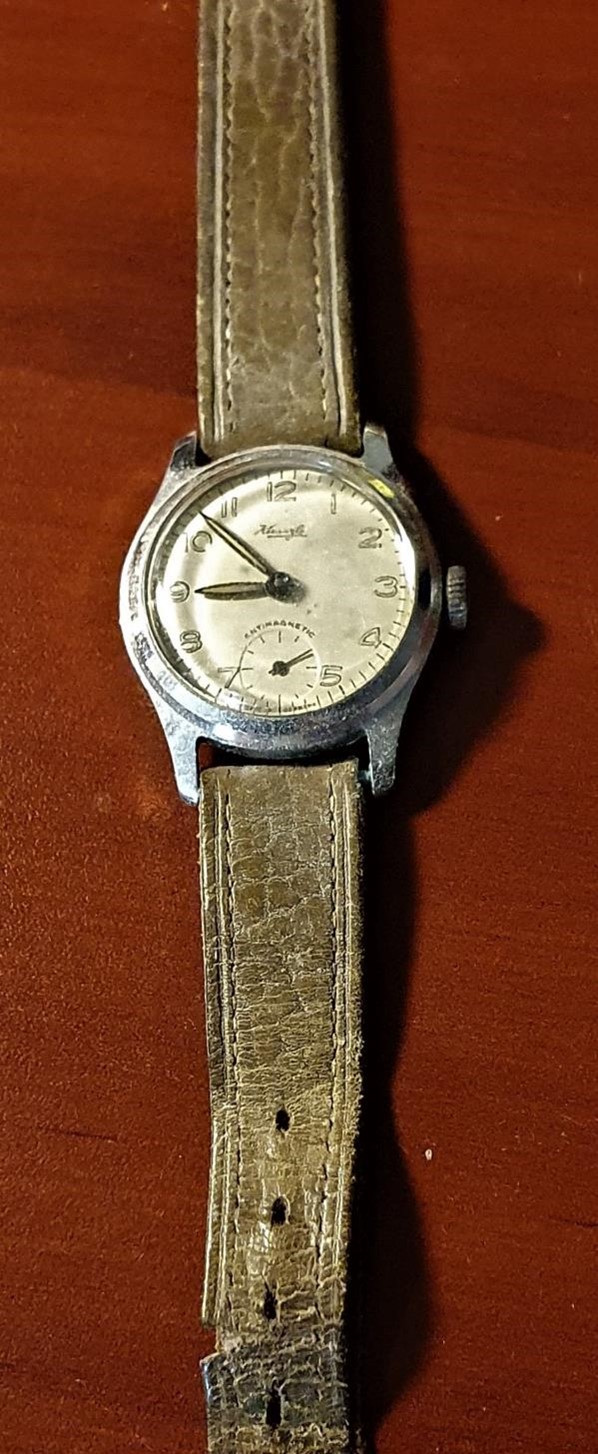
I have no keepsakes that date from my youngest years, but I do still have the watch my parents gave me just before I left home. I’d never owned a watch but now I was 16 and heading off to work in Edinburgh. So Dad took me to the only place in town that sold watches, a tiny jeweller’s shop. There was a choice of about three, and I took the one with a grey strap and a straightforward watch face. As you’ll see from the photo, it was worn for years. It was a wind-up watch, of course, and the innards seized up a long time ago. Why do I still have the watch? Two things make it significant and memorable: it was a gift from my mum and dad, and I was given it just as I left home. So I’ve kept it.

But some folks seem to have the philosophy ‘everything we get we keep’. They let go of next to nothing. I visited one home where, once through the front door, I had to edge my way between mountains of stuff – broken appliances, stacks and stacks of papers, rails filled with old clothing, hundreds of books and magazines. I was invited to sit down. I couldn’t see where, but then my host cleared some heaps and revealed a chair. This wasn’t the only home I’ve visited like that. I can’t imagine what it was like to live there, or how great the fire risk was.

I’ve also seen overflowing work offices. I called on one senior official who had completely filled his private office with paperwork, so we met in his second office which was almost submerged as well. Apparently he was negotiating for a third office. I think it was Dale Carnegie who said a CEO offered to pay him any amount for advice on how to clear his clutter. He too had filled more than one office with ‘stuff’. Carnegie gave him just one bit of advice: pick up a piece of paper and don’t put it down again until you have done something final with it (like writing a reply or throwing it in the bin). In other words, do something that means you’ll never see that paper again. The executive called him just two weeks later. He’d done exactly what he was told, and he’d already cleared several desks of everything on them, and found two typewriters that had been missing for years.

The presenters of ‘de-clutter your home’ TV programmes often say the problem people have with parting with things is emotional. Memories are attached to everything they’ve acquired. I can only respond this way: the cost of keeping is higher than the cost of parting; parting is brief pain but keeping is pain that lasts for years.

Can’t let it go? Yes you can.

Undone and unfinished things

I studied bereavement counselling while preparing to be a pastor. I was told that, as well as grief, the most common emotion felt by bereaved relatives is guilt. Guilt – because of visits not made. Guilt- because of harsh words spoken in the last conversation. Guilt – because ‘I love you’ hadn’t been said for years. Guilt – because an argument that divided the family 20 years earlier hadn’t been resolved. When it’s too late to put things right, guilt is hard to let go.

The same is true for people who missed an opportunity which never came again. Perhaps a relationship was so special it would surely lead to marriage, but no proposal was made and the couple drifted apart. But one of them can’t let go of what might have been.

Or a missed opportunity at work. A big promotion is offered, but means moving to an overseas location. That would disrupt the family, involve learning a new language, and demand working all hours. So the promotion is turned down. But the firm is unforgiving. No other promotions are offered and as year after year of mundane work goes past, it’s hard not to think ‘If only…’.

Others have missed the chance to upgrade their skills. Martin’s employer was willing to let him study part-time for a PhD. With that qualification, he’d be on track for a top position. Martin began his studies, made good progress, but after two years got involved in significant work projects, family needs, hobbies and outdoor activities. With just one more year before getting his PhD, he paused. And he never finished. Every year since, Martin couldn’t let go of disappointment he hadn’t completed his PhD degree.

‘There is a time for everything…’ says the writer of Ecclesiastes (ch. 3:1). We mustn’t miss that time.

Failure
Everyone fails. But some failures stay with us more than others.

That’s especially true when we’ve betrayed a relationship. Cheating on a marriage is an obvious example. ‘How could I do that?’ is the lingering question.

Letting a friend down is also damaging. Imagine sympathising with a colleague who has been harassed by a fellow-worker, promising that if she complains about her harassment to the boss, you’ll support her because you’ve been harassed too. Your colleague lodges her complaint, the boss isn’t sympathetic, so now you keep quiet about your experience. Your friend feels abandoned and isolated. She resigns. You feel terrible. You let her down, and ever since you can’t let go of the fact that you failed her.

Or you promised to be with a friend at a special event – his wedding, or graduation, or a family funeral – but at the last moment someone gave you a ticket for a great seat to watch a top-level football match. You couldn’t miss the chance – you had to go to the match. But your friend never understood. You’d promised to be with him, and you abandoned him for a football match! He is hurt dreadfully, and you realise you’ve made an appalling mistake. You feel dreadful, and you can’t let that feeling go.

Choices have consequences, and those consequences can last a long time.

The good things

Usually negative experiences linger longer than positives in our minds. But, thankfully, the good things are sometimes the ones which we can’t let go. Wonderful times which we’ll never forget.

I’ll supply only one experience, though it happened four times. I’ll never let go of the immense privilege and joy at watching each of my four children come into the world. Men have it easy at childbirth. Alison took all the pain and did all the hard work while I just held her hand and said encouraging words. Then, after each of the children arrived safely, I proudly held them in my arms. I could never let go of that experience. (It’s mirrored these days with the joy of seeing how their lives have developed.)

That’s not an experience everyone has. But almost everyone has something or many things for which they’re immensely grateful. They’d never have wanted that part of their lives to have been any different. So they could never let go of those moments. We should all be grateful for them.

But, in closing, how do we let go of the bad or sad memories? I could write about counselling, about finding forgiveness, or about making a firm decision not to dwell on these times. All three of those would be appropriate.

However, on this occasion I’ll end by saying we can’t let go of certain experiences and, in one sense, we shouldn’t let go of them. Why? Because these things have shaped the person we are today. Because we got things wrong or because we went through dark times we’ve been changed. Perhaps we’re determined never to do something again, never to let down a friend, never to fail a colleague in their time of need. Or, because we’ve survived we’re stronger, and we’re more understanding when others face horrible tragedies. We can’t turn the bad thing of the past into a good thing, but we can transform its effects into something useful, something that makes us better, more careful, more considerate, and more resilient than we would otherwise have been.

So, what you can’t let go needs to become what you can’t do without to be the person you are now, or the one you are on the way to becoming. I realise that’s easy to write and hard to do, so my thoughts and prayers are with all who keep struggling.

——————————–

Note 1  My apologies that this blog is posted later than I’d imagined. I anticipated a delay, but not for this long. I doubt if the gap has broken anyone’s heart, but I am sorry and hope pauses won’t happen often.

Note 2  The podcast I described is the NPR Politics Podcast: https://www.npr.org/podcasts/510310/npr-politics-podcast  It’s refreshingly unbiased, serious but never boring. To hear the ‘can’t let go’ segment you need to listen to the Friday edition where they sum up the week’s news and then use the last five minutes to describe what they ‘can’t let go’ from that week’s news, whether it’s about politics or anything else. Enjoy!