When Jesus was a refugee

The hand on the woman’s shoulder was gentle, yet firm enough to stir her from deep sleep. “Mary,” the man said, “please wake up”. The room was in complete darkness. Only the familiar voice quelled Mary’s instinct to panic.

“Joseph, why are you awake? What’s happening? It must be the middle of the night,” she said.

“It is, and we need to pack what we can, take our son, and leave right now.”

“Joseph, you’re scaring me. What’s wrong? Where are we going and why must we leave now? Just come back to bed. We can talk this through in the morning.”

Joseph’s voice did not waver. “No, Mary. Please trust me. We must gather our things and be well on our way before daylight. If not, our son’s life will be at risk.”

There was no more argument. Mary rose, and by nothing more than the light of one candle, she and Joseph gathered clothes, blanket, food, and their few special possessions. Finally, they lifted Jesus from his bed, made soothing noises to keep him quiet, left the first home they’d known as a family, and set off into the cold night air.

Joseph, of course, will have given Mary further details as they trekked through the darkness, explaining what had happened to move him to such urgent action. The gospel writer Matthew describes it this way: “an angel of the Lord appeared to Joseph in a dream. ‘Get up,’ he said, ‘take the child and his mother and escape to Egypt. Stay there until I tell you, for Herod is going to search for the child to kill him.’” (2: 13)

Mary was startled. Who wouldn’t be? To set off by night on a long and dangerous journey because of a dream? Going to another country with no definite destination? Yet, so much in recent years for Mary had been strange, especially her own encounter with an angel who told her she’d bear God’s child. (Luke 1: 26-38)

But this? A sudden rush into the night? Fleeing the country? Hiding their child from soldiers ordered to kill him? Questions, many questions. But no refusal by Mary. Out into the night they went as a family, and headed for safety in Egypt.

The courage, faith and resilience of both these parents is remarkable. Down the centuries, Mary has rightly been recognised for her submission to God. “I am the Lord’s servant… May your word to me be fulfilled,” she answered the angel who spoke to her. (Luke 1: 38) Mary was a woman of faith. And so was Joseph. His obedience in marrying Mary must have damaged his reputation. Yet he didn’t hesitate. Nor does he hesitate now, as he gets Mary and Jesus on the road to safety in another country.

Taking turns to carry Jesus, Joseph and Mary walked and walked. Step after weary step they trudged south. Even the shortest distance to the border was about 40 miles (64 km). But they needed to go further than that, probably at least 50 or 60 miles to reach a city where they wouldn’t be noticed among the throng. With just two carrying the essentials of three, they couldn’t have covered more than 10 miles a day. Nor, while still in Judea, could they risk staying at an inn because someone might tell Herod’s soldiers that a family from Bethlehem with a young boy was there. So, each night, the three likely huddled under a blanket at the side of the road. It would be cold, uncomfortable and very dangerous. Travellers were favourite targets for wayside robbers, and they could be as vicious as Herod’s men.

Day after day they put one foot in front of the other, always weary on dusty, uneven roads, always uncertain about what lay ahead. They were doing exactly what they’d been told to do, but that didn’t ease aching feet or quell anxious thoughts. God’s will is rarely easy. Hardship is a frequent landmark on the road of discipleship.

Becoming refugees seemed so wrong, yet it was also significant. Egypt was the convenient and safe refuge for a Judean family in danger. Crossing the border put them beyond Herod’s reach. But genuine refugees – then and now – are vulnerable: often penniless, often homeless, often unfamiliar with the local language, often unable to find work.

But Joseph, Mary and Jesus had one advantage. The road to Egypt has been walked by many Jews before them, often for similar reasons to theirs. At that time, the Egyptian city of Alexandria had over a million Jews; others were elsewhere. So, wherever the little family settled, they would find fellow countrymen, people with similar backgrounds who understood what they were experiencing. Speaking the same language, they would explain customs and laws, and help with accommodation and employment.

But, along with all the practical issues, Joseph and Mary had one troubling thought. They knew Jesus was no ordinary child. Joseph had been told to name him Jesus “because he will save his people from their sins”. (Matt. 1: 21) And Mary was told: “He will be great and will be called the Son of the Most High. The Lord God will give him the throne of his father David, and he will reign over Jacob’s descendants forever; his kingdom will never end… the holy one to be born will be called the Son of God.” (Luke 1:32-33, 35) Both believed those words were from God, and everything that happened at the time of Jesus’ birth and in the months after confirmed their truth. In their care was the Son of God, and they had fled to Egypt to keep him alive.

But, they must have wondered, how can these amazing promises about Jesus be fulfilled if he is in Egypt? Surely God could have protected him back in Judea, but they had been told to flee. Joseph and Mary wanted their son to grow up and fulfil all the prophecies about him. But he couldn’t fulfil them if he was in Egypt.

What the couple could not know was how long they would stay in Egypt, and what reasons, other than physical safety, God had for them being there. They may have assumed there was a straight line for Jesus from his birth through his youth and then to saving people from their sins and reigning over a new kingdom. But God never promises straight lines. When we find our lives in strange places, it may be because our route needed to change so skills could be learned, character developed, wisdom gained, and bad times endured.

Matthew saw one other reason for this strange period in Jesus’ life. A prophecy would be fulfilled when the family finally left Egypt and returned to Judea. He wrote: “And so was fulfilled what the Lord had said through the prophet: ‘Out of Egypt I called my son.’” (2: 15) That prophecy first appears in the Old Testament book of Hosea (11: 1) where it refers to God bringing his son, the nation Israel, out of its captivity in Egypt (the Exodus story). Matthew saw how that prophecy also applies to Jesus. God’s Son will come out of Egypt. But, of course, with Jesus it has a greater significance: Israel was the redeemed people God called out of Egypt, but Jesus is the redeemer called out of Egypt.

Then it was time to go home, but that was fraught with danger too. King Herod died. The tyrant who thought nothing of killing babies and toddlers in Bethlehem went to meet his maker. It’s hard to imagine that was a happy meeting.

Now the ruler who wanted to kill Jesus was gone. Again Joseph was spoken to by an angel in a dream. “Get up, take the child and his mother and go…” It was time to return to the land of Israel, “for those who were trying to take the child’s life are dead.” (2: 20)

Joseph could have argued. The family had settled in Egypt. They had blended in well to the Jewish and Egyptian communities. He had carpentry work. Joseph and Mary had made friends. Jesus had playmates. To live there for longer – perhaps for ever – wasn’t a bad idea.

But it would have been the wrong idea. So Joseph did not debate with the angel. The family sorted out their possessions, and set off north. This time they could travel in daylight, but they knew the journey would still be demanding and dangerous. Though nervous, tired, and uncertain they were also obedient. They had been told to return, so they would. Joseph assumed they’d resettle in Bethlehem in Judea. It was where they’d lived after Jesus was born, and, being a royal city, it was a place appropriate for God’s Messiah.

But there was something Joseph didn’t know. He had assumed that with Herod dead, life in Bethlehem would surely be better and safer now. It wasn’t. It was worse.

Herod had ruled over a sizeable country, but he knew the Romans would not let a successor have so much power. So he had written a will which divided the land after his death between three sons. Herod Philip got the northern region called Trachonitis, Antipas was given Galilee, and the largest area, which included Idumaea, Judea, and Samaria, went to Archelaus. What sent shivers through Joseph was the last of these appointments – that Archelaus now ruled Judea. Why was that a problem? Bethlehem was in Judea. And, if Herod had been evil, Archelaus was twice as evil and twice as vindictive as his father. He wanted no rivals and no contrary voices, so he began his reign by killing 3000 of the most influential people in the land. If Archelaus would eliminate them, and now learned that the child his father had wanted dead was back in Bethlehem, he’d have no scruples about dispatching a murder squad to kill Jesus and probably Joseph and Mary too. Archelaus’ rulership over Judea made it impossible for the family to settle there.

In another dream Joseph was told to take the family even further north. This time their goal was Nazareth in Galilee. That was an extra 90 miles (145 km) over hills and through areas made dangerous by wild animals and thieves. But Nazareth was a familiar place for Joseph and Mary because it’s where they had grown up. And the important point was that Archelaus did not rule there.[1] Nazareth was in Galilee where Antipas was in charge. Though another of Herod’s sons, Antipas was a peaceful and good ruler. In Nazareth, the family were safe.[2] It was the right place for them to raise Jesus to be the man, the Saviour, the Lord he was always meant to be.

Here we (nearly) end the two-part story of the events which occurred after Jesus was born. Part one was the previous blog post about the visit of the wise men, and this one has described how Jesus became a refugee in Egypt, and then returned to his homeland. If you have not read part one, you’ll still find it helpful. You can access it at https://occasionallywise.com/?s=wise+men

From both parts of the story, and from my Christian perspective, I draw several lessons, including these seven.

It is remarkable but important that people from another land came and worshipped Jesus soon after his birth. The divine purpose may have been to show that one day every knee will bow before him (as Paul wrote in his letter to the Philippians, 2: 10).

The wise men risked their lives for Jesus by disobeying Herod’s command to reveal his location. Many have done the same since, with some making the ultimate sacrifice for their loyalty.

There  is no shortage of cruelty in the world. The evil of Herod, who had Bethlehem children murdered in an attempt to eliminate Jesus, and later the even greater ruthlessness of his son Archelaus as ruler over Judea, shows just how cold-hearted and brutal human beings can be to harmless and innocent people.

Guidance from God can come in strange, unexpected ways. But, for Joseph, it was always there when he needed it. At no point was the whole plan given to Joseph in advance, but he was always told in time what to do next.

Paths through life have frequent twists and turns. We get scared when plans are forced to change. That’s because we can’t see round corners, but God can and knows exactly what he is doing with our lives.

There’s no guarantee that, even in the centre of God’s will, life will be comfortable. The night when Joseph woke Mary and told her they had to flee, the couple had two choices. One was to stay in Bethlehem where they had settled – but then their little child would be murdered. The other was to get started while it was still dark, take almost nothing with them, and flee for their lives to a foreign land where they had no friends, no place to live, no means of support and did not know the language.

Of course the right choice was to flee. They did that one hundred percent in the middle of God’s will. But, that meant letting go of every shred of comfort and security, and becoming refugees. It’s a myth that doing what God wants will leave us feeling cosy and comfortable. But choosing what’s right, even when it’s tough, is always for the best.

God’s ultimate purposes do get fulfilled. Think how the story from the beginning of the gospel to now could have gone:

  • Mary: stoned to death for getting pregnant outside marriage
  • Joseph, to whom she was engaged, abandoning Mary because he knew he was not the father of her child
  • While they were travelling from Nazareth to Bethlehem, the couple could have been robbed or murdered, or Mary might have gone into labour on a remote hillside
  • Mary and Jesus could have died while she gave birth in a far-from-clinically-clean stable
  • Herod’s murder squad could have found and killed Jesus before they’d had time to escape
  • After they set off at night for Egypt, evil people or wild animals could have killed them and left their bodies at the side of the road
  • When they were settled in Egypt, Joseph might have felt secure, grown weary with moving about, and decided they should stay rather than return to Israel
  • If they had gone back to Judea, the seriously wicked son of Herod – Archelaus – might have murdered the whole family.

But none of that happened. God had a plan for his Son’s life and nothing was going to stop it. That is true also for everyone who belongs to God. Probably our paths through life will not be so dramatic as the path was for Jesus’ family, but we will be every bit as safe in the hands of God.


[1] Unfortunately for Archelaus he had one other flaw – he was hopelessly incompetent, and the Romans deposed and replaced him after just two years.

[2] Nazareth was not a tiny village, but also not a place of great note. It is never mentioned in the Old Testament.

Doubly wise men

If I was writing a novel about the birth of God’s Son, I would not have him born in a stable, laid in an animals’ food trough, make his first visitors people with low status like shepherds, and later have him worshipped by people with uncertain beliefs who arrived from a foreign land. But that is the Christmas story as given in the Bible.

Today we call the people from another land ‘wise men’ or ‘kings’. They were wise men but almost certainly not kings. The New Testament story of the wise men comes from the gospel writer Matthew (chapter 2). He wrote in Greek, and he describe the visitors as magi, the plural form of the word magos. A lexicon (dictionary) will give the meaning of magos as sage, magician or sorcerer. Those definitions are not wrong, but that doesn’t mean each is appropriate for the men who visited Jesus. I will explain.

The Magi were a Median tribe, part of the Persian empire. They were people with great learning and understanding, so much so that as priests they became advisors to Persian kings. Hence it’s right to describe them as ‘wise men’. Part of their wisdom came from study of old disciplines such as philosophy, medicine and the natural world. The natural world included the stars which at least some magi observed very carefully.

These were the magi who travelled many miles to worship Jesus. They likely held ideas many of us would regard as strange, but they were good men, holy men. Decades or centuries later, the word magos also became used for less worthy people: sorcerers, fortune-tellers, magicians. (In fact, our word ‘magic’ comes from magos.) But there is no sign at all that the magi Matthew writes about were sorcerers or magicians. They were men who studied the stars, and one night they saw a star rise in the sky. We don’t know how, but they understood that star meant God had sent a new-born baby to be King of the Jews.

Where did the Magi[1] come from?

We know only that they came from the east. There has been no shortage of speculation about where exactly they travelled from. If you look on a modern map, then east of Israel are countries such as Iraq, Iran, Afghanistan, and eventually China. But ancient Persia – modern day Iran – is a very likely host country for magi such as the visitors to Jesus. In the centuries before Christ, Persia was vast in size. Its borders stretched from countries like those we now call Bulgaria, Romania, and Ukraine right across to parts of India, and also south into Egypt. By the time of Christ it was smaller, but still large. And a natural home for magi.

How far did they travel to find Jesus?

Since no-one knows precisely where these Magi made their home, the guesses of how far they journeyed to Jerusalem and then Bethlehem range from 500 miles up to 1200 miles. Starting from homes anywhere between those numbers meant they had a very long journey. And, in those days, there were no cars, no trains, no planes, and no motorway standard roads.

How long did the journey take to get to Jesus and then back home?

We are not told, but we can assume that the wise men rode on camels. It’s highly likely, though, that they travelled as part of a larger party, and their attendants will have walked. Given the terrain, sometimes difficult weather, and the need of rest stops for both people and camels, it’s unlikely they could average more than 3 mph. Even if they travelled for 10 hours per day, they’d cover only 30 miles from dawn to dusk. Assume 30 miles a day and a trek of 1000 miles, and their pilgrimage will have taken approximately 330 days. That’s more than ten months. And they had it all to do again in reverse to get home.

So, the time involved to go and return may have been 20 months or more. The expenses (camels, servants, supplies) would be high. The risk – for there were many bandits dedicated to robbing rich travellers – was immense.

Put all this together, and it’s clear that these Magi made a major commitment of their lives for this journey. They saw a sign in the night sky, and they went. All so they could kneel and give gifts to a very special child.

How many Magi were there?

Down the centuries, people have imagined there were three wise men. Paintings have always portrayed three, and later legend gave them names: Gaspar (or Caspar), Melchior, and Balthasar. Some have thought they represented the three continents recognised in ancient times, Europe, Asia, and Africa.

There may have been three wise men, but the gospel writer Matthew either did not know or was not interested in details of that kind. So their names, their origins, and even their number are all much later speculation. So, why has it been traditional to believe there were three wise men? Simply because three gifts are mentioned: gold, frankincense, and myrrh. But three gifts doesn’t prove there were three givers. Perhaps six, or eight, or ten magi all contributed to these gifts. We simply don’t know how many wise men there were.

Did they kneel before the manger to worship Jesus?

Works of art usually show these wise and wealthy men bowing humbly before Jesus in the manger. It’s a moving scene.

But they didn’t. and they didn’t because Jesus was no longer in a manger in a stable. We know that for two reasons. One is that Matthew (2: 11) wrote that the wise men visited Jesus in a house. The word Matthew used was the Greek oikos and oikos always means a dwelling, a place of human habitation. It would never be used for a cave or stable.

The second reason we know the wise men never went to the stable is that by the time the wise men could have arrived to worship Jesus he would be several months old. Joseph and Mary with Jesus will have continued to live in Bethlehem, but, understandably, not in a stable. Two factors indicate the time lapse before the visit of these Magi.

First, the time it took for them to travel. the wise men told Herod they had seen the star rise “of the one who has been born king of the Jews”. (2: 1-2) The child from God had been born, and they must pay him homage. So, after Jesus’ birth, they prepared for their journey, and then rode or walked many months to reach Jerusalem and then Bethlehem.

Second, the age of the children Herod ordered to be killed. What the wise men told King Herod had troubled him deeply. He hated the idea that another king had been born. So, when the Magi never returned to his palace to report Jesus’ exact whereabouts, Herod ordered his troops to slaughter all the boys born in or near Bethlehem “who were two years old and under, in accordance with the time he had learned from the Magi”. (2: 16) Matthew is quite specific that Herod targeted the boys born in Bethlehem within the time frame the wise men had given. That included those born up to two years previously.

Given these factors, the evidence is that considerable time elapsed before the wise men arrived. They were not visiting a newborn baby.

Is it not odd that holy men with generally contrary beliefs came to worship Jesus?

Yes, it does seem strange. In fact, it is also surprising that shepherds were the first to visit after Jesus’ birth. In those times, shepherds were not held in high regard. Spending day and night guarding their flocks meant they often failed to observe the ceremonial laws. But, in their favour, they were Jews, members of God’s ancient people.

The wise men were not Jews. We know they had high rank and considerable wealth because their gifts were expensive. But they observed no Jewish laws and had no part in Jewish heritage. They came, honoured Jesus, and then they disappear completely from the story. There is no suggestion they became Jesus’ disciples. Our only information is that these were magi from another land, from a wholly different belief system, who saw a sign in the heavenlies which they rightly interpreted as indicating the birth of the child who would become king of the Jews, and they came to worship him. It is remarkable that God revealed such news to them, and also remarkable that they made a long, arduous and risky journey to find Jesus and when “they saw the child with his mother Mary… they bowed down and worshipped him.” (2: 11)

Now, none of that could have happened unless these Magi already believed in God. Their ideas will have been mixed with other beliefs that didn’t belong with either Judaism or (what became) Christianity, but they had sufficient faith in God to understand he was speaking to them by a special star in the sky. When that happened, they didn’t just stand back in amazement; they knew God wanted them to find this special child, and when they did they worshipped him. These were men who sought God, and God brought them nearer to himself by leading them to his Son so they could worship him. The lessons I take from that is that God can and will do whatever he wants with whomever he wants, and does remarkable things to draw people to himself.

But didn’t the wise men put Jesus at risk because of their visit?

Yes, looked at from a human perspective, they did put Jesus at risk. It’s a curious case of doing what was right by going to find Jesus, but in doing so they triggered Herod’s jealousy and murderous actions.

Let us be very clear: at no point did these Magi do wrong. They were right to make their long journey to worship Jesus, and, with the little they knew, it was understandable they went first to the royal palace to inquire about the birth of a new king of the Jews. They could not have known how alarming that would be to King Herod. And it was Herod who decided he must eliminate this risk to his throne. When he couldn’t find Jesus, he ordered (what we now call) the ‘slaughter of the innocents’ around Bethlehem.

Someone making a harsh judgment could say those two things – their visit and contact with Herod – cost the lives of many children. That person might say it would have been better if the wise men had never come.

However, the obvious truth is that the wise men did not motivate Herod to murder Jesus, nor his eventual decision to kill the young male children of Bethlehem. Herod, and Herod alone, is responsible for these dreadful deeds.

The horrific truth about King Herod is that these deaths in Bethlehem were not the greatest evil of his reign. All his life he’d done terrible things. Early in his rule he’d killed off half the Jewish Sanhedrin (the ruling court for the Jews). Later he’d had 300 of his court officers put to death. He also murdered his mother-in-law, his wife, and three of his sons. Finally, when he lay dying, he gave orders that one member of each family in Israel was to be killed. Why? To guarantee the nation would be mourning at the time he died. (Thankfully, with Herod dead, that last order was never carried out.) Herod has been described as “a man of ruthless cruelty…”. He certainly was.

This world has always had Herods, people with great power but few morals, people who will do anything to promote their interests, people who think nothing of sacrificing others to benefit themselves. That was true in the ancient world, true in the Middle Ages, true in modern times. Terrible people have always done terrible things to innocents who have done nothing to deserve it. In King Herod’s case his fear and jealousy were aroused by the visit of the Magi, but the wicked crimes that followed were Herod’s doing and Herod’s alone.

Did the wise men put their lives at risk by failing to return to Herod?

Yes, they certainly did. The Magi and their whole party might have been put to death by Herod’s soldiers.

After finding Jesus, the Magi were supposed to return to King Herod and reveal Jesus’ precise location in Bethlehem. He was very clear: “Report to me!” There was no option to refuse. This was a tyrant’s command, and failure to obey would cost them their lives.

The Magi had little time to consider their options. Bethlehem is only six miles from Jerusalem. That was only half a day’s walk, and Herod knew they could go one day and be back in his palace the next. Even if they’d stayed in Bethlehem for a couple of days, it needn’t be long before they stood in front of Herod again, this time with details of where the special baby could be found.

Herod, of course, had lied about why he wanted that information. He’d said he wanted to go and worship the child too. (2: 8) But the Magi got another divine message, this time a warning in a dream not to return to the palace, so they avoided Jerusalem and Herod, and took a back road to get out of the country.

That took great courage. First, they knew that Herod was a viciously cruel ruler who never tolerated disobedience. Second, he would certainly have them put to death if he caught them. Third, the wise men and their party could not journey inconspicuously. Herod’s soldiers would be hunting for them, and the local people might get a reward for revealing their whereabouts. There was a strong likelihood they’d be seen, reported, captured, and executed. Despite the risk, they took another route and headed home. It was a choice others would not have made.

So the wise men return to the east. But Jesus, of course, was still Herod’s target, and next time we’ll see how Joseph, Mary and Jesus became refugees who fled for their lives.

Last word on the wise men I think of these Magi as doubly wise men. First, they recognised God’s sign in the stars, and made an arduous and hazardous journey to worship a young child. They had the wisdom to obey a heavenly authority. Second, they then had the wisdom to disobey an earthly authority, accepting that decision could cost them their lives. But God’s priority was always their priority. You can never be wiser than that.


[1] I am giving an initial capital to Magi when referring directly to ‘the Magi’ of Matthew’s gospel, but using the lower case magi when referring to these priestly people more generally.

Christmas miscellany

There are only a few days to go before Christmas. In the UK, like many western countries, people seem geared towards an over-indulgent holiday season. Too much money will be spent on presents. Too much food and drink will be consumed. Too much effort will go into trying to ensure everyone has a wonderful time. Too much time will be spent watching special programmes on TV. And too few will reflect on the birthday of Jesus Christ, the event which should undergird everything we are celebrating.

But I’ve never believed in being a grumbler about Christmas. I enjoy Christmas though I admit that I don’t get close to crazy excited like I did when I was young. I’d wish more people thought about its origins, but even if they don’t it is still a wonderful season, including special time with family and giving and receiving presents.

For this last blog post before Christmas I’ve assembled a miscellany of things about Christmas. Some are serious, some less important. But I hope they’re all interesting. Enjoy reading.

Church or pub on Christmas Day

In the UK, only about 5 per cent of the population attend church regularly. That number may not be exact. Pollsters do not all use the same methods, and definitions of ‘regular church attendance’ aren’t all identical. Nevertheless, I suspect the 5 per cent figure is close to being right. My home nation is predominantly non-churched. Except, that is, at Christmas.

It’s not unusual to see full churches for Christmas Eve midnight services. I used to lead and preach at services like that. They could be eventful if some of those weaving their way home after an evening in the pub decided to join the service. All were welcome but not all were at peace with the world or church decorum.

Fewer attend church on Christmas Day. Other things capture attention, not least keeping children calm while they rip the paper wrappings off presents. Then there’s the massive task of preparing and serving a big meal for family and friends. Turkey is the traditional dish in the UK for a Christmas Day meal.

But ‘Statista’ asked people whether they plan to attend church on Christmas Day or spend their time and money in the pub. The answers they got surprised me. Take a look at the chart comparing church or pub attendance for the USA, UK and Germany.

Clearly the USA has the highest percentage of people who will attend church on Christmas Day – 19 per cent. To my surprise the UK trails by only 3 points at 16 per cent, but Germany scores only 12 per cent. However, what all three nations have in common is that church wins over pub. I don’t know why that happens. My guess is that, for some, there may be a long-observed family tradition of going to church on Christmas Day. Others may pass through church doors for a service of lessons and carols but that will be their one-time attendance until next Christmas. However, of course, most Christmas Day churchgoers are people with a real faith in Jesus. They make a priority of attending church to worship before other events overtake their day.  

The odd ancestry of Jesus

Some families have an unkempt uncle, an agonising aunt, or a grouchy grandparent, but Jesus had some really strange ancestors. Certainly Matthew, the writer of the first gospel in the New Testament, did not sanitise his list of Jesus’ forebears.

A few years ago I wrote two blog posts about those ancestors of Jesus. If you haven’t read those posts, I’d encourage you to do so now. I promise they’re interesting, challenging and encouraging. Here are the links:

Why is Christmas on December 25?

Why the 25th of December? Well, the first thing to say is that it’s unlikely that Jesus was born in late December. Scholars point out that shepherds wouldn’t have their flocks out in fields in mid-winter. It would also be a strange season  to travel with your heavily pregnant wife back to your hometown to be counted in a census (see the opening verses of Luke’s gospel, chapter 2, for mention of that census). For various reasons biblical scholars mostly consider that sometime between spring and summer is more likely for the time of Jesus’ birth.

What is also interesting is that the date of Jesus’ birth was not celebrated or even considered by the early Christians. Matthew’s and Luke’s gospels carry the story of his birth, but there’s no mention of a date. In fact the date of the Saviour’s birth was never discussed by the church until at least the 2nd century.

Two or three theories are put forward now for why December 25 was later made Jesus’ birthday.

A Roman and Christian historian called Sextus Julius Africanus dated a lot of things. (He was born around 180 and died around 250 AD.) For example, he calculated that creation was complete on March 25, 5499 BC. Sextus stuck with March 25 as the exact date when Jesus was conceived in Mary’s womb. That day had already been considered as the date of Jesus’ crucifixion, and perhaps Sextus thought it appropriate to date Jesus’ conception and death on exactly the same date (not in the same year, of course!). How does that affect the date of Christmas? Think: if Jesus was conceived on March 25, nine months later is December 25. Simple really. Well, it was for Sextus, so for him December 25 was the date Jesus was born.

But there could also be another reason for the date. In 274 AD, the Roman emperor Aurelian marked the rebirth of the Unconquered Sun (Sol Invictus) on December 25. Why then? The 25th was just after the winter solstice, and therefore the beginning of days that would gradually get longer. For Emperor Aurelian, December 25 was when the sun had been reborn so there should be a celebration. Move forward to the next century when Emperor Constantine ruled. He was a convert to Christianity who had made his faith the religion of the empire. In 336, and perhaps because he wanted to wean his empire away from pagan gods, he overlaid the Sol Invictus festival on December 25 by marking that date as the birth of Jesus. Thus December 25 became established in the western Roman empire as what we now call Christmas. January 6 was favoured in the east, and the modern Armenian church continues to mark the January date.

There is a popular, broader idea that the date of Christmas was fixed to replace a variety of pagan feasts held in mid winter. That suggestion was never made until the 12th century, and today’s scholars point out that the early Christians didn’t have any interest in borrowing dates from pagan religions. If anything, they distanced themselves from other faiths.

What we shouldn’t confuse here are two very different things. One is the idea of borrowing the date of Jesus’ birth from pagan religions. The other is adopting traditions for Christmas from those religions. The obvious example of the latter is the use of the Christmas tree, which does seem to have originated in the worship of the Druids. They were Celtic priests who decorated their temples with evergreens as a symbol of everlasting life.[1]

No-one can say with certainty why December 25 became the date for Jesus’ birth. Perhaps thinking of March 25 as Jesus’ conception in Mary’s womb, on the same date as his death during Passover, is what led people to the nine months later date for his birth, but there is no complete evidence to support any theory. Since Victorian times we’ve been bombarded at Christmas with wintry images of reindeer, snow flakes, snow covered trees, and children building snowmen. Then, from 1941, we’ve crooned along with Bing Crosby singing ‘I’m dreaming of a white Christmas’. Who would want to surrender all that for another date? I’d consider it. Australians don’t seem too sad about celebrating Christmas on the beach. I could get used to that too.

For more on the date of Christmas, you’ll find a well-written scholarly article – easily understood by non-scholars – here: https://www.biblicalarchaeology.org/daily/people-cultures-in-the-bible/jesus-historical-jesus/how-december-25-became-christmas/

Victoria, Albert and Christmas trees

Evergreen trees have always been popular because, well, they’re evergreen. Deciduous trees, like oak, chestnut and beech, flourish and then for half the year seem to lose their life. Evergreens are fully alive all the time.

So from the most ancient of times – long before Christianity – people collected evergreen branches to hang over doors and windows. In some cultures those evergreens were thought to shut out demons and other evil spirits, and even illness. During a long, hard winter the green branches were also a reminder that spring would come and plants and crops would grow again.

But how did that become the Christmas tree tradition?

There’s no single answer to that question, but there’s evidence that by the 16th century Christians in Germany were bringing evergreen trees into their homes and decorating them. There’s a story – possibly true – that the famous church reformer, Martin Luther, walked home on a dark but clear winter night feeling awestruck by the bright stars overhead. So he erected a tree in his home, and fastened lighted candles to its branches to recapture something of the magnificence he had seen outside.  

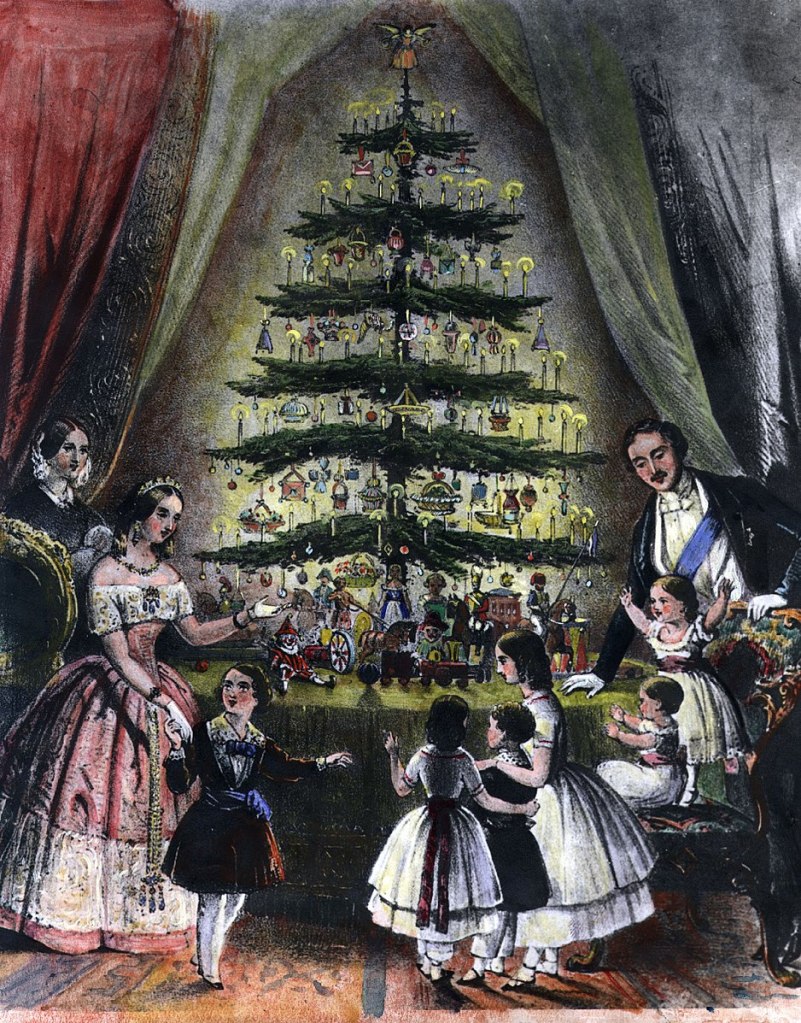
That German tradition slowly spread across Europe. But its popularity soared in the mid 1800s when Queen Victoria’s German husband, Albert, had trees erected in Windsor Castle and, in 1848, allowed a front cover painting to appear in The Illustrated London News showing the main tree covered in decorations and surrounded by the Royal Family. Other papers picked up on the story, and it massively influenced upper class customs in Britain and many other countries. Royal fever did its work.

Image in public domain

During the following decades and into the 20th century, the tradition of the Christmas tree spread quickly and widely. Across the western world almost all homes had Christmas trees. Local authorities mounted Christmas trees in public squares and on their buildings. Large stores placed trees on their balconies and in the main retail areas. Towns and cities publicised ceremonies of switching on the lights on large Christmas trees in prominent places. For example, since 1933 and continuing now, a large Norway spruce tree has been used for the Rockefeller Center Christmas Tree in New York. The 2024 tree is 74ft (22.5m) tall, 43 ft (13.1m) wide, and weighs about 11 tons (24,250 pounds, 11000kg). After the Christmas period, the tree will be donated to Habitat for Humanity and cut into lengths to help with building homes. In Washington DC the National Christmas Tree is erected near the White House, and its lights switched on by the President and First Lady. Trafalgar Square in London has had a Christmas tree donated by Oslo, Norway, every year since 1947. The 2024 tree is 20 metres (65.6ft) tall and has already been scaled by a protestor dressed as Santa Claus.

For a long time now Alison and I have had only artificial Christmas trees in our home, principally for three reasons: that means a real tree is still growing in the forest; artificial trees leave no mess; they can be used for many years. We follow a common tradition of laying presents around the base of the Christmas tree. When our children were young, those presents sparked curiosity which led to exploration. The children would secretly examine the size and weight of each neatly wrapped present, probably hoping the biggest and heaviest was for them. One thing we never have done or will do is sing around the Christmas tree. The TV series Downton Abbey portrays how the aristocratic family would sing along with their servants beside a giant Christmas tree. We have never done that. Maybe it’s because we don’t have servants. Or because we’re not very tuneful.

‘Once in Royal David’s City’

Every Christmas Eve millions in the UK and around the world tune in to a service of carols broadcast from King’s College, Cambridge. The first TV broadcast was in 1954, and then the service televised regularly from 1963. For over 100 years one tradition at the start of that service has not changed. Since 1919 the opening carol has been Once in Royal David’s City, with the first verse sung unaccompanied by a boy soprano. For that soprano, the thought of your solo being heard around the world must be terrifying. What must make it worse is that no-one knows who will be the soloist until the choirmaster selects one of the sopranos just as the service begins. A nod or pointed finger in your direction, and seconds later your voice penetrates the silence. And millions are listening.

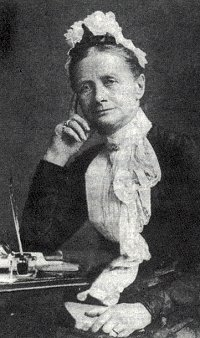
The writer of ‘Once in Royal David’s City’ was born Cecil Frances Humphries in 1818 in County Wicklow, Ireland. ‘Royal David’s City’ wasn’t her only famous hymn  – I’ll mention two more shortly. They may surprise you. Keep reading…

Cecil began writing poems in her school journal from an early age. They were beautifully composed in style and content, and that led to the publication of her first book of poetry called Verses for Seasons, a kind of ‘Christian Year’ of readings for children. That was only the beginning. Overall she wrote more than 400 hymns, basing them on subjects like the Apostles’ Creed, baptism, prayer, the Lord’s Supper and the Ten Commandments. All of them were written in simple language so children could understand and enjoy them.

When Cecil was 30, her book Hymns for Little Children was published. Each hymn was written to bring out the truth of some Christian teaching. Of course, without music the hymns read like poetry. But one year after publication a gifted English organist, Henry John Gauntlett, read Hymns for Little Children, and so loved ‘Once in Royal David’s City’ he composed music for it. As a hymn it was immensely popular and before long it was being sung far and wide.

Its origins as a children’s hymn show by the many direct lessons or references to children in the carol. For example, Cecil writes:

  • Christian children all must be / Mild, obedient, good as He.
  • For he is our childhood’s pattern; / Day by day, like us He grew;
  • And He leads His children on / To the place where He is gone.
  • Where like stars His children crowned / All in white shall wait around.

Cecil tells the story of Jesus in the carol, but also applies lessons and truths of the Christian faith for the children who would read or sing it. And that, after all, was her purpose. Hymns for Little Children carries a dedication by Cecil to her godsons, in which she hopes that the language of verse which children love “may help to impress on their minds what they are, what I have promised for them, and what they must seek to be”.

Two years later, in 1850, Cecil married Rev William Alexander (hence her hymns carry the name Cecil Frances Alexander). He eventually became the Anglican Primate of Ireland, a very senior role. Cecil poured her energies into writing hymns but also care for the very poor. The disastrous Irish potato famine – known as the Great Famine or Great Hunger – lasted from 1845-1852.[2] The parishes of Ireland were filled with masses of the disadvantaged. Cecil poured her heart and hands into care for them. Often she’d travel miles in difficult conditions to bring comfort to the sick and poor, and to give them food, medical supplies and warm clothes. Along with  her sister, she also founded a school for the deaf.

Cecil wrote many hymns before she died in 1895. One of those was the classic Easter hymn ‘There is a green hill far away’. Another was the hymn loved by children and adults ‘All things bright and beautiful’. Many have regarded Cecil Frances Alexander as one of the greatest hymn writers in the English language.

Eating mince pies at Christmas

There is every good reason to eat mince pies, but no special reason to eat them only at Christmas. They are just as enjoyable at any time of year.

Plate of freshly baked festive Christmas mince pies with decorated golden crusts and spicy fruit filling served sprinkled with sugar, one broken open to reveal the filling. By christmasstockimages.com – http://christmasstockimages.com/free/food-dining/slides/mince_pie_plate.htm, CC BY 3.0, https://commons.wikimedia.org/w/index.php?curid=97503821

Mince pies date from medieval times but back then they were shaped like a rectangular manger, with a pastry baby Jesus on top. I’d find it hard to bite into that. The round shape of mince pies came only after the Reformation in the 1500s.

People of old linked the ingredients of mince pies with the Christmas story:

  • meat (mostly lamb or mutton) represented the shepherds
  • dried fruit (raisins, prunes and figs), along with spices (cinnamon, cloves and nutmeg), all expensive items, symbolised the wise men’s gifts
  • the mince pies had 13 ingredients in total, equating to Jesus and his 12 disciples.

Eating a mince pie every day of the 12 days of Christmas was thought to bring happiness for the following 12 months.

Around the time of the Reformation, Puritans tried to ban everything associated with Catholicism. That included mince pies. The pies soon made a comeback.

We can all be glad that ban did not last. The popularity of mince pies today is immense. In the UK about 800 million are sold in the run up to Christmas. Add to that the very many which are made in the home. Assuming they’re all eaten, that’s a lot of mince pies and a lot of calories. Some eat none of course – they’re not food for babies, nor does my 102-year-old mother-in-law eat them now. And there are some strange people who don’t like mince pies. A reasonable guess, then, is that those who like mince pies consume an average of between 15 and 19 pies per person at Christmas. Personally I’m a fan of home made pies served warm, and I’m not admitting how many I eat each year.

Finally…

I can’t finish without saying that, for me, Christmas isn’t about carols, mince pies, or presents around a Christmas tree. It is about Jesus, God’s Son, entering this world. No other birth changed the world like his.

My hope and prayer every Christmas is that people will think carefully about the one whose birth began it all (whatever the precise date). I wish you the happiest of Christmases and a new year ahead with many reasons to be thankful.


[1] https://www.history.com/topics/christmas/history-of-christmas-trees

[2] History.com records the famine’s toll: “Before it ended in 1852, the Potato Famine resulted in the death of roughly one million Irish from starvation and related causes, with at least another million forced to leave their homeland as refugees.” For a fuller description of the famine, see: https://www.history.com/topics/immigration/irish-potato-famine

I wish you a merry Christmas

On the eve of one of the most special days of the year, I wish you and all those you love a very merry Christmas. Not everyone in our multicultural and multifaith faith world celebrates Christmas, and I respect their views while disagreeing with them.

For some, Christmas is happening in the midst of terrible trouble – war, famine, poverty, abuse, homelessness, or other dreadful experiences. It’s worth remembering that the first ever Christmas – the birth of Jesus – happened during a cruel occupancy by an invading force (the Romans) and under tyrannical and savage local rule (by King Herod who massacred all Bethlehem-born male children aged under 2). The angels who announced Jesus’ birth spoke a message of peace, but we are still far from seeing that fulfilled everywhere.

For me, God’s Son entering this world tells me God has not abandoned us. We get so much wrong because of our selfishness, prejudice, and wickedness, and God might have given up on us and all humankind. But God hasn’t done that, and he sent his Son into the world to change lives. Many resist that change, but billions have found forgiveness, hope, freedom and love in knowing God.

To me that’s Christmas with real meaning. It’s serious and wonderful.

But, while listening to music in the build-up to Christmas, their messages are often light-hearted and fanciful. Yes, they give reasons for celebrating Christmas, but those reasons are not what this season is about.

Here’s the kind of thing I mean.

From my youngest I liked the idea that Santa Claus is coming to town. But, wait a minute, apparently Santa has a list, and he’s studying it to see who’s been naughty or nice, bad or good. On that basis, I don’t think I’d ever have had presents. And the idea that you only get something if you’re ‘good enough’ is not a healthy message.

Of course the theme of children and presents comes through a lot. I wish it could be Christmas every day paints a rosy picture of Christmas – the kids starts singing, bands are playing, bells are ringing. And how do we know It’s beginning to look a lot like Christmas? We know because there are toys in every store. If you are Barney you’re hoping for ‘hopalong’ boots, and if you’re Ben you want a pistol that shoots. Really? A pistol? Not the ideal present, IMHO.

But, no scary thoughts allowed. Christmas – just because of the season it is – must surely mean joy, joy, joy. Merry Christmas Everybody says everyone is having fun, and Merry little Christmas tells me my heart can be light, and all my troubles out of sight. Nice thoughts. If only they were true. But I’ve met too many people who found Christmas stressful (too much work and getting into debt), or sad (as they remember those no longer with them), or lonely (after I sent an elderly person a Christmas card, I got a thank you letter from her because my card was the only one she had received).

Surely, though, Christmas is the season for romance? Countless films suggest romance blooms at Christmas. The standard story-line is that lonely single woman meets handsome widower, and after some to-ing and fro-ing of feelings, they kiss and embark on an always happy future together. And, if that’s not quite working, then you can ask Santa to put Mr Right on the doorstep – or so All I want for Christmas says. But, Last Christmas warns us to be careful who we give our hearts to. Heart given on Christmas Day; heart taken away the very next day. So, this year, it’ll be given only to someone special. That’s certainly a good idea, but I’m not sure why it would be true only at Christmas.

I apologise if these last paragraphs sound mean. Actually, I quite enjoy most of these songs. My complaint is only when they suggest fun, presents, tradition, Christmas trees, Santa, parties, romance is what Christmas is all about.

For me, there’s so much more. One Christmas, many years ago, I knelt down and prayed words like these: Dear Lord, Christmas is your birthday. I can’t give you any ordinary present. But I am giving you my life for whatever you want to do with me.

That wasn’t the only time I’d offered my life to God, but that Christmas prayer was special. It was answered by new direction, new wisdom, new strength to do what I believed right with the gifts God had given me.

I can’t tell anyone what to pray, but if you know there’s something you should ‘give’ to God this Christmas, that would be wonderful.

May you be greatly blessed at Christmas and throughout the new year.

——————————

An apology: I’m very aware that my posting to Occasionally Wise has been irregular recently. The major reason is that from October I began a new course of full-time university study. So far it’s been both demanding and good. Posts will continue to appear, but I cannot promise what the frequency will be. Please be patient – thank you.

The Coronation of King Charles III

On May 6th, 2023, Charles III was crowned king. He was already king, of course, because that title passed to him immediately upon the death of his mother, Elizabeth II, on September 8th, 2022, at 3.10 pm. Charles’ coronation today recognised his kingship, and included pledges by king and people of loyalty and service to each other.

I’m not an ardent royalist like some are, but also far from being anti-monarchy. There are parts of a nation’s history that should not easily be discarded, and hard-working and wise ‘royals’ can do much for the United Kingdom, its commonwealth countries and other ‘realms’.

So I settled down to watch the coronation service and its associated events. I knew I was in for a marathon – and it was that – but I could relax which is more than what was possible for the thousands of military and police on parade and guard duty, and those who had an active part inside Westminster Abbey. They’ll all sleep soundly tonight.

I will share a few personal thoughts on the day’s events. But – since this is written on the same day – they should be seen as immediate reactions rather than deeply considered reflections.

Here’s what stood out for me.

Superb organisation  It’s hard to grasp how anyone can bring together the complex content and timing that makes a coronation day work. And all today’s events were marvellously efficient. What undoubtedly helped is the little-known fact that ever since Elizabeth II became queen officials of the government, Church of England, and royal staff held meetings at least annually to plan Charles’ coronation. Now that’s being prepared.

But I’m not surprised. Decades ago – as a young journalist in Edinburgh – I saw advance press releases outlining visits by royalty. The itinerary was timed to the minute. Indeed, my newspaper had an early edition sold on the streets as soon as one royal event was over. The story detailed where the Queen had been, who she’d met, what she’d seen. How did they have it written so soon? They didn’t. It was written before the event, entirely from the detailed schedule issued in advance. Royal events – great and small – are planned to the smallest detail.

But today’s coronation was one of the greatest of events, and I applaud those who brought together people from all round the world, thousands of military personnel, many clergy and politicians, London’s city officials, broadcasters, and many more. Quite a feat.

Remarkable endurance  I was impressed that several people involved in the service could retain their posture for long periods of time. In many cases, they stayed still while holding ceremonial items. Charles himself had to stay balanced with a crown resting precariously on his head while sitting on an uncomfortable ancient Coronation Chair, holding an orb in one hand and a sceptre in the other. Queen Camilla was put through similar torture. Both did well. And so did others who kept their concentration, passed the correct items of regalia exactly at the right time, moved to new locations when needed, and so on.

Outside, on the routes between Buckingham Palace and Westminster Abbey, there was constant discipline from police who faced out to the crowd and military who faced in towards the procession. They stood there for hours from long before dignitaries went past.

To add to the discomfort outdoors it rained much of the time. That’s oddly normal for coronation days. It also rained on the previous four occasions, including the coronation of Elizabeth II in June 1953. Yet everything about Charles’ coronation seemed unaffected, except low cloud meant the fly past was scaled back to only helicopters and the Red Arrows performance team. (The plan had been for 14 waves of aircraft, ranging from World War II fighters and bombers to super-modern jets. Some were already flying holding patterns off the east coast when the Ministry of Defence cancelled their participation. Aircraft crashing over London is a risk that could not be taken.)

A very religious service  Coronation services have their origin in ancient times. And coronations at Westminster date back to William the Conqueror on 25th December 1066. For many centuries there was a strong belief in the divine right of kings, the view that kings were appointed by God and could rule absolutely. Though no-one now believes in divine right, the idea that a monarch should be blessed, strengthened and guided by God prevails.

Hence it’s not surprising that today’s coronation was a profoundly religious event, led by the senior clergy of the Church of England. For a long time Charles has recognised that British people are not only Christian; many adhere to other faiths. Thus representatives of other religions had roles too. However, the monarch is formally the supreme governor of the Church of England, so there’s no surprise that denomination’s forms of prayer and worship predominated.

Charles has also said that he intends to defend all faiths – in the sense that no faith should suffer discrimination – and I applaud that. For many of the tough situations he will face, I hope the prayers for Charles will be answered. He will need the wisdom only God can give to navigate the right way.

A considerate event  Two things particularly made me realise those responsible for the coronation had tried to be thoughtful and kind.

First, I was following the official coronation order of service, and right at the end I could read the wording of a greeting other faith leaders would give the king just before he exited the abbey. The TV cameras covered that moment but we didn’t hear a word they said. That seemed a shame to me. Until, later, a commentator explained the silence. The Chief Rabbi observes strict Jewish practices about the sabbath (which is a Saturday). That meant he could not travel by car or train to the service. That could be overcome by staying near the abbey overnight. But sabbath rules would also prohibit him speaking into a microphone. So, to allow the Rabbi to participate alongside other faith leaders, there was no microphone to pick up their voices. That is a remarkable consideration.

Second, thousands of military personnel marched well in advance of the ornate coaches that carried King Charles and Queen Camilla. That meant they never saw the monarch and his wife while on parade. That was tough. The day had begun at 3.30 am for many of them, as they had to travel into London and be in position early on. Then they stood and marched in the rain. Of course that was their duty, pleasant or not, and I’m sure they considered it a privilege to have a part in the day. But never to see their new king and queen? Someone thought that didn’t need to happen, so when they finished their march up The Mall they continued on past the frontage of Buckingham Palace and gathered on the vast lawn behind (where Garden Party events are held[1]). The troops lined up in long rows on the grass, and when the royal couple appeared on the terrace overlooking the grounds, the military removed their headwear and gave the heartiest of ‘hip, hip, hooray’ cheers. That’s something they’ll tell their children and grandchildren. I found it quite moving.

At the age of 74 King Charles today became the oldest person to be crowned monarch in Britain. He was just three years old when his mother became queen, making him the heir for over 70 years. That’s a long time to wait. He’s used a lot of that to campaign on important issues, especially about the environment. As monarch he can no longer speak on any subject considered political, but the king has other opportunities to do good. I believe he’ll make a positive difference, and do that with passion and wisdom.

Lastly, a note, especially for those who think it rains all the time in Britain. It really doesn’t. I enlightened many of my American friends on that subject, but even British commentators seemed to suggest today’s rain in London was typical late spring weather. So why have the coronation in May? But here are two facts:

  1. London’s largest airport, Heathrow, has recorded an average of 45.91mm (1.8 inches) of rain in May between 1991 and 2020. Only four other months are drier.
  2. Heathrow, London, has an average annual rainfall of 614.98 mm (24.2 inches) while Central Park, New York City, has 1267.5 mm (49.9 inches) – more than double London’s total. Even Paris has more rain annually than London – 641 mm (25.2 inches).

So, today wasn’t really a bad choice for Coronation Day. And King Charles – perhaps thinking of the long reign of his mother – described the rain as a ‘blessing’. May there be showers of blessing on his time as king.


[1] Many years ago my wife Alison was invited to attend the Queen’s Garden Party, and I was her ‘plus one’. I know my place.