Have a wonderful Christmas!

Before I began writing this blog nearly a year ago, I decided to avoid highlighting special events or seasons of the year. And then, at the beginning of January, my first blog was about ‘Resolutions’. I failed right at the start!

And I’ve failed right at the end of the year because I could not ignore Christmas, writing two blogs on the odd ancestors of Jesus, that strange family list which culminates in the birth of the Son of God in Bethlehem.

The last blogs of this year had to take account of the season. How could I ignore the birth of Jesus?

So, my original decision abandoned, as Christmas Day begins where I am in the UK, let me say HAPPY CHRISTMAS to those who’ve already been celebrating this day in places east of where I am, and the same to those who’ll celebrate in a few hours in places to the west.

The blog has been read this year in 32 countries. As I post this, those already celebrating Christmas include readers in Indonesia, South Korea, China, Australia, India, Pakistan. Those yet to reach Christmas Day may be in the USA, Canada, Ecuador, Chile, Bahamas. Unsurprisingly by far the greatest number of readers are in the UK (and I hope they’re now in bed!)

Wherever this is read, please know I’m grateful for your interest. This Christmas I’m praying that you know God’s peace and God’s goodness in your life, and that 2022 holds many blessings for you.

With warmest appreciation,

The odd ancestry of Jesus, part 1

It’s often said, ‘We can choose our friends, but not our family’. True. And most families include strange people. Like crazy uncle Henry who tells inappropriate stories at family gatherings. Or cousin Maureen who’s been married six times, divorced five times, and everyone’s guessing how long husband number six will last. Or like younger brother Bert who’s rarely talked about and rarely seen because most of his adult life has been in government funded accommodation. (No-one likes to use the word ‘prison’.)

Every family’s different, but it’s not unusual for some of our ancestors or present-day relatives to be odd.

Jesus certainly had odd characters in his family line. In this blog I’ll select three of Jesus’ ancestors listed in Matthew’s gospel, chapter 1, verses 1-16. (Some will know that another genealogy appears in Luke’s gospel. I’ll explain at the end why the two genealogies are not identical.[1]) This time, then, three ‘odd’ people among Jesus’ ancestors, and in the next blog another three.

Does ancestry sound boring or irrelevant? I promise these people are neither. Most of these stories are shameful and shocking, more so than many modern dramas. But it’s significant – even encouraging – that they are part of Jesus’ ancestry.

Three short notes before starting.

  1. At the time Jesus was born, genealogy was hugely important. Matthew began his gospel like this: ‘This is the genealogy of Jesus the Messiah the son of David, the son of Abraham…’ and what follows is a list of who is the father of whom. His story of the events leading to Jesus’ birth doesn’t start until verse 18. Why open with a genealogy? It was because Matthew was writing his gospel for a Jewish audience, and to a Jew a person’s family line was of utmost importance. To show your impeccable descent as a true Israelite was the most significant part of your ‘résumé’. So Matthew lays out Jesus’ ancestry.
  • Several of the names in Matthew’s list are people we regard as heroes of the faith, both Jewish and Christian. People like Abraham, Ruth, David are great names to have in your ancestry, but they are also ‘complicated’. That doesn’t make them any less great. After all, who’s not ‘complicated’? It’s fascinating and comforting that people who did seriously wrong things were and are heroes of faith.
  • It’s all right to talk about this. It’s tempting never to admit our heroes were flawed, or abused, or had problematic backgrounds. But: a) Matthew’s readers knew all that already; b) We need to know that God uses flawed and complicated people. There have never been any perfect saints.

Now on to the first three ancestors of Jesus.

1. Abraham

This is the man with whom God made a special covenant, that he would have a son, and down subsequent generations would come offspring as many as the stars in the night sky. (Genesis 15:4-5)

Abraham believed God, and in most things tried to go God’s way.

But he didn’t get everything right. In particular he made two enormous mistakes.

First, he handed over his wife Sarah to other men. Sarah was very beautiful, and other men wanted her. To save his own skin he pretended she was only his sister, and allowed them to take her. That happened not just once but twice.

The first time was in Egypt. (Genesis 12) Not knowing Sarah was already married, Pharaoh took Sarah into his harem. In punishment God inflicted serious diseases on Pharaoh and his household. Then it was discovered that Abraham had hidden the fact that Sarah was his wife. Pharaoh was furious and drove Abraham and his people from the land.

You’d think Abraham would learn his lesson. He didn’t.

In Gerar, again he said that Sarah was his sister. (Genesis 20) Abimelek, the king, took Sarah into his harem. But Abimelek had a dream in which God told him Sarah was a married woman, and he was saved from disaster because he had not yet had sex with Sarah. Abimelek was incensed with Abraham for deceit that almost brought destruction on him and all his people. Abraham protested she really was his sister. That was true. Abraham and Sarah had the same father but not mother, so she was his step sister. But she had become his wife, and from the start of their wanderings he had pressured her into concealing they were married in order to keep Abraham safe.

There was nothing good or acceptable in Abraham’s self-preserving dishonesty. He harmed many, none more than his own wife.

Second, Abraham had sex with another woman so he could have the son he was promised. Years went by and Abraham questioned whether God would keep his promise of an heir. He and Sarah were getting old, and Sarah had never become pregnant. It seemed Abraham would never have a son.

Then Sarah made a suggestion. She had a young Egyptian woman called Hagar as her slave. Sarah told Abraham he should have sex with her so they would have a son through her. Hagar would be a surrogate mother for their child. (Genesis 16)

It’s hard to know what Abraham thought but there is nothing in the story to say he protested or had to be pressurised. Because Hagar was a slave she had no choice and she became pregnant.

None of the three characters in the story behave well after that. Hagar seems to have taunted Sarah because she’d conceived when Sarah couldn’t. Sarah was upset. She complained to Abraham who took a hands-off approach by telling her to do whatever she pleased. Sarah then treated Hagar so badly she ran off into the desert. An angel told her to return, which she did, and gave birth to a son who was called Ishmael.

Abraham and Sarah struggled on. But they’d virtually given up on having a son of their own. Even when an angel of God promised them again that they will have a son, Sarah laughed to herself: ‘An old woman like me? Get pregnant? With this old man of a husband?’ (Gen.18:12, as paraphrased by The Message)

Not a polite reaction to an angel’s promise, and not at all full of faith. But God’s promise was stronger than this couple’s failure of faith. Abraham and Sarah eventually had their son, and he was given the name Isaac. (Genesis 21)

Abraham – the father of the nation Israel – was undoubtedly a great man. But, perhaps like most great men, he was far from perfect. And he was not the only odd ancestor of Jesus.

2. Jacob

Here is another very significant person in the story of God’s people, the man who wrestled with God and was then renamed Israel. (Genesis 32: 27-28)

But Jacob’s earlier history is not good. (Genesis 25) The problems centred on the relationship between Jacob and his brother Esau. The two boys were twins. Esau was born first, so number one in line to his father Isaac.

In many ways these brothers were very different from each other:

  • Esau was an outdoorsman, rough skinned and covered in hair. Much loved by his father, Esau was the hunter-son who brought Isaac the venison he liked.
  • Jacob was domesticated, a smooth skinned man. He was also the favourite of his mother Rebekah.

Jacob, it seems, hated being second, and, as grown men, his resentment came to a head in two sad and bad actions.

First, Jacob took advantage of Esau to ‘steal’ his birthright from him. Because he was born first, Esau would inherit the whole ‘family estate’ when his father, Isaac, died. That was his birthright. Until, that is, Jacob went to work.

Here’s what happened (as told in Genesis 25:29-34). Jacob – the stay-at-home son – had cooked some stew. Esau, meanwhile, had been wandering the hills, likely hunting for game. He’d been away for some time, and arrived home famished. The smell of the stew hit his nostrils, and he begged Jacob for the food. Jacob shrugged and said something like, ‘I’ll give you stew if you give me your birthright’. Esau – not thinking straight – replied he was about to die from hunger so what good was the birthright to him. Jacob seized the moment. He made Esau swear an oath giving his birthright to Jacob in exchange for bread and lentil stew. It was all over in a moment. That done, Esau sat down and ate his meal.

There’s no doubt Esau was extremely thoughtless and foolish. He showed an impulsiveness which also got him into trouble on other occasions (such as marrying Canaanite wives, which was forbidden).

But Jacob is not guiltless. He did nothing illegal, but his actions were far from commendable. It was ridiculous to take his brother’s birthright in exchange for a bowl of stew. Who would think anyone would sell his inheritance for one plate of food? Jacob would. He could imagine that Esau would be weak-willed and reckless enough to do exactly that. So Jacob took advantage of Esau when he was vulnerable and got away with it, but his actions were utterly unworthy.

Second, Jacob deceived his dying father with help from his scheming mother. The years have rolled on and the twins’ father Isaac is now old and weak. (Genesis 27) He is blind, and recognises his sons only by touch and smell. The day he will die approaches, so Isaac decides the birthright must now be passed from father to son.

But to which son? It’s not clear that the deal done earlier between the twins is valid. It certainly isn’t recognised by Isaac because he is ready to bestow his blessing on his older son, Esau.

Isaac tells Esau to hunt game and prepare a tasty meal just the way he likes it, and then he will give him his blessing. That ‘blessing’ will be the formal moment of passing the inheritance.

Esau’s mother Rebekah overhears, and swiftly gives instructions to Jacob. He is to fetch two goats, bring them to her, and she’ll prepare a meal the way Isaac likes it. Jacob will serve the food, and he will get the blessing. Jacob points out the obvious, that if Isaac feels him his smooth skin will immediately reveal that he is not Esau. His mother has a solution to that. When the meal is ready, she dresses Jacob in Esau’s clothes and covers his hands and his neck with rough goatskins.

Jacob goes to Isaac and blatantly lies to his father: ‘I am Esau your firstborn. I have done as you told me. Please sit up and eat some of my game, so that you may give me your blessing.’ (Genesis 27:19)

Isaac isn’t so sure – how could Esau be back so quickly? Besides the voice sounds like Jacob, not Esau. But he feels his hands and they are rough. Again he asks if he is really Esau, and Jacob replies ‘I am’. (v.24)  There is one final check. Isaac insists on being kissed by his son, and when he is close he smells his clothes. They smell as Esau’s clothes. And so Jacob gets the blessing of his father, and therefore inherits everything including rulership over his older brother.

Of course the deception is known as soon as Esau returns, but it’s too late. The blessing Isaac has given Jacob cannot be withdrawn. And so the course of history is changed.

There are ways in which the outcome was good. Esau would have had many failings, and children with Canaanite wives would have spoiled the whole line of descent from Abraham. But does the end justify the means? Is blatant lying for self-gain ever right? That is what Jacob did. He achieved his position as an ancestor of Jesus by deceit.

3. Tamar  

Tamar’s story (Genesis 38) could be a script for a scandalous TV drama. The details are unpleasant but important. I won’t be more explicit than the Bible is! Here are the core facts:

  • Judah – Jacob’s son – selected Tamar to be the wife for his son Er.
  • Er was a bad man, and died before they had children.
  • Onan, Er’s brother, was then obliged by ancient custom to marry Tamar and have children with her to continue his brother’s line.
  • But Onan didn’t want responsibility for children who would not be his, so he never completed sexual intercourse with Tamar to make sure she did not become pregnant. That was wrong – it defeated the purpose of kinship marriage – so he came under God’s judgment and died.
  • Judah told Tamar to stay a widow until his next son, Shelah, grew up. She accepted that, returned to her father and lived as a widow waiting to be married to Shelah.
  • A long time passed, which included one event and one non-event. The event was the death of Judah’s wife. The non-event was the promised marriage of Tamar to Judah’s son Shelah. The boy was now a man – Tamar should have been given in marriage to him – but Judah did nothing, a great wrong by the customs of the time.
  • Tamar heard Judah was on his way to another town, so she disguised herself as a prostitute with her face covered and waited at the side of the road. Judah solicited her services, and had sex with her without knowing it was Tamar, his daughter-in-law.
  • Tamar was given a pledge of Judah’s seal, cord and staff as guarantee of later payment for her services. She then disappeared from that place, and Judah could not find the woman to make payment and get his seal and staff returned. He forgot all about her.
  • But Tamar was now pregnant. After three months that was reported to Judah – he was outraged and ordered that Tamar be burned to death. As she was being led out to die, Tamar sent Judah, her father-in-law, a message. ‘I am pregnant by the man who owns these… See if you recognise whose seal and cord and staff these are.’ (Genesis 38:25) 
  • Judah recognised them – they were his – he was the father of her child. And he admitted: ‘She is more righteous than I, since I wouldn’t give her to my son Shelah’. (v. 26) He had realised she’d trapped him into sex with her only because he had failed to give his last son to her as a husband. Tamar was pardoned because she was the wronged person; Judah was far more a sinner than she was.
  • A few months later Tamar had twins, the older called Perez and the younger Zerah. And Perez – the child of a sexual encounter with a ‘prostitute’, a father-in-law / daughter-in-law liaison – is listed as an ancestor of Jesus. (Matthew 1:3)

Tamar is a victim in this story, a victim of bad husbands and a faithless father-in-law. Her abandonment left her desperate. Her story is told to point out the strangeness of the circumstances that led to the birth of Perez, the ancestor of Jesus. There are times when out of terrible wrong God brings something good.

And that brings me to one closing point. Whether it’s because of personal failure or dreadful circumstances, we may think our lives are beyond God’s reach. Or that what we’ve done means we’re no longer of any use to God. These stories say otherwise. Through people like these and circumstances like these, God does his work. He’s not thwarted, not stopped, not diverted. He is always at work for good, no matter what.

For many people the poem ‘The Old Violin’ by Myra Brooks Welch[2] is a favourite. It’s a copyright item so I can’t reproduce it here, but one of many sites where you can read it is this one: https://www.onlythebible.com/Poems/the-Touch-of-the-Masters-Hand–Old-Violin.html.

Here’s its story. An old violin looked so battered and scarred it seemed worthless to the auctioneer. Sure enough opening bids were low. But then an old man came forward, picked up the violin, tuned it, and played the most beautiful music. When he laid it down, the auction restarted, but now the bids were in the thousands. Some asked what had changed the violin’s worth. And the answer was, ‘The Touch of the Master’s hand’. So the message of the poem is the touch of the Master’s hand transforms lives which are battered and scarred. They seem worthless. Then God takes hold of that life, and the value changes immeasurably.

May that give you hope.

————————————–

[1] People often puzzle that the genealogy of Jesus in Matthew 1:1-16 is not the same as in Luke 3:23-38. It is not one hundred per cent clear, but almost all scholars agree that Matthew gives the legal ancestry of Jesus, therefore traced back from his legal father, Joseph, while Luke gives us Jesus’ ancestry through his one biological parent, his mother Mary. Naturally they are not the same, though overlap with several people (most notably King David).

[2] At some point, Welch’s poor health could have ended her writing. But it didn’t. From Wikipedia: ‘Welch was disabled in a wheelchair from arthritis, which later caused her to not be able to play music, such as the organ which she used to play. Her hands were disabled, but she wrote poems on a typewriter by pressing the keys with pencil erasers, despite the pain that it caused.’

The importance of being thankful

Friends in America told us: ‘Thanksgiving is almost better than Christmas – we gather the family together, enjoy wonderful food and play games, but we don’t have to buy any presents’.

I’ll always prefer Christmas because it celebrates Christ’s birth, but during our years in the US Alison and I also enjoyed Thanksgiving. It happens on the fourth Thursday of November each year. Many will fly or make long car trips to be with family.

Since our family was 4000 miles away, friends Jim and Barb invited us to join them. Actually, not just them – all their family. Almost 40 sat down each year at joined-up tables to eat an enormous meal. The main dish was turkey (not usually eaten at Christmas). The family made sure to give thanks for the blessings they enjoyed.

We brought the tradition back to the UK with us. Towards the end of each November, we’ve gathered family who live near us, cooked a turkey, enjoyed eating and playing some games, all the time giving thanks for each other and much more.

But I know many people find it hard to be thankful. They might be completely alone, or out of work, or sick, or facing problems they can’t solve. Life for them is hard; they don’t feel thankful.

But it is possible to be thankful, even when life is tough.

Here’s a big statement that’ll affect everything I write in this blog: Thanksgiving is an attitude of mind, not of circumstances.

Now, I am not saying that circumstances don’t matter. Don’t tell the woman brutally sexually assaulted she should be thankful the attack happened. Or say it to the family whose child was killed by a stray bullet during a drug gangs shootout. Or to those whose home and all their belongings have been destroyed by a tornado, leaving them with nothing but the clothes they wore as they huddled in their basement. These are dreadful tragedies which leave a deep and lasting sense of hurt and loss.

Yet many of the most thankful people I’ve known had gone through very hard times. Some were still struggling. But they had found ways to develop a positive and grateful attitude to life. I first met Sandy when I was unwell and he visited me. He was in his late 60s, a man with a bright, cheery, encouraging personality. I felt so much better after his visit. Only later did I learn he’d recently been diagnosed with terminal cancer. Until his death Sandy remained grateful for all his life had meant. Pat was like that too. Every joint in her body ached. She could walk unaided across a room, but not the length of her street. She got by with a Zimmer frame – a walker – but eventually needed a wheel chair. Yet when I visited to lift her spirits she lifted my spirits. She was thankful for her home, for her family, for neighbours that helped out, and much more. Pat died when her heart finally gave out, but we never forgot a kind lady who lived life grateful for all she’d had.

And that’s what I mean when I say that thanksgiving is an attitude of mind, not of circumstances.

I believe at least four things make a grateful life possible.

Living without resentment

The Old Testament account of Joseph is one of the greatest examples of letting go of the past and living for the future. Among several sons of Jacob, Joseph was his father’s favourite. His brothers were jealous and planned to kill him, but, at the last moment, chose to make money by selling Joseph to slave-traders. They in turn sold him on in Egypt. He served his master well, but was falsely accused of sexual assault and thrown into jail. But Joseph could interpret dreams, which he did for the Pharaoh. His reward was not only to be released from jail but given the highest post in the land, second only to Pharaoh. Joseph’s wise management saved Egypt from starvation during a long famine. But, back  in Canaan, his family were starving, so his brothers travelled to Egypt to buy grain. They were brought before Joseph. They did not recognise him, and after testing their honesty Joseph gave them grain. Later the brothers came begging forgiveness for how they’d wronged him. From the first moment they came to Egypt, Joseph could have had them executed. After all, they’d almost killed him. Instead they sold him. He was made a slave, falsely accused and put in jail. They had caused Joseph great harm. But he’d been merciful, and now Joseph’s reply to his brothers is astounding: ‘You intended to harm me, but God intended it for good’ (Genesis 50:20). Their evil against him was in the past, and Joseph could see how God had put him in exactly the right place to be found by Pharaoh, made a ruler in Egypt, and save millions of lives.

Joseph was a man who refused to live in the past, forever angered by wrongs done to him. He let go his grievances, forgave his disloyal brothers, and gave thanks for what was good, for what he’d been able to do with his life.

The alternative – never-ending anger – would have put him back in a cell, this time a cell of resentment. Plenty live in that kind of prison today – they’re sad, bitter, discontented – trapped by what once happened to them. It’s a bad place to be.  

Resentment about the past drags us down. Thankfulness for the present lifts us up.

Noticing and valuing the good things

My colleague Bert was notorious for his pessimism. Everything could be going great, but he’d focus on ‘what just might go wrong’ even though there was no sign or likelihood that it would. As someone said: ‘For Bert, every silver lining has a cloud’.

I hear an equivalent to that from fellow golfers. Every time their ball gets a bad bounce and rolls into a bunker, they get angry and moan: ‘Did you see that? It’s not fair. I always get bad bounces.’

Bert was almost always wrong with his pessimism. And the complaining golfers are wrong that they always get bad bounces – they forget all the times their ball got a good bounce, such as glancing off a tree into the middle of the fairway.

It seems that we can’t forget bad events and can’t remember good events. If that’s how our minds are focused, we won’t have much about which to be thankful.

But we don’t have to let the negative dominate our minds. One of the keys to thankfulness is noticing and valuing good things. This week I heard an interview with a coronavirus patient in hospital who said: ‘You don’t value your health until you lose it’. That’s often true, but it doesn’t have to be like that. With a little thought, we can value our health while it’s good and be grateful for what that lets us do. Similarly we can value our families, or that we have enough money to live on. Or be grateful for our job, our friends, our homes, our safety, and so on.

As a child I was trained very firmly about how to cross a road: Stop – look right – look left – look right again – then, if nothing is coming in either direction, walk across, but don’t run! (Adjust that guidance if you live in a country where driving on the right is normal!) That was simple advice compared to today’s more sophisticated instructions.[1] But my mind absorbed that  ‘right / left / right’ formula. And it worked.[2] Our minds can be trained. So, like my crossing the road routine, we can create a default mode to stop / think of good things / be thankful.

It easy to drift towards negativity, but it’s not inevitable. We can discipline our minds to think of things for which to be thankful.

Accepting that life doesn’t always go in our favour

I often hear someone complain: ‘Life isn’t fair’. The honest (but not tactful) reply could be: ‘And who said life should be fair?’

Here are two things about the fairness of life.

First, we live in a broken world. God made it perfect but after very little time it was spoiled. Theologians might say we now live in a ‘fallen world’. So, if it’s broken or fallen, it’s not likely that only good things will flow our way. Bad things will happen too. Sometimes they won’t be our fault. Sometimes they will be. We make rash choices, and suffer hard-to-bear consequences. This world isn’t perfect nor are we perfect, so our lives will include ‘unfair’ things.

Second, isn’t it arrogant to think everything that happens to us should be good, pleasant, fair? If the whole world was perfect, what everyone experienced would be perfect. But no-one really believes everyone and everything is perfect. But then, why should we be excused hardship? Why should nothing unfair happen to us? And not to our family? The hard reality is that we don’t get a pass. Every person goes through good and bad times. Life is not always good for anyone.

Therefore, let’s avoid unrealistic expectations. Life will bring trouble as well as joy. Accept that. A starving man is grateful for a plate of food, and doesn’t quibble that it includes brussels sprouts (or cabbage, or broccoli…). He’s just grateful to have food. Likewise, let’s be grateful for the life we have, pleasant and not so pleasant.

Always believing good things still lie ahead

I’ve talked with many couples who were planning their weddings. Usually one of them would say, ‘We want our wedding day to be the most wonderful day of our lives’. If I knew them well, with a smile I might joke: ‘Really? So everything will be downhill after your wedding day?’

Now, I knew what they meant, and they knew that I was teasing them. No-one was offended. And we’d have a good chat about how to make marriage wonderful for the long-term.

The serious point for now is that for some people the best is past, perhaps long past. Nothing good lies ahead. Which means there’s also nothing for which to be thankful.

I prefer to think of my life like chapters in a book. So, were there wonderful things about my childhood? Yes, there were. In my next chapter, moving through the teens, were there wonderful things? Yes. And the years just after leaving home and starting work? Yes. And so on, thinking through all the major stages of my life, each one like a new chapter in a book. What I don’t do is compare the later chapters to the earlier chapters. I’m the same person, but most other things are different. They’re not comparable. So I don’t wonder whether this chapter is as easy or pleasant as chapters from decades ago. I only seek the good in the chapter I’m living now, and hope for equal or greater happiness in chapters yet to be written.

It works for me. I don’t wish I was back where I once was in life. I do enjoy the time I’m in now, and I have plenty to look forward to in the next chapter. All of which makes it easier to be thankful for all that’s around and ahead of me. Living gratefully is wonderful.

——————————–

[1] A great guide for crossing the road, written for parents with young children, can be found at this UK website: https://www.rospa.com/media/documents/road-safety/teaching-road-safety-a-guide-for-parents.pdf

[2] Except once! I panicked and forgot my training, with near disastrous consequences. See my blog ‘Lasting relationships are not lucky or unlucky’ posted on June 27, 2021. You’ll find it via the Archives list


Can’t let it go

A news podcast I listen to ends one session each week asking presenters: Is there one thing from this week which you can’t let go? What is there that you can’t stop thinking about, perhaps could never forget? The answers they give are mostly light-hearted, but sometimes about something really significant. It’s fascinating. [Info on the podcast at the end]

So, to borrow their question, what can’t you let go? Don’t restrict your answer to just this last week. Think about things you’ve acquired but can’t part with. It might be a love letter! Or recall an event which was truly wonderful. Or maybe you trekked the Sahara and climbed Everest. Or experienced something so sad it’s darkened life ever since.

I’ll suggest some kinds of things which I’ve found people can’t let go. I’ll begin with the easiest to describe.

Can’t let go of things

I’m not the best but far from the worst about keeping ‘stuff’ I don’t need any more. But I do have a lot of possessions. I left home as a teenager with everything in a small suitcase; I shudder to think how many suitcases I’d need now for all I have.

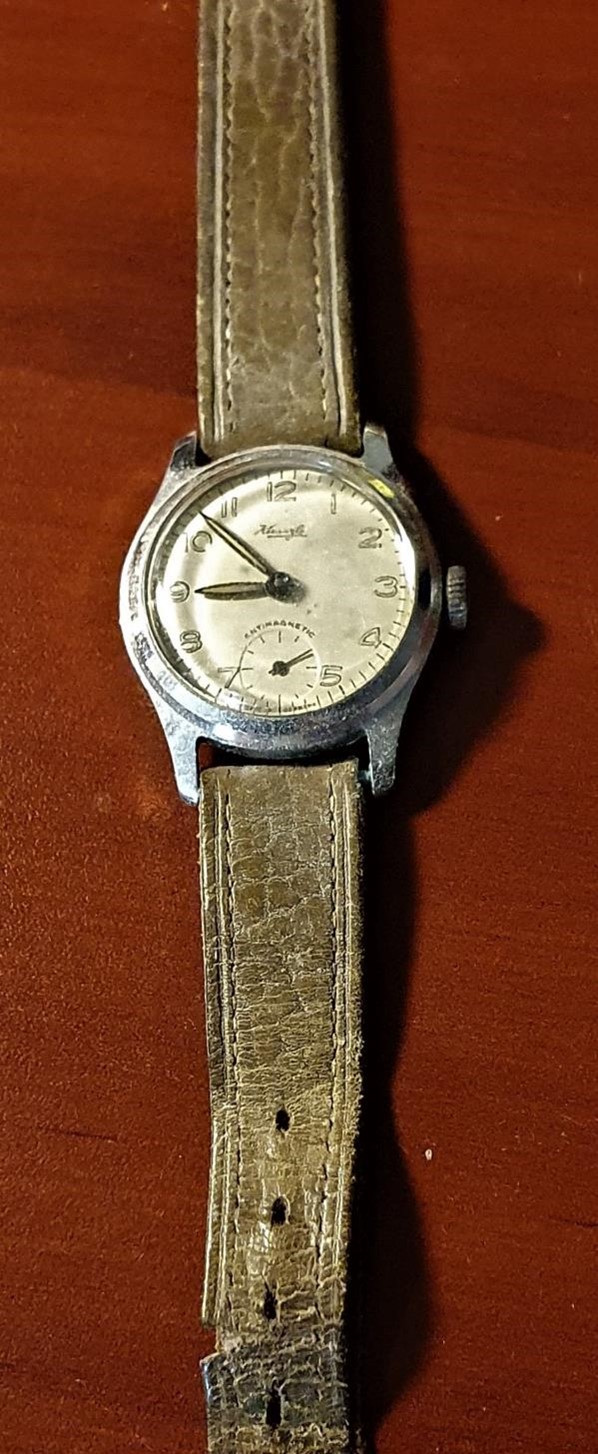
I have no keepsakes that date from my youngest years, but I do still have the watch my parents gave me just before I left home. I’d never owned a watch but now I was 16 and heading off to work in Edinburgh. So Dad took me to the only place in town that sold watches, a tiny jeweller’s shop. There was a choice of about three, and I took the one with a grey strap and a straightforward watch face. As you’ll see from the photo, it was worn for years. It was a wind-up watch, of course, and the innards seized up a long time ago. Why do I still have the watch? Two things make it significant and memorable: it was a gift from my mum and dad, and I was given it just as I left home. So I’ve kept it.

But some folks seem to have the philosophy ‘everything we get we keep’. They let go of next to nothing. I visited one home where, once through the front door, I had to edge my way between mountains of stuff – broken appliances, stacks and stacks of papers, rails filled with old clothing, hundreds of books and magazines. I was invited to sit down. I couldn’t see where, but then my host cleared some heaps and revealed a chair. This wasn’t the only home I’ve visited like that. I can’t imagine what it was like to live there, or how great the fire risk was.

I’ve also seen overflowing work offices. I called on one senior official who had completely filled his private office with paperwork, so we met in his second office which was almost submerged as well. Apparently he was negotiating for a third office. I think it was Dale Carnegie who said a CEO offered to pay him any amount for advice on how to clear his clutter. He too had filled more than one office with ‘stuff’. Carnegie gave him just one bit of advice: pick up a piece of paper and don’t put it down again until you have done something final with it (like writing a reply or throwing it in the bin). In other words, do something that means you’ll never see that paper again. The executive called him just two weeks later. He’d done exactly what he was told, and he’d already cleared several desks of everything on them, and found two typewriters that had been missing for years.

The presenters of ‘de-clutter your home’ TV programmes often say the problem people have with parting with things is emotional. Memories are attached to everything they’ve acquired. I can only respond this way: the cost of keeping is higher than the cost of parting; parting is brief pain but keeping is pain that lasts for years.

Can’t let it go? Yes you can.

Undone and unfinished things

I studied bereavement counselling while preparing to be a pastor. I was told that, as well as grief, the most common emotion felt by bereaved relatives is guilt. Guilt – because of visits not made. Guilt- because of harsh words spoken in the last conversation. Guilt – because ‘I love you’ hadn’t been said for years. Guilt – because an argument that divided the family 20 years earlier hadn’t been resolved. When it’s too late to put things right, guilt is hard to let go.

The same is true for people who missed an opportunity which never came again. Perhaps a relationship was so special it would surely lead to marriage, but no proposal was made and the couple drifted apart. But one of them can’t let go of what might have been.

Or a missed opportunity at work. A big promotion is offered, but means moving to an overseas location. That would disrupt the family, involve learning a new language, and demand working all hours. So the promotion is turned down. But the firm is unforgiving. No other promotions are offered and as year after year of mundane work goes past, it’s hard not to think ‘If only…’.

Others have missed the chance to upgrade their skills. Martin’s employer was willing to let him study part-time for a PhD. With that qualification, he’d be on track for a top position. Martin began his studies, made good progress, but after two years got involved in significant work projects, family needs, hobbies and outdoor activities. With just one more year before getting his PhD, he paused. And he never finished. Every year since, Martin couldn’t let go of disappointment he hadn’t completed his PhD degree.

‘There is a time for everything…’ says the writer of Ecclesiastes (ch. 3:1). We mustn’t miss that time.

Failure
Everyone fails. But some failures stay with us more than others.

That’s especially true when we’ve betrayed a relationship. Cheating on a marriage is an obvious example. ‘How could I do that?’ is the lingering question.

Letting a friend down is also damaging. Imagine sympathising with a colleague who has been harassed by a fellow-worker, promising that if she complains about her harassment to the boss, you’ll support her because you’ve been harassed too. Your colleague lodges her complaint, the boss isn’t sympathetic, so now you keep quiet about your experience. Your friend feels abandoned and isolated. She resigns. You feel terrible. You let her down, and ever since you can’t let go of the fact that you failed her.

Or you promised to be with a friend at a special event – his wedding, or graduation, or a family funeral – but at the last moment someone gave you a ticket for a great seat to watch a top-level football match. You couldn’t miss the chance – you had to go to the match. But your friend never understood. You’d promised to be with him, and you abandoned him for a football match! He is hurt dreadfully, and you realise you’ve made an appalling mistake. You feel dreadful, and you can’t let that feeling go.

Choices have consequences, and those consequences can last a long time.

The good things

Usually negative experiences linger longer than positives in our minds. But, thankfully, the good things are sometimes the ones which we can’t let go. Wonderful times which we’ll never forget.

I’ll supply only one experience, though it happened four times. I’ll never let go of the immense privilege and joy at watching each of my four children come into the world. Men have it easy at childbirth. Alison took all the pain and did all the hard work while I just held her hand and said encouraging words. Then, after each of the children arrived safely, I proudly held them in my arms. I could never let go of that experience. (It’s mirrored these days with the joy of seeing how their lives have developed.)

That’s not an experience everyone has. But almost everyone has something or many things for which they’re immensely grateful. They’d never have wanted that part of their lives to have been any different. So they could never let go of those moments. We should all be grateful for them.

But, in closing, how do we let go of the bad or sad memories? I could write about counselling, about finding forgiveness, or about making a firm decision not to dwell on these times. All three of those would be appropriate.

However, on this occasion I’ll end by saying we can’t let go of certain experiences and, in one sense, we shouldn’t let go of them. Why? Because these things have shaped the person we are today. Because we got things wrong or because we went through dark times we’ve been changed. Perhaps we’re determined never to do something again, never to let down a friend, never to fail a colleague in their time of need. Or, because we’ve survived we’re stronger, and we’re more understanding when others face horrible tragedies. We can’t turn the bad thing of the past into a good thing, but we can transform its effects into something useful, something that makes us better, more careful, more considerate, and more resilient than we would otherwise have been.

So, what you can’t let go needs to become what you can’t do without to be the person you are now, or the one you are on the way to becoming. I realise that’s easy to write and hard to do, so my thoughts and prayers are with all who keep struggling.

——————————–

Note 1  My apologies that this blog is posted later than I’d imagined. I anticipated a delay, but not for this long. I doubt if the gap has broken anyone’s heart, but I am sorry and hope pauses won’t happen often.

Note 2  The podcast I described is the NPR Politics Podcast: https://www.npr.org/podcasts/510310/npr-politics-podcast  It’s refreshingly unbiased, serious but never boring. To hear the ‘can’t let go’ segment you need to listen to the Friday edition where they sum up the week’s news and then use the last five minutes to describe what they ‘can’t let go’ from that week’s news, whether it’s about politics or anything else. Enjoy!

Plundering the archives

We all have the experience that ‘life gets in the way’ of what we plan to do. Last week we had an unexpected need to transport a bed inside our car. (Yes, inside the car – and it’s not an especially big car but we got the bed in.) This week builders arrived to repair the fence between our house and the neighbour’s which, even though it’s not our fence, took time and imprisoned our dogs indoors. We were glad to move the bed to help out family, and we’re glad the fence has been fixed. Things like these come along, and they have to be fitted in.

All this is to say that right now I have one of my major study assignments to write, and it’s taken longer than I expected. So – with another major part of my life taking my time – I haven’t been able to create a blog article this week. My apologies, but the assignment really must have priority over the blog.

Instead, I’ve looked back over 2021 and identified a few of the archived blogs which I know have been read more often than most. (I don’t know who reads each blog, but I do know the number who read each one.)

There are six listed just below. One is fairly recent (The Tay Bridge disaster) and the rest from further back.

Of course there are 40+ in the archives, and you can pick out any of them for reading now.

Whether my selection or others, I hope you find something useful. And my sincere apologies for the delay in offering a fresh article. Normal service will be resumed as soon as possible.

Here’s the list:

How a motorcycle crash changed my life (but not in the way you think)  June 19, 2021

Blind to what’s obvious August 22, 2021

The Tay Bridge disaster October 31, 2021

How we caused a plague of frogs  June 12, 2021

Surviving Susie April 18, 2021

Being true to your word (and suspicious of your car nav system) June 6, 2021

To find any of these, just click on the ‘month’ links under Archived blogs and you’ll be in the right month to find the one you want.

You get to the same place by using a web link like this: https://occasionallywise.com/2021/06/ The numbers in the link are a date, so the link I’ve used as an example would take you to blogs in the month of June 2021. If you wanted to access April, change the ‘06’ to ‘04’, or to September by changing the ‘06’ to ‘09’, and so on.