Keep on keeping on

Who recorded this entry in their autobiography?

Well, my book was finally written. The next thing was to find a publisher. I typewrote it myself, on my old secondhand typewriter that never made the capitals plain and wouldn’t print “w” at all, and I sent it to a new American firm that had recently come to the front with several “best sellers.” I thought I might stand a better chance with a new firm than with an old established one that had already a preferred list of writers. But the new firm very promptly sent it back. Next I sent it to one of the “old, established firms” and the old established firm sent it back. Then I sent it, in turn, to three “Betwixt-and-between firms”, and they all sent it back. Four of them returned it with a cold, printed note of rejection; one of them “damned with faint praise.” They wrote that “Our readers report that they find some merit in your story, but not enough to warrant its acceptance.”

That finished me. I put **** away in an old hat-box in the clothes room, resolving that some day when I had time I would take her and reduce her to the original seven chapters of her first incarnation. In that case I was tolerably sure of getting thirty-five dollars for her at least, and perhaps even forty.

The manuscript lay in the hatbox until I came across it one winter day while rummaging. I began turning over the leaves, reading a bit here and there. It didn’t seem so very bad. “I’ll try once more,” I thought. The result was that a couple of months later an entry appeared in my journal to the effect that my book had been accepted. After some natural jubilation I wrote: “The book may or may not succeed. I wrote it for love, not money, but very often such books are the most successful, just as everything in the world that is born of true love has life in it, as nothing constructed for mercenary ends can ever have.

“Well, I’ve written my book! The dream dreamed years ago at that old brown desk in school has come true at last after years of toil and struggle. And the realization is sweet, almost as sweet as the dream.”

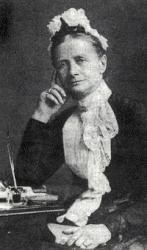
If you’re struggling to identify the writer, here are a few clues: Canadian, female, born 1874, died 1942, the four letter word I’ve hidden with stars **** is the first name of her best-known character, and that character famously insisted the last letter of her name was an ‘e’.

By now many will have realised the book being talked about is Anne of Green Gables. It was the first and the most famous work of Lucy Maud Montgomery.

L.M. Montgomery’s book was published in 1908. It has sold more than 50 million copies, and been translated into at least 36 languages. Anne of Green Gables is usually mentioned when people are listing the best-sellers of all time in all languages. After success with Anne, Montgomery wrote many more books.[1] Some were sequels to Anne of Green Gables, though by 1920 Montgomery recorded in her journal that she was tired of Anne as a character. In all she penned 20 novels, over 500 short stories, an autobiography, and a book of poetry. Not bad.

But what if Lucy Maud Montgomery had never retrieved that first manuscript from her hatbox? What if she’d been so discouraged by publishers’ refusals that she had never sent it to the Page Company of Boston, Massachusetts? But she did send it, and Anne’s appeal to both children and adults was recognised. The rest is literary history.

A modern day parallel to Montgomery’s publishing experience involves another female writer, J.K. Rowling.[2] She finished writing Harry Potter and the Philosopher’s Stone in June 1995, and was accepted as a client by a noted literary agency. But her fantasy novel was then turned down by 12 publishers. Finally, it was bought by Bloomsbury Publishing because the head of the firm let his young daughter read the manuscript, and saw how she kept wanting to read chapter after chapter. Harry Potter and the Philosopher’s Stone was published in 1997, the first of seven volumes in the Harry Potter series which has sold over 600 million copies, been translated into 84 languages, and made into successful films.

There are two immediate lessons from the experiences of these women. One, even the most famous writers have endured multiple disappointments when their work has been rejected. Two, many publishers must weep over best-sellers they could have accepted but didn’t.

For me, the most impressive lesson is that these two wonderful women writers didn’t give up. They kept on keeping on, and eventually found success. They persevered.

Perseverance is an important character trait. I looked up perseverance in my thesaurus for words of similar meaning, and got this entry: constancy, dedication, determination, doggedness, endurance, indefatigability, persistence, purposefulness, resolution, sedulity, stamina, steadfastness, tenacity.

So, exploring the theme of keep on keeping on, I’ll expand on some of the words my thesaurus gave me, hoping that will help us understand the value of perseverance.

Purposefulness

During the time I was a reporter in the Glasgow office of a national newspaper, one of the journalists retired after working there for 40 years. The staff gathered round, speeches were made, glasses were raised, and parting gifts were given. Then the elderly reporter left, and everyone else returned to work on their stories.

On the Monday following, the team were back at work, and, to everyone’s surprise, the retired journalist was back too. And he was there on the Tuesday. And Wednesday. And Thursday. And every day after that. Our former colleague simply couldn’t cope with sitting around at home with no purpose for each day. Once it was obvious he’d keep coming to the office, the news editor let him report on minor stories. Which he did for many months.

We all need purpose in our lives. It may come from paid work, or from family, study, caring for others, from a compelling sport or hobby, community projects, or many other things. There is a strong drive to keep doing what gives us purpose.

A motivating purpose is an essential element of perseverance. In 1924 George Mallory made his third attempt to reach Everest’s summit. If he succeeded, he’d be the first to stand on top of the world’s highest mountain. It was his life’s goal. Mallory – and his climbing partner, Andrew (Sandy) Irvine – knew there was a high risk of failure and death. So, in his final letter to his wife Ruth, Mallory wrote, “It is 50 to 1 against us but we’ll have a whack yet & do ourselves proud”. Soon after, Mallory and Irvine disappeared in the mist, and it has never been known for sure whether or not they reached Everest’s summit. (Their bodies were finally discovered only in 1999 and 2024.) Maybe they were right to try; maybe they should not. But, imbued with a driving purpose, they felt they must make one final attempt, whatever the consequence.

Perseverance and purpose are inextricably linked together.

Stamina

I have painful and humbling memories from the school day when the P.E. teacher told us to run four laps of the athletic track. I started well, by which I mean only that I almost kept up with everyone else during lap one. Lap two wasn’t as good, but I got round it without completely losing sight of the leaders. My mental and physical agony began on the third lap. For one thing the leaders were going past me on their fourth lap. For another thing I had a near disabling pain in my side, and my legs were getting heavier with every stride. My humiliation and suffering peaked on lap four. Clearly someone had secretly attached invisible lead weights to my legs, because now they refused any signal from my brain to go faster. I kept telling my legs to run, but they weren’t listening. In fact running was now no more than a dream. All I could do was drag my legs forward, one painful step after another. I never finished. I just didn’t have what it takes to run four laps of that track.

What was missing was stamina. I had a purpose, a goal to get round all four laps as quickly as possible. But neither my head nor my body could supply the staying power to keep running.

The inability to last the course is disturbingly common. I’ve watched marathon races in both London and Chicago. The elite runners did really well. The good runners kept striving for PBs (personal best times). But then, long after most, came the mass of marathon one-timers. For too many of them, training had been little more than occasional runs around their local park, which was seriously inadequate preparation for a 26.2 mile (42km) race. They failed, some because they hadn’t prepared their bodies, and others because they had never really believed they could run the distance, and therefore gave up as soon as they experienced pain.

Similarly, I’ve seen work colleagues give up on complex tasks. When they couldn’t find answers immediately, they didn’t keep trying; they just abandoned the project. I’ve known dog owners take their puppies to obedience classes, but completely fail later to continue the disciplines with their dog. One owner shrugged his shoulders and muttered “the training didn’t work”. Wrong. The owner didn’t work. He didn’t keep applying the lessons until the dog really knew what to do. He should have kept trying, kept persevering. But he didn’t. He lacked stamina, an essential element for reaching any important goal.

Constancy

I like this word. Dictionaries define it with synonyms and phrases like ‘faithfulness’, ‘fidelity’, ‘loyalty’, ‘dependability’, ‘endurance’, ‘steadfastness of mind under duress’, ‘quality of being unchanging’. In short, constancy describes the character of someone who sticks to their task, who can be depended on not to give up, who won’t be swayed by persuasion, problems, or even occasional failures. They will do what they said they will do.

Angie was like that. She wasn’t the brightest or the quickest, but give Angie a job to do and she’d work away quietly and steadily and produce good results. I never had to worry that she wouldn’t be thorough, or that she’d give up. Angie just kept going and did her work well. Colleagues like Angie were priceless.

I’ve had friends like that, people who were far more than just casual acquaintances. They supported me through the hardest of times, knew my mistakes but didn’t judge me, and they stuck with me for the long-term when others would have given up. I knew I could trust my life to friends like that. Constancy very well describes the quality I saw in them.

Sedulity

I admit I didn’t know the word ‘sedulity’ so I looked it up. The dictionary defines sedulity as ‘the quality or fact of being careful and using a lot of effort. Two key aspects of perseverance are highlighted in that definition.

One is about being careful. Perseverance does not legitimise persisting with unwise or unrealistic projects. I know of someone who applied for a new line of work, and wrote that he knew the new role must be right for him because every career choice he’d made before had come to nothing. I can’t imagine why he thought writing that in his application would help. Maybe he imagined that his persistence in trying was a quality, or that by discovering what was not right for him, his latest choice must be the one that was right for him. Those considering his application did not agree. The applicant showed perseverance, but no evidence of being careful about either his career choices or his standard of work.  

Sedulity also means working hard. An oft-used phrase is ‘when the going gets tough, the tough get going’. That’s clever but too trite. However, there is some truth in it. In my mid-20s, I was employed by a local council’s education department to organise school buses for children who lived beyond walking distance from their schools. (Note for North America friends: school bussing in the UK is done by contracts with private bus or coach firms, not by owning a fleet of buses.) I began by studying the established routes which for many years had been put out for bids to contractors. They made no sense to me. The most blatant nonsense was that no children lived on some of those routes. At one time they had, but not now. I talked to the bosses of the bus firms, and then understood what had happened over the years. Keeping track of children needing transport was problematic – new children moved into the area; around age 12 children switched from primary to secondary schools; older children finished schooling; some elected to go to other schools; others just moved out of our area. It was complex. So complex that my predecessors in the job just accepted it was a muddle, put out the same routes year after year and left the bus owners to make the best of the bad information. They did what they could, but the system wasn’t right and wasn’t efficient. Buses went down ‘empty’ routes, and other kids got no transport. That was no way to serve families or run a budget-hungry service. Working with the schools, I tracked who needed the service now, plotted routes on maps, and then sent out the detailed routes for tenders. The new system worked, much to the relief of parents, schools and (mostly) the contractors. Perseverance often requires digging in to complicated and awkward issues, and working for as long as it takes to sort them out.

Dedication 

This is another word I like. It carries meanings like devotedness, faithfulness, loyalty and commitment. No-one ‘keeps keeping on’ without those qualities.

The story of dedication I grew up with in Scotland, and also known around the world, is not about a person’s devotion but a dog’s – Greyfriars Bobby. Here’s a short version of Bobby’s story.

In the 1850s, in Scotland’s capital city of Edinburgh, John Gray kept himself out of the workhouse by being hired as a night watchman with the city’s police force. His partner through cold winter nights was his small Skye Terrier, Bobby. Night after night, they were an inseparable pair as they walked Edinburgh’s cobbled streets together. But those hard nights damaged John’s health, and he died of tuberculosis in 1858, and was buried in the small cemetery surrounding Greyfriars Kirk (church). After the funeral service in the churchyard, everyone left. Except Bobby. From then on, day and night, and whatever the weather, Bobby stayed by his master’s grave. A graveyard gardener eventually put sacking between two adjacent ‘tablestones’ (gravestones mounted horizontally about 30 inches (76 cm) off the ground) so Bobby had shelter. And a local joiner persuaded Bobby to go with him to a coffee house each day where Bobby was given a meal. When a city law was passed that all dogs must have a licence or be destroyed, the Lord Provost paid for Bobby’s licence and gave him a unique collar attesting to that. For 14 years Bobby kept watch over his master’s grave, and then he died in 1872. The following year a granite fountain with a sculpture of Bobby was erected near the entrance to the Greyfriars Kirkyard. It is still there, and has this inscription: “A tribute to the affectionate fidelity of GREYFRIARS BOBBY. In 1858 this faithful dog followed the remains of his master to Greyfriars Churchyard and lingered near to the spot until his death in 1872”.[1]

The life size statue to Greyfriars Bobby.
Michael Reeve, CC BY-SA 3.0 <http://creativecommons.org/licenses/by-sa/3.0/&gt;, via Wikimedia Commons

Bobby’s dedication to his master was remarkable. Similarly, people who persevere must be devoted, loyal, and committed. How dedication is shown depends on circumstances, but no-one will keep keeping on without it. Just these words in closing. Too often these days we want everything now or to get them without effort. Governments are supposed to deliver results from the day they’re elected. Employees are meant to plan and deliver projects without delay. Things we want to buy we buy now, whether or not we have the money. Relationships – including marriages – are supposed to be wonderful for ever without pain or strain. But reality is different. The best accomplishments require time and work. That means they require perseverance, which includes the qualities listed above. Keep on keeping on. It’s worth it.


[1] A favourite of mine is Rilla of Ingleside, a story centred on Rilla (a short form of Marilla), the youngest child of Anne. The book is the eighth and last in the Anne of Green Gables series.

[2] It is interesting that both Montgomery and Rowling used initials and not first names for their books. Montgomery had adopted that practice with short stories she wrote before ‘Anne’. It was a common custom at the time for women writers to hide their gender. Rowling was born Joanne Rowling. But her publisher urged her to have a gender-neutral pen name, so she added Kathleen as a middle name and used the initials J.K. She was working for Amnesty International in London when she began writing the Harry Potter series.

[3] Though I’ve known the story of Greyfriars Bobby since childhood, my summary here is based on the record made by Historic UK: https://www.historic-uk.com/HistoryUK/HistoryofScotland/Greyfriars-Bobby/

When Jesus was a refugee

The hand on the woman’s shoulder was gentle, yet firm enough to stir her from deep sleep. “Mary,” the man said, “please wake up”. The room was in complete darkness. Only the familiar voice quelled Mary’s instinct to panic.

“Joseph, why are you awake? What’s happening? It must be the middle of the night,” she said.

“It is, and we need to pack what we can, take our son, and leave right now.”

“Joseph, you’re scaring me. What’s wrong? Where are we going and why must we leave now? Just come back to bed. We can talk this through in the morning.”

Joseph’s voice did not waver. “No, Mary. Please trust me. We must gather our things and be well on our way before daylight. If not, our son’s life will be at risk.”

There was no more argument. Mary rose, and by nothing more than the light of one candle, she and Joseph gathered clothes, blanket, food, and their few special possessions. Finally, they lifted Jesus from his bed, made soothing noises to keep him quiet, left the first home they’d known as a family, and set off into the cold night air.

Joseph, of course, will have given Mary further details as they trekked through the darkness, explaining what had happened to move him to such urgent action. The gospel writer Matthew describes it this way: “an angel of the Lord appeared to Joseph in a dream. ‘Get up,’ he said, ‘take the child and his mother and escape to Egypt. Stay there until I tell you, for Herod is going to search for the child to kill him.’” (2: 13)

Mary was startled. Who wouldn’t be? To set off by night on a long and dangerous journey because of a dream? Going to another country with no definite destination? Yet, so much in recent years for Mary had been strange, especially her own encounter with an angel who told her she’d bear God’s child. (Luke 1: 26-38)

But this? A sudden rush into the night? Fleeing the country? Hiding their child from soldiers ordered to kill him? Questions, many questions. But no refusal by Mary. Out into the night they went as a family, and headed for safety in Egypt.

The courage, faith and resilience of both these parents is remarkable. Down the centuries, Mary has rightly been recognised for her submission to God. “I am the Lord’s servant… May your word to me be fulfilled,” she answered the angel who spoke to her. (Luke 1: 38) Mary was a woman of faith. And so was Joseph. His obedience in marrying Mary must have damaged his reputation. Yet he didn’t hesitate. Nor does he hesitate now, as he gets Mary and Jesus on the road to safety in another country.

Taking turns to carry Jesus, Joseph and Mary walked and walked. Step after weary step they trudged south. Even the shortest distance to the border was about 40 miles (64 km). But they needed to go further than that, probably at least 50 or 60 miles to reach a city where they wouldn’t be noticed among the throng. With just two carrying the essentials of three, they couldn’t have covered more than 10 miles a day. Nor, while still in Judea, could they risk staying at an inn because someone might tell Herod’s soldiers that a family from Bethlehem with a young boy was there. So, each night, the three likely huddled under a blanket at the side of the road. It would be cold, uncomfortable and very dangerous. Travellers were favourite targets for wayside robbers, and they could be as vicious as Herod’s men.

Day after day they put one foot in front of the other, always weary on dusty, uneven roads, always uncertain about what lay ahead. They were doing exactly what they’d been told to do, but that didn’t ease aching feet or quell anxious thoughts. God’s will is rarely easy. Hardship is a frequent landmark on the road of discipleship.

Becoming refugees seemed so wrong, yet it was also significant. Egypt was the convenient and safe refuge for a Judean family in danger. Crossing the border put them beyond Herod’s reach. But genuine refugees – then and now – are vulnerable: often penniless, often homeless, often unfamiliar with the local language, often unable to find work.

But Joseph, Mary and Jesus had one advantage. The road to Egypt has been walked by many Jews before them, often for similar reasons to theirs. At that time, the Egyptian city of Alexandria had over a million Jews; others were elsewhere. So, wherever the little family settled, they would find fellow countrymen, people with similar backgrounds who understood what they were experiencing. Speaking the same language, they would explain customs and laws, and help with accommodation and employment.

But, along with all the practical issues, Joseph and Mary had one troubling thought. They knew Jesus was no ordinary child. Joseph had been told to name him Jesus “because he will save his people from their sins”. (Matt. 1: 21) And Mary was told: “He will be great and will be called the Son of the Most High. The Lord God will give him the throne of his father David, and he will reign over Jacob’s descendants forever; his kingdom will never end… the holy one to be born will be called the Son of God.” (Luke 1:32-33, 35) Both believed those words were from God, and everything that happened at the time of Jesus’ birth and in the months after confirmed their truth. In their care was the Son of God, and they had fled to Egypt to keep him alive.

But, they must have wondered, how can these amazing promises about Jesus be fulfilled if he is in Egypt? Surely God could have protected him back in Judea, but they had been told to flee. Joseph and Mary wanted their son to grow up and fulfil all the prophecies about him. But he couldn’t fulfil them if he was in Egypt.

What the couple could not know was how long they would stay in Egypt, and what reasons, other than physical safety, God had for them being there. They may have assumed there was a straight line for Jesus from his birth through his youth and then to saving people from their sins and reigning over a new kingdom. But God never promises straight lines. When we find our lives in strange places, it may be because our route needed to change so skills could be learned, character developed, wisdom gained, and bad times endured.

Matthew saw one other reason for this strange period in Jesus’ life. A prophecy would be fulfilled when the family finally left Egypt and returned to Judea. He wrote: “And so was fulfilled what the Lord had said through the prophet: ‘Out of Egypt I called my son.’” (2: 15) That prophecy first appears in the Old Testament book of Hosea (11: 1) where it refers to God bringing his son, the nation Israel, out of its captivity in Egypt (the Exodus story). Matthew saw how that prophecy also applies to Jesus. God’s Son will come out of Egypt. But, of course, with Jesus it has a greater significance: Israel was the redeemed people God called out of Egypt, but Jesus is the redeemer called out of Egypt.

Then it was time to go home, but that was fraught with danger too. King Herod died. The tyrant who thought nothing of killing babies and toddlers in Bethlehem went to meet his maker. It’s hard to imagine that was a happy meeting.

Now the ruler who wanted to kill Jesus was gone. Again Joseph was spoken to by an angel in a dream. “Get up, take the child and his mother and go…” It was time to return to the land of Israel, “for those who were trying to take the child’s life are dead.” (2: 20)

Joseph could have argued. The family had settled in Egypt. They had blended in well to the Jewish and Egyptian communities. He had carpentry work. Joseph and Mary had made friends. Jesus had playmates. To live there for longer – perhaps for ever – wasn’t a bad idea.

But it would have been the wrong idea. So Joseph did not debate with the angel. The family sorted out their possessions, and set off north. This time they could travel in daylight, but they knew the journey would still be demanding and dangerous. Though nervous, tired, and uncertain they were also obedient. They had been told to return, so they would. Joseph assumed they’d resettle in Bethlehem in Judea. It was where they’d lived after Jesus was born, and, being a royal city, it was a place appropriate for God’s Messiah.

But there was something Joseph didn’t know. He had assumed that with Herod dead, life in Bethlehem would surely be better and safer now. It wasn’t. It was worse.

Herod had ruled over a sizeable country, but he knew the Romans would not let a successor have so much power. So he had written a will which divided the land after his death between three sons. Herod Philip got the northern region called Trachonitis, Antipas was given Galilee, and the largest area, which included Idumaea, Judea, and Samaria, went to Archelaus. What sent shivers through Joseph was the last of these appointments – that Archelaus now ruled Judea. Why was that a problem? Bethlehem was in Judea. And, if Herod had been evil, Archelaus was twice as evil and twice as vindictive as his father. He wanted no rivals and no contrary voices, so he began his reign by killing 3000 of the most influential people in the land. If Archelaus would eliminate them, and now learned that the child his father had wanted dead was back in Bethlehem, he’d have no scruples about dispatching a murder squad to kill Jesus and probably Joseph and Mary too. Archelaus’ rulership over Judea made it impossible for the family to settle there.

In another dream Joseph was told to take the family even further north. This time their goal was Nazareth in Galilee. That was an extra 90 miles (145 km) over hills and through areas made dangerous by wild animals and thieves. But Nazareth was a familiar place for Joseph and Mary because it’s where they had grown up. And the important point was that Archelaus did not rule there.[1] Nazareth was in Galilee where Antipas was in charge. Though another of Herod’s sons, Antipas was a peaceful and good ruler. In Nazareth, the family were safe.[2] It was the right place for them to raise Jesus to be the man, the Saviour, the Lord he was always meant to be.

Here we (nearly) end the two-part story of the events which occurred after Jesus was born. Part one was the previous blog post about the visit of the wise men, and this one has described how Jesus became a refugee in Egypt, and then returned to his homeland. If you have not read part one, you’ll still find it helpful. You can access it at https://occasionallywise.com/?s=wise+men

From both parts of the story, and from my Christian perspective, I draw several lessons, including these seven.

It is remarkable but important that people from another land came and worshipped Jesus soon after his birth. The divine purpose may have been to show that one day every knee will bow before him (as Paul wrote in his letter to the Philippians, 2: 10).

The wise men risked their lives for Jesus by disobeying Herod’s command to reveal his location. Many have done the same since, with some making the ultimate sacrifice for their loyalty.

There  is no shortage of cruelty in the world. The evil of Herod, who had Bethlehem children murdered in an attempt to eliminate Jesus, and later the even greater ruthlessness of his son Archelaus as ruler over Judea, shows just how cold-hearted and brutal human beings can be to harmless and innocent people.

Guidance from God can come in strange, unexpected ways. But, for Joseph, it was always there when he needed it. At no point was the whole plan given to Joseph in advance, but he was always told in time what to do next.

Paths through life have frequent twists and turns. We get scared when plans are forced to change. That’s because we can’t see round corners, but God can and knows exactly what he is doing with our lives.

There’s no guarantee that, even in the centre of God’s will, life will be comfortable. The night when Joseph woke Mary and told her they had to flee, the couple had two choices. One was to stay in Bethlehem where they had settled – but then their little child would be murdered. The other was to get started while it was still dark, take almost nothing with them, and flee for their lives to a foreign land where they had no friends, no place to live, no means of support and did not know the language.

Of course the right choice was to flee. They did that one hundred percent in the middle of God’s will. But, that meant letting go of every shred of comfort and security, and becoming refugees. It’s a myth that doing what God wants will leave us feeling cosy and comfortable. But choosing what’s right, even when it’s tough, is always for the best.

God’s ultimate purposes do get fulfilled. Think how the story from the beginning of the gospel to now could have gone:

  • Mary: stoned to death for getting pregnant outside marriage
  • Joseph, to whom she was engaged, abandoning Mary because he knew he was not the father of her child
  • While they were travelling from Nazareth to Bethlehem, the couple could have been robbed or murdered, or Mary might have gone into labour on a remote hillside
  • Mary and Jesus could have died while she gave birth in a far-from-clinically-clean stable
  • Herod’s murder squad could have found and killed Jesus before they’d had time to escape
  • After they set off at night for Egypt, evil people or wild animals could have killed them and left their bodies at the side of the road
  • When they were settled in Egypt, Joseph might have felt secure, grown weary with moving about, and decided they should stay rather than return to Israel
  • If they had gone back to Judea, the seriously wicked son of Herod – Archelaus – might have murdered the whole family.

But none of that happened. God had a plan for his Son’s life and nothing was going to stop it. That is true also for everyone who belongs to God. Probably our paths through life will not be so dramatic as the path was for Jesus’ family, but we will be every bit as safe in the hands of God.


[1] Unfortunately for Archelaus he had one other flaw – he was hopelessly incompetent, and the Romans deposed and replaced him after just two years.

[2] Nazareth was not a tiny village, but also not a place of great note. It is never mentioned in the Old Testament.

Doubly wise men

If I was writing a novel about the birth of God’s Son, I would not have him born in a stable, laid in an animals’ food trough, make his first visitors people with low status like shepherds, and later have him worshipped by people with uncertain beliefs who arrived from a foreign land. But that is the Christmas story as given in the Bible.

Today we call the people from another land ‘wise men’ or ‘kings’. They were wise men but almost certainly not kings. The New Testament story of the wise men comes from the gospel writer Matthew (chapter 2). He wrote in Greek, and he describe the visitors as magi, the plural form of the word magos. A lexicon (dictionary) will give the meaning of magos as sage, magician or sorcerer. Those definitions are not wrong, but that doesn’t mean each is appropriate for the men who visited Jesus. I will explain.

The Magi were a Median tribe, part of the Persian empire. They were people with great learning and understanding, so much so that as priests they became advisors to Persian kings. Hence it’s right to describe them as ‘wise men’. Part of their wisdom came from study of old disciplines such as philosophy, medicine and the natural world. The natural world included the stars which at least some magi observed very carefully.

These were the magi who travelled many miles to worship Jesus. They likely held ideas many of us would regard as strange, but they were good men, holy men. Decades or centuries later, the word magos also became used for less worthy people: sorcerers, fortune-tellers, magicians. (In fact, our word ‘magic’ comes from magos.) But there is no sign at all that the magi Matthew writes about were sorcerers or magicians. They were men who studied the stars, and one night they saw a star rise in the sky. We don’t know how, but they understood that star meant God had sent a new-born baby to be King of the Jews.

Where did the Magi[1] come from?

We know only that they came from the east. There has been no shortage of speculation about where exactly they travelled from. If you look on a modern map, then east of Israel are countries such as Iraq, Iran, Afghanistan, and eventually China. But ancient Persia – modern day Iran – is a very likely host country for magi such as the visitors to Jesus. In the centuries before Christ, Persia was vast in size. Its borders stretched from countries like those we now call Bulgaria, Romania, and Ukraine right across to parts of India, and also south into Egypt. By the time of Christ it was smaller, but still large. And a natural home for magi.

How far did they travel to find Jesus?

Since no-one knows precisely where these Magi made their home, the guesses of how far they journeyed to Jerusalem and then Bethlehem range from 500 miles up to 1200 miles. Starting from homes anywhere between those numbers means they had a very long journey. And, in those days, there were no cars, no trains, no planes, and no motorway standard roads.

How long did the journey take to get to Jesus and then back home?

We are not told, but we can assume that the wise men rode on camels. It’s highly likely, though, that they travelled as part of a larger party, and their attendants will have walked. Given the terrain, sometimes difficult weather, and the need of rest stops for both people and camels, they are unlikely to have covered more than 20 miles per day. If we assume their journey to Bethlehem was 1000 miles, we can make this calculation: 1000 miles ÷ 20 miles per day = 50 days. For the round trip, you should add in stops in Jerusalem and Bethlehem, and going home by a ‘minor road’. That means the journey out and back would take around 120 days, close to 4 months.

That is a long time to be away from home to visit a child you knew about only because of a star in the sky. The expenses (camels, servants, supplies) would be high. The risk – for there were many bandits dedicated to robbing rich travellers – was immense.

Put all this together, and it’s clear that these Magi made a major commitment of their lives for this journey. They saw a sign, and they went. All so they could kneel and give gifts to a very special child.

How many Magi were there?

Down the centuries, people have imagined there were three wise men. Paintings have always portrayed three, and later legend gave them names: Gaspar (or Caspar), Melchior, and Balthasar. Some have thought they represented the three continents recognised in ancient times, Europe, Asia, and Africa.

There may have been three wise men, but the gospel writer Matthew either did not know or was not interested in details of that kind. So their names, their origins, and even their number are all much later speculation. So, why has it been traditional to believe there were three wise men? Simply because three gifts are mentioned: gold, frankincense, and myrrh. But three gifts doesn’t prove there were three givers. Perhaps six, or eight, or ten magi all contributed to these gifts. We simply don’t know how many wise men there were.

Did they kneel before the manger to worship Jesus?

Works of art usually show these wise and wealthy men bowing humbly before Jesus in the manger. It’s a moving scene.

But they didn’t. and they didn’t because Jesus was no longer in a manger in a stable. We know that for two reasons. One is that Matthew (2: 11) wrote that the wise men visited Jesus in a house. The word Matthew used was the Greek oikos and oikos always means a dwelling, a place of human habitation. It would never be used for a cave or stable.

The second reason we know the wise men never went to the stable is that by the time the wise men could have arrived to worship Jesus he would be several months old. Joseph and Mary with Jesus will have continued to live in Bethlehem, but, understandably, not in a stable. Two factors indicate the time lapse before the visit of these Magi.

First, the time it took for them to travel. the wise men told Herod they had seen the star rise “of the one who has been born king of the Jews”. (2: 1-2) The child from God had been born, and they must pay him homage. So, after Jesus’ birth, they prepared for their journey, and then rode or walked many months to reach Jerusalem and then Bethlehem.

Second, the age of the children Herod ordered to be killed. What the wise men told King Herod had troubled him deeply. He hated the idea that another king had been born. So, when the Magi never returned to his palace to report Jesus’ exact whereabouts, Herod ordered his troops to slaughter all the boys born in or near Bethlehem “who were two years old and under, in accordance with the time he had learned from the Magi”. (2: 16) Matthew is quite specific that Herod targeted the boys born in Bethlehem within the time frame the wise men had given. That included those born up to two years previously.

Given these factors, the evidence is that considerable time elapsed before the wise men arrived. They were not visiting a newborn baby.

Is it not odd that holy men with generally contrary beliefs came to worship Jesus?

Yes, it does seem strange. In fact, it is also surprising that shepherds were the first to visit after Jesus’ birth. In those times, shepherds were not held in high regard. Spending day and night guarding their flocks meant they often failed to observe the ceremonial laws. But, in their favour, they were Jews, members of God’s ancient people.

The wise men were not Jews. We know they had high rank and considerable wealth because their gifts were expensive. But they observed no Jewish laws and had no part in Jewish heritage. They came, honoured Jesus, and then they disappear completely from the story. There is no suggestion they became Jesus’ disciples. Our only information is that these were magi from another land, from a wholly different belief system, who saw a sign in the heavenlies which they rightly interpreted as indicating the birth of the child who would become king of the Jews, and they came to worship him. It is remarkable that God revealed such news to them, and also remarkable that they made a long, arduous and risky journey to find Jesus and when “they saw the child with his mother Mary… they bowed down and worshipped him.” (2: 11)

Now, none of that could have happened unless these Magi already believed in God. Their ideas will have been mixed with other beliefs that didn’t belong with either Judaism or (what became) Christianity, but they had sufficient faith in God to understand he was speaking to them by a special star in the sky. When that happened, they didn’t just stand back in amazement; they knew God wanted them to find this special child, and when they did they worshipped him. These were men who sought God, and God brought them nearer to himself by leading them to his Son so they could worship him. The lessons I take from that is that God can and will do whatever he wants with whomever he wants, and does remarkable things to draw people to himself.

But didn’t the wise men put Jesus at risk because of their visit?

Yes, looked at from a human perspective, they did put Jesus at risk. It’s a curious case of doing what was right by going to find Jesus, but in doing so they triggered Herod’s jealousy and murderous actions.

Let us be very clear: at no point did these Magi do wrong. They were right to make their long journey to worship Jesus, and, with the little they knew, it was understandable they went first to the royal palace to inquire about the birth of a new king of the Jews. They could not have known how alarming that would be to King Herod. And it was Herod who decided he must eliminate this risk to his throne. When he couldn’t find Jesus, he ordered (what we now call) the ‘slaughter of the innocents’ around Bethlehem.

Someone making a harsh judgment could say those two things – their visit and contact with Herod – cost the lives of many children. That person might say it would have been better if the wise men had never come.

However, the obvious truth is that the wise men did not motivate Herod to murder Jesus, nor his eventual decision to kill the young male children of Bethlehem. Herod, and Herod alone, is responsible for these dreadful deeds.

The horrific truth about King Herod is that these deaths in Bethlehem were not the greatest evil of his reign. All his life he’d done terrible things. Early in his rule he’d killed off half the Jewish Sanhedrin (the ruling court for the Jews). Later he’d had 300 of his court officers put to death. He also murdered his mother-in-law, his wife, and three of his sons. Finally, when he lay dying, he gave orders that one member of each family in Israel was to be killed. Why? To guarantee the nation would be mourning at the time he died. (Thankfully, with Herod dead, that last order was never carried out.) Herod has been described as “a man of ruthless cruelty…”. He certainly was.

This world has always had Herods, people with great power but few morals, people who will do anything to promote their interests, people who think nothing of sacrificing others to benefit themselves. That was true in the ancient world, true in the Middle Ages, true in modern times. Terrible people have always done terrible things to innocents who have done nothing to deserve it. In King Herod’s case his fear and jealousy were aroused by the visit of the Magi, but the wicked crimes that followed were Herod’s doing and Herod’s alone.

Did the wise men put their lives at risk by failing to return to Herod?

Yes, they certainly did. The Magi and their whole party might have been put to death by Herod’s soldiers.

After finding Jesus, the Magi were supposed to return to King Herod and reveal Jesus’ precise location in Bethlehem. He was very clear: “Report to me!” There was no option to refuse. This was a tyrant’s command, and failure to obey would cost them their lives.

The Magi had little time to consider their options. Bethlehem is only six miles from Jerusalem. That was only half a day’s walk, and Herod knew they could go one day and be back in his palace the next. Even if they’d stayed in Bethlehem for a couple of days, it needn’t be long before they stood in front of Herod again, this time with details of where the special baby could be found.

Herod, of course, had lied about why he wanted that information. He’d said he wanted to go and worship the child too. (2: 8) But the Magi got another divine message, this time a warning in a dream not to return to the palace, so they avoided Jerusalem and Herod, and took a back road to get out of the country.

That took great courage. First, they knew that Herod was a viciously cruel ruler who never tolerated disobedience. Second, he would certainly have them put to death if he caught them. Third, the wise men and their party could not journey inconspicuously. Herod’s soldiers would be hunting for them, and the local people might get a reward for revealing their whereabouts. There was a strong likelihood they’d be seen, reported, captured, and executed. Despite the risk, they took another route and headed home. It was a choice others would not have made.

So the wise men return to the east. But Jesus, of course, was still Herod’s target, and next time we’ll see how Joseph, Mary and Jesus became refugees who fled for their lives.

Last word on the wise men I think of these Magi as doubly wise men. First, they recognised God’s sign in the stars, and made an arduous and hazardous journey to worship a young child. They had the wisdom to obey a heavenly authority. Second, they then had the wisdom to disobey an earthly authority, accepting that decision could cost them their lives. But God’s priority was always their priority. You can never be wiser than that.


[1] I am giving an initial capital to Magi when referring directly to ‘the Magi’ of Matthew’s gospel, but using the lower case magi when referring to these priestly people more generally.

Christmas miscellany

There are only a few days to go before Christmas. In the UK, like many western countries, people seem geared towards an over-indulgent holiday season. Too much money will be spent on presents. Too much food and drink will be consumed. Too much effort will go into trying to ensure everyone has a wonderful time. Too much time will be spent watching special programmes on TV. And too few will reflect on the birthday of Jesus Christ, the event which should undergird everything we are celebrating.

But I’ve never believed in being a grumbler about Christmas. I enjoy Christmas though I admit that I don’t get close to crazy excited like I did when I was young. I’d wish more people thought about its origins, but even if they don’t it is still a wonderful season, including special time with family and giving and receiving presents.

For this last blog post before Christmas I’ve assembled a miscellany of things about Christmas. Some are serious, some less important. But I hope they’re all interesting. Enjoy reading.

Church or pub on Christmas Day

In the UK, only about 5 per cent of the population attend church regularly. That number may not be exact. Pollsters do not all use the same methods, and definitions of ‘regular church attendance’ aren’t all identical. Nevertheless, I suspect the 5 per cent figure is close to being right. My home nation is predominantly non-churched. Except, that is, at Christmas.

It’s not unusual to see full churches for Christmas Eve midnight services. I used to lead and preach at services like that. They could be eventful if some of those weaving their way home after an evening in the pub decided to join the service. All were welcome but not all were at peace with the world or church decorum.

Fewer attend church on Christmas Day. Other things capture attention, not least keeping children calm while they rip the paper wrappings off presents. Then there’s the massive task of preparing and serving a big meal for family and friends. Turkey is the traditional dish in the UK for a Christmas Day meal.

But ‘Statista’ asked people whether they plan to attend church on Christmas Day or spend their time and money in the pub. The answers they got surprised me. Take a look at the chart comparing church or pub attendance for the USA, UK and Germany.

Clearly the USA has the highest percentage of people who will attend church on Christmas Day – 19 per cent. To my surprise the UK trails by only 3 points at 16 per cent, but Germany scores only 12 per cent. However, what all three nations have in common is that church wins over pub. I don’t know why that happens. My guess is that, for some, there may be a long-observed family tradition of going to church on Christmas Day. Others may pass through church doors for a service of lessons and carols but that will be their one-time attendance until next Christmas. However, of course, most Christmas Day churchgoers are people with a real faith in Jesus. They make a priority of attending church to worship before other events overtake their day.  

The odd ancestry of Jesus

Some families have an unkempt uncle, an agonising aunt, or a grouchy grandparent, but Jesus had some really strange ancestors. Certainly Matthew, the writer of the first gospel in the New Testament, did not sanitise his list of Jesus’ forebears.

A few years ago I wrote two blog posts about those ancestors of Jesus. If you haven’t read those posts, I’d encourage you to do so now. I promise they’re interesting, challenging and encouraging. Here are the links:

Why is Christmas on December 25?

Why the 25th of December? Well, the first thing to say is that it’s unlikely that Jesus was born in late December. Scholars point out that shepherds wouldn’t have their flocks out in fields in mid-winter. It would also be a strange season  to travel with your heavily pregnant wife back to your hometown to be counted in a census (see the opening verses of Luke’s gospel, chapter 2, for mention of that census). For various reasons biblical scholars mostly consider that sometime between spring and summer is more likely for the time of Jesus’ birth.

What is also interesting is that the date of Jesus’ birth was not celebrated or even considered by the early Christians. Matthew’s and Luke’s gospels carry the story of his birth, but there’s no mention of a date. In fact the date of the Saviour’s birth was never discussed by the church until at least the 2nd century.

Two or three theories are put forward now for why December 25 was later made Jesus’ birthday.

A Roman and Christian historian called Sextus Julius Africanus dated a lot of things. (He was born around 180 and died around 250 AD.) For example, he calculated that creation was complete on March 25, 5499 BC. Sextus stuck with March 25 as the exact date when Jesus was conceived in Mary’s womb. That day had already been considered as the date of Jesus’ crucifixion, and perhaps Sextus thought it appropriate to date Jesus’ conception and death on exactly the same date (not in the same year, of course!). How does that affect the date of Christmas? Think: if Jesus was conceived on March 25, nine months later is December 25. Simple really. Well, it was for Sextus, so for him December 25 was the date Jesus was born.

But there could also be another reason for the date. In 274 AD, the Roman emperor Aurelian marked the rebirth of the Unconquered Sun (Sol Invictus) on December 25. Why then? The 25th was just after the winter solstice, and therefore the beginning of days that would gradually get longer. For Emperor Aurelian, December 25 was when the sun had been reborn so there should be a celebration. Move forward to the next century when Emperor Constantine ruled. He was a convert to Christianity who had made his faith the religion of the empire. In 336, and perhaps because he wanted to wean his empire away from pagan gods, he overlaid the Sol Invictus festival on December 25 by marking that date as the birth of Jesus. Thus December 25 became established in the western Roman empire as what we now call Christmas. January 6 was favoured in the east, and the modern Armenian church continues to mark the January date.

There is a popular, broader idea that the date of Christmas was fixed to replace a variety of pagan feasts held in mid winter. That suggestion was never made until the 12th century, and today’s scholars point out that the early Christians didn’t have any interest in borrowing dates from pagan religions. If anything, they distanced themselves from other faiths.

What we shouldn’t confuse here are two very different things. One is the idea of borrowing the date of Jesus’ birth from pagan religions. The other is adopting traditions for Christmas from those religions. The obvious example of the latter is the use of the Christmas tree, which does seem to have originated in the worship of the Druids. They were Celtic priests who decorated their temples with evergreens as a symbol of everlasting life.[1]

No-one can say with certainty why December 25 became the date for Jesus’ birth. Perhaps thinking of March 25 as Jesus’ conception in Mary’s womb, on the same date as his death during Passover, is what led people to the nine months later date for his birth, but there is no complete evidence to support any theory. Since Victorian times we’ve been bombarded at Christmas with wintry images of reindeer, snow flakes, snow covered trees, and children building snowmen. Then, from 1941, we’ve crooned along with Bing Crosby singing ‘I’m dreaming of a white Christmas’. Who would want to surrender all that for another date? I’d consider it. Australians don’t seem too sad about celebrating Christmas on the beach. I could get used to that too.

For more on the date of Christmas, you’ll find a well-written scholarly article – easily understood by non-scholars – here: https://www.biblicalarchaeology.org/daily/people-cultures-in-the-bible/jesus-historical-jesus/how-december-25-became-christmas/

Victoria, Albert and Christmas trees

Evergreen trees have always been popular because, well, they’re evergreen. Deciduous trees, like oak, chestnut and beech, flourish and then for half the year seem to lose their life. Evergreens are fully alive all the time.

So from the most ancient of times – long before Christianity – people collected evergreen branches to hang over doors and windows. In some cultures those evergreens were thought to shut out demons and other evil spirits, and even illness. During a long, hard winter the green branches were also a reminder that spring would come and plants and crops would grow again.

But how did that become the Christmas tree tradition?

There’s no single answer to that question, but there’s evidence that by the 16th century Christians in Germany were bringing evergreen trees into their homes and decorating them. There’s a story – possibly true – that the famous church reformer, Martin Luther, walked home on a dark but clear winter night feeling awestruck by the bright stars overhead. So he erected a tree in his home, and fastened lighted candles to its branches to recapture something of the magnificence he had seen outside.  

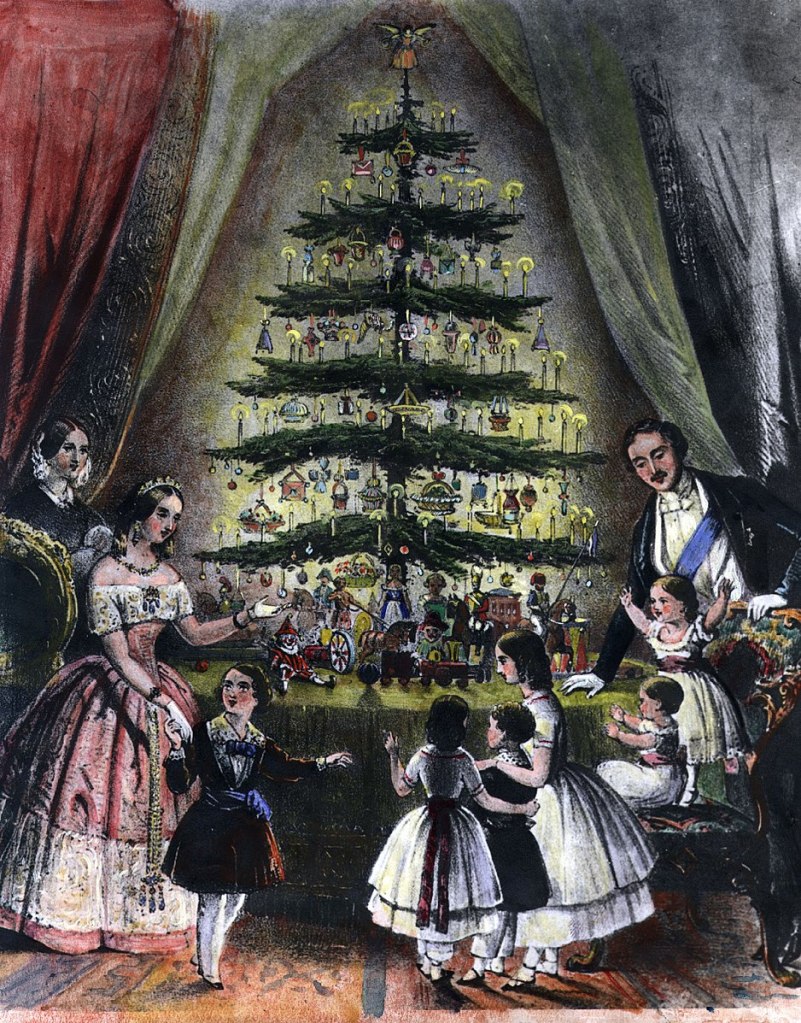
That German tradition slowly spread across Europe. But its popularity soared in the mid 1800s when Queen Victoria’s German husband, Albert, had trees erected in Windsor Castle and, in 1848, allowed a front cover painting to appear in The Illustrated London News showing the main tree covered in decorations and surrounded by the Royal Family. Other papers picked up on the story, and it massively influenced upper class customs in Britain and many other countries. Royal fever did its work.

Image in public domain

During the following decades and into the 20th century, the tradition of the Christmas tree spread quickly and widely. Across the western world almost all homes had Christmas trees. Local authorities mounted Christmas trees in public squares and on their buildings. Large stores placed trees on their balconies and in the main retail areas. Towns and cities publicised ceremonies of switching on the lights on large Christmas trees in prominent places. For example, since 1933 and continuing now, a large Norway spruce tree has been used for the Rockefeller Center Christmas Tree in New York. The 2024 tree is 74ft (22.5m) tall, 43 ft (13.1m) wide, and weighs about 11 tons (24,250 pounds, 11000kg). After the Christmas period, the tree will be donated to Habitat for Humanity and cut into lengths to help with building homes. In Washington DC the National Christmas Tree is erected near the White House, and its lights switched on by the President and First Lady. Trafalgar Square in London has had a Christmas tree donated by Oslo, Norway, every year since 1947. The 2024 tree is 20 metres (65.6ft) tall and has already been scaled by a protestor dressed as Santa Claus.

For a long time now Alison and I have had only artificial Christmas trees in our home, principally for three reasons: that means a real tree is still growing in the forest; artificial trees leave no mess; they can be used for many years. We follow a common tradition of laying presents around the base of the Christmas tree. When our children were young, those presents sparked curiosity which led to exploration. The children would secretly examine the size and weight of each neatly wrapped present, probably hoping the biggest and heaviest was for them. One thing we never have done or will do is sing around the Christmas tree. The TV series Downton Abbey portrays how the aristocratic family would sing along with their servants beside a giant Christmas tree. We have never done that. Maybe it’s because we don’t have servants. Or because we’re not very tuneful.

‘Once in Royal David’s City’

Every Christmas Eve millions in the UK and around the world tune in to a service of carols broadcast from King’s College, Cambridge. The first TV broadcast was in 1954, and then the service televised regularly from 1963. For over 100 years one tradition at the start of that service has not changed. Since 1919 the opening carol has been Once in Royal David’s City, with the first verse sung unaccompanied by a boy soprano. For that soprano, the thought of your solo being heard around the world must be terrifying. What must make it worse is that no-one knows who will be the soloist until the choirmaster selects one of the sopranos just as the service begins. A nod or pointed finger in your direction, and seconds later your voice penetrates the silence. And millions are listening.

The writer of ‘Once in Royal David’s City’ was born Cecil Frances Humphries in 1818 in County Wicklow, Ireland. ‘Royal David’s City’ wasn’t her only famous hymn  – I’ll mention two more shortly. They may surprise you. Keep reading…

Cecil began writing poems in her school journal from an early age. They were beautifully composed in style and content, and that led to the publication of her first book of poetry called Verses for Seasons, a kind of ‘Christian Year’ of readings for children. That was only the beginning. Overall she wrote more than 400 hymns, basing them on subjects like the Apostles’ Creed, baptism, prayer, the Lord’s Supper and the Ten Commandments. All of them were written in simple language so children could understand and enjoy them.

When Cecil was 30, her book Hymns for Little Children was published. Each hymn was written to bring out the truth of some Christian teaching. Of course, without music the hymns read like poetry. But one year after publication a gifted English organist, Henry John Gauntlett, read Hymns for Little Children, and so loved ‘Once in Royal David’s City’ he composed music for it. As a hymn it was immensely popular and before long it was being sung far and wide.

Its origins as a children’s hymn show by the many direct lessons or references to children in the carol. For example, Cecil writes:

  • Christian children all must be / Mild, obedient, good as He.
  • For he is our childhood’s pattern; / Day by day, like us He grew;
  • And He leads His children on / To the place where He is gone.
  • Where like stars His children crowned / All in white shall wait around.

Cecil tells the story of Jesus in the carol, but also applies lessons and truths of the Christian faith for the children who would read or sing it. And that, after all, was her purpose. Hymns for Little Children carries a dedication by Cecil to her godsons, in which she hopes that the language of verse which children love “may help to impress on their minds what they are, what I have promised for them, and what they must seek to be”.

Two years later, in 1850, Cecil married Rev William Alexander (hence her hymns carry the name Cecil Frances Alexander). He eventually became the Anglican Primate of Ireland, a very senior role. Cecil poured her energies into writing hymns but also care for the very poor. The disastrous Irish potato famine – known as the Great Famine or Great Hunger – lasted from 1845-1852.[2] The parishes of Ireland were filled with masses of the disadvantaged. Cecil poured her heart and hands into care for them. Often she’d travel miles in difficult conditions to bring comfort to the sick and poor, and to give them food, medical supplies and warm clothes. Along with  her sister, she also founded a school for the deaf.

Cecil wrote many hymns before she died in 1895. One of those was the classic Easter hymn ‘There is a green hill far away’. Another was the hymn loved by children and adults ‘All things bright and beautiful’. Many have regarded Cecil Frances Alexander as one of the greatest hymn writers in the English language.

Eating mince pies at Christmas

There is every good reason to eat mince pies, but no special reason to eat them only at Christmas. They are just as enjoyable at any time of year.

Plate of freshly baked festive Christmas mince pies with decorated golden crusts and spicy fruit filling served sprinkled with sugar, one broken open to reveal the filling. By christmasstockimages.com – http://christmasstockimages.com/free/food-dining/slides/mince_pie_plate.htm, CC BY 3.0, https://commons.wikimedia.org/w/index.php?curid=97503821

Mince pies date from medieval times but back then they were shaped like a rectangular manger, with a pastry baby Jesus on top. I’d find it hard to bite into that. The round shape of mince pies came only after the Reformation in the 1500s.

People of old linked the ingredients of mince pies with the Christmas story:

  • meat (mostly lamb or mutton) represented the shepherds
  • dried fruit (raisins, prunes and figs), along with spices (cinnamon, cloves and nutmeg), all expensive items, symbolised the wise men’s gifts
  • the mince pies had 13 ingredients in total, equating to Jesus and his 12 disciples.

Eating a mince pie every day of the 12 days of Christmas was thought to bring happiness for the following 12 months.

Around the time of the Reformation, Puritans tried to ban everything associated with Catholicism. That included mince pies. The pies soon made a comeback.

We can all be glad that ban did not last. The popularity of mince pies today is immense. In the UK about 800 million are sold in the run up to Christmas. Add to that the very many which are made in the home. Assuming they’re all eaten, that’s a lot of mince pies and a lot of calories. Some eat none of course – they’re not food for babies, nor does my 102-year-old mother-in-law eat them now. And there are some strange people who don’t like mince pies. A reasonable guess, then, is that those who like mince pies consume an average of between 15 and 19 pies per person at Christmas. Personally I’m a fan of home made pies served warm, and I’m not admitting how many I eat each year.

Finally…

I can’t finish without saying that, for me, Christmas isn’t about carols, mince pies, or presents around a Christmas tree. It is about Jesus, God’s Son, entering this world. No other birth changed the world like his.

My hope and prayer every Christmas is that people will think carefully about the one whose birth began it all (whatever the precise date). I wish you the happiest of Christmases and a new year ahead with many reasons to be thankful.


[1] https://www.history.com/topics/christmas/history-of-christmas-trees

[2] History.com records the famine’s toll: “Before it ended in 1852, the Potato Famine resulted in the death of roughly one million Irish from starvation and related causes, with at least another million forced to leave their homeland as refugees.” For a fuller description of the famine, see: https://www.history.com/topics/immigration/irish-potato-famine

Why don’t we change when we know we should?

“Change? We don’t want to change!” I was told. The message couldn’t be clearer. Arguing would have been pointless. But what I thought was ‘If you won’t change, then your group will die’.

For more than a year I’d been hearing complaints from the church women’s group that the younger ladies wouldn’t come to their meetings. In the distant past that women’s group had been relatively large, perhaps 40 or 50 attending each week. Every meeting followed the same pattern. Notices at the beginning, then a speaker, and after that tea and cake. Frankly, what mattered most was the tea and cake time, not for the refreshments but because that’s when they could chat to each other. The main reason many ladies attended was for ‘fellowship’ – being friends, sharing news, giving encouragement, asking for advice, and, so some said, staying up to date with the gossip. But the years had passed, and the oldest members had either died or were no longer able to come out on dark nights. The headcount had declined, down to about 15 on a good week. But the numbers of women in the church had grown, in fact grown a lot. The newcomers were younger, most with ages ranging from early twenties to late forties. Many were studying or working, often with long hours. Some had families. Others belonged to organisations not related to the church, and several went with friends or husbands to neighbourhood home group meetings. The traditional women’s group held little attraction for them.

But their absence didn’t go down well with the leaders of the women’s group. So, as pastor of the church, I decided to meet with them. The leaders didn’t hold back. The younger generation of women were letting them down. They should come to the meetings and swell their numbers. So I was told. Tactfully, I tried to explain that the younger ones lived such busy lives they didn’t feel able to add another meeting into their schedules. “But they should come,” they said. “They are women who belong to this church, so they should support the women’s group.” Summoning up the courage to be more direct, I explained that if, say, 30 of the younger ladies joined the women’s group, they’d outnumber the existing members by two to one, and they’d almost certainly vote for change. Which is when they replied “Change? We don’t want to change!”. And so our meeting ended, and within two years the women’s group had its final speaker, last cups of tea and slices of cake, locked the doors, and never met again.

It was obvious that they needed to change, but they wouldn’t. In their case, they liked what they had and didn’t want anything different from that. It was a fatal attitude.

But not an unusual attitude. Whether we think about personal habits or organisational practices, it’s often the case that clearly things must change and yet they don’t. But why not? That’s what this blog post is about.

First, though, I should clarify that I won’t be trying to explain compulsive behaviour caused by addiction or mental illness. Alcoholics, for example, often know perfectly well that drinking is ruining their health, family life, and job performance. Yet they can’t resist that first drink which then leads to many more drinks. A young man told me a similar story, but in his case about a gambling addiction which had caused him financial ruin. Drug addicts may also be well aware that their ‘habit’ is killing them but they’re unable to refuse the next ‘hit’. The complexities of addiction and mental illness lie beyond the scope of this blog post. Here I’m writing about the more common experience described some 2000 years ago by the Apostle Paul: “I do not do the good I want to do, but the evil I do not want to do – this I keep on doing” (Romans 7:19).

What follows are seven reasons why we don’t change when we know we should, including when we wish we could. Most of these refer to personal change, but the first is about organisations.

Organisations have remarkably sticky cultures.  Management books describe how the appointment of a new CEO rarely brings about significant change in the way a company goes about its business. The CEO might put forward a new policy, but staff will react with “That’s not the way we do things around here”. They may never say those words publicly, but it’s how the employees feel, and therefore how they react to proposed change. Businesses have a culture – beliefs and customs – which reinforce the status quo. For the staff, the way things get done is the only way to get things done. Hence change is resisted.

In 1990 Peter Senge wrote a masterful book called ‘The Fifth Discipline’, with the subtitle ‘The Art & Practice of The Learning Organization’. His conviction is that businesses are rarely learning organisations, and since they don’t learn they don’t change. Senge writes: “What if even the most successful companies are poor learners – they survive but never live up to their potential?” He continues:

“It is no accident that most organizations learn poorly. The way they are designed and managed, the way people’s jobs are defined, and, most importantly, the way we have all been taught to think and interact (not only in organizations but more broadly) create fundamental learning disabilities. These disabilities operate despite the best efforts of bright, committed people”.[1]

Note Senge’s words about “the way we have all been taught to think and interact”. Our ideas have been conditioned and our brains trained to operate in certain ways, and it’s devilishly hard to change those patterns. Hence organisations keep doing what they’ve always done. Those ‘stuck in a rut’ ways of thinking and acting are huge barriers to change, even when such change would obviously be good.

Unwillingness to admit we’ve been doing things the wrong way.  Adopting a new way of thinking or working seems like an admission that what we had or did before was second-rate. Pills used to come in screw top containers; now those containers have child-proof tops. I typed a thesis of some 100,000 words on a typewriter, throwing away every page which needed more than the simplest correction. Now even the simplest laptop has software that makes writing easy, with nothing printed out until near perfect. My parallel parking in a tight space often used to involve getting out of the car to see exactly how much further back I could go. Now my car has a reversing camera, so judging how much space I’ve got left is easy. With each of these examples, what was mentioned first was clearly inferior to what I described second. Adopting the new was admitting the old wasn’t great.

Rather than accept that, some cling to what is old and familiar. I knew a finance director who so disliked computer spreadsheets that he longed for the large bound ledgers he’d used when an apprentice accountant. I’ve met car mechanics who agree that the technology of modern cars aids reliability, but they still long for the simple engines and fittings of a past era, because they loved taking them to bits and using their skills to make repairs.

Accepting that the old ways or old things were not very good, and occasionally really bad, is not easy for many. Hence they resist change.

Change requires time, effort and sometimes money.  Let’s never ignore a fundamental reason people dislike change – they need to learn the new thing. Not everyone enjoys learning new skills. Our moderately large organisation needed to adopt the most popular word processing software. Most of the staff were delighted, because it meant our word processors would easily and accurately incorporate the electronic documents sent by people outside our organisation. But there was a resistance movement. Some had mastered keyboard shortcuts in the old software, and they knew how to reveal hidden codes which helped with editing. Worse, they loved the DOS software[2] because of its clean screen and none of the myriad options via drop-down lists.  But, fundamentally, most who resisted simply didn’t want the effort of learning a new system. To surrender to laziness would have been short-sighted and foolish. The change was made. It required persuasion, time, effort and money, but all the staff eventually appreciated the new software.

Suggesting change is needed can offend.  Telling a spouse or partner that they drive badly is maritally dangerous! It certainly risks a furious row. There’s much the same risk when criticising a different kind of driving – that of a fellow golfer who keeps slicing the ball off the tee. I had the uncomfortable experience of playing alongside a couple when the husband constantly criticised his wife’s standard of play. He got angrier and angrier at her poor shots; she just went quiet. What she might have said – but wisely didn’t – is that he wasn’t much of a golfer either. I know of an organisation which provided parenting coaches to advise parents on how to bring up their children. The coaches were typically uninvited by the parents after two visits. No-one wanted to be told their child raising skills were lacking. Management gurus have the same problem when hired to help a struggling business. The company CEO may have brought in the consultant to fix his employees, and does not appreciate being told that what needs to improve is his leadership skills.

Without great sensitivity, advising people that they need to change can create a defensive, negative reaction. That just makes a bad situation worse.

Taking someone out of their comfort group.  At almost all golf clubs, groups of friends regularly play together. After the match, they’ll sit around enjoying a beer or a coffee. Their socialising after the game can last as long as their game because they enjoy each other’s company. Each of them feels they belong there. But what if one of them must leave the group? Perhaps he can’t afford all the drinks, or needs to give those hours to another activity. Surely he can just leave? Actually, he may feel he can’t. Over the years the group has transitioned from being casual friends to a place where everyone feels they belong, where they feel safe. They draw strength from each other as they share opinions, hopes, problems, challenging issues and get encouragement. The person who feels he should leave wonders how he can manage without the group.

What makes a close-knit group strong is what makes it hard to leave, or to disagree with the majority. That can be true in a workplace, where one person would struggle to differ on important issues like attitude to the boss, whether pay levels are fair, and how hard everyone should work. Group belonging is also strong in churches, where people share faith, pray together, get encouragement, and come away feeling more able to face hardships. It happens between people who have lived near to each other for a long time. My parents were close friends with all their neighbours. They talked at front doors, visited in each other’s homes, and got together on significant occasions such as midnight on Hogmanay (a Scottish custom at the start of a new year). In any of these cases, leaving or disagreeing with the group is difficult. My parents eventually moved to another part of town, but it robbed them of important friends. It would be the same for someone giving up on a golf fraternity. In the workplace, rejecting a group’s view can lead to being ostracised from the company of colleagues.

Even when people feel they should change, they may opt not to change if it means leaving a group which is important for them.

Fear of an unknown future.  Change creates something unfamiliar. In the late 1990s Alison and I moved hundreds of miles from Aberdeenshire in Scotland to Oxfordshire in England. Many things were different. Busier roads near London meant I learned to ask how long will my journey take, not how far is my journey. Affluent Oxfordshire had alternative values from those I’d grown up with in Scotland. All our friends and family were in the north, far distant from where we had moved to. Now I was heading up a large mission organisation, very different work from being a church pastor. And, instead of a normal routine of local journeys, now I travelled all over Britain and to literally dozens of other countries. People in Oxfordshire thought I spoke strangely, remarking “You have an accent”. I learned to reply, “So you think you don’t?”

The very word ‘change’ means things won’t be the same. Change takes us into a future we’ve never experienced, perhaps one we could never have imagined. And, for many, that prospect is daunting, so daunting they refuse to change and they stay with what they already have and know. Twelve years later, when we told family and friends we were leaving Oxfordshire to live and work across the Atlantic, several said “I couldn’t do that…”. They said they couldn’t. Actually they could, but what they meant was they wouldn’t do that. They’d choose the familiar over the uncertain.

Whatever the pluses or minuses of what we have already, the big positive is that it is known. We can cope with it. The future may not be like that. What if our hopes and dreams turn to dust? What if we quickly regret the change? We may never be able to go back to what we left. That can feel too big a risk to take. Therefore people resist change.

No decision is a decision.  This is my last note about change. Imagine a CEO has to decide whether to market his business in a completely different way. Or, more radically, the CEO has to decide whether the company should abandon its old merchandise for shiny new products. The old stuff is still selling but not as well as it once did. And new lines might bring new customers. He wishes he could sell both the old and new, but he can’t. To have the new he must let go of the old, and he’s not sure he can do that. In a dream which is close to a nightmare, he’s getting into a beautiful boat and sailing away from a safe pier, only to find the boat sinks. When he wakes, he fears that’s what might happen if he moves to a new product line. He’ll take his company from its safe place, only for it soon to sink. The CEO is paralysed with uncertainty, so in the end makes no decision at all.

But, of course, he has made a decision. Not to change is a decision, and, for that CEO, sticking with an old product line would be a bad one because market trends were moving on. Sometimes change is absolutely necessary. That’s how it feels for those threatened by war who abandon their homes and become refugees. Or, in a more ordinary situation, the change might be to another employer, one who treats staff more kindly. For the refugee, failure to change could result in death. For the employee, staying with a bad employer would mean years of overwork and exploitation. Some situations, of course, are not clear cut, but I’d argue that, in most circumstances, change must be an option. Yes, it has to be well thought through – all possibilities considered – then followed by a thoroughly positive decision. Not changing may be the right thing; it simply shouldn’t be for the wrong reasons.

I’ve listed seven reasons why change doesn’t happen even when we know it should. But none of those reasons are invincible barriers to change. We are not prisoners of the status quo. Down the years I’ve experienced change many times, and almost always change has been positive for me. It has not always been easy, and most times uncomfortable at first. But change has gifted me with new challenges and new experiences, the large majority of which have been positive and meaningful. Be brave!


[1] Page 18 in the 1990 edition. Peter Senge is a senior lecturer at the Sloan School of Management at MIT (the world-renowned Massachusetts Institute of Technology, located in Cambridge, just outside Boston). The Fifth Discipline is still published, now in a 2006 edition by Random House Business. The book has sold in the millions world-wide.

[2] DOS stands for Disk Operating System. Many web sites explain how DOS works, including this one: https://en.wikipedia.org/wiki/Disk_operating_system