What I wish I’d known when I was 13

Experience is something young people can’t have. It’s impossible to teach, learn from a book, or borrow from another person. Experience – good or bad – is what we discover during life’s journey. And, if there’s an advantage from being older, you’ve a lot of experience.

My mind started thinking about that after I came across a photo of me when I was 13. It was a semi-official picture taken at school, probably to have a photo of me in my file. I know exactly when the photo was taken because there’s a poppy in my lapel, which was the custom around the time of Remembrance Day each November.[1]

I look young, and untroubled by issues that concern adults. However, I began to wonder what my 13-year-old self would like to have known but didn’t. Were there things it would have been good for me to understand at age 13?

I’d like to have known that one day I’d have a girlfriend

I’m starting here because girls are exactly what this 13-year-old boy was bothered about. Girls were no longer a nuisance. In fact, they had become rather interesting.

But, at 13, and with only a brother, girls were a mystery to me. How could you know if a girl liked you, and what should you say to her? If only everyone was fitted with a light and when two were attracted to each other their lights would go on. But we hadn’t been fitted with lights, and the mystery remained for a few more years.

By my later teens, though, I had a wide circle of friends, and my breakthrough realisation was that getting close to a girl was less about attraction, and more about being interested in each other, about really getting to know someone, enjoying being together, sharing ideas and plans. Then, one Sunday evening, I found myself walking up a road in Edinburgh chatting to a girl who was more interesting than anyone else. Decades later, now with children and grandchildren, Alison is still more interesting than anyone else.

The 13-year-old me would have been so much more at peace if only I’d known that would happen.

I’d like to have had a career goal

Some know the work they want to do from an early age. Perhaps their ambition is to be a ballerina, an international footballer, win a Formula One championship, do research that wins a Nobel Peace Prize, invent world-changing technology, write block-buster novels. They’re good thoughts, but most will disappear when faced with massive challenges. Some, however, will dedicate themselves to a particular career path, and get there. They’ll be great doctors, top scientists, own a profitable business, or become a member of Parliament.

But I had no idea what I would do for a career. When I was eight or nine I thought I’d like to be a bus driver, or become an Automobile Association patrolman who rode around on an old style yellow motorcycle with sidecar looking for members whose cars needed rescue.[2] But these were just a child’s idle dreams, not serious career goals.

At 13 I had no idea what work I might do. However, when I was 15, my school ran a careers evening with spokespeople describing their work. One was a police officer, and he highlighted all the different specialities that existed within policing. The wide range of options appealed to me, so later I read up about police service. Then I found a problem. In those days the minimum height for men to enter the police force was 5’8”, and in my area even higher at 5’10”. I didn’t think I’d reach either of those heights, so abandoned that plan.[3] When I was 16 I began to think about leaving school,[4] but had no idea still about a career.

I’ve mixed feelings now about that lack of a sense of direction. A career goal would have motivated me about my school work, and reassured me about where my life was headed. Yet, without a particular goal, I was open to any possibility, and that may have been helpful. In the end I began in journalism, became a church minister, then led a large international mission agency, and finished by being President of a seminary in the USA. I changed my work (not just my employer) several times, something that is now considered normal. I was ahead of my time.

So, though I wish I’d had a career goal, the lack of one did me no harm. I was flexible, and accepted change when it presented itself.

It would have helped if I’d had confidence in my own abilities

When I was 13 I was moderately good at rugby. I could tackle, catch and pass the ball, and kick it well too. I was also good at cricket, not so much as a batter but as a bowler and fielder. Somehow I could flip my wrist to make the ball break sharply left, completely confusing batters as the ball zipped past and hit their wickets. And, because I had fast reactions and virtually never dropped a catch, I relished every chance to be a slip fielder.

But sport was simply enjoyable. It was a pastime, not a passion nor a career goal. What was supposed to matter to me aged 13 was my academic work. But, in that area, I had every reason to be modest with my expectations. My teachers were equally modest in their expectations of me. When I was 13 the set curriculum I had to study covered a wide range of subjects, including physics, chemistry, biology and Latin. When I was 14 I was allowed to narrow my schedule. I dropped all the sciences and Latin with the approval and relief of my teachers. After another year I was due to take national exams. My teachers wouldn’t present me for the German exam since I was bound to fail. And fail was exactly all I achieved in three subjects, French, Maths, and Arithmetic. My only successes were in English and history, and I passed those at a higher level the following year.

But, with that track record, I had no confidence in my abilities. I never imagined I could be admitted to university, and no-one ever suggested I should try. In fact a career advisor advised me to start work in a department store sweeping the floors, and perhaps I could work my way up to being a store manager. I swept that idea aside, but he was not the only one with low expectations of me in those early to mid teen years.

For a while that was discouraging and unhelpful. Yet, looking back, it may have triggered a desire to prove them all wrong. Which was probably the best response.

I wish I’d understood that not all people are good

I grew up in a loving family unit with two parents and a brother. Nearby were aunts, uncles, and cousins we saw regularly. Our town was relatively crime free, big enough to have shops for everyday needs but small enough that traffic jams were unknown. I walked or cycled to school, came home for lunch, and, when daylight allowed, spent evenings playing football or cricket with friends. During summer holidays from school I’d play golf in the morning and cricket in the afternoon, and when I wanted a change I’d play cricket in the morning and golf in the afternoon. I had a very privileged early life.

The only downside is that it was also a very protected life. When I was 13 almost all I knew of the ills of the world was that I should never go off with a stranger, that a girl in my class had died from a serious illness, and a boy had fallen from his bike in front of a lorry and been killed. But I didn’t know of anyone dying of cancer, anyone getting divorced, anyone without food, anyone committing a major crime. My parents would watch the news on TV, but, as far as I was concerned, bad things happened far away. I had a sheltered existence.

That resulted in an unhelpful innocence, a naivety that everyone is kind and good and no harm can befall you. Of course we must not make children fearful or untrusting. But – as with many things – I wish there had been an age-appropriate way of making me aware that bad things happen in this world.

From my later teens and into my twenties I was a journalist with a national newspaper. That gave me a rude awakening to tragedies and evils. I attended car, rail and plane disasters where mangled bodies were pulled from wreckage. I sat through murder trials, such as the killing of a 15-year-old girl by beating and strangling.[5] It shocked me that one person should so violently and deliberately end another person’s life. There were cases of gang warfare, often drug related. Some politicians were considered corrupt, others attention-seeking. I attended court sessions and local government meetings which were supremely tedious. Some of my colleagues were deep in debt, unfaithful in their marriages, addicted to alcohol, or dying of lung cancer. Of course there were also ‘good news’ stories, but I was used to them from my upbringing. It was the ‘bad news’ that jolted me into a broader understanding of the world.

It would have helped me, certainly by the time I was 13, to have learned something about the harsher sides of life.

I could have known more of how poor most of the world is

My Aunt Milla – whose working life was mostly as a community nurse – rarely spent much on her housing. During two periods she lived in run-down tenements. The first had no toilet facilities inside the building. None at all. Instead there was a small hut out the back which contained a simple toilet. No wash-hand basin, and sometimes no toilet roll, only torn sheets of newspaper which were guaranteed to leave their mark. Day or night, perhaps in pouring rain, the ‘need to go’ was an unpleasant adventure into the outdoors to use the ‘privy’. Milla moved upmarket with her later tenement living. There still was no toilet in the flat, but there was one on the ‘half-landing’ (so named because it was up some steps from the level of flats just below and down some steps from the level of flats above). Since there were two flats on each level, the toilet might be shared by four households. Perhaps queues were avoided only by exploring for ‘vacancies’ at toilets on other half-landings.

These were poor facilities – unhygienic and inconvenient – but were common in many towns and cities, and not just in the UK. We often stayed with my aunt, and therefore used the outhouse or half-landing toilets many times. At home we had indoor plumbing, but I knew many lived with facilities like my aunt, so never thought of her situation as poor or bad. When I was 13, I had no idea at all that most of the world lived in very much worse circumstances.
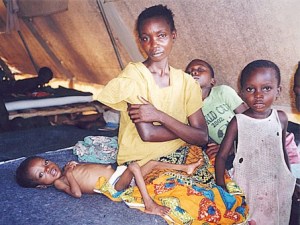
Almost 30 years later I visited remote desert areas of Pakistan, sleeping overnight in tribal villages. Toilet facilities? The far side of the sand dunes. In a mountainside village in Nepal, there was an outhouse for toilet use, but it was no more than a small enclosure around an open hole with charcoal six feet below to (unsuccessfully) deaden the stench. In a remote Congo village I thought that children were wearing dirty and torn t-shirts as play clothes, then realised those t-shirts were their only clothes. There I also met a mother with seriously malnourished children, hoping for help from medical missionaries. I saw many small houses with damaged roofs. I was told: “There’s no longer anyone skilled in repairing roofs. When people don’t have money to buy food, no-one pays to have their roof repaired.”

I could multiply these stories, but won’t. The hard truth is that a large part of the world’s population live in poverty. I never knew that when I was 13. As children grow up, and gradually decide on lifestyle and career priorities, shouldn’t those priorities take account of world need? In affluent countries, we shelter children from harsh realities. That’s understandable, but should they not know billions are less well off, and their needs may matter more than our comfort?

I wish I’d known what I needed to do for God to become real in my life

God was never absent from my life (nor is he from anyone’s), but when I was 13 I didn’t relate much to God other than with some prayers. My mother told me several times that she made a special commitment to God when she was 13. That commitment coloured everything she did, and a lot of her time went on supporting church activities and helping neighbours. So, when I became 13, I imagined something might happen in my life to make me a Christian like her. Nothing did, and as the next few years passed I wondered if it ever would.

What I’d failed to realise is that I had a responsibility to reach out to God. I was waiting for God to invade me while, in a sense, he was waiting to be invited. That did all change when I was 18, and I’ve written about that before (https://occasionallywise.com/2021/02/20/serious-business/).

It wasn’t that I was ignorant about the Christian message. I just needed to respond to it. Thankfully I was only five years beyond 13 in doing so. But, if I’d known sooner, my life would have changed much earlier.

Writing this blog post about what I wished I’d known when I was 13 has kept generating more thoughts than I’ve recorded here. Perhaps I’ll set them down another time. And one day I may also write things I’m glad I did know when I was 13. That seems just as important a subject.

I’d encourage you to think what you wish you’d known when you were younger, and what you’re glad you did know. You might be surprised about your conclusions.


[1] Fighting in World War I ceased at the 11th hour of the 11th month in 1918, commemorated annually throughout Commonwealth countries ever since. https://en.wikipedia.org/wiki/Remembrance_Day

[2] There’s a good photo of an AA motorcycle and sidecar here: https://www.theaa.com/breakdown-cover/our-heritage-vehicles

[3] Actually I did reach 5’8” but my interests by then lay elsewhere.

[4] In Scotland, the school leaving age was raised to 14 in 1901, and though from the 1940s there were plans to make the minimum age 15 that was never made law. The minimum age was set at 16 in 1973.

[5] The case set a new legal precedent because the accused was identified by having left unique bite marks on his victim’s body. See https://www.dentaltown.com/magazine/article/7528/the-biggar-murder-some-personal-recollections

Cautious boldness

We use maxims, aphorisms and proverbs all the time. Short, pithy sayings that we think wise and helpful.

My parents taught me ‘Waste not, want not’ and ‘Every penny counts’. The Scouts gave me the motto ‘Be prepared’. Nowadays we warn children about ‘stranger danger’. Signs and ads say ‘Don’t drink and drive’. Short sayings are remembered, and often keep us right.

A few years back I coined my own to improve my golf game: ‘Cautious boldness’. Those two words have helped me win trophies. With golf, it’s sometimes best to play safe. Perhaps there are deep bushes alongside a fairway – time for caution. But you can’t be cautious all the time. If you’re on the green, putting from only a few metres, you must be bold. ‘Never up, never in’ is the right thought, because, obviously, no putt has ever been holed which didn’t reach the hole. So, I realised being cautious all the time was no good, and being bold all the time was no good. Therefore cautious boldness became my maxim – sometimes one, sometimes the other. Winning depended on knowing which was right in each situation.

That seemingly contradictory mix, cautious boldness, is also relevant to living life wisely and well. I’ll illustrate how it could apply in four contexts. The first two concern important life-directing issues. The other two are more down-to-earth, but perhaps will make you think and smile.

Relationships

Like many I suffered the teenage angst of wondering ‘Does she like me?’ and ‘Will she laugh if I ask her out?’ But I worked my way through my inner turmoil, occasionally holding back wrongly and occasionally pushing forward wrongly. Sometimes too much caution. Sometimes too much boldness. (It was all better in my early 20s when I met Alison…)

Getting the caution/boldness balance right is important too in long-term relationships. Let’s imagine Colin and Christine. Colin is struggling with depression. He feels his life is useless; he can’t see a good future. The last thing he needs, at that moment, is Christine telling him to pull himself together, to brighten up and be positive. Colin can’t handle that. Christine needs to take a more cautious, gentle, reassuring approach.[1]

A few years earlier Christine had her own struggle, albeit of a very different kind. She excelled in her administrative role for a large firm, and was often called on to supervise new colleagues. She had a gift for bringing out the best in them. One day the managing director asked Christine if she’d consider being appointed department head. Christine’s head spun, and sensibly asked for a day or two to decide. At home Colin listened as she poured out a catalogue of doubts and fears about her abilities. Wisely, Colin let Christine get it all out of her system, and then carefully but positively drew out from her an equal catalogue of abilities and strengths she knew she had. He followed that with encouragement, helping her believe this was a deserved promotion, and one good for her and for her firm. She took the job, and never regretted it.

There are times to exercise caution and times to offer boldness.

Career / work

In my journalism years I had two types of colleagues. One group were ‘journeymen’ (they were all men at that time). The news editor could send them to a meeting, where they’d take shorthand notes and write an accurate report of what had happened. Or they might interview someone making news, and write an acceptable story. But that’s all they did. They didn’t spot news opportunities. They never wrote in an exciting, captivating style. They just went about things in their quiet and cautious way year after year.

Some were different. They could do the routine stuff, but they had eyes and ears to discover news. Maybe it was something a politician let slip. Maybe they picked up on gossip about a sports star. They followed up on their leads, and often had a front page story in the next edition. They showed initiative and talent, and moved on fast in their careers.

I’ve seen the same distinction in other places where I’ve worked. One type of worker is slow and dependable, another type creative and pushing forward. Each has their strengths. But most of us can have both strengths. There is wisdom in moving between times of caution (working carefully and steadily) and times of boldness (offering new ideas, striving for advancement). Those with only an abundance of caution may come to regret the tedium of doing the same thing constantly. Those with overmuch boldness may find themselves promoted beyond their competence (aka, promoted to the point of incompetence).

Caution at times and boldness at times – when rightly judged – has much to commend it.

Driving

My friend Keith, a policeman, was an examiner for motorbike riders attempting to pass an advanced test. He’d been my examiner, and we’d remained friends afterwards. ‘You wouldn’t believe,’ he told me one day, ‘how many flagrantly break the speed limit while taking their test.’ Keith eventually realised they never rode within the speed limit, so it didn’t occur to them to ride differently during the test. ‘And speeding is a definite failure,’ he said.

Interestingly, though, just as you can fail an advanced test for going too fast, you can also fail it for going too slow. I’ve taken both car and motorcycle advanced tests, and, thankfully, remembered the formula for getting the speed right: ‘make good progress’. In other words, don’t go too slow because then you’re a hazard, and don’t go too fast because then you’re a danger. So, in a 30 mph area, I should aim to drive or ride very close to 30, but not more than 30. That’s good progress.

Not everyone makes good (and safe) progress. We’ve likely all moaned about a slow driver on a standard (single lane each way) road, with tight bends, oblivious that there’s a queue of 20 cars behind with frustrated drivers because there’s next to no chance of a safe overtake. It’s little better on a busy motorway. The slow driver cruises along at 40 or 50 mph in the middle lane, causing a blockage and hazard as cars jostle to move into the outside lane to get past. (In the UK, going past another car on its nearside isn’t allowed.)

Of course I’ve seen many dangerous attempts to overtake on narrow roads, and plenty times, when I’ve been driving on a motorway at the speed limit of 70 mph, a car has roared past me doing at least 90 if not 100 mph. Is it a sin to pray there’s a police speed trap just ahead? If so, I have sinned.

People die trying to overtake someone who’s dawdling along at a dangerously slow speed. And people die because they’re driving far too fast, killing not only themselves but possibly others too. There are times to be cautious and times to be bold. Lives depend on judging which is appropriate.

Practical tasks

I have no memory of my father doing DIY jobs around the house. He worked, played golf and did gardening. He didn’t repair or maintain things. So, when I left home aged 16, I’d no idea how to look after a property.

I learned fast when, with family help, I bought a near 100-year old tenement flat in Edinburgh. It was affordable for two reasons: 1) It was very small, just two rooms; 2) it had never been modernised – it had an old range, electric wiring hung loose, there was no bathroom, and so on. There was plenty to fix. I couldn’t take on a complete renovation of the place. That would involve new walls, new electrics, new plumbing, which would require experts. But there were innumerable small jobs.

I got hold of a DIY book, read the relevant sections, and did my best. Much was trial and error, but I soon learned how to drill holes, use wall plugs, and hang towel rails or shelves. I replastered a section of wall – not perfect but acceptable. I stripped about seven layers of wallpaper away, including varnished wallcoverings which may have dated from the flat’s construction. After a while I was quite good at DIY.

It was several years before I had a car, and the first was not at all in good condition. I set about treating the rust with metal brush, fiberglass, filler, hardener and careful, gentle rubbing to get the surface perfectly smooth. Eventually I resprayed the whole car. In the engine area I put in new spark plugs, adjusted the tappets and fitted a new clutch. The sills on the underside of the car were rusted through, so I welded fresh metal in place. I had to do something about the car’s poor braking, so bought new brake shoes, fitted them, and, thankfully, the car stopped when it was meant to.

As the years went on, I did less DIY work. For three reasons:

  • I simply didn’t have time. My real work was all-consuming.
  • We had enough money to pay mechanics, plumbers, electricians. They did things better and in a fraction of the time I would have taken.
  • I realised the limits of my skills, and that I’d probably overstepped those limits in the past. There were no disasters, but there might have been. It was time to be more realistic about what I could do and what it was best I didn’t do.

But I’d learned that with a lot of courage and a bit of skill I could do many practical things. There was no mystery about most of them; nothing about which to be frightened – and a lot of money could be saved. But, the wisdom of the years taught me about my limits, and when it was best (and sometimes legally required) to bring in professionals.

Times for boldness and times for caution.

Two last things.

First, I don’t believe for a minute that DIY is a ‘man thing’. While working in America, a colleague mentioned his wife was visiting her parents for a few days, so he’d be on his own. ‘But,’ he said, ‘I won’t be idle. She’s left me a long Honey Do list’. I had to ask what a Honey Do list was, the answer being ‘Honey, I want you to do this and do that’ – a long list of jobs his wife wanted done while she was away. (Go online, type in Honey Do, and you’ll find templates for a Honey Do list, plus innumerable posters or cartoons related to it – my favourite is of a skeleton on a bench with the caption ‘Waiting on that honey-do-list to be done’.)

I’m happy to report that my wife, Alison, is very capable with DIY – mending our shower, unblocking sinks, laying carpet, painting, wall-papering, sharpening tools, repairing appliances. She’s about to replace a tap washer (which she’s done before). But, like me, she’s well aware of her limits.

Second, I’ll tell the story of when we literally pushed our personal boundaries.

Alison and I lived in that tenement flat after we were married. We modernised most of it, but of course it was still very small. When Alison was pregnant, we knew a baby came with baggage, and we’d need another chest of drawers to store baby things. Except, we didn’t have anywhere for another chest of drawers. There never was a lot of wall space, and every inch had something against it already. Except the back wall of a deep cupboard. We measured its width, bought a chest of drawers an inch or two smaller, and thought ‘problem solved’. It wasn’t solved. We’d only measured the back wall, and the doorway into the cupboard was narrower, even with the door removed. We could carry the chest of drawers into the cupboard by turning it sideways, but then it had to be straightened, and at an angle it was wider than the cupboard, so that didn’t work. So, we took the chest of drawers out again, thought hard, thought some more, and then we knew what to do.

First we took out the drawers and then dismantled the ‘carcass’. Off came the top, sides and back panel, leaving us with the equivalent of a modern ‘flat pack’. We took all the parts into the cupboard, and reassembled the chest of drawers facing in the correct direction. Alison was at the far end of the cupboard to screw the back panel into place. She did her job perfectly. But, of course, Alison was now completely blocked in behind the chest of drawers. However, we had a plan. I’d lift the chest of drawers as high as I could, spread my legs as wide as I could, and Alison would crawl out underneath the chest and underneath me, and then I’d lower the chest in place. At any time that plan was at the far edge of boldness because the chest of drawers was not light and the space for Alison to crawl through was small. At this time there was another complication. Alison was now fully nine months pregnant. But we had to try. I spread my feet to each side of the cupboard, lifted up the chest of drawers, Alison crawled, and all was well. Our son was born two days later.

(When we eventually left the tenement flat, the chest of drawers was dismantled again to get it out of the cupboard, then later rebuilt, and used in four other homes for over 20 years.)  

I tell that story hoping only to amuse. But perhaps it has some lessons. We were thoughtless in our purchase, but bold with our idea for how we could fit the chest of drawers into the cupboard, and then actually quite cautious/careful about how we did it. But I would urge: be bold about what you do, but super cautious when someone is nine months pregnant.

—————————

[1] During my own time of deep depression, Alison had the wisdom not to scold me for feeling so low, and not to offer trite solutions. But, when I was at my worst during the darkest hours of the night, I’d feel her hand take mine gently and just hold on. It was all I could cope with, but also all I needed.


Parenthood

I left school and home when I was 16 because I’d been recruited by The Scotsman as a trainee journalist. I had only two weeks to get ready. Then my Mum and Dad drove me to Edinburgh where I had arranged a place to stay. First thing on Monday morning I went to the newspaper office, and so my career journey began.

Not once was I anxious about leaving home and starting work. Not once did I think I might not be ready for all this. Why not? Because my parents had done a good job. They’d loved me, provided for me, protected me, patched me up, forgiven me, encouraged me, believed in me, and much more. I had as solid and secure an upbringing as any child could want. So, excited and confident, off I went to change the world…

I’ve often thought and talked about parenthood down the years. Sometimes that’s been with parents anxious because a child has fallen into bad company, or developed dangerous habits, or lacked any idea about what they’ll do with their life, or is no longer talking to mum and dad. But most conversations about parenting have happened while counselling young adults, or people in mid-life, who are trying to resolve issues that should never have existed in their lives. Their issues related to things their parents did or said.

Before I write more about parenthood, I need to say three things.

First, I recognise not everyone wants or can have children. If you’ve longed for children, but it’s been impossible, my heart goes out to you. And please don’t read any further if this subject makes you unhappy.

Second, some children will become great intellectuals, engineers, doctors, lawyers. But not every child. For all sorts of reasons some don’t have the same advantages as others. I value them just as much. They may not design the next generation of space rockets, but they’re amazing people with exactly the same worth as anyone on this planet.

Third, there are many models of family life today, not just Dad, Mum and children. When I refer to dads and mums I mean those who occupy those kinds of parenting roles. This blog is about parenting, and is not the place for comment on the variety of modern family units. Please forgive me if my language is clumsy.

So I’ll now share principles of parenthood I’ve learned. My list isn’t exhaustive.

I’ll start with one big statement:

The goal of parenthood is to move your children from complete dependence as infants to full independence as adults.

The first part of that statement – dependence – is self-evident. Alison and I left the maternity hospital with our baby son, got back to our tiny flat, and realised this little boy was completely dependent on us for everything. It was an awesome thought.

The last part of my statement – about children reaching full independence as adults – needs a couple of explanations.

One, I don’t mean ‘independence’ in the sense of losing touch or losing affection. We have four children, and we’re all great friends who don’t hesitate to say ‘I love you’ and spend time together.

Two, by ‘adults’ I mean ‘mature adults’, people who can manage their lives and relationships, and make good decisions about what they believe and how they should live.

The most important aspect of my ‘goal of parenthood’ statement is that it describes a transition from helpless infant to competent grown up. I’ve heard people with young children say, ‘Wouldn’t it be wonderful if they just stayed the age they are now?’ The answer is ‘No! That would be dreadful. They’re not meant to stay four or eight or ten. They’re meant to grow up.’

But that idea wasn’t shared by one neighbour. With great delight, she told me how her three sons’ marriages had all ended in divorce ‘and now I’ve got all my boys back with me’. Clearly she’d never wanted to let them go, and I came away from the conversation wondering how much – consciously or unconsciously – she’d undermined their marriages.

Parenthood is about moving helpless infants to mature adulthood.

Towards that goal, here are principles of parenthood that I believe matter.

The foundation that supports everything is love. When parents love their children – enthusiastically, joyfully, thoughtfully, unconditionally – children feel supported, protected, valued and free to express their creativity and individuality. Their self-esteem is strong, and thus able to deal with disappointments and failures. They don’t question their worth, because worth was built into them from their earliest years.

When it was cuddle-down-and-go-to-sleep time for our children, I’d sometimes crouch beside them and whisper, ‘I’m proud of you. Not just what you do but the wonderful person you are’. Usually there would be a gentle smile, and they went off to sleep feeling good and feeling important.

Realise that who you are has a great influence on who your children become. Ask a school teacher if they affect children’s lives more than educationally, they’ll agree they impact their behaviour, their goals, their beliefs. ‘But,’ the teacher will add, ‘nothing like as much as their parents do’. That’s true. Those in parenting roles model attitudes, behaviour, beliefs, love, hope, values and much more. A child sees or senses what you think, what you value, what you aim for. You may not intend it, but you can’t stop it.

I was around 55 when I first realised how like my father I was. I was 5 foot 8 inches (173cm) in height; so was he. I wore size 8 shoes; so did he. I had begun to ‘thin on top’ in my forties; so did he. And it wasn’t just physical characteristics. My Dad played golf; so do I. My Dad was proud to be Scottish; so am I. My Dad hated making tax returns; so do I. My Dad was stubborn; so… !

Like father, like son. Dad died 23 years ago, but much of him has lived on through my brother and me.

Children are unique, not clones. But, in many ways they will grow up to be like their parents, and that’s a sobering responsibility for those raising them.

What parents say can never be unsaid. Lydia was in tears while we spoke. She’d never felt accepted by her parents, especially her father, and tried and tried to win his approval. But nothing she did ever met his standards, and sometimes his rage erupted. ‘When I was eight…’ she began, hesitated, but finally got the words out. ‘When I was eight, my father said, “I hate you and wish you’d never been born”’. I was stunned. How could any parent say that? But Lydia’s father had, and the wound never healed.

Since then I’ve found Lydia’s experience wasn’t unique. Others have told me their parents spoke near identical words to them. With some ‘I hate you’ was shouted in a moment of extreme rage. Others were told it over and over, often in a chillingly quiet voice. Those were evil words, weapons of abuse that hurt their children for the rest of their lives.

Vicky’s situation was different but equally bad. Her university friends were worried about Vicky’s mental state as she waited for her end of first year exam results. I met with Vicky, and spoke encouragingly, but it was obvious I wasn’t getting through. Suddenly she started crying and said, ‘My father has told me I can’t ever come home unless I’ve passed everything. He doesn’t want me back if I’ve failed any of my exams.’ Those words from Vicky’s father – whether he meant them literally or not – were destroying her.

The good or bad things parents say have life-long effects on children.

Your dream job isn’t your child’s dream job. Neither of my parents pushed me towards any particular career. The nearest my father came was airing his idea that banking was a safe long-term career. He didn’t press it. I’m glad he didn’t because banking would have been a terrible choice for me: a) I’m really bad with numbers; b) about 20 years later, the banking industry slimmed their operations and shed huge numbers of staff. My parents would never have thought of journalism. Nor would they have imagined I’d go to university. Nor become a minister, nor director of an international mission agency, nor president of an American graduate school. I forged my own path.

But some parents do shape their children’s choices. One medical school issues this warning for potential applicants: ‘Some medical students are expected to follow in their parents’ footsteps, or at least their expectations… Before you spend a lot of money, time, and effort on medical school, do some soul-searching to make sure it is you who wants this.’*

That’s a good warning. I suspect some parents nudge their children towards the career they wished they’d followed. That’s not wise, and not fair if their children find themselves in the wrong career.

Apologise when you’ve said or done the wrong thing. I confess there were times when I lost my temper and shouted at my children. I frightened them, and as soon as I calmed down I apologised. Of course I should never have been so angry – I wish it had never happened. But the apology at least told my child I knew I was wrong. More than once my apology was met with, ‘It’s okay Dad…’ Which is very humbling.

I don’t believe I’ve ever pretended to my children that I was right about facts after realising I was wrong. But some people have a hard time admitting errors, especially to their children. Perhaps they want to maintain an image of infallibility. But the truth is this: children don’t lose respect when someone admits they were wrong; they do lose respect when someone won’t admit they were wrong.

Don’t be naïve about your children. Several things can be bundled under this heading.

First, of course your son/daughter keeps secrets from you. I listened as Jean assured me her 14-year-old Janey told her everything.

So I asked, ‘Jean, when you were 14, did your parents know everything you did and everyone you met?’

‘Certainly not!’ she replied, smiling grimly at what her parents would have thought.

‘Is it not likely, then, that Janey tells you as much as you told your mum?’

Silence. Point made; point taken.

Second, your child isn’t always a paragon of virtue. When the Scout Leader says Archie was smoking behind the building, he has no motive for making that up. The argument ‘Archie would never do that’ won’t impress him.

Third, most children aren’t academically smart in all subjects. It’s inevitable they’ll do less well in some. American teachers told me stories of parents insisting their child shouldn’t have been given a ‘B’ because Tanya is a ‘straight As’ student. But, at that time in that subject, Tanya was a ‘B’ student. To argue otherwise was to do Tanya no favours because she may simply not be clever in that subject, and pretending she’s better than she is denies her the help she needs to improve.

Children must be allowed to be children. They’re not 3-year-old or 5-year-old adults. What we expect from them should be age appropriate. That’s why the old saying ‘children should be seen and not heard’ is cruel. So is assuming they won’t scatter their toys everywhere. Or that they’ll always be back from playing with their friends exactly when told. And so on. They’re children, just children.

Children must be given the chance to grow up. Henry was telling me about his three-year-old daughter, and said he couldn’t imagine letting her go anywhere on her own.

‘You mean, not until she’s older?’ I asked.

‘No, I can’t imagine ever letting her go someplace by herself.’

I didn’t argue with him. But I was surprised and concerned. As I said in my ‘goal of parenthood’ statement, every child must move stage by stage from being helpless to being competent. That can happen only if they’re gradually given more responsibility. Each parent’s job is to judge the pace of that transition, and it’s tricky. Often there’ll be anxiety. But for every risk of moving them forward too fast, there are alternative risks by holding them back.

Remember you matter as more than a parent. Life with children can be all-consuming. Perhaps our job takes us away for hours every day, but everything else is about being mum or dad. Sometimes –after children have left home – parents still address each other as ‘Mum’ and ‘Dad’. But we’re more than that. Hopefully we’re still in love, and enjoy being together. And we have intellectual lives, social lives, sporting lives, community lives. Or, at least we should. We’re not failing our children if we find time for these things; we may be failing ourselves if we don’t.

It’s a wonderful thing to have children. We focus on the challenges of bringing up kids, and people love to tell us scare stories about how hard the next stage will be. But – despite the exhaustion, exasperation, uncertainties, self-doubt – children are a great privilege and joy. My heart goes out to those who’ve found it impossible to have children, and to those for whom the burden has been too great. But let’s not lose sight of the thrill of seeing young lives grow and become good people who will make this world a better place through what they do, who they influence, and, hopefully, by being your best friends always.

*(https://ausoma.org/medical-school-tips/dropout-rate-for-medical-students/)