Christmas miscellany

There are only a few days to go before Christmas. In the UK, like many western countries, people seem geared towards an over-indulgent holiday season. Too much money will be spent on presents. Too much food and drink will be consumed. Too much effort will go into trying to ensure everyone has a wonderful time. Too much time will be spent watching special programmes on TV. And too few will reflect on the birthday of Jesus Christ, the event which should undergird everything we are celebrating.

But I’ve never believed in being a grumbler about Christmas. I enjoy Christmas though I admit that I don’t get close to crazy excited like I did when I was young. I’d wish more people thought about its origins, but even if they don’t it is still a wonderful season, including special time with family and giving and receiving presents.

For this last blog post before Christmas I’ve assembled a miscellany of things about Christmas. Some are serious, some less important. But I hope they’re all interesting. Enjoy reading.

Church or pub on Christmas Day

In the UK, only about 5 per cent of the population attend church regularly. That number may not be exact. Pollsters do not all use the same methods, and definitions of ‘regular church attendance’ aren’t all identical. Nevertheless, I suspect the 5 per cent figure is close to being right. My home nation is predominantly non-churched. Except, that is, at Christmas.

It’s not unusual to see full churches for Christmas Eve midnight services. I used to lead and preach at services like that. They could be eventful if some of those weaving their way home after an evening in the pub decided to join the service. All were welcome but not all were at peace with the world or church decorum.

Fewer attend church on Christmas Day. Other things capture attention, not least keeping children calm while they rip the paper wrappings off presents. Then there’s the massive task of preparing and serving a big meal for family and friends. Turkey is the traditional dish in the UK for a Christmas Day meal.

But ‘Statista’ asked people whether they plan to attend church on Christmas Day or spend their time and money in the pub. The answers they got surprised me. Take a look at the chart comparing church or pub attendance for the USA, UK and Germany.

Clearly the USA has the highest percentage of people who will attend church on Christmas Day – 19 per cent. To my surprise the UK trails by only 3 points at 16 per cent, but Germany scores only 12 per cent. However, what all three nations have in common is that church wins over pub. I don’t know why that happens. My guess is that, for some, there may be a long-observed family tradition of going to church on Christmas Day. Others may pass through church doors for a service of lessons and carols but that will be their one-time attendance until next Christmas. However, of course, most Christmas Day churchgoers are people with a real faith in Jesus. They make a priority of attending church to worship before other events overtake their day.  

The odd ancestry of Jesus

Some families have an unkempt uncle, an agonising aunt, or a grouchy grandparent, but Jesus had some really strange ancestors. Certainly Matthew, the writer of the first gospel in the New Testament, did not sanitise his list of Jesus’ forebears.

A few years ago I wrote two blog posts about those ancestors of Jesus. If you haven’t read those posts, I’d encourage you to do so now. I promise they’re interesting, challenging and encouraging. Here are the links:

Why is Christmas on December 25?

Why the 25th of December? Well, the first thing to say is that it’s unlikely that Jesus was born in late December. Scholars point out that shepherds wouldn’t have their flocks out in fields in mid-winter. It would also be a strange season  to travel with your heavily pregnant wife back to your hometown to be counted in a census (see the opening verses of Luke’s gospel, chapter 2, for mention of that census). For various reasons biblical scholars mostly consider that sometime between spring and summer is more likely for the time of Jesus’ birth.

What is also interesting is that the date of Jesus’ birth was not celebrated or even considered by the early Christians. Matthew’s and Luke’s gospels carry the story of his birth, but there’s no mention of a date. In fact the date of the Saviour’s birth was never discussed by the church until at least the 2nd century.

Two or three theories are put forward now for why December 25 was later made Jesus’ birthday.

A Roman and Christian historian called Sextus Julius Africanus dated a lot of things. (He was born around 180 and died around 250 AD.) For example, he calculated that creation was complete on March 25, 5499 BC. Sextus stuck with March 25 as the exact date when Jesus was conceived in Mary’s womb. That day had already been considered as the date of Jesus’ crucifixion, and perhaps Sextus thought it appropriate to date Jesus’ conception and death on exactly the same date (not in the same year, of course!). How does that affect the date of Christmas? Think: if Jesus was conceived on March 25, nine months later is December 25. Simple really. Well, it was for Sextus, so for him December 25 was the date Jesus was born.

But there could also be another reason for the date. In 274 AD, the Roman emperor Aurelian marked the rebirth of the Unconquered Sun (Sol Invictus) on December 25. Why then? The 25th was just after the winter solstice, and therefore the beginning of days that would gradually get longer. For Emperor Aurelian, December 25 was when the sun had been reborn so there should be a celebration. Move forward to the next century when Emperor Constantine ruled. He was a convert to Christianity who had made his faith the religion of the empire. In 336, and perhaps because he wanted to wean his empire away from pagan gods, he overlaid the Sol Invictus festival on December 25 by marking that date as the birth of Jesus. Thus December 25 became established in the western Roman empire as what we now call Christmas. January 6 was favoured in the east, and the modern Armenian church continues to mark the January date.

There is a popular, broader idea that the date of Christmas was fixed to replace a variety of pagan feasts held in mid winter. That suggestion was never made until the 12th century, and today’s scholars point out that the early Christians didn’t have any interest in borrowing dates from pagan religions. If anything, they distanced themselves from other faiths.

What we shouldn’t confuse here are two very different things. One is the idea of borrowing the date of Jesus’ birth from pagan religions. The other is adopting traditions for Christmas from those religions. The obvious example of the latter is the use of the Christmas tree, which does seem to have originated in the worship of the Druids. They were Celtic priests who decorated their temples with evergreens as a symbol of everlasting life.[1]

No-one can say with certainty why December 25 became the date for Jesus’ birth. Perhaps thinking of March 25 as Jesus’ conception in Mary’s womb, on the same date as his death during Passover, is what led people to the nine months later date for his birth, but there is no complete evidence to support any theory. Since Victorian times we’ve been bombarded at Christmas with wintry images of reindeer, snow flakes, snow covered trees, and children building snowmen. Then, from 1941, we’ve crooned along with Bing Crosby singing ‘I’m dreaming of a white Christmas’. Who would want to surrender all that for another date? I’d consider it. Australians don’t seem too sad about celebrating Christmas on the beach. I could get used to that too.

For more on the date of Christmas, you’ll find a well-written scholarly article – easily understood by non-scholars – here: https://www.biblicalarchaeology.org/daily/people-cultures-in-the-bible/jesus-historical-jesus/how-december-25-became-christmas/

Victoria, Albert and Christmas trees

Evergreen trees have always been popular because, well, they’re evergreen. Deciduous trees, like oak, chestnut and beech, flourish and then for half the year seem to lose their life. Evergreens are fully alive all the time.

So from the most ancient of times – long before Christianity – people collected evergreen branches to hang over doors and windows. In some cultures those evergreens were thought to shut out demons and other evil spirits, and even illness. During a long, hard winter the green branches were also a reminder that spring would come and plants and crops would grow again.

But how did that become the Christmas tree tradition?

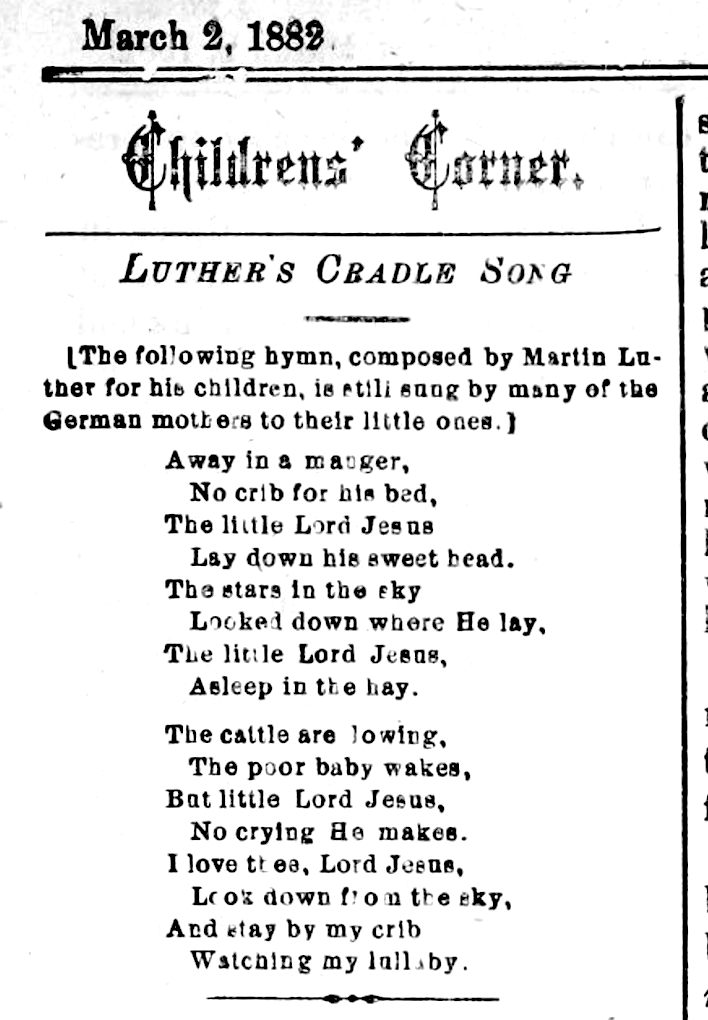
There’s no single answer to that question, but there’s evidence that by the 16th century Christians in Germany were bringing evergreen trees into their homes and decorating them. There’s a story – possibly true – that the famous church reformer, Martin Luther, walked home on a dark but clear winter night feeling awestruck by the bright stars overhead. So he erected a tree in his home, and fastened lighted candles to its branches to recapture something of the magnificence he had seen outside.  

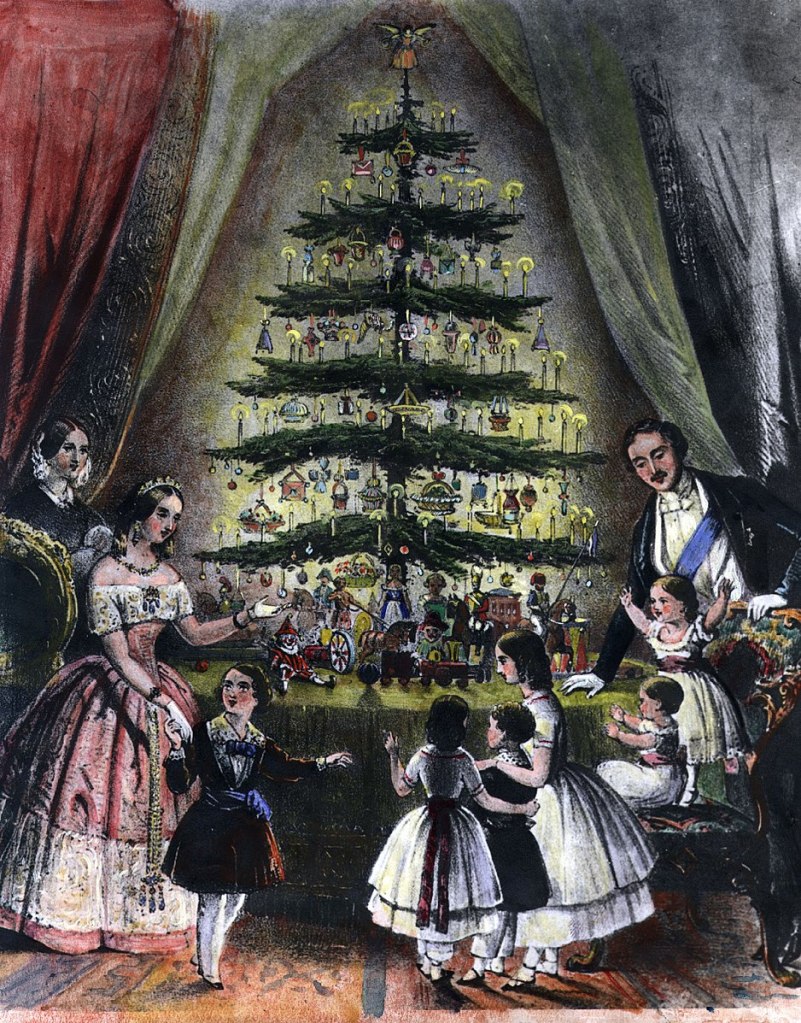
That German tradition slowly spread across Europe. But its popularity soared in the mid 1800s when Queen Victoria’s German husband, Albert, had trees erected in Windsor Castle and, in 1848, allowed a front cover painting to appear in The Illustrated London News showing the main tree covered in decorations and surrounded by the Royal Family. Other papers picked up on the story, and it massively influenced upper class customs in Britain and many other countries. Royal fever did its work.

Image in public domain

During the following decades and into the 20th century, the tradition of the Christmas tree spread quickly and widely. Across the western world almost all homes had Christmas trees. Local authorities mounted Christmas trees in public squares and on their buildings. Large stores placed trees on their balconies and in the main retail areas. Towns and cities publicised ceremonies of switching on the lights on large Christmas trees in prominent places. For example, since 1933 and continuing now, a large Norway spruce tree has been used for the Rockefeller Center Christmas Tree in New York. The 2024 tree is 74ft (22.5m) tall, 43 ft (13.1m) wide, and weighs about 11 tons (24,250 pounds, 11000kg). After the Christmas period, the tree will be donated to Habitat for Humanity and cut into lengths to help with building homes. In Washington DC the National Christmas Tree is erected near the White House, and its lights switched on by the President and First Lady. Trafalgar Square in London has had a Christmas tree donated by Oslo, Norway, every year since 1947. The 2024 tree is 20 metres (65.6ft) tall and has already been scaled by a protestor dressed as Santa Claus.

For a long time now Alison and I have had only artificial Christmas trees in our home, principally for three reasons: that means a real tree is still growing in the forest; artificial trees leave no mess; they can be used for many years. We follow a common tradition of laying presents around the base of the Christmas tree. When our children were young, those presents sparked curiosity which led to exploration. The children would secretly examine the size and weight of each neatly wrapped present, probably hoping the biggest and heaviest was for them. One thing we never have done or will do is sing around the Christmas tree. The TV series Downton Abbey portrays how the aristocratic family would sing along with their servants beside a giant Christmas tree. We have never done that. Maybe it’s because we don’t have servants. Or because we’re not very tuneful.

‘Once in Royal David’s City’

Every Christmas Eve millions in the UK and around the world tune in to a service of carols broadcast from King’s College, Cambridge. The first TV broadcast was in 1954, and then the service televised regularly from 1963. For over 100 years one tradition at the start of that service has not changed. Since 1919 the opening carol has been Once in Royal David’s City, with the first verse sung unaccompanied by a boy soprano. For that soprano, the thought of your solo being heard around the world must be terrifying. What must make it worse is that no-one knows who will be the soloist until the choirmaster selects one of the sopranos just as the service begins. A nod or pointed finger in your direction, and seconds later your voice penetrates the silence. And millions are listening.

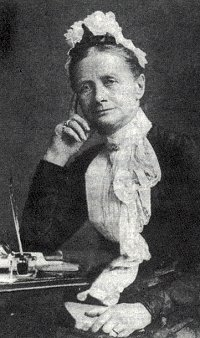
The writer of ‘Once in Royal David’s City’ was born Cecil Frances Humphries in 1818 in County Wicklow, Ireland. ‘Royal David’s City’ wasn’t her only famous hymn  – I’ll mention two more shortly. They may surprise you. Keep reading…

Cecil began writing poems in her school journal from an early age. They were beautifully composed in style and content, and that led to the publication of her first book of poetry called Verses for Seasons, a kind of ‘Christian Year’ of readings for children. That was only the beginning. Overall she wrote more than 400 hymns, basing them on subjects like the Apostles’ Creed, baptism, prayer, the Lord’s Supper and the Ten Commandments. All of them were written in simple language so children could understand and enjoy them.

When Cecil was 30, her book Hymns for Little Children was published. Each hymn was written to bring out the truth of some Christian teaching. Of course, without music the hymns read like poetry. But one year after publication a gifted English organist, Henry John Gauntlett, read Hymns for Little Children, and so loved ‘Once in Royal David’s City’ he composed music for it. As a hymn it was immensely popular and before long it was being sung far and wide.

Its origins as a children’s hymn show by the many direct lessons or references to children in the carol. For example, Cecil writes:

  • Christian children all must be / Mild, obedient, good as He.
  • For he is our childhood’s pattern; / Day by day, like us He grew;
  • And He leads His children on / To the place where He is gone.
  • Where like stars His children crowned / All in white shall wait around.

Cecil tells the story of Jesus in the carol, but also applies lessons and truths of the Christian faith for the children who would read or sing it. And that, after all, was her purpose. Hymns for Little Children carries a dedication by Cecil to her godsons, in which she hopes that the language of verse which children love “may help to impress on their minds what they are, what I have promised for them, and what they must seek to be”.

Two years later, in 1850, Cecil married Rev William Alexander (hence her hymns carry the name Cecil Frances Alexander). He eventually became the Anglican Primate of Ireland, a very senior role. Cecil poured her energies into writing hymns but also care for the very poor. The disastrous Irish potato famine – known as the Great Famine or Great Hunger – lasted from 1845-1852.[2] The parishes of Ireland were filled with masses of the disadvantaged. Cecil poured her heart and hands into care for them. Often she’d travel miles in difficult conditions to bring comfort to the sick and poor, and to give them food, medical supplies and warm clothes. Along with  her sister, she also founded a school for the deaf.

Cecil wrote many hymns before she died in 1895. One of those was the classic Easter hymn ‘There is a green hill far away’. Another was the hymn loved by children and adults ‘All things bright and beautiful’. Many have regarded Cecil Frances Alexander as one of the greatest hymn writers in the English language.

Eating mince pies at Christmas

There is every good reason to eat mince pies, but no special reason to eat them only at Christmas. They are just as enjoyable at any time of year.

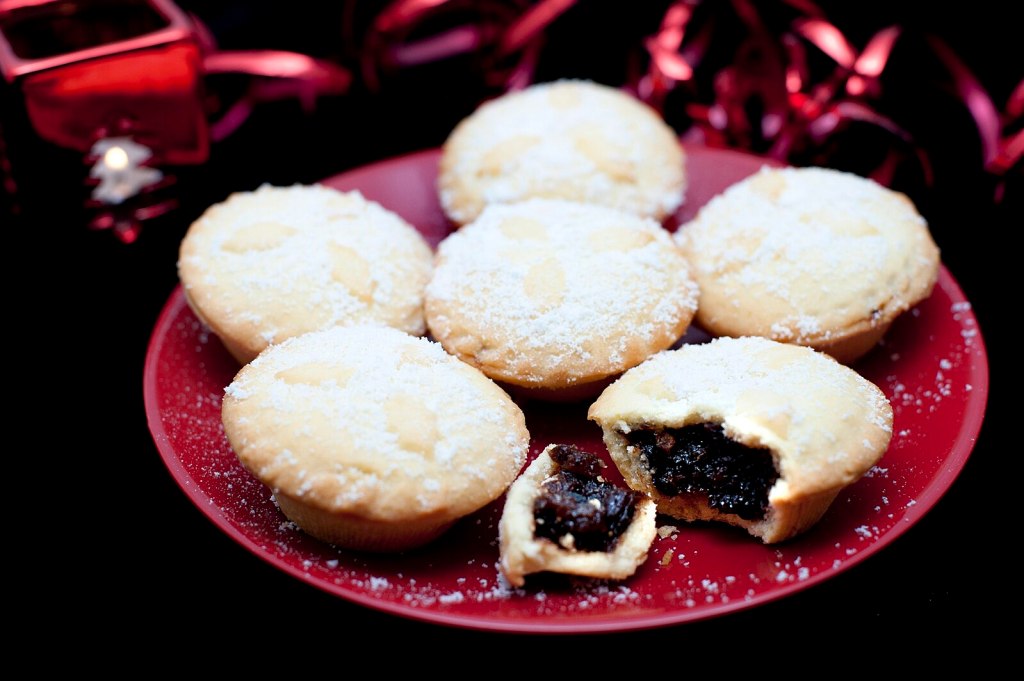
Plate of freshly baked festive Christmas mince pies with decorated golden crusts and spicy fruit filling served sprinkled with sugar, one broken open to reveal the filling. By christmasstockimages.com – http://christmasstockimages.com/free/food-dining/slides/mince_pie_plate.htm, CC BY 3.0, https://commons.wikimedia.org/w/index.php?curid=97503821

Mince pies date from medieval times but back then they were shaped like a rectangular manger, with a pastry baby Jesus on top. I’d find it hard to bite into that. The round shape of mince pies came only after the Reformation in the 1500s.

People of old linked the ingredients of mince pies with the Christmas story:

  • meat (mostly lamb or mutton) represented the shepherds
  • dried fruit (raisins, prunes and figs), along with spices (cinnamon, cloves and nutmeg), all expensive items, symbolised the wise men’s gifts
  • the mince pies had 13 ingredients in total, equating to Jesus and his 12 disciples.

Eating a mince pie every day of the 12 days of Christmas was thought to bring happiness for the following 12 months.

Around the time of the Reformation, Puritans tried to ban everything associated with Catholicism. That included mince pies. The pies soon made a comeback.

We can all be glad that ban did not last. The popularity of mince pies today is immense. In the UK about 800 million are sold in the run up to Christmas. Add to that the very many which are made in the home. Assuming they’re all eaten, that’s a lot of mince pies and a lot of calories. Some eat none of course – they’re not food for babies, nor does my 102-year-old mother-in-law eat them now. And there are some strange people who don’t like mince pies. A reasonable guess, then, is that those who like mince pies consume an average of between 15 and 19 pies per person at Christmas. Personally I’m a fan of home made pies served warm, and I’m not admitting how many I eat each year.

Finally…

I can’t finish without saying that, for me, Christmas isn’t about carols, mince pies, or presents around a Christmas tree. It is about Jesus, God’s Son, entering this world. No other birth changed the world like his.

My hope and prayer every Christmas is that people will think carefully about the one whose birth began it all (whatever the precise date). I wish you the happiest of Christmases and a new year ahead with many reasons to be thankful.


[1] https://www.history.com/topics/christmas/history-of-christmas-trees

[2] History.com records the famine’s toll: “Before it ended in 1852, the Potato Famine resulted in the death of roughly one million Irish from starvation and related causes, with at least another million forced to leave their homeland as refugees.” For a fuller description of the famine, see: https://www.history.com/topics/immigration/irish-potato-famine

I wish you a merry Christmas

On the eve of one of the most special days of the year, I wish you and all those you love a very merry Christmas. Not everyone in our multicultural and multifaith faith world celebrates Christmas, and I respect their views while disagreeing with them.

For some, Christmas is happening in the midst of terrible trouble – war, famine, poverty, abuse, homelessness, or other dreadful experiences. It’s worth remembering that the first ever Christmas – the birth of Jesus – happened during a cruel occupancy by an invading force (the Romans) and under tyrannical and savage local rule (by King Herod who massacred all Bethlehem-born male children aged under 2). The angels who announced Jesus’ birth spoke a message of peace, but we are still far from seeing that fulfilled everywhere.

For me, God’s Son entering this world tells me God has not abandoned us. We get so much wrong because of our selfishness, prejudice, and wickedness, and God might have given up on us and all humankind. But God hasn’t done that, and he sent his Son into the world to change lives. Many resist that change, but billions have found forgiveness, hope, freedom and love in knowing God.

To me that’s Christmas with real meaning. It’s serious and wonderful.

But, while listening to music in the build-up to Christmas, their messages are often light-hearted and fanciful. Yes, they give reasons for celebrating Christmas, but those reasons are not what this season is about.

Here’s the kind of thing I mean.

From my youngest I liked the idea that Santa Claus is coming to town. But, wait a minute, apparently Santa has a list, and he’s studying it to see who’s been naughty or nice, bad or good. On that basis, I don’t think I’d ever have had presents. And the idea that you only get something if you’re ‘good enough’ is not a healthy message.

Of course the theme of children and presents comes through a lot. I wish it could be Christmas every day paints a rosy picture of Christmas – the kids starts singing, bands are playing, bells are ringing. And how do we know It’s beginning to look a lot like Christmas? We know because there are toys in every store. If you are Barney you’re hoping for ‘hopalong’ boots, and if you’re Ben you want a pistol that shoots. Really? A pistol? Not the ideal present, IMHO.

But, no scary thoughts allowed. Christmas – just because of the season it is – must surely mean joy, joy, joy. Merry Christmas Everybody says everyone is having fun, and Merry little Christmas tells me my heart can be light, and all my troubles out of sight. Nice thoughts. If only they were true. But I’ve met too many people who found Christmas stressful (too much work and getting into debt), or sad (as they remember those no longer with them), or lonely (after I sent an elderly person a Christmas card, I got a thank you letter from her because my card was the only one she had received).

Surely, though, Christmas is the season for romance? Countless films suggest romance blooms at Christmas. The standard story-line is that lonely single woman meets handsome widower, and after some to-ing and fro-ing of feelings, they kiss and embark on an always happy future together. And, if that’s not quite working, then you can ask Santa to put Mr Right on the doorstep – or so All I want for Christmas says. But, Last Christmas warns us to be careful who we give our hearts to. Heart given on Christmas Day; heart taken away the very next day. So, this year, it’ll be given only to someone special. That’s certainly a good idea, but I’m not sure why it would be true only at Christmas.

I apologise if these last paragraphs sound mean. Actually, I quite enjoy most of these songs. My complaint is only when they suggest fun, presents, tradition, Christmas trees, Santa, parties, romance is what Christmas is all about.

For me, there’s so much more. One Christmas, many years ago, I knelt down and prayed words like these: Dear Lord, Christmas is your birthday. I can’t give you any ordinary present. But I am giving you my life for whatever you want to do with me.

That wasn’t the only time I’d offered my life to God, but that Christmas prayer was special. It was answered by new direction, new wisdom, new strength to do what I believed right with the gifts God had given me.

I can’t tell anyone what to pray, but if you know there’s something you should ‘give’ to God this Christmas, that would be wonderful.

May you be greatly blessed at Christmas and throughout the new year.

——————————

An apology: I’m very aware that my posting to Occasionally Wise has been irregular recently. The major reason is that from October I began a new course of full-time university study. So far it’s been both demanding and good. Posts will continue to appear, but I cannot promise what the frequency will be. Please be patient – thank you.

Christmas shreddings

It was mid-afternoon on Christmas Eve, and I was alone in the large office building where I was General Director. Every staff member had left already, but I’d stayed late to clear my in-tray before the holiday break. And now I was on my knees.

I’d realised some documents had to be shredded. That was straightforward. We had a large capacity shredder which I’d used many times. I switched it on, and dropped a few sheets into the slot. The shredder immediately cut out. I tried again, and again it stopped. I noticed a small light had illuminated – apparently the bag which caught the shreddings was full. Really? That shouldn’t happen, but someone had wanted a quick exit and cleared off without replacing the shredder bag.

But all I had to do was switch the full bag with an empty bag. Easy. Well, easy if you know where the replacement bags are kept. Which I didn’t. I searched every cupboard within any sensible distance from the shredder. No bags. I moved my search further out, and finally, 20 minutes after starting, I found a roll of large black bags. I pulled one from the roll, opened up the shredder, dragged out the vastly over-filled bag, attached the new one, inserted my documents and they were instantly annihilated. All was well.

All was not well because it’s impossible to slide clear an overfull bag of shreddings without spilling some of its contents. Tiny slivers of paper were scattered across the office carpet. If I left them there the cleaners would be unjustly blamed for not doing their job. So a new search began, this time for a vacuum cleaner or brush to sweep up the shreddings. I knew the cupboard where such things were kept, pulled on the door, but those cleaners guarded their equipment carefully. The cupboard was locked. Though I had many keys to the building, no-one had thought I’d ever need one for the brooms and brushes cupboard. Back I went to the shredder. Mary Poppins had not passed through and made all the shreddings disappear. The paper shards were still all over the carpet.

So I got down on my knees, and, with no way to sweep those pieces of paper into a pile, began the laborious, wearying job of picking them up one by one. That took at least 15 minutes. At some point I heard myself say, ‘On Christmas Eve, what other CEO is on his knees picking up pieces of shredded paper?’ Not many. Probably not any.

But that task brought home an important lesson:

Never think yourself too important to do the humblest of tasks

As I’ve thought about Christmas, I realised that down through the years the Christmas season has taught me many simple lessons like that one.

An early childhood memory was that my Dad went to work for half of Christmas Day. His occupation was on the administration side of the Post Office, and with mail being moved around and house deliveries made even on that day, someone had to be at the main office making sure everything went smoothly. That person was my Dad.

To wholly understand why he and many others in Scotland worked on Christmas Day you need some background details:

  • Until the Reformation happened in Scotland – in 1560 – Christmas was a recognised religious feast day of the Roman Catholic Church. But when Presbyterianism became dominant, gradually most Catholic festivals disappeared. That included Christmas, and an Act was passed in the Scottish Parliament in 1640 making any observance of Christmas illegal.
  • The mid-winter celebrations became transferred to New Year’s Eve – known in Scotland as Hogmanay. That change caused no problem for the religious authorities because Hogmanay was a secular event.
  • So, right into the second half of the 20th century Christmas Day was another working day in Scotland. Hence my father went to his office.

Of course, over many years the traditions from down south in England had crept north, and once television had spread and religious fervour diminished, Scots were also celebrating Christmas with trees, lights, presents and parties. Nevertheless, it was only in 1958 that Christmas Day was designated a public holiday in Scotland. (Did that diminish the celebrations of Hogmanay? Absolutely not! Canny Scots just chose to revel at Christmas and New Year, and often to do so with more enthusiasm than wisdom.)

However, remembering that my Dad went off to work on Christmas morning, there is another lesson:

Many people – especially in emergency or caring professions – have to work on Christmas Day, and for that we should be grateful.

Like most small children, my brother Alan and I were always up early on Christmas Day, running through to the room where we’d hung stockings by the fireplace, to see what presents we’d got. There was never much in those long socks – an apple, an orange and perhaps a bar of chocolate and tiny toy car. But we were fortunate because there was more for us. We gazed in awe at the nicely wrapped larger presents laid on the floor.

I never wasted a moment, ripping open the Christmas paper to find the toys or games or clothes inside those boxes. The clothes never excited me, but the games and toys did, and I’d have them all out and be playing with them in very little time.

But my brother Alan had a different temperament, and took great care about opening his presents. He’d examine each parcel, undo the paper neatly, be excited about the contents, and then extract the toy and play with it. All before moving on to his next gift.

His meticulous process meant I was finished and done with my presents when Alan had only just started. I had to watch while he moved through his gifts one at a time. Some years I complained to my Mum that Alan clearly had more presents than I did. She assured me he didn’t. He just enjoyed each one fully before moving to the next.

So, another lesson:

There’s a lot to be said for what is now called ‘delayed (or deferred) gratification’, because many things are better by not being rushed.[1]

I grew up in a home where green vegetables were not a major part of the diet. My Dad grew peas, cabbages and cauliflowers along with root crops and fruit. But we didn’t eat ‘greens’ in any quantity. My Aunt Milla – a nurse who should have maximised health benefits – would put a tiny spoonful of peas alongside meat and potatoes ‘for decoration’.

But, on Christmas Day, we were always given a generous portion of what we called ‘Brussel sprouts’, though the first word probably should be pluralised because of the vegetables’ origin. What are Brussel sprouts? Let me tell you:

  • The Brussels sprout is a member of the Gemmifera cultivar group of cabbages (Brassica oleracea), grown for its edible buds. The leaf vegetables are typically 1.5–4.0 cm (0.6–1.6 in) in diameter and resemble miniature cabbages. The Brussels sprout has long been popular in Brussels, Belgium, from which it gained its name.[2]

I did not enjoy eating those edible buds of a cabbage. I simply didn’t like their taste. Some people don’t like broccoli[3], and I didn’t like Brussel sprouts.

But what was put on my plate had to be eaten. The usual warning was: ‘If you don’t eat your sprouts, you won’t get any dessert’. And since dessert was Christmas pudding, perhaps with cream, the blackmail to swallow those sprouts worked.

I must add that age has improved my taste. My willingness to eat Brussel sprouts gradually moved into the positive column. They are actually very good. But, in my early years, I ate them only because I had to.

So there is another lesson here:

We all have to do things we don’t like or want – that’s life.

Christmas has one form of annoying and unnecessary delayed gratification. It concerns the toy or appliance that won’t work without batteries, but no-one thought to buy them. When I was about seven I got one of those presents – a toy that was exactly what I wanted – but no batteries came with it and there were none in the house. My frustration was expressed loudly. So loudly my Dad set off on foot to find any shop open, but the few doing business didn’t sell batteries. I suffered (but not in silence) for about 24 hours, by which time batteries had been bought.

These days batteries are often packaged with the product, which helps avoid a Christmas crisis. But it’s not good to assume they’ll be included. Nor is it good to buy gloves that fit your hands but not the hands of the person receiving the gift. Or wrong-sized boots. Or a sweater with a dazzling design the recipient will hate. Or a tool they don’t need or want. Or music they’ll never play. Or a ‘Cooking for Beginners’ book for someone who already considers him or herself an expert. Or a dog for someone who likes cats. I even know a case where a few well-off individuals bought a CEO who was retiring a brand new SUV to replace the car he’d driven for years. The gift was amazingly generous, except the retiree whispered to me, ‘The problem is I really, really like my old car. I didn’t want a new car.’

The lesson, then, is this:

When buying presents, do your research and plan ahead.

When we lived in America we adjusted to the custom of eating turkey at Thanksgiving. In the UK turkey is the traditional meal at Christmas. Sometimes we’d travel back to the UK to spend Christmas with family, so we overate with US turkey in late November and overate with UK turkey in late December. Just as well we like turkey.

Many years before, when we lived in north east Scotland, our good friends Malcolm and Tina decided that they would buy us a turkey every Christmas. The only problem was that they never said explicitly that they’d give us a turkey every Christmas. Initially we thought they’d gift us a turkey once or twice, and then move on to give turkeys to other friends. But their turkey-at-Christmas kindness didn’t stop. A few days before each Christmas they’d call round with a turkey.

Then the year came when they didn’t. Not on December 20, or 21, or 22, or 23. By then we’d realised no turkey would be arriving. Alison, happily, had put some turkey in our freezer, so we wouldn’t fail to have our traditional meal. The 24th – Christmas Eve – dawned and Alison and I spent a hectic day preparing food, organising presents, putting final decorations in place, and, as pastor of a large church, I had events to prepare for and attend. In the evening I joined a group singing carols in a local hospital, hurried home and then went out again to lead and preach at our Watchnight Service which started at 11.15 pm and continued into a celebration of Christ’s birth at midnight. Around 12.30 am I headed home. Thankfully the children were all in bed and asleep. Alison was busy preparing various parts of our Christmas Day meal. I hadn’t had a moment to wrap presents, so I settled down to that task. Given my significant lack of expertise, gift wrapping was not a quick process. I finished around 3.00 am. Alison was still occupied in the kitchen, and I had a few more things to do before I could go to bed. At 3.30 am we heard a van arrive in our driveway, our doorbell rang, and it was our friend Malcolm with our turkey. Apparently we were his final delivery and he’d made us last because, as he said: ‘I knew you wouldn’t be in your beds yet!’ No, we weren’t. But it was 3.30 on Christmas morning!! More than a little on the late side to be delivering a turkey for that day’s meal. But we were very grateful, not just for the turkey but for friends like Malcolm and Tina.

So, this time two lessons:

Be generous and kind to all this Christmas.

But, if you can, don’t deliver turkeys at 3.30 in the morning.

________

This message is posted on Christmas Eve, and comes with my sincere hope that you are able to enjoy a happy Christmas, appreciating the wonderful truth that God sent his Son into this world. And, if possible, I long that you will have good food and friendship to enjoy.

This particular year (2022) the news is filled with stories of severely cold weather across much of the USA and Canada, and of power cuts imposed on the people of Ukraine resulting in much suffering from the cold and shortages throughout this winter. Many others in our world also struggle, so please keep them in your thoughts and prayers, and, if you can, provide support for those in such great need. May 2023 bring many good days for which you can be thankful.


[1] In the UK there is a magazine called Delayed Gratification, which covers news which is moving out of the headlines. Its slogan is ‘last to breaking news’. https://www.slow-journalism.com/

[2] From Wikipedia: https://en.wikipedia.org/wiki/Brussels_sprout

[3] Including some US Presidents: https://today.yougov.com/topics/politics/articles-reports/2013/07/13/presidential-broccoli-debate

Have a wonderful Christmas!

Before I began writing this blog nearly a year ago, I decided to avoid highlighting special events or seasons of the year. And then, at the beginning of January, my first blog was about ‘Resolutions’. I failed right at the start!

And I’ve failed right at the end of the year because I could not ignore Christmas, writing two blogs on the odd ancestors of Jesus, that strange family list which culminates in the birth of the Son of God in Bethlehem.

The last blogs of this year had to take account of the season. How could I ignore the birth of Jesus?

So, my original decision abandoned, as Christmas Day begins where I am in the UK, let me say HAPPY CHRISTMAS to those who’ve already been celebrating this day in places east of where I am, and the same to those who’ll celebrate in a few hours in places to the west.

The blog has been read this year in 32 countries. As I post this, those already celebrating Christmas include readers in Indonesia, South Korea, China, Australia, India, Pakistan. Those yet to reach Christmas Day may be in the USA, Canada, Ecuador, Chile, Bahamas. Unsurprisingly by far the greatest number of readers are in the UK (and I hope they’re now in bed!)

Wherever this is read, please know I’m grateful for your interest. This Christmas I’m praying that you know God’s peace and God’s goodness in your life, and that 2022 holds many blessings for you.

With warmest appreciation,