‘Is my family odd?’ Yes, but that’s normal

My wife, Alison, was planting bulbs around a family grave in my home town. I wandered off, reading the words on headstones. One made me stop and stare. I had never seen a grave stone inscribed like this one.

Three things made it different from all others. Two of the three were truly remarkable.

First, though the headstone was not unusually large, there were more family names on that stone than I would have thought possible. Several generations were being memorialised.

Second, very strangely, the last name listed was someone not yet dead. The person who’d had all the family names inscribed on the headstone had added his own. His name and date of birth were there after which there was simply a space, presumably to be filled eventually with the date of his death.

Third, and most peculiar of all, was the inscription right at the foot. I had never seen anything like it on any grave stone anywhere, so I took a photograph.
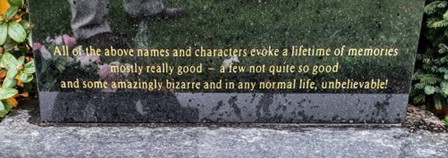
The wording may not be readable, so here it is:

All of the above names and characters evoke a lifetime of memories / mostly really good – a few not quite so good / and some amazingly bizarre and in any normal life, unbelievable!

Gravestones usually have tender words, kind sentiments praising the life of the deceased. This inscription wasn’t unkind; just the most honest I’ve ever seen.

The truth is that all of us – or, at least, most of  us – belong to odd families. When Alison studied health science, including the sociology of health, her lecturer said most people wonder why they’re the only one to struggle with health issues, while the truth is that everyone has health problems. And, likewise, we wonder why our family is so odd compared to others, but actually almost every family has its share of mad, bad, sad and some glad individuals.

It might be the eccentric and extrovert uncle who embarrasses everyone at weddings with his off-key singing or crazy dancing, so dreadful the rest of the family pretend he’s not related to them. Or a brother who’s recently re-joined the family after several years of being accommodated by the government because he dealt in drugs. Or the sister who has been married and divorced so many times that everyone is terrified they’ll use the wrong name for her latest partner. Or the father who abused his daughters. No-one who knows what happened ever mentions his name. Or the niece who has been weak and ill almost all her life. Or the cousin who has changed jobs repeatedly and been spectacularly unsuccessful every time. Or another brother and his wife who lost their only child, killed by a drunk driver. And sometimes, one or more who have found happiness in relationships, success in career, and comfort and hope in their beliefs.

I can’t think of any family who has the whole package I’ve just described. But I also can’t think of any family without a substantial mix of stresses and struggles. Is it the norm to have a happy extended family with everyone friends and no serious problems? Absolutely not.

One of the most memorable speeches of Queen Elizabeth, who died in 2022, was given 30 years earlier when she described 1992 as an annus horribilis, literally a ‘horrible year’. What especially made it so horrible were family troubles:

  • February: The estrangement between (then) Prince Charles and Princess Diana became all too evident when she was photographed seated alone in front of the Taj Mahal.
  • March: Prince Andrew and Sarah Ferguson announced they were separating.
  • April: Princess Anne and Mark Phillips were divorced. They were already separated, and news had recently broken that he had fathered a child a few years earlier with a New Zealand woman.
  • June: the ‘tell-all’ book Diana: Her True Story, written by Andrew Morton, was published. It revealed Diana’s deep unhappiness, including an attempted suicide.
  • August: Photographs appeared in the press of Sarah Ferguson in an intimate relationship with her Texan financial advisor.
  • November: Windsor Castle, the beloved retreat of the Queen just outside London, went up in flames. A spotlight in Queen Victoria’s chapel had ignited a curtain, and the fire then spread to the roof and other locations. It destroyed 115 rooms, including nine state rooms. (The castle was restored at a cost of £36.5 million, a cost equal to almost £90 million in 2022.)

Only the last of these was not a problem of relationships within the royal family. The year was truly an annus horribilis for the Queen, sadly not her only one. There is no family without its troubles.

If worries and woes are the norm, what are wise ways to respond and cope? There are probably many, but here I’ll suggest four.

Let’s be honest. I like the inscription on the grave stone because of its honesty. Not everyone in the family had been good, and some were bizarre to the point of being unbelievable. I’ve sat through funeral services where the deceased person is made to sound like the greatest of all saints, except everyone knew he wasn’t. Someone might well have turned to his neighbour and asked, ‘Whose funeral was that, because the preacher certainly wasn’t describing Joe?’ Our family troubles shouldn’t be turned into headline news, but neither should we pretend everything and everyone is wonderful. A reasonable honesty about life and relationships is good.

Let’s be comforted. If it’s news to you that having odd, difficult or bad people in your family is normal, it may reassure you that, after all, your family isn’t unique. Over the years Alison and I have received Christmas newsletters which mention only great achievements for someone’s children and other near relations. We have looked at each other, and smiled as we said ‘our family is not like that’ and ‘we don’t believe that’s the whole story for their family either’. Sometimes the harder truths have emerged later, perhaps that someone’s marriage has broken up, or a family member has dropped out of university without any plan for what’s next. There is no place for rejoicing over anyone else’s troubles, but there is reassurance in knowing your family is not the only one with misfits and miscreants.

Let’s be caring. I was being humorous earlier about having an uncle so embarrassingly crazy the rest of the family pretend they’re not related to him. That’s not exactly true, but it’s also not exactly untrue. Sometimes families shun relatives who are weird, or super-needy, or old, or behaved badly, or who are simply unlikeable. Can that ever be right? I don’t believe it is. Yes, family members can be difficult or demanding, but they are family members and that relationship creates an obligation to care. The New Testament is very straight about family responsibility: ‘Anyone who does not provide for their relatives, and especially for their own household, has denied the faith and is worse than an unbeliever.’ (1 Timothy 5:8)

My Aunt Milla was a nurse, her career spent mainly in challenging places with very disadvantaged people. She was hard to shock. For the last few years of her professional life, however, she was a hospital almoner (a social-service worker in a large hospital). Her work included liaising with families whose elderly mother had completed treatment, and was now fit to be discharged except she could no longer live alone. Would the patient’s family take in their mother? Most times the answer was a very firm ‘No!’ That did shock my aunt. Their children were grown up and long gone from home, so the house had spare bedrooms, but people would not look after their mother. They enjoyed their freedom, and caring for mother would restrict that. The only thing they were willing to do was put mother into a care home.

Family members are often not easy, but please let’s care for them.

Let’s be gracious. The word gracious comes from ‘grace’ which means undeserved favour. In the Bible parable, grace is what the father showed to his prodigal son, the one who took his inheritance early, then squandered it and nearly starved before coming to his senses and returning home. His father could have shunned him, but instead flung his arms around the boy and welcomed him back into the family.[1]

Our relatives know when they’re being shunned, or judged, or looked down on, or hated. I won’t pretend it’s easy to be kind to those who have hurt us in terrible ways. But – as far as possible – our goal should be forgiveness and restoration.

Some years ago, during long car journeys, I’d listen to the songs of Chuck Girard. One stood out particularly. Here’s the chorus: Don’t shoot the wounded. They need us more than ever. They need our love no matter what it is they’ve done. Sometimes we just condemn them, and don’t take time to hear their story. Don’t shoot the wounded. Someday you might be one. At one time Chuck Girard struggled with alcoholism. His song may reflect the need he once felt to be taken back into family and fellowship. What’s more, as Girard points out at the end of the chorus, one day we might be one of the wounded, and then long desperately for restoration.

Let me finish with this. Over the years I’ve often been tempted to label a colleague or a church member as a ‘problem person’, someone with a special ability to annoy me or make my life difficult. Then, one day, I realised something obvious: that if someone was a ‘problem person’ for me, I was surely a ‘problem person’ for someone else. That person would find things I said or did annoying, or my decisions difficult to accept.

The hard truth is that none of us are perfect. All of us need forgiveness and acceptance, not just from God but probably from our families too. The writer of the gravestone inscription didn’t think all his family had been good, and some were amazingly bizarre. He was a little odd himself, with the strange summary of his family and having his own name on the gravestone while still alive. But oddness is normal, and recognising and accepting that will make for happier families.


[1] The story can be found in the New Testament, Luke chapter 15. I wrote about the prodigal a few blog posts ago – see https://occasionallywise.com/2022/11/02/change/
Even more wisdom

Dictionaries struggle to define the word ‘love’. Because it’s not a ‘thing’ it’s hard to describe, so dictionaries use phrases such as ‘strongly liking another person’ and also talk about romance. Not exactly comprehensive. But, since you can’t put love under a microscope you can’t analyse its constituent elements. You can only talk about how love is felt or shown, especially when that love is between people. (Loving your job, your house, your garden, even your dog, isn’t quite the same.)

Describing wisdom is as problematic as describing love. You can’t sum up wisdom with a word or phrase; instead you give examples of wise decisions or actions. That’s what I’ve done in the last two blogs, and this one isn’t different.

I’ve listed six categories in which wisdom matters. I could have listed 16, and by next week even more. But one I’ve listed here is about knowing when to stop, and I will stop writing about wisdom (at least for a long time) after this blog.

Here goes with (hopefully) even more wisdom.

Value

Oscar Wilde wrote that a cynic was ‘a man who knows the price of everything and the value of nothing.[1]

It’s a great line, and likely true concerning many people. The second half is disturbing: that, someone could know many things but know nothing about their value. Not know where worth really lies. Not know what’s truly important.

Wise people don’t make that mistake. They understand what matters, and they prioritise and pursue those things rather than the trivial and ephemeral, things that are unimportant and don’t last.

I’ve been privileged to pour myself into work that has deeply affected people’s lives, both in the UK and many other countries. I have seen some people change; others, scattered around the world, I simply knew about through friends and colleagues.

Not everyone can have jobs aimed directly at transforming and improving lives. Sadly, some have hated their jobs. Their work, it seemed to them, contributed nothing other to boost the profits of a large multinational corporation. Why did they not find other employment? They didn’t leave because they were well paid. One was so well paid he had three cars: a Jaguar, a Porsche, and a Maserati. And he bought a ranch as well. I’m not suggesting cars or a ranch are ‘sinful’ – just that directing your life towards accumulating wealth or owning ‘things’ produces no lasting worth.

Wise people know where value really lies, and set their goals accordingly.

Health

My mother started smoking in her mid teens, a long time before the general population had any idea that cigarettes were harmful. My father probably started around then too, but never smoked heavily except perhaps during World War II when he was in the army. As my brother and I were growing up, mum and dad both discouraged us from smoking because ‘it causes shortness of breath’. But – unknown to them – smoking was much more serious than that. It was killing them. My mother’s heart was badly affected, and she died aged 55. My dad immediately stopped smoking but that couldn’t eradicate the damage already done. He had a massive heart attack when 64, and survived it, probably because he was already in hospital and got immediate attention. He reached 79, and then died of a second heart attack. Our most favourite aunt – my mum’s sister – smoked all her adult life, and she died aged 74.

You’ll gather I have strong feelings about the harm cigarettes do to the human body. Thankfully I took my parents’ advice and never smoked, not even once.

This paragraph isn’t meant to be a rant about cigarettes, but a statement that wise people take good care of their health. At a minimum that’ll involve a good diet and exercise. I married well, and Alison ensures we eat only what’s good for us. Diet: tick. And we walk our dogs up and down hills every day, and Alison is a committed gardener while I play golf two or three times a week. Exercise: tick.

I spoke at a large conference in the north of Scotland, a talk during which I said we should care for our health to avoid hastening death. One man came to me straight afterwards, anxious to persuade me that we can’t hasten our deaths. We can die only when God has ordained it. My answer was along the lines that God has ordained that we care for the bodies he’s gifted us so we can fulfil all the potential he’s invested in us. That man and I didn’t argue, but also didn’t agree. Oddly, we stayed in touch, became friends and that led to the publishing of four of my books.

Whether we believe our bodies are gifts of God, wisdom dictates we care well for them. Damage your body at your peril. You can’t trade it in for a replacement.

Family

I have attended many retirement events, at which we celebrated people’s long service and achievements. At the end the retirees would speak. Almost always they’d say that if they had it all to do over again, they’d give less time to their work and more to their family. It seems their children had grown up strangers to them. I vowed to never have to give that speech. Certainly Alison and the family made sacrifices because of my work, but we all survived, and now our grown-up children are our best friends. We get on great. Whatever wisdom helped that happen, I’m grateful for it.

Destiny

Image in public domain

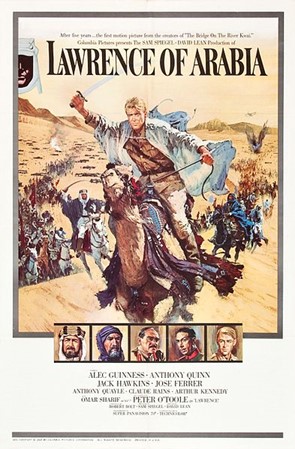
In the 1962 film Lawrence of Arabia, based on the life of T.E. Lawrence, there’s a short scene that influenced me significantly. Lawrence is doubting he can continue leading Arab tribes in battles against the Turks during World War I. Exhausted and emotionally troubled, Lawrence considers giving up the fight. Then the top general challenges him with words like these: ‘Many go through life with no awareness of a destiny. But it is a terrible thing to have a destiny, and not to fulfil it.’ Those words stir Lawrence, lift him from his depression and weariness, and he presses on to win significant battles.

The words in the film were probably the work of a script-writer and not original. Yet they captured Lawrence’s situation, and impacted me when I was worn down. I knew I had a calling, a destiny, and it hit me freshly that it would be terrible not to fulfil it.

My guess is that most people don’t think of having a ‘destiny’ for their lives. The word sounds grandiose. But many do have some sense of purpose or opportunity. There is something they could do and should do. It would be terrible to reach old age and suddenly realise they’ve left it too late to do what they’ve always believed they were in this world to do. A wise person thinks early on about their purpose and potential, and moves steadily towards that goal.

Starting and stopping

I’ve always been tempted to take on more things than I can handle. Giving in to that temptation inevitably leads to stress and incompetence – stress, because we’re overworked; incompetence, because there’s only so many things we can do well.

But most of us are under constant pressure: to join a committee, take on a task, support a good cause. I’ve been asked to lend a hand – it sounded so innocuous – ‘I just need a little help with a project…’ Before long I was doing the project and he’d gone fishing.

Perhaps the only way to have a quiet life is to be hopelessly incompetent, because then no-one asks you to do anything.

Incompetence, though, is a bad solution. Rather, the wise person considers whether a new thing is a right thing.

To be a right thing, three conditions have to be met, best done by asking ourselves questions:

  1.  Does this thing fit with the particular gifts or abilities I have? Most of us could do all sorts of things, but there are some things we’re particularly good at. Those things – which especially fit our skill-set – are likely to be the tasks we should take on.
  2. Should someone else be doing the new task? Many things can be done by many people, so this task doesn’t specifically require me. Just because I could do it doesn’t mean I should do it. Beware those who say, ‘You’re the only one I could ask’ because the real truth may be that ‘You’re the only one I have asked’. Some people don’t look far afield when enrolling help. Don’t be a soft touch.
  3. Can you stop doing other things in order to do the new thing? There’s a saying, ‘If you want something done, ask a busy person’ – because they’re the kind of person who’ll say ‘yes’ when asked to help. But that’s exploitation. They hate to say ‘no’, so soon become overloaded. Unless, that is, they let other things go. I wrote an earlier blog under the heading Necessary Endings (available in Archives, April 11, 2021). I’d been helped by a book with that title by Henry Cloud, a clinical psychologist. He sums up his message early on: ‘…the tomorrow that you desire and envision may never come to pass if you do not end some things you are doing today.’ Wise people limit their work so they can work well. And survive their workload.

Appreciation

One of our dog behaviour books tells us that far beyond any other kind of treat, the greatest motivator for a dog is praise. Lots of enthusiastic ‘Good boy’ ‘Good girl’ ‘Well done’ statements with gentle stroking is key to good dog behaviour. Humans need appreciation too.

I can think of a boss – not one I ever had, thankfully – who was never grateful for what any of his staff did. No recognition of excellence; no recognition of working all hours to get a project finished. Their work was taken for granted; no need for thanks. But if a project went wrong or was late, he flew into a temper and raged at his staff even if the problem had nothing to do with them. You can guess what that boss’s bullying and ungrateful behaviour did to his staff: how little they enjoyed their work; how much they dreaded what might lie ahead as they walked through the office door each morning; how demotivated they were about continuing in that employment.

A wise person is an appreciative person, someone who says ‘you did a great job’. If we can’t appreciate people we’re in the wrong job. Recognising worth and sharing praise is rarely dwelt on in management books, but, done sincerely, appreciation bonds a team and builds achievement.

The Old Testament book of Proverbs says ‘fools despise wisdom’ (ch.1:7). And the New Testament book of James says ‘If any of you is lacking in wisdom, ask God, who gives to all generously and ungrudgingly, and it will be given you’ (ch.1:5). So, fools reject wisdom. But those with a little wisdom can seek more, which God will give. I agree – I’d be a fool not to.


[1] Spoken by Lord Darlington, in Lady Windermere’s Fan, a play first performed in 1892. Wilde wrote the play while living in the English Lake District, hence the source of the name Windermere.

The odd ancestry of Jesus, part 1

It’s often said, ‘We can choose our friends, but not our family’. True. And most families include strange people. Like crazy uncle Henry who tells inappropriate stories at family gatherings. Or cousin Maureen who’s been married six times, divorced five times, and everyone’s guessing how long husband number six will last. Or like younger brother Bert who’s rarely talked about and rarely seen because most of his adult life has been in government funded accommodation. (No-one likes to use the word ‘prison’.)

Every family’s different, but it’s not unusual for some of our ancestors or present-day relatives to be odd.

Jesus certainly had odd characters in his family line. In this blog I’ll select three of Jesus’ ancestors listed in Matthew’s gospel, chapter 1, verses 1-16. (Some will know that another genealogy appears in Luke’s gospel. I’ll explain at the end why the two genealogies are not identical.[1]) This time, then, three ‘odd’ people among Jesus’ ancestors, and in the next blog another three.

Does ancestry sound boring or irrelevant? I promise these people are neither. Most of these stories are shameful and shocking, more so than many modern dramas. But it’s significant – even encouraging – that they are part of Jesus’ ancestry.

Three short notes before starting.

  1. At the time Jesus was born, genealogy was hugely important. Matthew began his gospel like this: ‘This is the genealogy of Jesus the Messiah the son of David, the son of Abraham…’ and what follows is a list of who is the father of whom. His story of the events leading to Jesus’ birth doesn’t start until verse 18. Why open with a genealogy? It was because Matthew was writing his gospel for a Jewish audience, and to a Jew a person’s family line was of utmost importance. To show your impeccable descent as a true Israelite was the most significant part of your ‘résumé’. So Matthew lays out Jesus’ ancestry.
  • Several of the names in Matthew’s list are people we regard as heroes of the faith, both Jewish and Christian. People like Abraham, Ruth, David are great names to have in your ancestry, but they are also ‘complicated’. That doesn’t make them any less great. After all, who’s not ‘complicated’? It’s fascinating and comforting that people who did seriously wrong things were and are heroes of faith.
  • It’s all right to talk about this. It’s tempting never to admit our heroes were flawed, or abused, or had problematic backgrounds. But: a) Matthew’s readers knew all that already; b) We need to know that God uses flawed and complicated people. There have never been any perfect saints.

Now on to the first three ancestors of Jesus.

1. Abraham

This is the man with whom God made a special covenant, that he would have a son, and down subsequent generations would come offspring as many as the stars in the night sky. (Genesis 15:4-5)

Abraham believed God, and in most things tried to go God’s way.

But he didn’t get everything right. In particular he made two enormous mistakes.

First, he handed over his wife Sarah to other men. Sarah was very beautiful, and other men wanted her. To save his own skin he pretended she was only his sister, and allowed them to take her. That happened not just once but twice.

The first time was in Egypt. (Genesis 12) Not knowing Sarah was already married, Pharaoh took Sarah into his harem. In punishment God inflicted serious diseases on Pharaoh and his household. Then it was discovered that Abraham had hidden the fact that Sarah was his wife. Pharaoh was furious and drove Abraham and his people from the land.

You’d think Abraham would learn his lesson. He didn’t.

In Gerar, again he said that Sarah was his sister. (Genesis 20) Abimelek, the king, took Sarah into his harem. But Abimelek had a dream in which God told him Sarah was a married woman, and he was saved from disaster because he had not yet had sex with Sarah. Abimelek was incensed with Abraham for deceit that almost brought destruction on him and all his people. Abraham protested she really was his sister. That was true. Abraham and Sarah had the same father but not mother, so she was his step sister. But she had become his wife, and from the start of their wanderings he had pressured her into concealing they were married in order to keep Abraham safe.

There was nothing good or acceptable in Abraham’s self-preserving dishonesty. He harmed many, none more than his own wife.

Second, Abraham had sex with another woman so he could have the son he was promised. Years went by and Abraham questioned whether God would keep his promise of an heir. He and Sarah were getting old, and Sarah had never become pregnant. It seemed Abraham would never have a son.

Then Sarah made a suggestion. She had a young Egyptian woman called Hagar as her slave. Sarah told Abraham he should have sex with her so they would have a son through her. Hagar would be a surrogate mother for their child. (Genesis 16)

It’s hard to know what Abraham thought but there is nothing in the story to say he protested or had to be pressurised. Because Hagar was a slave she had no choice and she became pregnant.

None of the three characters in the story behave well after that. Hagar seems to have taunted Sarah because she’d conceived when Sarah couldn’t. Sarah was upset. She complained to Abraham who took a hands-off approach by telling her to do whatever she pleased. Sarah then treated Hagar so badly she ran off into the desert. An angel told her to return, which she did, and gave birth to a son who was called Ishmael.

Abraham and Sarah struggled on. But they’d virtually given up on having a son of their own. Even when an angel of God promised them again that they will have a son, Sarah laughed to herself: ‘An old woman like me? Get pregnant? With this old man of a husband?’ (Gen.18:12, as paraphrased by The Message)

Not a polite reaction to an angel’s promise, and not at all full of faith. But God’s promise was stronger than this couple’s failure of faith. Abraham and Sarah eventually had their son, and he was given the name Isaac. (Genesis 21)

Abraham – the father of the nation Israel – was undoubtedly a great man. But, perhaps like most great men, he was far from perfect. And he was not the only odd ancestor of Jesus.

2. Jacob

Here is another very significant person in the story of God’s people, the man who wrestled with God and was then renamed Israel. (Genesis 32: 27-28)

But Jacob’s earlier history is not good. (Genesis 25) The problems centred on the relationship between Jacob and his brother Esau. The two boys were twins. Esau was born first, so number one in line to his father Isaac.

In many ways these brothers were very different from each other:

  • Esau was an outdoorsman, rough skinned and covered in hair. Much loved by his father, Esau was the hunter-son who brought Isaac the venison he liked.
  • Jacob was domesticated, a smooth skinned man. He was also the favourite of his mother Rebekah.

Jacob, it seems, hated being second, and, as grown men, his resentment came to a head in two sad and bad actions.

First, Jacob took advantage of Esau to ‘steal’ his birthright from him. Because he was born first, Esau would inherit the whole ‘family estate’ when his father, Isaac, died. That was his birthright. Until, that is, Jacob went to work.

Here’s what happened (as told in Genesis 25:29-34). Jacob – the stay-at-home son – had cooked some stew. Esau, meanwhile, had been wandering the hills, likely hunting for game. He’d been away for some time, and arrived home famished. The smell of the stew hit his nostrils, and he begged Jacob for the food. Jacob shrugged and said something like, ‘I’ll give you stew if you give me your birthright’. Esau – not thinking straight – replied he was about to die from hunger so what good was the birthright to him. Jacob seized the moment. He made Esau swear an oath giving his birthright to Jacob in exchange for bread and lentil stew. It was all over in a moment. That done, Esau sat down and ate his meal.

There’s no doubt Esau was extremely thoughtless and foolish. He showed an impulsiveness which also got him into trouble on other occasions (such as marrying Canaanite wives, which was forbidden).

But Jacob is not guiltless. He did nothing illegal, but his actions were far from commendable. It was ridiculous to take his brother’s birthright in exchange for a bowl of stew. Who would think anyone would sell his inheritance for one plate of food? Jacob would. He could imagine that Esau would be weak-willed and reckless enough to do exactly that. So Jacob took advantage of Esau when he was vulnerable and got away with it, but his actions were utterly unworthy.

Second, Jacob deceived his dying father with help from his scheming mother. The years have rolled on and the twins’ father Isaac is now old and weak. (Genesis 27) He is blind, and recognises his sons only by touch and smell. The day he will die approaches, so Isaac decides the birthright must now be passed from father to son.

But to which son? It’s not clear that the deal done earlier between the twins is valid. It certainly isn’t recognised by Isaac because he is ready to bestow his blessing on his older son, Esau.

Isaac tells Esau to hunt game and prepare a tasty meal just the way he likes it, and then he will give him his blessing. That ‘blessing’ will be the formal moment of passing the inheritance.

Esau’s mother Rebekah overhears, and swiftly gives instructions to Jacob. He is to fetch two goats, bring them to her, and she’ll prepare a meal the way Isaac likes it. Jacob will serve the food, and he will get the blessing. Jacob points out the obvious, that if Isaac feels him his smooth skin will immediately reveal that he is not Esau. His mother has a solution to that. When the meal is ready, she dresses Jacob in Esau’s clothes and covers his hands and his neck with rough goatskins.

Jacob goes to Isaac and blatantly lies to his father: ‘I am Esau your firstborn. I have done as you told me. Please sit up and eat some of my game, so that you may give me your blessing.’ (Genesis 27:19)

Isaac isn’t so sure – how could Esau be back so quickly? Besides the voice sounds like Jacob, not Esau. But he feels his hands and they are rough. Again he asks if he is really Esau, and Jacob replies ‘I am’. (v.24)  There is one final check. Isaac insists on being kissed by his son, and when he is close he smells his clothes. They smell as Esau’s clothes. And so Jacob gets the blessing of his father, and therefore inherits everything including rulership over his older brother.

Of course the deception is known as soon as Esau returns, but it’s too late. The blessing Isaac has given Jacob cannot be withdrawn. And so the course of history is changed.

There are ways in which the outcome was good. Esau would have had many failings, and children with Canaanite wives would have spoiled the whole line of descent from Abraham. But does the end justify the means? Is blatant lying for self-gain ever right? That is what Jacob did. He achieved his position as an ancestor of Jesus by deceit.

3. Tamar  

Tamar’s story (Genesis 38) could be a script for a scandalous TV drama. The details are unpleasant but important. I won’t be more explicit than the Bible is! Here are the core facts:

  • Judah – Jacob’s son – selected Tamar to be the wife for his son Er.
  • Er was a bad man, and died before they had children.
  • Onan, Er’s brother, was then obliged by ancient custom to marry Tamar and have children with her to continue his brother’s line.
  • But Onan didn’t want responsibility for children who would not be his, so he never completed sexual intercourse with Tamar to make sure she did not become pregnant. That was wrong – it defeated the purpose of kinship marriage – so he came under God’s judgment and died.
  • Judah told Tamar to stay a widow until his next son, Shelah, grew up. She accepted that, returned to her father and lived as a widow waiting to be married to Shelah.
  • A long time passed, which included one event and one non-event. The event was the death of Judah’s wife. The non-event was the promised marriage of Tamar to Judah’s son Shelah. The boy was now a man – Tamar should have been given in marriage to him – but Judah did nothing, a great wrong by the customs of the time.
  • Tamar heard Judah was on his way to another town, so she disguised herself as a prostitute with her face covered and waited at the side of the road. Judah solicited her services, and had sex with her without knowing it was Tamar, his daughter-in-law.
  • Tamar was given a pledge of Judah’s seal, cord and staff as guarantee of later payment for her services. She then disappeared from that place, and Judah could not find the woman to make payment and get his seal and staff returned. He forgot all about her.
  • But Tamar was now pregnant. After three months that was reported to Judah – he was outraged and ordered that Tamar be burned to death. As she was being led out to die, Tamar sent Judah, her father-in-law, a message. ‘I am pregnant by the man who owns these… See if you recognise whose seal and cord and staff these are.’ (Genesis 38:25) 
  • Judah recognised them – they were his – he was the father of her child. And he admitted: ‘She is more righteous than I, since I wouldn’t give her to my son Shelah’. (v. 26) He had realised she’d trapped him into sex with her only because he had failed to give his last son to her as a husband. Tamar was pardoned because she was the wronged person; Judah was far more a sinner than she was.
  • A few months later Tamar had twins, the older called Perez and the younger Zerah. And Perez – the child of a sexual encounter with a ‘prostitute’, a father-in-law / daughter-in-law liaison – is listed as an ancestor of Jesus. (Matthew 1:3)

Tamar is a victim in this story, a victim of bad husbands and a faithless father-in-law. Her abandonment left her desperate. Her story is told to point out the strangeness of the circumstances that led to the birth of Perez, the ancestor of Jesus. There are times when out of terrible wrong God brings something good.

And that brings me to one closing point. Whether it’s because of personal failure or dreadful circumstances, we may think our lives are beyond God’s reach. Or that what we’ve done means we’re no longer of any use to God. These stories say otherwise. Through people like these and circumstances like these, God does his work. He’s not thwarted, not stopped, not diverted. He is always at work for good, no matter what.

For many people the poem ‘The Old Violin’ by Myra Brooks Welch[2] is a favourite. It’s a copyright item so I can’t reproduce it here, but one of many sites where you can read it is this one: https://www.onlythebible.com/Poems/the-Touch-of-the-Masters-Hand–Old-Violin.html.

Here’s its story. An old violin looked so battered and scarred it seemed worthless to the auctioneer. Sure enough opening bids were low. But then an old man came forward, picked up the violin, tuned it, and played the most beautiful music. When he laid it down, the auction restarted, but now the bids were in the thousands. Some asked what had changed the violin’s worth. And the answer was, ‘The Touch of the Master’s hand’. So the message of the poem is the touch of the Master’s hand transforms lives which are battered and scarred. They seem worthless. Then God takes hold of that life, and the value changes immeasurably.

May that give you hope.

————————————–

[1] People often puzzle that the genealogy of Jesus in Matthew 1:1-16 is not the same as in Luke 3:23-38. It is not one hundred per cent clear, but almost all scholars agree that Matthew gives the legal ancestry of Jesus, therefore traced back from his legal father, Joseph, while Luke gives us Jesus’ ancestry through his one biological parent, his mother Mary. Naturally they are not the same, though overlap with several people (most notably King David).

[2] At some point, Welch’s poor health could have ended her writing. But it didn’t. From Wikipedia: ‘Welch was disabled in a wheelchair from arthritis, which later caused her to not be able to play music, such as the organ which she used to play. Her hands were disabled, but she wrote poems on a typewriter by pressing the keys with pencil erasers, despite the pain that it caused.’