Great Fire of London 4 Aftermath

Was the death toll from the Great Fire four or four thousand? Did the blaze end the Great Plague? Who or what emerged hairless but alive from the heart of the inferno? How long was it before the bakers of London apologised that one of their own had started the fire? Did someone commit suicide by falsely confessing he set London alight?

Answers to these questions and much more will follow.

There were both serious and less serious consequences from the Great Fire of London. This is the fourth and final part of the story of the 1666 Great Fire, and I’ll explore a variety of outcomes here. Episode 1 of this series describes the beginnings of the Great Fire in a bakehouse in Pudding Lane, and explains why it spread quickly.[1] Episode 2 shows how the fire intensified, with residents fleeing the city and leadership failing.[2] Episode 3 records the fire’s relentless spread; St Paul’s Cathedral is lost but the Tower of London is saved.[3] The footnote links in this paragraph will take you quickly to those earlier episodes.

The Great Fire began in the early hours of Sunday, September 2nd, 1666. Most consider that the destruction was over by the end of Wednesday 5th, four full days later.[4] But, of course, the consequences of the fire lasted far longer than the blaze.

In this final episode, I’ve summarised some of the major effects of the Great Fire under several headings. A few oddities I’ve uncovered along the way are mentioned under ‘Eleven curious details’ near the end.

I’m aware this section is lengthy. I hope you’re willing to read it all, but if time or energy fails you, I’ll admit the parts that most interested me have the headings: ‘Death toll’, ‘The plague’, ‘The lust for vengeance’ and ‘Eleven curious details’. You may especially appreciate those sections too. I’d like to believe you would also find my final summing up under ‘Lessons from the Great Fire’ important.

Extent of damage

All reports of the physical damage done by the Great Fire are not identical. However, the figures below are commonly cited.

Property and land destroyed:

  • Houses: 13,200-13,500, leaving 130,000 people homeless
  • Churches: 87
  • Significant buildings: St Paul’s Cathedral, Baynard’s Castle, The Royal Exchange, the Custom House, Bridewell Palace, The Guildhall, 52 livery company halls and three city gates.
  • Acreage: approximately 436 acres, equal to more than four fifths of London. Some quote the figure as 86% of the city.
  • Total financial loss of the damage was approximately £10 million (equivalent to £1.79 billion in 2021). To put the £10 million in perspective, the annual income of the city was only £12,000.

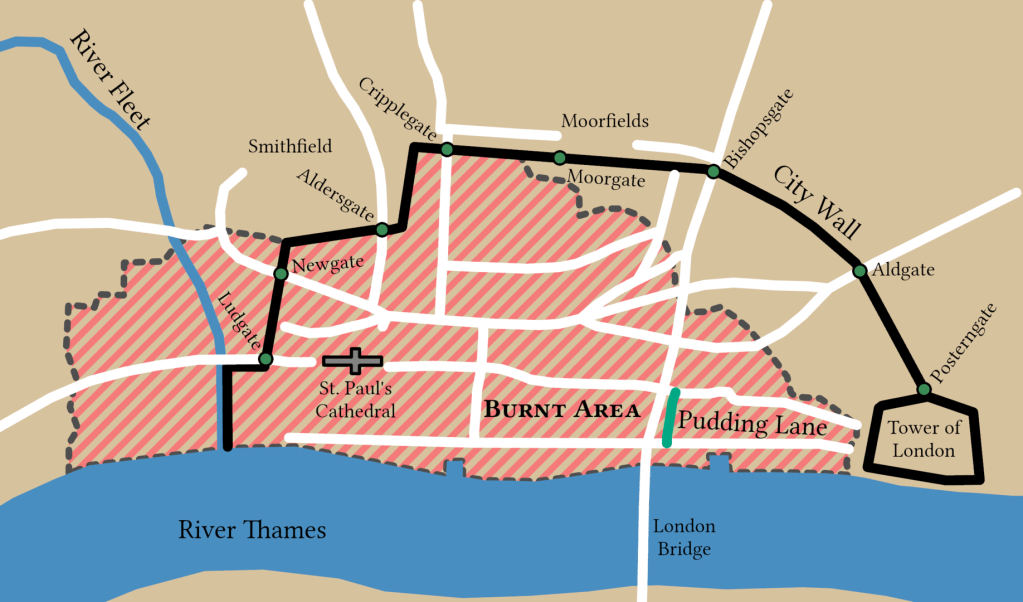
The map shows the final spread of the Great Fire across London. The area surrounded by a bold black line is the city surrounded by the ancient Roman-built walls. The locations of the various gates are marked. The fire originated in Pudding Lane indicated by a green line. The fire mostly drifted westward, driven by the wind, and spread to areas outside the walls. But – inside those walls – the greatest part of London was destroyed.
People:

Bald statistics do not, of course, tell the human story. In addition to loss of life (to which we’ll come next), the loss of homes was devastating. The majority of those forced to camp outside the city walls in fields, or living in primitive shelters among the ruins inside the city, really were homeless. They had no immediate means of rescuing their situation. There was virtually no such thing as house insurance. Besides, the large majority were renters. They didn’t know if their landlords had the finances to rebuild homes, if they’d wish to rebuild homes, and, even if they did, whether those homes would be leased to them. Meanwhile the refugees’ employment was largely gone. Some would be engaged in rebuilding projects, but for the foreseeable future the ordinary factory worker or tradesperson had lost their livelihood. Tens of thousands, then, were now utterly insecure with no idea how they’d survive.

Death toll

There are very varying ideas of how many died in the Great Fire. Numbers extend from a handful to a large multitude.

Official accounts written soon after the fire put the death toll in single figures. Some say four, others six or perhaps eight. And there are modern writers who would argue that people had time to escape so these numbers may well be accurate.

However, there are several reasons to be cautious about a very modest death toll:

  1. We should ask, ‘Were there reasons to understate the death toll?’ For example, perhaps the largely absent Lord Mayor Bloodworth[5] wished to play down the consequences of his failure of leadership. Other civic leaders – thinking of future investment in England’s foremost city – may have wanted to minimise the devastating consequences of the fire.
  2. The late 1660s was an age without anything like modern forensic science. No-one picked their way carefully through the ruins of thousands of fire-ravaged homes for skeletal remains. Perhaps, in any case, there would be virtually no remains. Those who choked and collapsed because of smoke or intense heat may well have been cremated by the intensity of the flames which swept through their property.
  3. Attributing deaths to any disaster is not simple. Issues of how, where and when someone died arise. To illustrate, think about a large battle during a war. When a death toll is stated, are we being told the number who died during the battle? Or does the death toll include those who were wounded, lived for several days or even a few months and then died of wounds sustained during the battle? Then what about those so severely scarred mentally by what they went through they later took their own lives? Defining one number for casualties is complicated. So it is with the death toll of the Great Fire. Are very low numbers of deaths referring only to those who died in the flames? If so, is it not better, for example, to include the large number who perished later because they were still camped outside the city walls when winter fell? Those poor people didn’t die in the fire, but they did die because of the fire.

So, how many deaths can really be attributed to the Great Fire?

Some modern historians still support a death toll in single figures, albeit accepting that some deaths would have been unrecorded, and that refugees also died later camped in fields. Another historian supports a number greater than the lowest figures but thinks it likely the total would not run into the hundreds. Neil Hanson draws attention to known deaths because of hunger and exposure during the cold winter after the fire. He also believes that while some foreigners and Catholics were rescued from mob-lynching, many violent deaths went unrecorded. Hanson also supports the theory that the heat at the heart of the firestorms was much more intense than an ordinary house fire, and thus able to near fully consume bodies. He believes that instead of four, six or eight the death toll was “several hundred and quite possibly several thousand times that number”.[6]

The writers of the Short History of the Great Fire of London podcast researched parish records for deaths before the fire, for the year of the fire, and then for a short time after the fire. They find anomalies in those figures, perhaps suggesting that the recording of deaths was unreliable. What I find even more enlightening is a comparison they make with deaths linked to the Great Fire of Chicago. The Chicago fire was not until 1871, but there are similarities with London’s 1666 fire – population size, density of wooden buildings, time of year, and presence of a strong wind. Deaths were more properly recorded in the late 1800s, and between 200 and 300 are attributed to the Chicago fire. Thus, the writers conclude, the London fire likely also resulted in several hundred deaths but probably not thousands.[7]

Given all the limitations of a major disaster in the 17th century, we will never know an exact number of deaths because of the Great Fire of London. My own view is that the low numbers are unlikely, but so are the extremely high guesses.

Planning a new London

Before the fire, the writer John Evelyn compared London to the grandeur of Paris and described Britain’s largest city as a “wooden, northern, and inartificial congestion of houses”. That’s a confusing mix of words, but he’s trying to describe how poorly designed and built London was. For Evelyn, the city was an unorganised sprawl of unattractive streets and homes.

Within days of the Great Fire ending, many – including King Charles II – determined the rebuilt London would be much better. The city would be redesigned, and homes built to a much higher standard.

Work began almost immediately to clear massive heaps of debris, almost all of it unusable. A special Fire Court[8] was set up to decide property disputes. Many of those were arguments between tenants and landlords about who should pay for rebuilding. Cases were decided quickly with verdicts based on ability to pay. Without the Fire Court legal issues could have lasted years and seriously delayed rebuilding.

Right from the start drawings of a new London flooded in. Many of the submissions were sent direct to the King. Some came from ordinary citizens with radical ideas, and some came from people with planning experience, including Christopher Wren. Most proposals involved a grid system of streets, a significantly different pattern to how London had evolved. There were also plans for boulevards and piazzas similar to those in French and Italian cities. Along with the drawings came bold and romantic statements of rebirth, that a marvellous new London would emerge from the ashes.

But almost none of that ever happened.

Wren’s plan, for example, failed because a very large number of property titles would have had to be redefined, an almost impossible task because land in London was owned by many people. Besides, no-one was willing to wait for complex plans to be assessed. With little building control, work had already started on building new homes on the scorched earth. People needed houses simply to survive. So London was rebuilt much as before.

However, some new regulations were imposed.

One of the reasons the fire had spread so easily and quickly was the density of the housing. There were almost no gaps between houses. Streets were very narrow, and roofs overhung so far they virtually joined with adjoining homes, even those on the opposite side of the road. Another reason the fire took such a strong hold was that most houses were made of wood which, when dry, was perfect fuel for the fire. So, the new construction regulations required all buildings to have at least a stone or brick facing. Streets must be widened and new pavements[9] built. Two new streets were created. No houses must obstruct access to the River Thames, and better wharves must be built there. The cost of building materials was regulated, as were the wages of workers. A deadline of three years for rebuilding was set; if not met, land could be sold. In the end most private rebuilding was done by 1671.

Supervision of much of the reconstruction was entrusted to a six-person committee, with Christopher Wren as the ‘Commissioner for Rebuilding’. Wren was born in October 1632, therefore still just 33 at the time of the Great Fire. Though his general plans for a new London were mostly rejected, he did design 51 new city churches and The Monument (more on which shortly). His most famous achievement was designing and overseeing the rebuilding of St Paul’s Cathedral. The excellence of Wren’s work was recognised with a knighthood on 14th November, 1673 (hence he had the title ‘Sir’ after that date).

Overall it took almost 50 years before the fire-ravaged area of London was rebuilt. It was 1711 until the reconstruction of St Paul’s was complete.

The Monument

Because the Great Fire of London was so momentous, a decision was made by the King to build a commemorative monument close to where the fire started. Some attribute the design work of a monument to Christopher Wren, others to surveyor Robert Hooke – very likely they combined their skills. Work began on a Doric column in 1671 and it was completed in 1677. Known simply as The Monument, it stands 202 feet tall (61.5 metres) and is located exactly 202 feet from where the fire began in the Pudding Lane bakery. At the very top is a drum and copper urn from which flames emerged, symbolizing the Great Fire.[10]

On the column were sculptures and engravings telling the story of the fire. In 1681 a plaque was added attributing blame for the fire. An official enquiry determined the Great Fire  was due to “the hand of God, a great wind, and a very dry season”, but, with anti-Catholic feeling running high, the inscription on The Monument put the blame on the ”treachery and malice of the Popish faction”. The inscription was removed in 1830.

Fire Insurance and Fire Brigade

The Great Fire made people think more seriously about better fire safety and the cost of repairs. In 1680 Nicholas Barbon set up the ‘Fire Office’, an insurance company.[11] Other similar companies were soon established.

By 1700, those fledgling companies had the common sense to realise it was probably cheaper to extinguish fires than pay for repairs. They set up their own fire brigades, and had plates fastened to houses naming which company insured that property. If a fire brigade of another company put out the fire, the insurers had reciprocal arrangements so the correct insurer would cover the cost.

Eventually even more common sense prevailed. The most efficient fire-fighting system would be one unified force covering the whole of London. So, in 1833 the London Fire Engine Establishment was founded. There were numerous fire stations across the city, each providing 24/7 coverage. Floating engines were built for The Thames to tackle fires in the docks.

Now known as The London Fire Brigade, it has become one of the largest firefighting and rescue organisations in the world. It employs more than 5000 people, and in 2022 dealt with 125,390 incidents, of which 19,297 were fires.

The plague

The Great Plague (or Black Plague) began to spread in early 1665. It was deadly, and the number of victims rose quickly. In London about 15 per cent of the population died in the plague’s first year. That could be as many as 75,000 deaths, a huge number.

There were plague victims also in 1666, then in September the city was consumed by the Great Fire. And afterwards the Great Plague faded away. Why? The obvious conclusion is that the insanitary houses – overrun with rats and fleas which spread the plague – were gone, so the epidemic was halted. The tragedy of the Great Fire eradicated the tragedy of the Great Plague.

Except it didn’t. Sometimes an obvious conclusion is a wrong conclusion.

The Museum of London says that the idea that the Great Fire stopped the Great Plague is the most talked about myth they hear.[12] It’s nice to think there was a silver lining to the Great Fire. But the idea isn’t true. The Museum lists five reasons:

  1. The Great Fire burned only about a quarter of the overall London metropolis. It could not have killed off the plague for the whole ‘Greater London’ area.
  2. Houses built after the fire had stone or brick-faced walls, but hygiene and sanitation did not significantly improve.
  3. Areas where the plague was worst – Whitechapel, Clerkenwell, Southwark – were not affected by the fire.
  4. The number of plague-related deaths was already declining long before the fire.
  5. People in London still died from the plague after the Great Fire was over.

 The Great Plague’s major death toll occurred during 1665-66, and the Great Fire broke out in September 1666. So it’s not surprising that the second is assumed to have eradicated the first. But that is a wrong assumption. The Museum says: “We are still not sure why the plague did not return to our shores after it faded out in the 1670s but it wasn’t due to London’s 1666 fire”.

The lust for vengeance

During the Great Fire, anger became rage and rage became a lust for vengeance. In the minds of many, the destruction of London could not be an accident. Farriner protested long and hard that the fire did not start in his bakery. He had double checked his ovens before he went to bed. Many were willing to believe him. A fire like this had to be a deliberate attack. A Parliamentary investigation blamed the fire on the hand of God, the strong wind, and the dry season, but those reasons were not enough. Enemies of London and of England were surely responsible. Blame was directed at Catholics and foreigners.

The anger was fed by homelessness and near starvation. Camped outside London while autumn temperatures dropped, people were dying. Evelyn wrote: “Many (were) without a rag or any necessary utensils, bed or board… reduced to extremest misery and poverty”. The King, Charles II, was so afraid these refugees would rise against the monarchy, he ordered daily supplies of bread to be brought to the city and new markets created.

Charles went even further, encouraging people to move away from London and ordering neighbouring towns and cities to permit incomers to engage in their trades in these new locations.

These were good measures, but still thousands suffered. The mood was volatile. For those living in and around London there was an overwhelming longing to hit back at those responsible for their misery. Before the fire had even been fully extinguished, a rumour spread that French and Dutch troops were approaching. Londoners would not wait to be slaughtered, so mobs rushed through the streets attacking foreigners. Soldiers had to intervene to stop the violence.

In the months following, the lust for vengeance was undiminished. It was inexcusable to attack people simply because they were foreigners, but Londoners were traumatised and panicked. As still happens today, the general population didn’t entirely trust official statements from central authority, in their case from the King. And – with no press or TV or internet – they were fed a strong diet of rumours. And since the only rumours worth spreading are those which are frightening or threatening, people became terrified and angry.

As well as rumours there was (what we now call) ‘fake news’. The official parliamentary enquiry into the fire[13] heard evidence from many people, including those who suspected the Dutch or French or Catholics. The committee recorded everything that was said, but rejected the suspicions of arson and ruled that the fire was an accident made worse by the strong wind and dry season. But someone collated the testimonies of those who blamed foreigners, made those statements into a pamphlet, and leaked it to the public. By now it was obvious there was no Dutch or French invasion, so the story spread that shadowy Catholic agents had started the fire.[14]

In fact, a man who swore he was Catholic had already been arrested, tried and executed. His name was Robert Hubert.

Hubert was a watchmaker who originated from Rouen in France. He had come to London, but, as he headed later for east coast ports, he was stopped just outside the city. Authorities questioned him. Hubert admitted he was a member of a gang, that the fire was a French plot, and he had started the fire. He was charged, and imprisoned in one of the unburned jails.

There are several reports that Hubert was not fully able to explain himself. Some have said he was simple-minded, and may not have realised the implications of his confession, or had imagined the story he told. It’s also possible he was tortured.

Hubert’s story was inconsistent. Originally he said the French gang was 24, but then he dropped the number to just four. He stated that he started the fire in Westminster, but then learned no fire had ever reached there. Where the fire actually began was mentioned to him, so his story changed to how he had thrown a fire grenade through an open window of the Pudding Lane bakery.

He was brought to trial in October 1666 at the Old Bailey courts. There were doubts about his evidence. Some said he had not even been in London when the fire started. He insisted he was a Catholic, but those who knew him said he was Protestant and a Hugeunot.[15] His story of throwing a grenade through a window was nonsense, because the bakery in Pudding Lane had no windows. Besides, Hubert was crippled and incapable of throwing a grenade. The Lord Chief Justice, who presided over the trial, said Hubert’s confession was so disjointed he couldn’t possibly believe him guilty. But Hubert insisted he was guilty. McRobbie says that put officials in the strange position of trying to prove he hadn’t done what he said he did. But Hubert was adamant that he had started the fire, so was found guilty and hanged at Tyburn on 29th October, 1666.

Hubert was innocent. Evidence soon emerged from the captain of a Swedish ship that he had been on that ship in the North Sea when the Great Fire started. He did not arrive in London until two days after that. He was not a Catholic, not a member of a French gang, and certainly had not started the fire.

Perhaps the strength of his confession meant a guilty verdict had to be given. Perhaps people thought that convicting Hubert would end the rage of the crowds. Perhaps Hubert wanted to die. Apparently his life had been miserable, and he wanted to end it. In that case, to use a phrase of McRobbie’s, Hubert committed ‘suicide by confession’.

Anti-Catholic sentiment and suspicion of foreigners continued for many years. Negative feelings do not change quickly, as many today would still testify.

Eleven curious details

One  In 1681 a plaque was placed in Pudding Lane blaming ‘Papists’ for the Great Fire. In the mid-1700s it was removed. Why? Had people realised Catholics were not to blame? No. It was taken down because people stopped to read the wording and that caused a traffic hazard.

Two  The Monument was designed with a 311 step internal staircase leading to a viewing platform, so Londoners could see their city being rebuilt. A mesh cage was added to the viewing platform in the mid-19th century because people had committed suicide by jumping. Some 100,000 people each year continue to climb to the viewing platform.

Three  In 1986 – 320 years after the Great Fire – the London members of the Worshipful Company of Bakers apologised to the Lord Mayor for the fire. They placed a plaque in Pudding Lane acknowledging that one of their own, Thomas Farriner, was in fact guilty for causing the Great Fire.

Four  Sir Christopher Wren’s range of professional interests included astronomy, optics, cosmology, mechanics, microscopy, surveying, medicine, meteorology. He was also an inventor of scientific instruments.

Five  Wren began studying architecture in Paris in 1665. By the next year he was back in London, where he drew his first design to improve the rapidly decaying (Old) St Paul’s Cathedral. One week later the Great Fire began in Pudding Lane on Sunday 2nd September. On the evening of Tuesday 4th September embers landed on St Paul’s and before morning the building was gone. Wren’s masterpiece, the new St Paul’s Cathedral, was completed in 1710.

Six  Sir Christopher married twice. Though neither wife lived long there were two children from each marriage. Wren died aged 90 years, and of these years was married for only nine.[16]

Seven  Though Wren’s designs for a new-look London were never implemented, he was honoured in 2016 (the 350th anniversary of the Great Fire) with a Royal Mail stamp illustrating him presenting his plan.

Eight  A central shaft in The Monument was created as a scientific instrument for the Royal Society. It included a telescope and a space to enable experiments on gravity. However, the vibrations of nearby heavy traffic spoiled those experiments which were soon discontinued.

Nine  On Wednesday 5th September, 1666 – the fourth day of the Great Fire – the diarist Samuel Pepys witnessed a cat being rescued from the ruins of the fire ravaged Royal Exchange. He wrote: ‘I also did see a poor cat taken out of a hole in the chimney… with the hair all burned off the body, and yet alive’.[17]

Ten  St Paul’s Cathedral famously survived the ‘Second Great Fire of London’, the World War II London blitz with incendiary bombs.

Eleven  John Evelyn summed up what the Great Fire had done to his city in six words: ‘London was, but is no more’.

Lessons from the Great Fire

There have been many lessons as the story has unfolded:

  • Something small, such as one spark, can have massive consequences
  • The unimaginable should have been imagined, and preparations made
  • Clear and decisive leadership is vital to deal with a catastrophe
  • How ready people are to find someone to blame, and take the law into their own hands. The sad truth is that people want villains and want vengeance.
  • Sometimes you can’t wait for permission; you must act now. That’s what happened when the garrison at the Tower of London used gunpowder to demolish houses between the fire and the Tower. They’d waited for help which never came. So, before it was too late they took responsibility for halting the flames, and thus saved the Tower.
  • Nowhere is immune from harm. Many thought the stone-built St Paul’s Cathedral was safe so they put all their possessions inside. That was a bad decision. The Great Fire was greater than the resistance of the cathedral, and the building and everything inside was lost.
  • Often you can’t control an outcome. The best firefighting efforts did not stop the Great Fire. What halted its spread was that the easterly wind subsided. The flames were no longer driven westward, thus providing an opportunity to extinguish fires.

Here’s my final lesson. I began this series by saying one spark from a fire left smouldering under an oven caused the Great Fire. Just one spark cost vast amounts of property to be destroyed, many lives lost, and a huge financial cost to rebuilt London.

We neglect the small or ordinary things of life at great peril. Those seemingly small things can be personal, like time with family or looking after our health. They can be the background factors when running a business, like getting to know colleagues or being careful about contracts. They can be the affairs of state or global relationships, such as misunderstanding or neglecting an issue, or threat, or contrary voice.

There’s a saying that large doors swing on small hinges. Extremely large consequences flow from small, seemingly unimportant matters.

Bad things will always happen. But some can be avoided by careful attention to details, by preparation for worst case scenarios, by wise and decisive leadership, and the other lessons taught to us by the Great Fire.


My major online resources for this series on the Great Fire are listed at the foot of the first episode. See https://occasionallywise.com/2023/01/28/great-fire-of-london-1/


[1] https://occasionallywise.com/2023/01/28/great-fire-of-london-1/

[2] https://occasionallywise.com/2023/02/10/the-fire-that-changed-the-weather/

[3] https://occasionallywise.com/2023/03/18/the-great-fire-defence-and-disaster-but-the-end-is-nigh/

[4] Some record that the remains of some buildings continued to smoulder for several months.

[5] Bloodworth’s failings are detailed in the first episode of this series, https://occasionallywise.com/2023/01/28/great-fire-of-london-1/

[6] Hanson, Neil (2001), The Dreadful Judgement: The True Story of the Great Fire of London. Doubleday.

[7] Details of the Short History of… podcast are given at the end of part 1 of this series.

[8] The Fire Court operated through most of 1667 and 1668, and again between 1670 and 1676.

[9] Pavements = sidewalks in America.

[10] Details from the website of The Monument – https://www.themonument.info/history/introduction.html

[11] These details and others to follow from the Museum of London: https://www.museumoflondon.org.uk/discover/great-fire-london-1666

[12] Details here and following from https://www.museumoflondon.org.uk/discover/three-myths-you-believe-about-great-fire-london

[13] The official investigation began just over three weeks after the Great Fire started.

[14] Information here and following predominantly from Linda McRobbie’s excellent article: https://www.smithsonianmag.com/history/great-fire-london-was-blamed-religious-terrorism-180960332/

[15] Hugeunots were certainly Protestant, and many fled France to avoid Catholic persecution.

[16] From: https://en.wikipedia.org/wiki/Christopher_Wren

[17] Museum of London: https://www.museumoflondon.org.uk/discover/cats-in-museums-feline-history-london
The fire that changed the weather

Homeless and hungry, exhausted and terrified, possessions gone, families separated, violent mobs in the street, the people of London are still in the first 24 hours of the Great Fire raging through their city. Heat burns their faces. Thick smoke makes breathing difficult. Homes are now only a red hot bonfire of roofs, rafters, walls and furniture. Even the pavement on which people walk gives off an intense heat. They’ve heard preachers talk of an end-times lake of fire, and their city is now very like that.

It is Sunday, September 2nd, 1666. At 1.00 am a spark sputtered out from a not-fully-extinguished oven in Thomas Farriner’s bakehouse. Quickly fire spread up the walls to the living quarters on upper storeys. Farriner and his family escaped, but the fire spread to adjacent houses and businesses. A strong east to west wind fanned the flames. The primitive tools used for firefighting were hopelessly inadequate. By midday many streets in the old city were alight.

This is part two of the story of the Great Fire of London. If you haven’t read the beginnings of the fire, you can find my account here: https://occasionallywise.com/2023/01/28/great-fire-of-london-1/. The blaze lasted from early Sunday to late Wednesday (with small outbreaks even later), so is usually described as burning for four days. But even before day one ended it ranked as ‘already the most damaging fire to strike London in living memory’.[1]

In this part of the story – covering the later part of Sunday and most of Monday – we’ll see these things:

  • The fire’s intensity becomes so strong, it even changes the weather over London
  • Desperate people flee their homes with whatever they can carry or cart away
  • When civic leadership fails, the King and his brother organise firefighting
  • Vigilantes roam the streets attacking anyone they think responsible for the fire.

The fire intensifies

In 1666 the oldest part of London lies north of the River Thames, surrounded by a two mile long wall built by an invading Roman army between 190 and 225 AD. Only the south has no wall. It never needed one because that approach to the city was protected by the river.

The ‘footprint’ inside the wall is not large – even today it’s referred to as the ‘Square Mile’. But tens of thousands are crammed into that tight space. Recent weather has been dry and warm, making thatch on roofs and wooden walls perfect fuel for the fire. Once alight it spreads quickly because neighbouring properties virtually touch each other, even across the street. Early attempts to create firebreaks fail.

During the first night the fire which started in one bakery and home in Pudding Lane is engulfing hundreds of homes. The strong wind fans the flames. Some householders run to the Thames for water, but their buckets carry very little and the water has no effect on so great a fire.

Those in homes still unaffected are too frightened to sleep. All they can do is hope that this fire, like others before, will burn itself out before it reaches them. But this fire won’t burn out and can’t be halted. The wind from the east is no mere breeze – some call it a gale – and it fans the flames and scatters embers. Then someone in the street screams: ‘The fire is here! Run!’ People seize whatever they can carry, including their children, and, braving the wall of heat moving towards them, make their escape.

Many head for the nearby Thames. If they can, they climb onto boats. If no boat is available, they throw their furniture and possessions into the water. Brave (or foolish) souls plunge in too hoping to drag their goods downstream and bring them ashore somewhere safe. Others clamber down steps to the water’s edge. If the flames come close, they move sideways to other steps to get as far from the fire as they can.

In the streets people press against each other. Those escaping push one way; those still trying to fight the fire push the other way. There is screaming, crying, shouting, praying. Driven by the wind, the fire moves steadily west. It’s not just homes that burst into flame, but halls and churches too. Pepys, who kept a diary record of the Great Fire, writes of ‘a most horrid malicious bloody flame’ reaching more than a mile across the city. He adds: ‘It made me weep to see it’.

Pepys’ ‘malicious flame’ has become a firestorm which affects the weather. To understand, picture an ordinary household fire. It sucks in air, which accelerates burning, then pushes hot air up its chimney. The Great Fire did the same but on a massive scale. Needing oxygen, the fire sucked in air at near gale force through the narrow spaces between overhanging buildings. The flames got their fuel, and hot, fiery air was pushed upwards to a great height. At ground level and above, the heat is so intense no-one can get near. Breathing becomes impossible, and the force of the wind irresistible. Fire is consuming the city from ground level to high in the air. And no-one can stop it.

The fire moves outward to the west, north and south. The Church of St Magnus the Martyr is destroyed. Eventually 83 more churches will burn. Barrels of tar in a supply store explode, and flaming debris is scattered, lighting more fires. Near the Thames guildhalls and warehouses fall prey to the flames. So do homes built on London Bridge, though the fire on the bridge is halted because there’s a gap between buildings. A 1633 fire destroyed tenements on the bridge, and they have never been replaced.

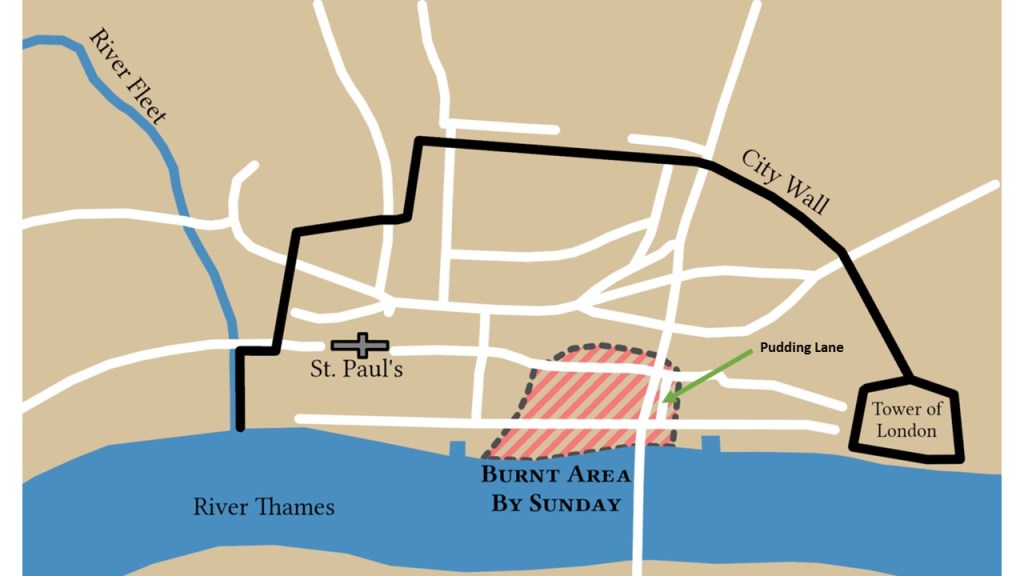
The hatched pink area shows the extent of the fire at end of day one. Pudding Lane, where it began, is marked with a green arrow. The right to left drift of flames is caused by the strong east to west wind.
© Bunchofgrapes and Tom Fish // Creative Commons CC BY-SA 3.0

Residents become refugees

There is no darkness over London as Sunday moves into Monday. The fire never sleeps. Nor do many Londoners. Hundreds of homes are gone, and their occupants search for somewhere to be safe. Where people live some distance from the fire, the few who sleep restlessly in their beds don’t realise the severity of this blaze, hoping it will yet be extinguished. Their optimism or naivety will not last long.

On Monday the winds become stronger and the fire worse. Many now realise they can’t fight a fire so intense and spreading so fast. To survive, they must flee.

But the affluent will not run until they’ve done everything they can to protect their wealth. Bankers cart away stacks of gold coins before they melt. Other wealthy citizens bury or hide valuables they can’t carry. Samuel Pepys records that he buried his expensive cheeses and wine. What he could not bury he hauled off. Referring to the second night of the fire, Pepys writes: ‘About four o’clock in the morning, my Lady Batten sent me a cart to carry away all my money, and plate, and best things… Which I did riding myself in my night-gowne in the cart.’ We might smile about an important dignitary escaping in his night attire, but Pepys’ flight says much about the haste and terror of that night.

During Monday despair grips almost everyone. They watch as the Royal Exchange (a stock exchange and shopping centre) is engulfed, along with ‘upmarket’ shops in Cheapside. John Evelyn – a courtier and diarist – describes the mood of the crowds:

‘The conflagration was so universal, and the people so astonished, that … I know not by what despondency or fate, they hardly stirred to quench it, so that there was nothing heard or seen but crying out and lamentation, running about like distracted creatures… such a strange consternation there was upon them.’

But now people realise they are trapped inside the city’s ancient walls while an inferno moves steadily towards them. There are gates in those walls, eight of them. The names of some are still recognised today, such as Ludgate, Moorgate, Bishopsgate, Aldgate. But the gates are narrow. In Roman times, entrances were deliberately small so invading hordes could not rush in and overwhelm the city. Now, some 1400 years later, those narrow gates prevent evacuees rushing out of the city. Even worse, while many are desperate to exit, others are entering. People who had left earlier are returning with their carts to move away even more of their possessions. Some make those journeys four or five times. Inside the walls, with the fire near, and getting nearer, there is desperation, anger, and panic. Carts, wagons, horses and people jostle together.

Those already outside the walls are relatively safe, at least for now. But there’s no rescue organisation, nothing and no-one to tell people where to go, what to do, or to provide food and shelter. The Thames is covered with barges and boats, most piled high with goods. To the north and east, the fields are strewn with people and their possessions. They huddle under improvised tents. ‘Oh, the miserable and calamitous spectacle!’ Evelyn writes.

Royal leaders take charge

The Lord Mayor, Sir Thomas Bloodworth, has given up. Realising he should have acted sooner, and having no idea during Monday how to stop the immense blaze, he has literally walked away, not to be seen again while the Great Fire rages.

Bloodworth had refused any orders or assistance from King Charles II. But now Bloodworth is gone, and from his royal barge the King surveys the fire from the River Thames. He is shocked by the extent of the fire and outraged to see that houses are still not being demolished to create firebreaks. London is not ruled by the monarch, but Charles acts anyway. Powered by the wind, the fire is spreading west fast, and he orders his own troops to tear down large numbers of homes on that side of the fire.

But the sad reality is that demolition can no longer stop the fire. Lifted high in the air, embers are carried over any gap, and they light the thatch and then the houses across the firebreak.

However, the King’s intervention is the beginning of organised attempts to confront the blaze. Assuming overall control, Charles gives his brother James, the Duke of York, authority for all firefighting operations. James is already known to the people for his courage in battle against the Dutch. He’s bold, and perhaps impulsive. Certainly no enemy frightens him. That includes this Great Fire. He immediately sets up command posts around the fire’s perimeter. James uses the palace’s courtiers, people who are companions and advisers to the King. Three are in charge of each command post. Teams of firefighters are organised, supported by 30 soldiers stationed at each post. Significantly, the courtiers have the King’s authority to do anything necessary to stop the fire. There will be no hesitation now about pulling down houses. Whatever has to be done will be done.

During that Monday, and on subsequent days, both Charles II and the Duke of York actively survey the fire and direct operations. The palace is outside the city walls, but they are seen near where the fire rages. A report in the following week’s London Gazette notes their ‘indefatigable and personal pains to apply all possible remedies to prevent (the fire’s spread), calling upon and helping the people with their Guards’. The newspaper may have intentionally flattered the royals, but it’s true that their presence among and support of the people is noticed and appreciated.

Yet, despite the organisation and everything the courtiers do, the fire spreads. Every time they tear down houses, the fire leaps across the gap, rushing west to consume ever more homes. People living 30 miles away can now see light from the Great Fire. More and more citizens flee, either to the Thames or by forcing their way through increasing chaos at the city gates to camp in the fields beyond.

And now another deadly danger is spreading in the city.

Mob violence

Rumours spread that the fire is no accident. The baker, Thomas Farriner, insists nothing was alight in his ovens when he went to bed. He didn’t cause the fire. Others point out that new fires are breaking out at some distance from the main blaze. And, despite the noise of the fire, people hear loud explosions. Houses and warehouses are blowing up, surely caused by incendiary bombs. And there’s a common view that no accident has ever caused, nor could cause, a fire so great as this. London must be under attack.

There is little doubt in most minds that either the Dutch Republic or France is to blame. Perhaps both are. There have been outbreaks of fighting with these nations just across the sea from England. Just two weeks earlier, English sailors pursued the Dutch merchant fleet to the port of West-Terschelling, destroying 150 vessels, burning the city to the ground, and killing many of its people. It seems very possible that Dutch agents are now taking revenge by planting fire bombs in London.

Relations are also bad with France, fed by a strong anti-Catholic bias. In the popular mind, no Catholic is to be trusted. Londoners are very aware of the failed Gunpowder Plot of 1605, when Guy Fawkes was one of 13 Catholic conspirators who filled a basement of Parliament with gunpowder, intending to blow up the King and the House of Lords.[2] Thus, in the minds of panicking Londoners in 1666, to be foreign or Catholic makes you a suspect.

The facts, of course, are these: Flames spreading far and wide are caused by a strong wind scattering sparks hundreds of yards. There is no surprise that homes remote from the main fire were set alight. And the explosions? There is no mystery about them either. Many homes and warehouses stored gunpowder. When fire reached them they blew up.

But those explanations are not enough for violent mobs in London’s streets. Fire has destroyed their homes. They must find the culprits who set them alight, and stop them starting even more fires. The mood – the blind passion – is revenge.

In a large cosmopolitan city, the mobs are not short of suspects to attack. A Dutch baker is dragged from his business before a gang tear his premises apart. A Frenchman walking down the street is struck violently with an iron bar. A French woman is carrying chicks in her apron but a crowd thinks she’s holding incendiary bombs and cut off her breasts. Another Frenchman is almost dismembered because he’s seen carrying a box of fireballs, but in fact his ‘bombs’ are only tennis balls.[3]

James, the Duke of York, has had to leave fire-fighting to counter acts of violence against innocent people. Accompanied by cavalry, he rides his horse around the streets. He’s blackened with soot, but constantly alert. In a small alley he sees men crowding in a shop doorway. Perhaps they’re stealing. James springs into action. The space is too narrow for a full-on mounted charge, so James leaps from his horse, draws his sword and runs straight for the mob. The men look up, recognise the Duke of York with sword drawn and his guards behind him, and immediately run in the other direction. James stops beside a bundle of clothing the men have dropped. Then the bundle moves, and James realises someone is wrapped inside. He kneels, and uncovers a man badly wounded and terrified. With difficulty the victim speaks. He’s French. And around his neck is a noose. Its other end is already hanging from a sign above the shop doorway. Had James arrived even a minute later, the Frenchman would have been dead.[4]

The mob have decided that foreign agents have started and are now spreading the fire. Their suspicion is that setting London alight is the ‘softening up’ preliminary to a full-blown invasion. There is nothing to counter the rumours, no broadcast media, no social media, not even a newspaper since the office of The London Gazette has burned down. The mood to stop terrorists and wreak vengeance for what is happening has gripped many Londoners. ‘The need to blame somebody was very, very strong,’ says one writer.[5]

The worst atrocity never happened during the Great Fire. It came later, as we shall see in another episode.

Late on Monday the fire threatens Baynard’s Castle. It is a mediaeval palace, situated on the Thames riverbank. It was first built in the 11th century, and rebuilt and greatly enlarged by King Henry VII in 1501. It has several towers, and massive thick stone walls. Such a building is indestructible. But it’s not, not when the Great Fire reaches it. The castle catches fire on Monday night, and the blaze rages through every part of the building until daybreak. It is utterly ruined.[6] If this can happen to one of London’s strongest structures, nothing is safe.

In the right centre of the drawing is Baynards Castle. From Wellcome Images, operated by the Wellcome Trust.  Wellcome L0006919.jpg CC BY 4.0

So, as we pause the story here, what can we learn from these events? There is only one lesson I want to highlight at this point.

The greatest failure of leadership is no leadership

Some years ago I studied management. One strongly worded statement I read is this: that often the worst decision a leader can make is to make no decision at all. Lord Mayor Bloodworth was woefully guilty of that. When the fire was small, and the firefighters needed strategy and resources, he abandoned them and went back to his bed. Later, when it was evident the fire was out of control, he disappeared from public view. He deserted. At the most crucial time he left the city with no leadership.

Until, that is, the King appointed his brother James to head up operations. James provided leadership, and did so with vigour and with organisation. If his efforts were not enough, that was only because nothing he and his teams could do would ever have been enough. But at least the people knew they weren’t abandoned and all that could be done was being done.

Now Londoners are realising that this Great Fire cannot be extinguished. As we shall see in the next episode, tragically the worst is yet to come.


My major online resources for this series on the Great Fire are listed at the foot of the first episode. See https://occasionallywise.com/2023/01/28/great-fire-of-london-1/


[1] Field, J. (2017) London, Londoners and the Great Fire of 1666: Disaster and Recovery. London, Routledge.

[2] Guy Fawkes was English and Catholic, born in York. When the plot against the King failed, he was arrested and sentenced to death by being hung, drawn and quartered. However, some think he jumped when hanged, causing the noose to break his neck, so avoiding the torture that would have followed a partial hanging. Marking the failure of the Gunpowder Plot with a bonfire and fireworks dates from the 1650s with an effigy laid on the fire from the 1670s. For many years the effigy was usually of the Pope. In modern times the effigy has been of Guy Fawkes. In the UK, large bonfires are lit and fireworks launched every 5th November, marking the date in 1605 when the conspirators intended to blow up Parliament.

[3] These details from the Smithsonian Magazine: https://www.smithsonianmag.com/history/great-fire-london-was-blamed-religious-terrorism-180960332/

[4] Another version of this account suggests the man was Swedish. Whether French or Swedish, the account illustrates the violence wreaked on all foreigners.

[5] Adrian Tinniswood in By Permission of Heaven: The Story of the Great Fire.

[6] Baynard’s Castle was never fully rebuilt, and over the centuries the site was used for various purposes. In the 1970s a concrete office block named Baynard House was built there and occupied by the telecom company BT.

One spark, and fire consumes a city

Just one spark. Probably the embers in the baker’s oven aren’t fully extinguished, the spark sets fire to nearby kindling material, and flames spread to wooden furniture and walls. Within minutes the whole ground floor is alight.

It’s 1.00 am and upstairs from the bakery Thomas Farriner is sound asleep. Thankfully his son is not. He smells smoke, and runs to wake his father. For a moment Farriner is disoriented. He cannot understand what his son his saying. Then he too smells the smoke. He leaps from his bed and runs downstairs, but is met by a wall of smoke and flame. There is nothing he can do to halt the fire. The house has two storeys above the ground-level bakery. Farriner’s wife Hanna died in 1665, and his daughter Mary is married. But his other two children, Thomas and Hanna, are in the house. He gathers them and the maidservant. Their only hope is to go up.

It’s September 2nd, 1666, the bakery is in Pudding Lane, and the blaze there is the beginning of the Great Fire of London.

Farriner’s house – as almost every home in mediaeval London – is made entirely of wood. The late summer has been warm with no rain. The dried out wood is perfect fuel for the fire which is spreading fast. If the family don’t escape quickly, they’ll die when the flames reach them or the house collapses.

Farriner forces open an attic window. He climbs out onto the thatched roof, reaches back and pulls his children after him. He crawls to the edge of the roof, but he’s now in great danger of falling to his death on the street below. At upper levels, houses in Pudding Lane extend over the street, almost touching the houses opposite. Farriner can reach across to the butcher’s home across the street, gets his attention, and with his help Farriner and his children clamber over to safety. But not their maid. She’s still in the attic, terrified by the fire below yet too frightened of falling to climb out the window. Farriner’s maid is the first to die in the Great Fire.

This is part one of a multi-episode account of the Great Fire of London. We’ll see why fire in one house spread quickly to others, why fire-fighting attempts proved futile, how city leaders failed, and later how prejudice led to severe violence against immigrant Londoners, why the fire finally stopped, and how the building of a new London began. And much more.

Before picking up the story of the fire again, there are six background facts worth knowing in order to understand why and how events unfolded as they did.

First, London was a very large city. The population in the 1660s is estimated between 350,000 and 500,000. That’s immense for its time, around ten to fifteen times the size of other British cities. It made London likely the largest city in Europe and the third largest in the western world. Behind the old Roman walls, in the mediaeval city, a huge population lived in overcrowded streets, their houses virtually touching each other. A ring of suburbs surrounded the old city, including the independent City of Westminster.[1] A fire could spread easily and widely.

London as it was drawn by Claes Visscher in 1616. The old St Paul’s Cathedral is left of centre. London Bridge over the River Thames is in the lower right. The bridge is covered in tenement housing, much of which was destroyed in a 1633 fire. The only reason the 1666 fire did not cross the bridge was because that housing had not been rebuilt.

Second, because homes were made of wood, thatch, and doused in flammable pitch, they could catch fire easily and be completely consumed by flames within minutes. Many also stored highly flammable hay and straw. And the ‘jetties’ – the overhanging upper storeys – meant fire in one easily spread to others. But the houses were built like that because wood was a relatively cheap building material, and tax was paid only on the ground level footprint of a home, not its overall size. Officially that kind of structure was banned, but the law was not enforced by local officials, so oversized wooden homes continued to be built.

Third, fire-fighting methods were primitive by modern standards. There were essentially two techniques.

  • The first was water. There was plenty of water since the River Thames was close to Pudding Lane, but the ordinary citizens had only leather buckets which held little water and took time to get to a fire. There was no modern-style fire brigade, but London had ‘fire engines’. However, they were little more than large barrels mounted on sleds with a spout to spray water towards flames – that is, if the heat even allowed you to get close. Only some sleds had wheels, and, being immensely heavy, they were hard to haul through the streets, and doubly difficult among panicking crowds. During the Great Fire several toppled into the Thames while refilling and were lost.
  • The second technique involved partial or total demolition of homes to create firebreaks. Firehooks could pull burning thatch off a roof, and even tear down a wall. They were relatively effective. More extreme but also useful was gunpowder. Blowing up houses completely could create a larger firebreak, successful unless the fire found some way to jump across.

Buckets of water, axes, ladders, water squirts and firehooks were stored in local churches. But access to them was difficult in the early hours of the morning, and these tools were inadequate once the fire had spread.

Fourth, the Great Fire spread rapidly because of a persistent strong wind blowing east to west. Those who fought the fire couldn’t keep pace with the rapid progress caused by that wind. It also explains why burning embers drifted across firebreaks.

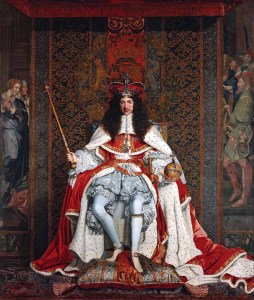
Charles II at his coronation in 1661, painted by John Michael Wright

Fifth, the governance of London failed its people when the fire erupted. London, like most English cities and towns, was managed by aldermen and a Lord Mayor. London, though, was also the location of Parliament and of the king, and that complicated matters. Here’s the super-short background. The English King Charles I was beheaded in 1649 during a period of civil wars between monarchists and parliamentarians (republicans). Under the leadership of Oliver Cromwell, reforms had taken place, but he died in 1658 and his son Richard who followed was significantly less able. Another king was needed, and Charles II came to the throne in 1660. Thus began what was called the ‘Restoration’, a period of social change which included reopening theatres (closed under the puritanism of Cromwell) and flourishing of literature. Charles II was relatively popular, and was nicknamed the ‘Merry Monarch’.[2] However, not all welcomed the restoration of the monarchy. That was particularly true in predominantly parliamentarian London, and resistance to rulership or interference by the king played its part in mismanagement of the Great Fire.

Sixth, England and the Dutch Republic were in conflict over extracting precious minerals and gold from West Africa, and that had worsened into a mainly naval war. Foreigners in London from European countries were increasingly distrusted. As we shall see, they became prime suspects for starting and spreading the fire.

But it’s in Farriner’s bakery in Pudding Lane that the fire starts in the early hours of Sunday 2nd September, 1666. Farriner is sometimes described as the king’s baker, but that’s correct only because he supplied baked biscuits to the Royal Navy. The street name Pudding Lane sounds odd in modern ears, especially for those who use the word ‘pudding’ as a near-equivalent to ‘dessert’. But pudding in those times was offal, the entrails and internal organs of an animal, material often discarded and eaten by birds or dumped into rivers like the Thames. Pudding Lane acquired its name because a great number of butchers’ shops were located there. In fact many trades were in Pudding Lane, so it was a street in which people stored tar, rope, oil, brandy and other goods that burned easily. It was the worst place  for a fire to start.

With the word ‘Fire!’ shouted loudly, parish constables arrive. In the first hour, the flames consume only a few shops and houses. But it must not be allowed to spread further, especially to warehouses alongside the nearby River Thames because they store highly dangerous materials, including lamp oil, tallow[3], spirits, and gunpowder.

The constables decide that homes on either side of those burning must be torn down to create a firebreak. But they lack the authority to demolish private property. The Lord Mayor, Sir Thomas Bloodworth,[4] does have that authority and he is soon on the scene. But he makes two fateful decisions. First, he will not allow soldiers to help. The aldermen to whom he answers were parliamentarians in the civil war, and he knows they will not tolerate the king’s army acting within city walls. Second, Bloodworth massively underestimates the danger. He thinks the fire insignificant, that it’ll die out soon. In his diary Samuel Pepys records Bloodworth’s rude and inappropriate comment that the fire is so small a woman’s piss could put it out. With that judgment, Bloodworth returns home and goes back to his bed.[5]

The fire does not die out. More and more buildings are added to the blaze. The thatch and dry wood are perfect fuel for the fire. Locals form lines to pass buckets of water taken from the Thames, but their efforts cannot keep pace with the spread of this fire. They do tear down some buildings, but the strong wind carries embers across firebreaks and the fire spreads to adjoining streets. Soon, many are no longer thinking about fighting the fire. Instead they’re gathering their families and whatever possessions they can carry, and trying to find a place of safety.

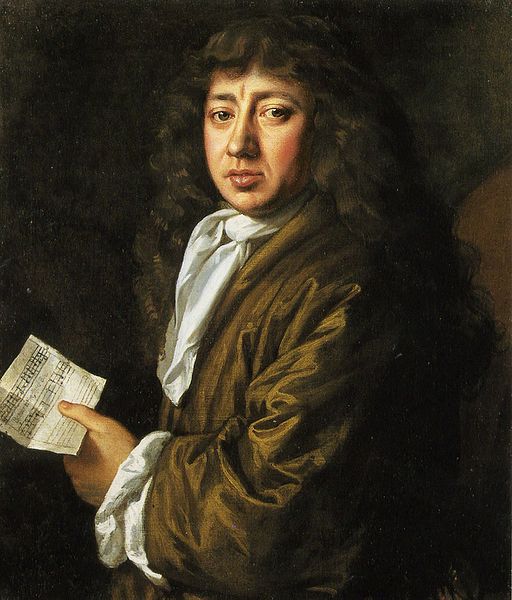
Samuel Pepys
John Hayls, Public domain, via Wikimedia Commons

Not far away Samuel Pepys[6] is wakened by a servant. Pepys is a remarkable man. He’s described as a diarist and naval administrator, but that underplays his significance. Under Charles II (and his successor James II) he became Chief Secretary to the Admiralty. He had no sea-going experience, but implemented essential reforms which organised and professionalised the navy. Additionally, he wrote down all that was happening around him during the years 1660 to 1669. His diary writings – more than a million words – were published much later and not only give invaluable insights into that decade, but especially its great events which include the Great Fire of London.

It is still the middle of the night, and 33-year-old Pepys is as reluctant as anyone to leave his bed. But the maid insists. He steps over to his bedroom window, and sees fire and smoke rising only one-third of a mile away. But he’s not especially perturbed. It’s just another London fire, and he’s suffering constant pain from bladder stones, so he returns to his bed.

He wakens again at 7.00 am. He looks out his window. The fire is now much larger. Pepys has access to the king, and thinks the monarch should be informed. First he goes to the Tower of London from where he can get a better view of the fire. He sees how fast the strong wind is pushing the flames. At the Thames he clambers onto a boat from where he has a view towards Pudding Lane. People are running from the fire with their possessions, some throwing themselves and their property into the river, and others stacking their goods on boats.

He uses his boat to reach Whitehall where the royal palace is located. King Charles is alarmed, and instructs Pepys to return to the old city, find the Lord Mayor, instruct Bloodworth to tear down houses, and tell him that the king will send soldiers to help. These are sensible measures, but the mayor will not care to be instructed by the king nor want his soldiers.

By mid-morning Pepys is touring streets by coach but has yet to find Bloodworth. The fire is widening its reach minute by minute, pushed along by an ever-stronger wind. The lanes are crammed with an odd mix of citizens. Some are dressed smartly and on their way to church. Others are covered in soot, and hurrying away from the fire carrying children and possessions. Flames reach into the sky. Dark clouds billow up over the city.

Pepys continues to search, by now on foot. The crowds have made coach travel slower than walking. At St Paul’s Cathedral he watches people pushing to gain entry, not for Sunday worship but bringing their clothes, furniture, and other goods inside. Many take them down to the crypt. St Paul’s is large and made of stone. It will not burn. It is a safe place. Or so they think.

Where is Bloodworth? Pepys heads towards the fire. People rush past him, some trying to stem the flames and others getting as far as possible from the flames. One man tells Pepys the mayor might be anywhere, and that 300 homes are burning now. He presses on, forcing his way through the throngs. He rounds a corner and for the first time feels the heat from the fire on his face. In front of him are not homes, but what looks like a giant bonfire. ‘It made me weep to see it’, writes Pepys. One writer describes his reaction: ‘This is no longer the few burning streets he’d told the king about. This is a vision of hell.’[7]

As well as what Pepys sees and feels, what he hears is terrifying. Burning wood is not silent. It breaks apart with loud bangs, like the firing of pistol shots. Everywhere fires roar. Pepys steps away, moves down alleys not yet ablaze, and finally finds Lord Mayor Bloodworth in Cannon Street surrounded by constables and locals. To Pepys he looks defeated and near to collapse. He had a chance to extinguish this fire, but now it’s too late.

Pepys tells Bloodworth he brings orders from the king. Houses in the path of the fire must be demolished. Despite the awful reality of a fire out of control, the mayor stubbornly refuses. The two men argue. For Pepys whatever can be done to save the city must be done. Bloodworth, though, will not give up his control and take commands from the king. Though the mayor has no idea what to do he will not let King Charles tell him what to do. He protests that he has been up all night, he now needs to go. And he does go, leaving his city to burn. Lord Mayor Bloodworth is never seen again while the Great Fire rages.

It’s now not even midday on Sunday, only the first day of the fire, and already hope of saving much of London is gone. And here we will pause our narrative. This has been only the introduction to our story. The worst of the Great Fire is yet to come. Details to follow in the next blog posts.

In closing, though, is there any wisdom to be gleaned from the beginning of the Great Fire of 1666? There is. Very briefly, I’ve noted four lessons.

  1. There was clearly a failure to imagine the unimaginable. London often had fires, but they were small, and their primitive fire-fighting measures were adequate. Those in authority had never imagined a fire which quickly became an inferno and then spread further and further across the city driven by a near gale force wind. But, actually, that was not ‘unimaginable’. It was simply not imagined. Very strong winds happened, often in early autumn. If only they’d planned and prepared for a fire breaking out at such a time.
  2. Laws were not enforced and that had consequences. Foolish practices, while not illegal, were allowed. There were laws about the size and overhang of houses which no-one enforced. Highly inflammable and even explosive materials were stored in wooden houses and sheds and no-one intervened. This was madness, a classic case of nothing being done until there’s a disaster. There was indeed a disaster, one that claimed lives and destroyed a large part of London.
  3. Dogma took priority over effective action. As we will see, once soldiers were organised and deployed, more effective firefighting took place. But for crucial hours the king’s men were refused. Many of London’s leaders had not wanted another king, so they certainly didn’t want his soldiers. That decision had devastating consequences.
  4. Those who should have taken decisive action failed. Most historians condemn Lord Mayor Bloodworth for his inaction. But some believe he faced impossible pressures politically, and was simply out of his depth when faced with a massive fire. Both hard judgments and soft judgments can reasonably be made about Bloodworth. But the bottom line is that he did little in the early hours, and removed himself when firm and effective action was most needed. He was the city’s leader, but he wasn’t a leader in a major crisis.

The Great Fire of London lasted four days. So far we have seen only its beginning. There is much more to come.


I have used several sources for the information in this series on the Great Fire. A special thanks is due to the podcast, Short History of the Great Fire of London. It not only gives more information than most web sources, it tells the story. I have used my own words, but, with gratitude, I’ve followed the podcast’s story line to unfold information and events on a day by day basis. I also want to warmly commend all the episodes of the ‘Short History of…’ podcast. The team cover a wide range of subjects. It is one of my most favourite podcasts – important subjects, brilliantly told, easily followed, fair interpretations. The link to its website is just below.

Here are my major web sources:

Short History of the Great Fire of London podcast. It can be found in two places:

The Monument, erected between 1671 and 1677 to commemorate the fire, and still accessible today, has a website which describes the fire at: https://www.themonument.org.uk/history

Of course Wikipedia has a wealth of information on the Great Fire and, via other pages, on many of the main characters mentioned in its story. The Great Fire entry is at: https://en.wikipedia.org/wiki/Great_Fire_of_London

London Fire Brigade can trace the inspiration for its founding back to the Great Fire. It gives its account of the fire at: https://www.london-fire.gov.uk/museum/history-and-stories/the-great-fire-of-london/#:~:text=In%201666%2C%20a%20devastating%20fire,Paul’s%20Cathedral

Inside History tells the Great Fire story in two parts.

The Museum of London has many resources related to the Great Fire. Its web pages are here: https://www.museumoflondon.org.uk/discover/great-fire-london-1666


[1] Now the location of the UK Parliament.

[2] His merriness included fathering at least 12 illegitimate children with mistresses, but he left no legitimate heir. He was succeeded on the throne by his brother James.

[3] Tallow is rendered animal fat, more commonly called ‘dripping’ in the UK. In the 17th century, one of its uses was for candles.

[4] His last name also appears as Bludwoth.

[5] Bloodworth is blamed for allowing the fire to spread in its early stages. But tearing down private property, if later deemed unnecessary, could have left him personally liable for damages unless the king had authorized his actions. But his aldermen – parliamentarians – would not have allowed the king to decide on firefighting measures in the city.

[6] The pronunciation of his last name sounds like ‘peeps’.

[7] John Hopkins & Danny Marshall, ‘Short History of the Great Fire of London’ podcast, 22’18”.


Does the end really justify the means?

It is September 1666, and the Great Fire of London has broken out in a bakery. For four days flames rage uncontrolled through thousands of wooden homes. Though few perish in the fire, enormous numbers are homeless, possessions lost, with nothing to eat and no work available. Many of them die during the winter months. Almost immediately after the fire rumours swirl that the blaze was begun by Dutch or French Catholics. Mobs roam the street demanding an arrest. The authorities fear large scale civil unrest.

Then a simple-minded man confesses. He is Robert Hubert, believed to be a French Catholic. Hubert soon retracts his confession but he is brought to trial, convicted by the jury, and the death sentence passed. It is what the crowds wanted, and they disperse. Next month Hubert is hanged.

It would seem justice was done. But it wasn’t. Hubert certainly did not start the fire. He couldn’t have because there was incontrovertible evidence he was at sea on a ship when the fire began. London had already been burning for two days before he arrived in the city. The authorities always had doubts about Hubert’s guilt, but his conviction prevented riots, and it was better that one die than many.

Why tell that story? Because it illustrates what can happen if the rightness of actions is judged by how good or useful their consequences. Philosophers have a name for that kind of moral theory: consequentialism. One kind of consequentialism is utilitarianism, which I will explain later.

I imagine you’re telling yourself: ‘I wouldn’t hang an innocent man under any circumstances – I’m not a consequentialist!’ But I’d be ninety-nine per cent sure you are a consequentialist, probably quite often. My mother was when it came time to remove a band-aid plaster from my knee. ‘If I do it quickly it won’t hurt so much,’ she’d say. That’s consequentialism – let’s do the hard thing now because it’ll be better later. And we’re consequentialists any time we pay a false compliment about someone’s clothes or hairstyle, or cross our fingers while saying we like their friends. We don’t want to hurt their feelings, so we tell them what they’d like to hear. That’s consequentialism – we’re focused on outcomes, especially happy ones.

If you’ve been following recent blog posts, you’ll know I’ve been studying the philosophical issues around (what’s called) dirty hands. Dirty hands refers to doing something bad, but we do it because we believe it’ll lead to a good outcome. The situations I’m looking at are usually a lot more serious than hurting someone’s feelings. Two posts back (https://occasionallywise.com/2022/08/06/would-you-torture-a-terrorist-if-that-would-save-thousands-of-lives/) I shared an often-quoted imaginary scenario, which is this:

  • a terrorist is arrested while planting a bomb
  • the authorities learn there are more bombs, all with timers to go off soon
  • the terrorist won’t say where they are
  • if they torture him to get that information they will save hundreds, perhaps thousands of lives
  • but torture is evil and illegal, so only the most extreme of emergencies could possibly justify its use
  • might saving a thousand lives be such a situation?

That’s the standard imaginary story to explain the dirty hands dilemma. You could say it’s about doing wrong to do right, about doing a bad thing for a good outcome. But can really dreadful things like torture ever be allowed, no matter how good the goal? That’s what I’m studying, and I’m asking if there is any moral theory that has the answer.

Before going further, I recognise some are fascinated by subjects like this, and others are switched off. I’d encourage you to keep going. The issues are actually very important. But don’t feel bad if this subject is not for you.

In the last post I looked at one theory. It’s about rule-keeping but goes by the fancy name of deontology. (See: https://occasionallywise.com/2022/08/14/never-tell-a-lie-but-what-if-telling-the-truth-will-cost-a-life/)  A very famous 18th century philosopher called Immanuel Kant believed no act was right unless you could will that everyone behaved that way. For example, he didn’t believe the world could function if everyone lied, so, for him, lying was always wrong no matter the consequences. That might mean telling a murderer where his intended victim is hiding. But, the question I asked was: how could a lie be more important than saving someone’s life?

Consequentialism isn’t about obeying rules. What’s right is doing what gives the best outcomes / consequences. Therefore it seems exactly right for dirty hands issues, because they’re about doing bad things to achieve good outcomes. Hence, can you torture a terrorist if that’s the only way to find and diffuse bombs? Some think that, in these circumstances, it’s the right thing to do; others think torture is always wrong.

The first person to organise consequentialist thought was a strange man. Well, I think someone is strange who writes in his will that, after death, his head should be preserved and placed on his body, seated upright on his usual chair, so he could join meetings of his ‘disciples’ when they gathered together.

The philosopher was Jeremy Bentham (1748-1832). Though his wish was extremely odd, it was granted and his auto-icon (body preserved and displayed as still living) is on display to this day in the Student Centre of University College London.[1]

Bentham was a pioneer in developing philosophical method. In the 17th century Francis Bacon had brought orderliness into scientific investigation, and Bentham wanted to do the same for philosophy. His key interests were morality and justice, so he wrote a book called ‘Introduction to the Principles of Morals and Legislation’. It very nearly never got published. He had it ready in 1780 and, as many authors do, he let his friends read it in advance so he could make any corrections. These friends were unsparingly honest with Bentham, and pointed out so many imperfections Bentham confessed he believed the book ‘doomed to oblivion’. But he kept working at it, and it was published nine years later. But – being an odd man – Bentham wrote into the book some of his own criticisms of it. Over the years he continued to make corrections for a new edition which finally came out 34 years later.

So, what was Bentham’s moral philosophy?

He considered human beings to be governed by pain and pleasure. And his principle of ‘utility’ (usefulness) – hence the name utilitarianism – approved or disapproved of actions according to how much they increased or diminished the happiness of an individual or community. If an action produced benefit, advantage, pleasure, good, or happiness, then it was right. It could also be right if it prevented mischief, pain, evil, or unhappiness. He defined six circumstances which could affect the value of pleasures or pains for an individual – see the footnote below for the details.[2] Then he specified an exact way of working out whether an action tended towards good or evil when everything was taken into account. His method is amusingly or frustratingly complicated – again, see below for details.[3] He didn’t believe his process could be followed before every moral judgment, but said the more precisely his method was observed, the more the result would be exact.

You might think that’s quite enough. Not for Bentham! What follows in his book are nine pages of kinds of pleasures and pains. There are 33 different lists. I have only skim-read them, and that left me exhausted.

To be kind to Bentham, his method and lists were an attempt to stimulate legal reforms and regularise sentencing in the justice system. But he was also trying to bring a more scientific process to moral decision-making.

His attempt at a method was applauded and criticised. It was impractical, and Bentham’s focus on calculating rightness on a numerical basis left open the chance of great evils. For example, was it right that slaves and Christians were tied up in Roman arenas so large crowds could watch them torn to pieces by wild animals? Bentham’s system would seem to say ‘yes’, because for a few there was extreme pain, while for the many there was great joy and excitement. Far more had pleasure than the number who suffered pain. And that’s what Bentham said was the way to judge rightness.

Jeremy Bentham was great friends with a man called James Mill, and he tutored James’ son. That boy became an even more famous philosopher than Bentham, and sought to rescue utilitarianism from the crude versions of consequentialism. His name was John Stuart Mill (1806-1873).

His father decided that John Stuart would have a genius intellect. He was put through an immensely rigorous training, which John Stuart detailed in his autobiography. From Wikipedia, here’s how it began:

At the age of three he was taught Greek. By the age of eight, he had read Aesop’s Fables, Xenophon‘s Anabasis, and the whole of Herodotus, and was acquainted with Lucian, Diogenes Laërtius, Isocrates and six dialogues of Plato. He had also read a great deal of history in English and had been taught arithmetic, physics and astronomy.[4]

Lists of his immense learning cover several more paragraphs. It’s a massive amount and range of academic knowledge. Then, aged 20, John Stuart Mill contemplated suicide. He’d realised the direction his life was taking would not bring happiness. What brought him back from the brink was the poetry of William Wordsworth.

Mill became an MP for a short time, but he made his greatest impact through his writings on several branches of philosophy. His book ‘Utilitarianism’ continues to fascinate me.

Mill was unquestionably a man of great learning. He was also shrewd, and he affirmed, adjusted and added to Bentham’s views to make them better.

Affirmed    He agreed with Bentham’s way of deciding between right and wrong. Here’s how Mill puts it: ‘actions are right in proportion as they tend to promote happiness, wrong as they tend to produce the reverse of happiness’.

Adjusted    Bentham had given all forms of pleasures the same value, so critics said many of them were no better than beasts would enjoy. Mill adapts the understanding of pleasure by arguing that the quality of pleasure matters as well as the quantity. In other words, there are ‘higher pleasures’ (such as those of the intellect, morality and aesthetics) and ‘lower pleasures’ (such as those of the body and senses). That allows Mill to say: ‘It is better to be a human being dissatisfied than a pig satisfied’. Mill’s view smacks of elitism, but allows him to elevate his utilitarianism above the crudity of consequentialism.

Added    Bentham’s system involved calculating the happiness or usefulness of each act for most people. But his formula was tedious to calculate, and allowed the Roman masses to revel in watching people mauled to death. Mill, wisely, did not reject all that, but he added something that transformed it: the idea that it is not individual acts that should be assessed for pleasure or pain, but the assessment should be made of ‘rules and precepts for human conduct’. What that means is this: if a moral rule is widely accepted as good, and an action fits within that rule, then that action is morally good. For example, if there’s a rule that says ‘It’s a good thing to assist the poor’ and you take a loaf of bread to an impoverished neighbour, you no longer need to assess the moral rightness of your gift of bread because it’s already covered by the ‘assist the poor’ rule. That makes sense.

But, surely there are times when rules can’t be kept, such as the need to lie to someone intent on murder? Mill picks up on exactly that famous case I mentioned in the previous post. Yes, lying is wrong, but Mill says that even such a sacred rule has to allow exceptions. One of his examples, unsurprisingly, is that lying would be justified to ‘preserve someone from great and unmerited evil’. There can’t be rule-exceptions for self-interest, such as to avoid embarrassment, but, to save someone else from harm, a rule could be broken. Though that is a very reasonable position, Mill was criticised that he made his rules useful when convenient, but abandoned when inconvenient.

Eventually – in the late 1950s – Bentham’s views were labelled ‘act utilitarianism’ and Mill’s views ‘rule utilitarianism’. Not many today advocate the ‘act’ version, but plenty still identify with ‘rule utilitarianism’. It’s a softer, more reasonable form of consequentialism.

My special interest, of course, is whether any moral theory helps us justify a ‘dirty hands’ action, such as torturing a terrorist to find the bombs he’s planted.

A raw version of consequentialism would simply say, ‘Of course torture is justified providing more people benefit than suffer’. That’s straightforward, but no better than justifying slaughter in a Roman arena to amuse the crowd. No moral judgment is being made about the torture, only a calculation about how many gain from it.

I think Mill’s rule utilitarianism helps, but only goes so far. Here’s what I mean. Unquestionably torture would be against any normal moral rule. So, on that basis, you should refuse torture. However, you only remove the immoral action. You don’t remove the immoral consequence of inaction. By not torturing, you allow bombs to explode and many hundreds die.

So you have to resort to claiming this dreadful scenario needs one of Mill’s rule-exceptions. You could argue for a ‘supreme emergency’ exception to the no-torture rule. But who gets to define what is a ‘supreme emergency’? It’s not hard to imagine that many situations could be claimed as a supreme emergency. After all, that’s the line of thought which authorities, faced with mobs in the street, used to convict and hang Robert Hubert for starting the Great Fire, even though he was innocent.

My final conclusion will not be that consequentialism is the moral theory that resolves all dirty hands issues.

One more major moral theory to go still. It’s not remotely a religious theory, but some words of Jesus could sum it up: ‘Likewise, every good tree bears good fruit, but a bad tree bears bad fruit. A good tree cannot bear bad fruit, and a bad tree cannot bear good fruit’ Matthew 7:17-18). I shall explain next time.


[1] See: https://www.ucl.ac.uk/library/news/2020/mar/ucl-student-centre-welcomes-jeremy-bentham#:~:text=9%20March%202020,both%20in%20life%20and%20death. Understandably the head now on his shoulders is made of wax.

[2] His six are: 1. intensity 2. duration 3. certainty or uncertainty 4. propinquity or proximity, 5. fecundity (‘more of the same’ to follow), 6. purity (unlikelihood of opposite sensations following). If the issue concerned a group, Bentham had a seventh: extent (the number affected).

[3] Here’s how Bentham instructs his readers to ‘take an exact account then of the general tendency of any act’. It is to be an exact process: value each initial pleasure and each initial pain; then secondary pleasures and pains. Then total the values of the pleasures against the values of the pains. If the balance is on the side of pleasure, there is a good tendency to the act, and a bad tendency to the act if the balance shows pain. Also, consider how many people are affected by the act, and do the calculations again for each one. Then do the ‘balance sheet’ calculation again to calculate if the tendency is good on the whole or bad on the whole. Where the balance lies will show whether the act has a good tendency or an evil tendency.

[4] From: https://en.wikipedia.org/wiki/John_Stuart_Mill