Christmas Quiz – part 3

Welcome to the third and last section of the Christmas Quiz I used during a recent church service.

Many have followed the earlier parts of this quiz. In the last few days there have been readers from 20 nations, including the United Arab Emirates, Singapore, Cambodia, Bangladesh, Finland, Laos, Moldova, Venezuela, Vietnam, Japan, Hong Kong, USA and the UK. I am delighted people from all these countries and cultures find something useful here.

If this is your first encounter with the Christmas Quiz, you would enjoy beginning with the first two parts. Here’s where to find them:

As well as the quizzes, you’ll discover how each one has three parts: 1) the quiz; 2) the answers; 3) a personal reflection. The reflections were the challenge I brought to the church congregation, and it would be wrong to omit them here.

Lastly before we start, avid readers of Occasionally Wise may have an advantage for this third quiz, because I wrote about some of the same subjects in Christmas Miscellany (https://occasionallywise.com/2024/12/21/christmas-miscellany/). But, this time, I’ve added a lot of extra information. You’ll enjoy what you read here!

Part 1  Christmas celebrations

Q1  What percentage of people in the UK say they will attend church on Christmas Day?

  1. 6%
  2. 16%
  3. 26%

Q2  Looking back in history, who was most influential in promoting the Christmas tree tradition?

  1. Ancient pagans, such as Druids
  2. Martin Luther, around 1536
  3. Queen Charlotte, German wife of King George III, in the late 1700s and early 1800s
  4. Queen Victoria and her husband Prince Albert, from the 1840s

Q3  In 1848 Cecil Frances Alexander wrote ‘Once in Royal David’s City’ as a children’s hymn. Which of these other hymns did she write?

  1. ‘There is a green hill far away’.
  2.  ‘All things bright and beautiful’. 
  3. ‘Away in a manger’

Q4  In Norway, Sweden, and Denmark, people think little elf-like creatures bring presents on Christmas Eve. What food do children leave out for them to eat – to thank them and help them on their way?

  1. Sausages
  2. Porridge
  3. Cakes

Q5  Mince pies were being enjoyed 800 years ago. Back then what were their main ingredients?

  1. Meat
  2. Dried fruit
  3. Spices

Q6  In the UK, how many mince pies are sold in the run-up to Christmas?

  1. 80,000
  2. 800,000
  3. 800,000,000

Q7  Mince pies have had various shapes over the years. Back in medieval times what shape were they?

  1. Round
  2. Star
  3. Rectangular

Part 2  Answers to Quiz 3 questions

Question 1 asks what percentage of people surveyed in the UK say they will attend church on Christmas Day. Maybe the most important words in the question are “say they will attend”. That tells you the survey was done before Christmas. If the survey had been done after Christmas and asked how many had actually gone to church on Christmas Day, the numbers would surely have been smaller. Intentions do not always lead to actions. True for all of us.

The right answer – from that survey – is 16%. That may not seem many, but 16% is close to 1 in 6 of the population. I live in the UK and I’m sure that 1 in 6 of those who live near me do not attend church on any day, including Christmas Day! Maybe my affluent neighbours in Oxfordshire are sucked into feasting and present-giving/receiving at Christmas.

The survey not only compared planned attendances at church between the USA, UK, and Germany, but also how many intended to go to the pub. Two things may have skewed answers to the pub question. First, maybe other countries are different, but many pubs in the UK do not open on Christmas Day. Second, there is something wonderful about being in church at Christmas but nothing particularly special happens in the pub on Christmas Day. And nipping off to the pub when you’ve got famly duties at home could have serious consequences!

Nevertheless, it’s interesting to note from the survey that in all three countries, church wins over pub. At least that’s what they told the pollsters.

Question 2 asks who was most influential in promoting the Christmas tree tradition. Once again it’s important to think carefully about the wording of the question.

First, let’s take pagans and Druids of ancient times out of the picture. They did gather branches of evergreen trees to ward off evil spirits. Why those branches? Precisely because they were evergreen – they never seemed to die which, they believed, meant those who gathered them would also never die. But pagans are not behind our Christmas tree tradition. They weren’t interested in promoting their traditions, and Christians were never much interested in adopting them.

What about Martin Luther, the reformer of the church in the 1500s? The story goes that he was walking home on a cold, clear winter night, and felt overwhelmed by the remarkable display of  bright stars overhead. He erected an evergreen tree in his home, and fastened lighted candles to its branches, intending to recapture something of the beauty he had seen in the sky outside. The result was Impressive, and Germany did develop an early custom with similar trees, but Luther’s tree did not inspire a world-wide movement.

Now, if the question had asked who first introduced the Christmas tree tradition to Britain, then Queen Charlotte would be a great answer. She grew up in the German duchy of Mecklenburg-Strelitz, where it was customary at Christmas to lay out a single yew branch, to which were attached wax tapers that could be lit. Presents would be placed under the branch.
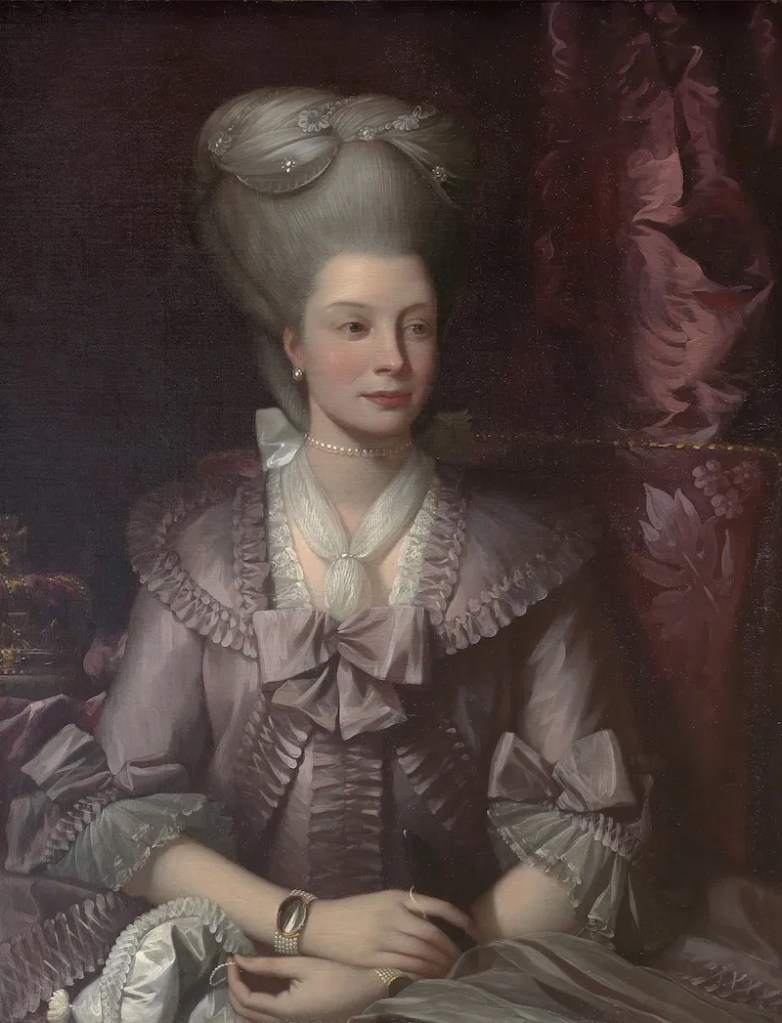
Queen Charlotte, Benjamin West, 1777. Yale Center for British Art. Public Domain.

Charlotte came to Britain in 1761 to marry King George. She soon established the yew branch tradition in her new home, but that was only for her family with some court members joining them to sing carols. But the tradition got a significant upgrade in 1800 when Queen Charlotte set up a Christmas tree at Queen’s Lodge, Windsor, and that is reckoned to be the first ever Christmas tree in the UK. Charlotte decorated the tree with tinsel, glass, ornaments and fruits, and brought local children in for a party. John Watkins attended the party and later wrote a biography of Queen Charlotte in which he described the branches of the tree from which “hung bunches of sweetmeats, almonds and raisins in papers, fruits and toys, most tastefully arranged; the whole illuminated by small wax candles. After the company had walked round and admired the tree, each child obtained a portion of the sweets it bore, together with a toy, and then all returned home quite delighted.”[1] I am sure they did.

Erecting Christmas trees began to catch on among the nobility, and in some of the colonies. But by far the biggest boost for the tradition came several decades later. Note that the question asked who was most influential in promoting the Christmas tree tradition, and the correct answer is Queen Victoria and her husband Prince Albert.

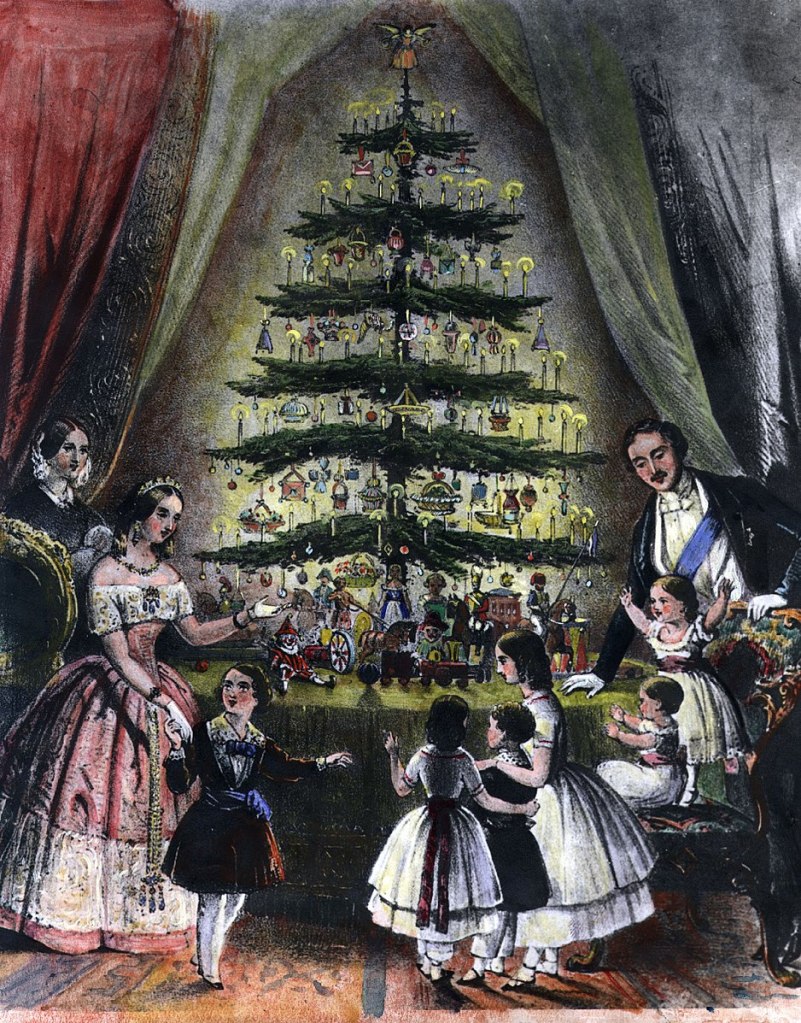
Victoria and Albert had both enjoyed Christmas trees during their childhood. They married in 1840, and Christmas trees soon appeared around Windsor Castle. Then Prince Albert did something in 1848 which massively spread the tradition. He allowed a front cover painting to appear in The Illustrated London News showing the main tree covered in decorations and surrounded by the Royal Family.[2] Other publications – in the UK and many other countries, especially the United States – reproduced the painting and followed up on the story. The publicity had a massive influence on Christmas customs, and by 1860 almost every well-off family in Britain and Ireland had a Christmas tree in their home. Royal fever had done its work.
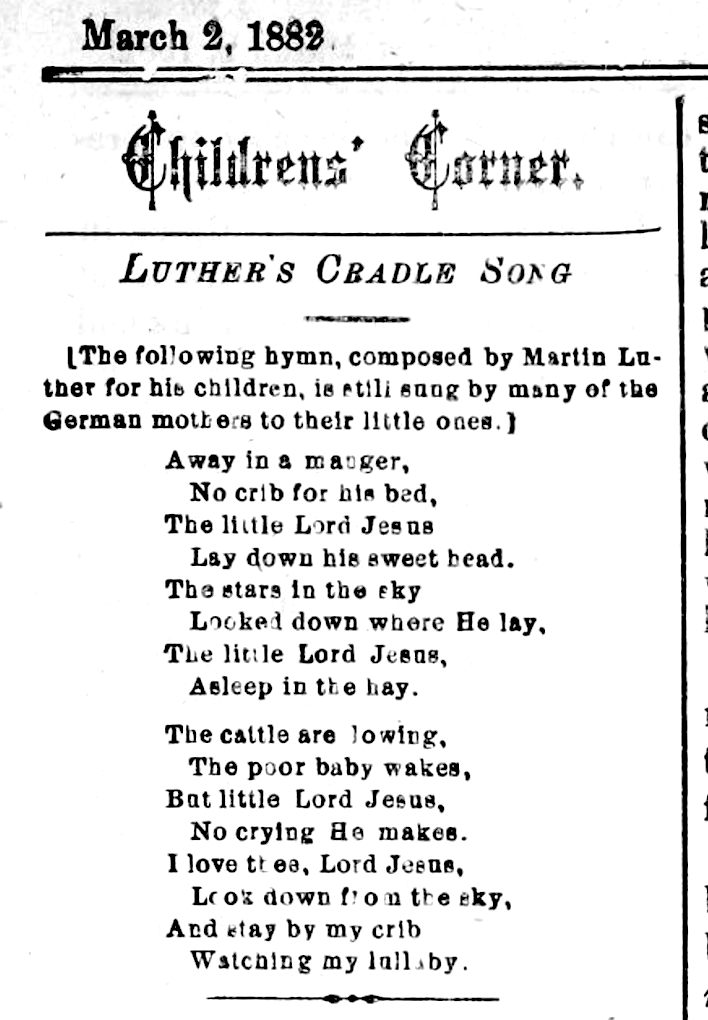
Early publication of the first two verses of “Away in a Manger” from the “Christian Cynosure” newspaper of March 2nd 1882. Public Domain

Question 3 asks about hymns possibly written by Cecil Frances Alexander in addition to her famous carol ‘Once in Royal David’s City’. I listed three. When I posed this question to the church congregation, a large number chose a wrong answer: ‘Away in a manger’. Though that carol is hugely popular, its authorship is unknown. The first two verses appeared in various American publications in the 1880s, typically attributing the hymn to Martin Luther. The third verse which begins ‘Be near me, Lord Jesus’ first appeared in 1892 in Gabriel’s Vineyard Songs. But, even without the extra stanza, what was being called “Luther’s Cradle Song” was being sung widely in America. There is no evidence of a version dating from Martin Luther’s time, but attributing the hymn to him probably helped spread its popularity. Luther and his wife Katie had 6 children as well as raising 8 orphaned nieces and nephews. It must have been difficult to lull them all to sleep, but it wasn’t done by singing ‘Away in a Manger’.
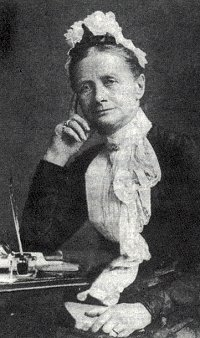
Cecil Frances Alexander Public Domain

So, which of the other two hymns were written by Cecil Frances Alexander? The correct answer is that she’s the author of both ‘There is a green hill far away’ and ‘All things bright and beautiful’. These two, and ‘Once in Royal David’s City’ first appeared in Alexander’s Hymns for Little Children in1848. The simple style and structure of all three will have been a major reason they became so popular.

Cecil married an Anglican clergyman who later became Bishop of Derry and Archbishop of Armagh, and spent much of her time caring for poor, sick or disadvantaged people, especially during the Irish potato famine (1845-1852). She has been criticised, however, for the original third verse of ‘All things bright and beautiful’ because it acknowledges the separation of classes: ‘The rich man in his castle, The poor man at his gate, God made them high or lowly, And ordered their estate.’ That verse is almost never sung today.

Question 4 pondered what treats are left out in some Scandinavian countries for elf-like creatures who bring presents at Christmas. A good number of votes in church went for sausages, even more for cakes, and only a few for porridge. But the correct answer is porridge. Apparently Scandinavian children think healthy food will speed elves on their way through a long night of leaving presents. There must be very healthy children and elves in Scandinavia.

Question 5 asks about the main ingredients of mince pies when first made and eaten 800 years ago. The options were Meat, Dried fruit, or Spices. The right answer is all three. And each part of the mince pie was there for a reason:

  • meat (mostly lamb or mutton) was simple food because it represented the shepherds
  • dried fruit (raisins, prunes and figs) because they were an affordable alternative to sugar to sweeten the mince pie
  • spices (cinnamon, cloves and nutmeg), were, along with the fruit, expensive items as they were imported from the Middle East, but their cost symbolised the lavish gifts of the wise men.

In those medieval times mince pies had 13 ingredients. Why 13? Because that was equal in number to Jesus and his 12 disciples.

Question 6 was about how many mince pies are sold in the UK during the run-up to Christmas. I offered alternatives of 80 thousand, 800 thousand or 800 million. The correct answer is a staggering 800 million. Of course that’s only how many are sold. It does not include all those baked at home, nor those bought or made at other times of the year.

To know how many mince pies per person are eaten each Christmas in the UK, you can’t just divide the population into 800 million. Why not? Because some people don’t like mince pies so never eat any. Then there are babies who can’t or shouldn’t eat mince pies, and young children who don’t like them now but may later in life. However, rough estimates suggest that those who like mince pies will eat between 15 and 19 per person at Christmas. Add to that all the other fattening foods they’ll consume, and it’s no mystery why many of us put on weight over Christmas!

Question 7 explains that mince pies have had various shapes, but asks what shape they were in medieval times. Were they round, star or rectangular? The correct answer is rectangular because they were baked in large dishes with that shape – and consequently often called ‘coffins’. But bakers of ancient times also recognised rectangular dishes were similar to a manger, and, with that in mind, many topped their pies with a pastry baby Jesus figure. Personally I can’t imagine cutting or biting into a pie decorated with Jesus. The round shape of mince pies – common today – dates only from the Reformation in the 1500s.

Part 3  Reflection

Christians tend to frown on the extravagance and excess of fringe activities which accompany Christmas – parties, decorations, gifts, over-indulgent meals, perhaps even the mince pies. Surely these things are not what Christmas is all about?

No, they are not. But there is nothing wrong with Christmas celebrations providing the fringe things do not become the main thing. Jesus went to a wedding reception with plenty of food and wine. He didn’t refuse to attend, objecting that food, drink and dancing were not what marriage is about. He joined others in celebrating what the main event meant, a couple pledging their love and lives to each other. Likewise, as long as we recognise that the main thing about Christmas is God coming into this world to save us, we can celebrate.

But we go wrong if we allow Christmas to stand alone. Christmas belongs with Easter, because Easter is the fulfilment of what began at Christmas. You need both to understand what God was doing by coming into this world. I’ll explain.

I grew up only nine miles from St Andrews, the ancient ‘home of golf’. When I was aged about 13, I entered the prestigious Eden Boys’ Golf Championship at St. Andrews. It was played on the Eden Golf Course, but those who qualified in the early rounds would play later rounds on the famous Old Course. I was playing well. I knew I’d qualify.

I arrived at the course, carrying my second hand clubs in an old canvas golf bag, and wearing the same clothes as I did when playing football with friends. But one boy, maybe aged 15, was dressed immaculately. He had a proper golf hat, proper golf slacks, proper golf sweater, proper golf shoes. And he’d brought brand new clubs in a brand new bag which contained brand new balls. He even had a caddie to carry his clubs and guide him round the course. He stepped onto the first tee with a swagger. His backswing was immaculate and the downswing looked good too. But clearly it wasn’t, because although the lad hit the ball hard, he sliced his shot way off to the right where it disappeared over the course boundary to land among old railway sheds. His caddie tossed the boy another brand new ball. He drove, and off to the right and out of bounds that one went too. So did number 3. Number 4 did not, only because he topped the ball and it ran a mere 100 yards down the fairway. As he walked away, I saw no swagger, just a crestfallen figure who knew he’d lost any chance of winning on the first hole. I wasn’t going to do that.

I didn’t. My chances didn’t disappear on the first hole, just on almost every hole after that. From hole 2 on, my drives and fairway shots went all over the place and my putts kept missing the hole. I was well over par after nine holes.  My Dad had come to watch me. He was a very good player with a low single figure handicap. That day he was at the side of every fairway, and I knew he would be silently cheering me on. But, as I messed up yet another shot, I was thinking ‘Today what I need is not my Dad watching me; I need him to come over here and play the shots for me.’ Which, of course he couldn’t. I didn’t qualify.

Christmas is not about God watching us as we mess up our lives. It is about God coming from heaven to earth to save us. We mess up – so much of what we think and do is out of bounds – but God did not sit in heaven, wringing his hands and feeling sorry or angry about our lives. He came, not to watch us but to save us. That began with his birth into this world at Christmas, and was completed when he died and rose again at Easter.

God – ruler, judge over all – stepped down to be with sinful men and women, and then take the penalty on the cross for their sins. He died in our place. The angel who told Joseph to take Mary as his wife said: “She will give birth to a son, and you are to give him the name Jesus, because he will save his people from their sins” (Matthew 1:21). To save us is why he came. That is why Christmas matters so much. I am all for celebrating Christmas. It’s a wonderful, joyous time. The Lord has come. All people on earth should receive their king. Watching from a distance would not have been enough. He came right alongside to save us, and that’s what makes Christmas so special.


[1] Quotation from Wikipedia: https://en.wikipedia.org/wiki/Charlotte_of_Mecklenburg-Strelitz

[2] By 1848 the couple had six children and they are shown in the painting: Victoria (1840), Albert Edward (1841), Alice (1843), Alfred (1844), Helena (1846), and their newest arrival, Princess Louise, born in March 1848. Eventually there were nine children, five daughters, four sons. Their last child – Princess Beatrice – was born in 1857. She died in 1944, having long outlived not only her mother but all her siblings.

The Tay Bridge disaster

I can’t imagine what it’s like to design, construct and supervise a world leading structure, receive wide praise and recognition, and have it fail causing dozens of deaths 19 months later. Thomas Bouch knew exactly what that was like.

I learned about the Tay Bridge disaster when I was very young. I grew up in Fife, and to get to Dundee we went north by train crossing the River Tay estuary on the 2.75 mile long Tay Bridge.

Aged less than seven, I looked out the train window and down to the water, and asked ‘Why are there stone blocks in the water alongside our bridge?’

My mum explained, ‘Those large blocks held up the first bridge. But it fell down.’ That wasn’t an encouraging answer, but I wanted to know more. And I’m still interested today.

In this blog I’ll tell the story of what happened to the original Tay Bridge. This is a different kind of blog to most. It’s longer, because the story can’t be told properly without detail. And why things went so terribly wrong is a lesson or warning for all of us.

But if it’s too much, you’re about to be given a shortcut.

Construction

I’m about to provide considerable detail about the construction of the bridge, including failings that likely caused its downfall. Not everyone will have time or will wish to read this. If so, pick up the story again in the section headed ‘Collapse’.

The River Tay flows into the North Sea just east of Dundee. Its estuary is wide with fast flowing currents and strong winds. To bridge across the river near its mouth would be a massive engineering feat.

Thomas Bouch

Proposals were drawn up in 1854, but nothing done. In the 1860s, however, two rail companies rivalled each other for the route to the north east. The key to success was building a bridge over the River Tay. The North British Railway Company got approval to do that, and they appointed a noted civil engineer called Thomas Bouch. He was 49, and already experienced with major railway projects in both Scotland and England. The whole contract – design, construction and ongoing maintenance – went to him. In 1871 work began.

From earliest days Bouch’s design was criticised. The bridge would be only single track so traffic capacity would be low. The centre section needed to be built high above water to allow ships to pass underneath. Bouch’s tall and slim design appeared to lack stability.

Problems soon emerged once construction started. Bouch’s design specified piers (on which the bridge would rest) of solid masonry and brickwork. But 15 piers out from the south side, the borers who dug into the next part of the river bed found the underlying material insufficient to hold the weight of solid piers. They would shift or collapse. So Bouch redesigned these piers to be lighter and wider. Above water level, instead of masonry there would be slender cast-iron columns. He made another change: originally the centre of the bridge was to have fourteen 61-metre spans, but finally he settled on thirteen 65.5-metre spans (the gap between piers).

Three other issues are worth mentioning.

The foundry  Bouch built a foundry at Wormit, immediately beside the south end of the bridge. That was a good idea – hardly any distance was involved in transporting the iron. But numerous reports described low-quality iron emerging from that foundry – inconsistent in shape and inconsistent in quality.

The height necessary to allow vessels to pass  For most of the bridge, girders ran under the rails. But those low girders reduced the height of the bridge, far too low for ships to pass underneath. So, in the centre section the girders were constructed alongside and above the railway track, allowing trains to pass through a tunnel-like gap between the metalwork. Hence that section got the name of the High Girders.

Wind pressure  Modern standards for wind resistance did not exist in Bouch’s time, but engineers were well aware of the issue. He took advice about wind pressure. French and American engineers had already adopted 40-50 pounds per square foot for wind loading (and if a Tay Bridge was being built today that would be the design requirement). But the lowest recommendation Bouch was given was 10 pounds per square foot. He took that, believing that wind intensity at that level would not force the bolts upwards that secured the columns to their piers.

Throughout the project there was pressure on Bouch from his employers to work as fast as possible, and to keep costs down. The bridge took six years to build. The materials used included:

  • 10,000,000 bricks
  • 2,000,000 rivets
  • 87,000 cubic feet of timber
  • 15,000 casks of cement

Six hundred men were employed during the construction; 20 of them died in accidents. The bridge cost was £300,000 which was not a high amount at the time. It equates to approximately £20,000,000 today, though modern bridges cost many times that sum.

The bridge was more than two miles long. Some records say it was the longest bridge in the world; others that it was the longest iron bridge, or the longest rail bridge. It impressed many. General Ulysses Grant, who led the Union Armies to victory in the American Civil War, visited the construction in 1877 while he was President of the United States.

The Tay Bridge was opened officially on 31st May, 1878, with great celebrations. Directors were taken over the bridge in a special train. Passenger traffic commenced the next day. Profits for the rail company soared.

First Tay Bridge, viewed from the north. Note the High Girders section in the upper centre-left of the photo.

In June 1879 Queen Victoria crossed the bridge as she journeyed south from Balmoral Castle. A few days later Thomas Bouch was knighted by the Queen at Windsor Castle.

Collapse

It’s now Sunday evening of the 28th December, 1879. Winter nights in Scotland are cold. This night there are also howling winds. On a naval training ship moored at Dundee, the wind speed is measured as gusting to Force 10/11.

On the south side of the River Tay a train approaches the bridge. There’s the locomotive, its tender, five passenger carriages and a luggage van. The last passengers have boarded at St Fort Station and are likely locked in, thought of as a safety measure. At Wormit, on the southern edge of the river, the train slows to 3 or 4 mph as a safety baton is passed over. At 7.13 pm the train moves on to the Tay Bridge.

It’s only 19 months since the bridge was opened. Thousands of passengers have crossed, including Queen Victoria. But not on a night like this. Gale force winds sweep down the Tay river valley. Some say no train should be using the bridge over the estuary on such a night. But this train does.

From the south signal box, through wind and rain an observer watches the tail lamps of the train as it moves on to the bridge. When it reaches 200 yards he sees sparks at the wheels. Probably the wind is pushing the wheel flanges against the edge of the rail. Those sparks fly for almost three minutes. Now the train is in the High Girders central section. The observer later described what happened next: ‘there was a sudden bright flash of light, and in an instant there was total darkness, the tail lamps of the train, the sparks and the flash of light all … disappearing at the same instant’.

He tells the signalman, who until now has been busy with other duties. Neither of them can see anything through the darkness. To be sure all is well, the signalman uses a cable phone (which was attached to the bridge) to call the signal box at the north end. He can’t get through. They don’t know what to think.

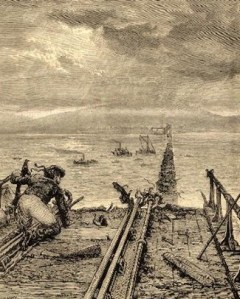
Newspaper illustration of railway officer crawling out during storm, finding central section of bridge gone.

Officials on the Dundee side expect the train to arrive. When it doesn’t, they wonder if it ever left the south bank. Still they wait, but see and hear nothing. Finally two men volunteer to go out on the bridge. Perhaps the train is stuck. Or something worse. What they’re doing is immensely risky. Many times they are almost blown off the bridge. One stops, but the other reaches the point where the high girder section starts. It’s gone. And the train is gone. Holding on to save his life, he peers out over the raging river, realising the bridge ahead, the train, the crew and the passengers have all plunged into the water.

At first light ships search the Tay. They find no survivors. To this day different numbers are given for how many died, but most agree it was around 75.

As news spreads there is nation-wide shock. Newspapers publish sensational drawings of the train plunging off the tracks into the Tay. The engineering world is stunned.

When the storm is over, divers go down to the wreck. They find the locomotive and its carriages still inside the girders. It had all come down together. Only 46 bodies are recovered.

One of the most remarkable feats of engineering now lies at the bottom of the river it spanned.

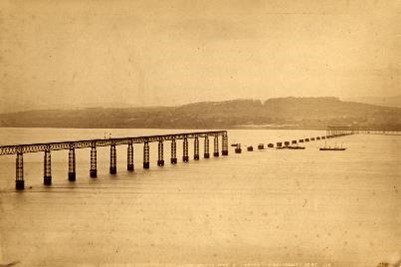
Bridge viewed from the south after the accident. The High Girders section has collapsed into the river along with the train.

Consequences

After a tragedy the two immediate questions are ‘How did it happen?’ and ‘Who should we blame?’ Answers came soon.

An official Court of Inquiry was set up immediately with three commissioners. The disaster occurred on 28th December, 1879, and evidence was taken as early as 3rd January, 1880, just six days later.

They gathered eye witness testimony from people who had seen something from shore, and appointed senior engineers to investigate the wrecked sections and the remainder of the bridge. Others considered the design and construction methods. Months were spent gathering and examining expert reports and interviewing key people.

None was more key than Sir Thomas Bouch, who argued that derailment and collision with the girders explained the tragedy. His view was considered to have little supporting evidence.

The Court of Inquiry’s report was published a few months later and presented to both the Commons and the Lords in the Houses of Parliament. All points were not agreed in the report. But there was reasonable unanimity in serious criticisms of the design, the poor ironwork produced by the Wormit foundry causing some parts to fail when under heavy load, mistakes made during construction, inadequate maintenance and remedial measures. And a failure to create a structure able to withstand the strength of winds which could occur in the Tay estuary.

Here are two damning comments in the official report: *

‘…can there be any doubt that, what caused the overthrow of the bridge, was the pressure of the wind, acting upon a structure badly built, and badly maintained.’ (p.41)

‘The conclusion then, to which we have come, is that this bridge was badly designed, badly constructed, and badly maintained, and that its downfall was due to inherent defects in the structure, which must sooner or later have brought it down. For these defects both in the design, the construction, and the maintenance, Sir Thomas Bouch is, in our opinion, mainly to blame. For the faults of design he is entirely responsible.’ (p.44)

Bouch was broken by the Inquiry’s findings. He became a recluse and died of ‘stress’ in October 1880, four months after the report was published. He was 58.

Down all the years, arguments persist about what caused the bridge to fall. Bouch continues to be blamed, though perhaps a little less severely than by the official inquiry. But if the ‘buck stops at the top’, he was, unquestionably, at the top with this project.

Here’s what I think happened. Almost all the factors mentioned earlier had their part to play. Parts failed that with proper workmanship and maintenance should have stayed strong. But, fatally, when the locomotive and all its carriages entered the high girders, they created what one website calls ‘a solid broadside resistance to the gale, which was blowing full on to them’.  A yacht is moved forcefully when the flat of the sail is presented to the wind. On that night, at the highest point of the bridge, that train plus the high girders were a heavy flat surface facing directly towards a powerful wind. It was too much. The whole central section was pushed sideways, tilting the girders over, snapping the cast-iron columns, and driving the high girders and the train into the Tay.**

Conclusions

From the story of the Tay Bridge disaster, I have three short conclusions for our lives today.

Too much dependence on one person is risky

I wouldn’t like to have been Thomas Bouch, even at the start of the bridge project. He was a brilliant civil engineer, but there are 20 or perhaps 50 different specialised areas involved in a major construction and he didn’t and couldn’t have knowledge and skills for all these areas.

When I led churches, the mission agency, the seminary, I was uncomfortable when too much about our work depended on one person. Sometimes I asked: ‘If you were run over by a bus, who could do your job?’ If no-one could, we were vulnerable.

Some people like feeling indispensable. But for an organisation, that’s not strength; it’s weakness.

A great vision isn’t enough. Implementation really matters

No-one had built a two-mile long iron bridge before. Bouch’s vision was great. But he was pressurised on time scale and on cost. Corners were cut, too much didn’t get designed well, built well, inspected well, maintained well. Bouch’s big ideas were really good, but many things during and just after construction were lacking. Hindsight is always 20/20, but it seems it was only a matter of time before the bridge failed.

Some of us look back to when we were given a great opportunity. A new job. A wonderful spouse. Good health. University entrance. A rare skill. And we didn’t make the most of it. We didn’t study, or develop our abilities, or got distracted on to far less important things. It’s one thing to get a great opportunity. It’s another to fulfil our potential with that opportunity. Implementation really matters.

What we do is always tested

The 28th of December, 1879 – the night of the terrible storm – was the ultimate test for the Tay Bridge. And it fell. When tested, it failed.

The sobering truth is that every life faces tests.

  • Politicians know re-election time is coming when what they’ve done will be scrutinised and voted on
  • Students will face assignments and exams, and what they know will be assessed
  • Workers will have appraisals. Their performance will be evaluated.
  • Relationships will go through hard times, a test of how strongly they hold together

Knowing that there will be times of testing should motivate us to prepare and live ready to face them.

My Aunt Milla drove really badly. Her top speed on all roads was 25 mph. She couldn’t parallel park on a deserted street. She was poor at judging traffic at junctions, and solved that by just going straight through. It was terrifying to be her passenger. Question: how did she ever pass a test when she drove like that? Answer: she didn’t pass a test. She’d begun to drive before there were any tests, so she simply applied for a licence and was given one. But because she’d never prepared for a test, she was forever a dreadful and dangerous driver.

We’re living well when we’re prepared for whatever test will come. Some tests are the ordinary challenges of this life. From my Christian perspective, there’s also the ultimate test of standing before God, and accounting for what we’ve done with all that’s been entrusted to us.

May we be ready for that, the greatest of tests, and all the others along the way.

—————————-

A special thanks and acknowledgment. The images in this blog are used with the permission of ‘Libraries, Leisure and Culture Dundee’. Their website is full of information, and their staff wonderfully helpful.

*  The official report can be found at: https://www.railwaysarchive.co.uk/documents/BoT_TayInquiry1880.pdf

** I’m grateful for this explanation from the Wonders of World Engineering website: https://wondersofworldengineering.com/tay-bridges.html

Thank you for persevering with this blog. If you’ve found it interesting or useful, pass it on to family and friends. You can use the ‘Share’ button, or just point them to www.occasionallywise.com

Three extra details:

The locomotive that plunged into the Tay was recovered, restored and put back in service. Its new nickname was ‘The Diver’.

Parts of the old bridge are still in use today – suitable girders were incorporated into the structure of the replacement Tay Rail Bridge.

The new bridge is twin track, opened in 1887 without any official ceremony.