Great Fire of London 4 Aftermath

Was the death toll from the Great Fire four or four thousand? Did the blaze end the Great Plague? Who or what emerged hairless but alive from the heart of the inferno? How long was it before the bakers of London apologised that one of their own had started the fire? Did someone commit suicide by falsely confessing he set London alight?

Answers to these questions and much more will follow.

There were both serious and less serious consequences from the Great Fire of London. This is the fourth and final part of the story of the 1666 Great Fire, and I’ll explore a variety of outcomes here. Episode 1 of this series describes the beginnings of the Great Fire in a bakehouse in Pudding Lane, and explains why it spread quickly.[1] Episode 2 shows how the fire intensified, with residents fleeing the city and leadership failing.[2] Episode 3 records the fire’s relentless spread; St Paul’s Cathedral is lost but the Tower of London is saved.[3] The footnote links in this paragraph will take you quickly to those earlier episodes.

The Great Fire began in the early hours of Sunday, September 2nd, 1666. Most consider that the destruction was over by the end of Wednesday 5th, four full days later.[4] But, of course, the consequences of the fire lasted far longer than the blaze.

In this final episode, I’ve summarised some of the major effects of the Great Fire under several headings. A few oddities I’ve uncovered along the way are mentioned under ‘Eleven curious details’ near the end.

I’m aware this section is lengthy. I hope you’re willing to read it all, but if time or energy fails you, I’ll admit the parts that most interested me have the headings: ‘Death toll’, ‘The plague’, ‘The lust for vengeance’ and ‘Eleven curious details’. You may especially appreciate those sections too. I’d like to believe you would also find my final summing up under ‘Lessons from the Great Fire’ important.

Extent of damage

All reports of the physical damage done by the Great Fire are not identical. However, the figures below are commonly cited.

Property and land destroyed:

  • Houses: 13,200-13,500, leaving 130,000 people homeless
  • Churches: 87
  • Significant buildings: St Paul’s Cathedral, Baynard’s Castle, The Royal Exchange, the Custom House, Bridewell Palace, The Guildhall, 52 livery company halls and three city gates.
  • Acreage: approximately 436 acres, equal to more than four fifths of London. Some quote the figure as 86% of the city.
  • Total financial loss of the damage was approximately £10 million (equivalent to £1.79 billion in 2021). To put the £10 million in perspective, the annual income of the city was only £12,000.

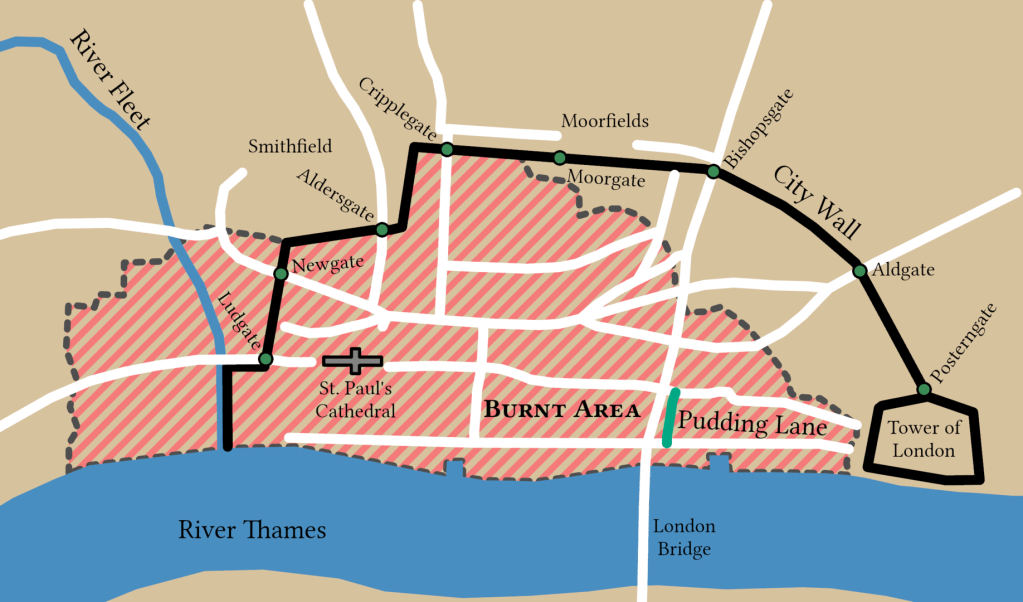
The map shows the final spread of the Great Fire across London. The area surrounded by a bold black line is the city surrounded by the ancient Roman-built walls. The locations of the various gates are marked. The fire originated in Pudding Lane indicated by a green line. The fire mostly drifted westward, driven by the wind, and spread to areas outside the walls. But – inside those walls – the greatest part of London was destroyed.
People:

Bald statistics do not, of course, tell the human story. In addition to loss of life (to which we’ll come next), the loss of homes was devastating. The majority of those forced to camp outside the city walls in fields, or living in primitive shelters among the ruins inside the city, really were homeless. They had no immediate means of rescuing their situation. There was virtually no such thing as house insurance. Besides, the large majority were renters. They didn’t know if their landlords had the finances to rebuild homes, if they’d wish to rebuild homes, and, even if they did, whether those homes would be leased to them. Meanwhile the refugees’ employment was largely gone. Some would be engaged in rebuilding projects, but for the foreseeable future the ordinary factory worker or tradesperson had lost their livelihood. Tens of thousands, then, were now utterly insecure with no idea how they’d survive.

Death toll

There are very varying ideas of how many died in the Great Fire. Numbers extend from a handful to a large multitude.

Official accounts written soon after the fire put the death toll in single figures. Some say four, others six or perhaps eight. And there are modern writers who would argue that people had time to escape so these numbers may well be accurate.

However, there are several reasons to be cautious about a very modest death toll:

  1. We should ask, ‘Were there reasons to understate the death toll?’ For example, perhaps the largely absent Lord Mayor Bloodworth[5] wished to play down the consequences of his failure of leadership. Other civic leaders – thinking of future investment in England’s foremost city – may have wanted to minimise the devastating consequences of the fire.
  2. The late 1660s was an age without anything like modern forensic science. No-one picked their way carefully through the ruins of thousands of fire-ravaged homes for skeletal remains. Perhaps, in any case, there would be virtually no remains. Those who choked and collapsed because of smoke or intense heat may well have been cremated by the intensity of the flames which swept through their property.
  3. Attributing deaths to any disaster is not simple. Issues of how, where and when someone died arise. To illustrate, think about a large battle during a war. When a death toll is stated, are we being told the number who died during the battle? Or does the death toll include those who were wounded, lived for several days or even a few months and then died of wounds sustained during the battle? Then what about those so severely scarred mentally by what they went through they later took their own lives? Defining one number for casualties is complicated. So it is with the death toll of the Great Fire. Are very low numbers of deaths referring only to those who died in the flames? If so, is it not better, for example, to include the large number who perished later because they were still camped outside the city walls when winter fell? Those poor people didn’t die in the fire, but they did die because of the fire.

So, how many deaths can really be attributed to the Great Fire?

Some modern historians still support a death toll in single figures, albeit accepting that some deaths would have been unrecorded, and that refugees also died later camped in fields. Another historian supports a number greater than the lowest figures but thinks it likely the total would not run into the hundreds. Neil Hanson draws attention to known deaths because of hunger and exposure during the cold winter after the fire. He also believes that while some foreigners and Catholics were rescued from mob-lynching, many violent deaths went unrecorded. Hanson also supports the theory that the heat at the heart of the firestorms was much more intense than an ordinary house fire, and thus able to near fully consume bodies. He believes that instead of four, six or eight the death toll was “several hundred and quite possibly several thousand times that number”.[6]

The writers of the Short History of the Great Fire of London podcast researched parish records for deaths before the fire, for the year of the fire, and then for a short time after the fire. They find anomalies in those figures, perhaps suggesting that the recording of deaths was unreliable. What I find even more enlightening is a comparison they make with deaths linked to the Great Fire of Chicago. The Chicago fire was not until 1871, but there are similarities with London’s 1666 fire – population size, density of wooden buildings, time of year, and presence of a strong wind. Deaths were more properly recorded in the late 1800s, and between 200 and 300 are attributed to the Chicago fire. Thus, the writers conclude, the London fire likely also resulted in several hundred deaths but probably not thousands.[7]

Given all the limitations of a major disaster in the 17th century, we will never know an exact number of deaths because of the Great Fire of London. My own view is that the low numbers are unlikely, but so are the extremely high guesses.

Planning a new London

Before the fire, the writer John Evelyn compared London to the grandeur of Paris and described Britain’s largest city as a “wooden, northern, and inartificial congestion of houses”. That’s a confusing mix of words, but he’s trying to describe how poorly designed and built London was. For Evelyn, the city was an unorganised sprawl of unattractive streets and homes.

Within days of the Great Fire ending, many – including King Charles II – determined the rebuilt London would be much better. The city would be redesigned, and homes built to a much higher standard.

Work began almost immediately to clear massive heaps of debris, almost all of it unusable. A special Fire Court[8] was set up to decide property disputes. Many of those were arguments between tenants and landlords about who should pay for rebuilding. Cases were decided quickly with verdicts based on ability to pay. Without the Fire Court legal issues could have lasted years and seriously delayed rebuilding.

Right from the start drawings of a new London flooded in. Many of the submissions were sent direct to the King. Some came from ordinary citizens with radical ideas, and some came from people with planning experience, including Christopher Wren. Most proposals involved a grid system of streets, a significantly different pattern to how London had evolved. There were also plans for boulevards and piazzas similar to those in French and Italian cities. Along with the drawings came bold and romantic statements of rebirth, that a marvellous new London would emerge from the ashes.

But almost none of that ever happened.

Wren’s plan, for example, failed because a very large number of property titles would have had to be redefined, an almost impossible task because land in London was owned by many people. Besides, no-one was willing to wait for complex plans to be assessed. With little building control, work had already started on building new homes on the scorched earth. People needed houses simply to survive. So London was rebuilt much as before.

However, some new regulations were imposed.

One of the reasons the fire had spread so easily and quickly was the density of the housing. There were almost no gaps between houses. Streets were very narrow, and roofs overhung so far they virtually joined with adjoining homes, even those on the opposite side of the road. Another reason the fire took such a strong hold was that most houses were made of wood which, when dry, was perfect fuel for the fire. So, the new construction regulations required all buildings to have at least a stone or brick facing. Streets must be widened and new pavements[9] built. Two new streets were created. No houses must obstruct access to the River Thames, and better wharves must be built there. The cost of building materials was regulated, as were the wages of workers. A deadline of three years for rebuilding was set; if not met, land could be sold. In the end most private rebuilding was done by 1671.

Supervision of much of the reconstruction was entrusted to a six-person committee, with Christopher Wren as the ‘Commissioner for Rebuilding’. Wren was born in October 1632, therefore still just 33 at the time of the Great Fire. Though his general plans for a new London were mostly rejected, he did design 51 new city churches and The Monument (more on which shortly). His most famous achievement was designing and overseeing the rebuilding of St Paul’s Cathedral. The excellence of Wren’s work was recognised with a knighthood on 14th November, 1673 (hence he had the title ‘Sir’ after that date).

Overall it took almost 50 years before the fire-ravaged area of London was rebuilt. It was 1711 until the reconstruction of St Paul’s was complete.

The Monument

Because the Great Fire of London was so momentous, a decision was made by the King to build a commemorative monument close to where the fire started. Some attribute the design work of a monument to Christopher Wren, others to surveyor Robert Hooke – very likely they combined their skills. Work began on a Doric column in 1671 and it was completed in 1677. Known simply as The Monument, it stands 202 feet tall (61.5 metres) and is located exactly 202 feet from where the fire began in the Pudding Lane bakery. At the very top is a drum and copper urn from which flames emerged, symbolizing the Great Fire.[10]

On the column were sculptures and engravings telling the story of the fire. In 1681 a plaque was added attributing blame for the fire. An official enquiry determined the Great Fire  was due to “the hand of God, a great wind, and a very dry season”, but, with anti-Catholic feeling running high, the inscription on The Monument put the blame on the ”treachery and malice of the Popish faction”. The inscription was removed in 1830.

Fire Insurance and Fire Brigade

The Great Fire made people think more seriously about better fire safety and the cost of repairs. In 1680 Nicholas Barbon set up the ‘Fire Office’, an insurance company.[11] Other similar companies were soon established.

By 1700, those fledgling companies had the common sense to realise it was probably cheaper to extinguish fires than pay for repairs. They set up their own fire brigades, and had plates fastened to houses naming which company insured that property. If a fire brigade of another company put out the fire, the insurers had reciprocal arrangements so the correct insurer would cover the cost.

Eventually even more common sense prevailed. The most efficient fire-fighting system would be one unified force covering the whole of London. So, in 1833 the London Fire Engine Establishment was founded. There were numerous fire stations across the city, each providing 24/7 coverage. Floating engines were built for The Thames to tackle fires in the docks.

Now known as The London Fire Brigade, it has become one of the largest firefighting and rescue organisations in the world. It employs more than 5000 people, and in 2022 dealt with 125,390 incidents, of which 19,297 were fires.

The plague

The Great Plague (or Black Plague) began to spread in early 1665. It was deadly, and the number of victims rose quickly. In London about 15 per cent of the population died in the plague’s first year. That could be as many as 75,000 deaths, a huge number.

There were plague victims also in 1666, then in September the city was consumed by the Great Fire. And afterwards the Great Plague faded away. Why? The obvious conclusion is that the insanitary houses – overrun with rats and fleas which spread the plague – were gone, so the epidemic was halted. The tragedy of the Great Fire eradicated the tragedy of the Great Plague.

Except it didn’t. Sometimes an obvious conclusion is a wrong conclusion.

The Museum of London says that the idea that the Great Fire stopped the Great Plague is the most talked about myth they hear.[12] It’s nice to think there was a silver lining to the Great Fire. But the idea isn’t true. The Museum lists five reasons:

  1. The Great Fire burned only about a quarter of the overall London metropolis. It could not have killed off the plague for the whole ‘Greater London’ area.
  2. Houses built after the fire had stone or brick-faced walls, but hygiene and sanitation did not significantly improve.
  3. Areas where the plague was worst – Whitechapel, Clerkenwell, Southwark – were not affected by the fire.
  4. The number of plague-related deaths was already declining long before the fire.
  5. People in London still died from the plague after the Great Fire was over.

 The Great Plague’s major death toll occurred during 1665-66, and the Great Fire broke out in September 1666. So it’s not surprising that the second is assumed to have eradicated the first. But that is a wrong assumption. The Museum says: “We are still not sure why the plague did not return to our shores after it faded out in the 1670s but it wasn’t due to London’s 1666 fire”.

The lust for vengeance

During the Great Fire, anger became rage and rage became a lust for vengeance. In the minds of many, the destruction of London could not be an accident. Farriner protested long and hard that the fire did not start in his bakery. He had double checked his ovens before he went to bed. Many were willing to believe him. A fire like this had to be a deliberate attack. A Parliamentary investigation blamed the fire on the hand of God, the strong wind, and the dry season, but those reasons were not enough. Enemies of London and of England were surely responsible. Blame was directed at Catholics and foreigners.

The anger was fed by homelessness and near starvation. Camped outside London while autumn temperatures dropped, people were dying. Evelyn wrote: “Many (were) without a rag or any necessary utensils, bed or board… reduced to extremest misery and poverty”. The King, Charles II, was so afraid these refugees would rise against the monarchy, he ordered daily supplies of bread to be brought to the city and new markets created.

Charles went even further, encouraging people to move away from London and ordering neighbouring towns and cities to permit incomers to engage in their trades in these new locations.

These were good measures, but still thousands suffered. The mood was volatile. For those living in and around London there was an overwhelming longing to hit back at those responsible for their misery. Before the fire had even been fully extinguished, a rumour spread that French and Dutch troops were approaching. Londoners would not wait to be slaughtered, so mobs rushed through the streets attacking foreigners. Soldiers had to intervene to stop the violence.

In the months following, the lust for vengeance was undiminished. It was inexcusable to attack people simply because they were foreigners, but Londoners were traumatised and panicked. As still happens today, the general population didn’t entirely trust official statements from central authority, in their case from the King. And – with no press or TV or internet – they were fed a strong diet of rumours. And since the only rumours worth spreading are those which are frightening or threatening, people became terrified and angry.

As well as rumours there was (what we now call) ‘fake news’. The official parliamentary enquiry into the fire[13] heard evidence from many people, including those who suspected the Dutch or French or Catholics. The committee recorded everything that was said, but rejected the suspicions of arson and ruled that the fire was an accident made worse by the strong wind and dry season. But someone collated the testimonies of those who blamed foreigners, made those statements into a pamphlet, and leaked it to the public. By now it was obvious there was no Dutch or French invasion, so the story spread that shadowy Catholic agents had started the fire.[14]

In fact, a man who swore he was Catholic had already been arrested, tried and executed. His name was Robert Hubert.

Hubert was a watchmaker who originated from Rouen in France. He had come to London, but, as he headed later for east coast ports, he was stopped just outside the city. Authorities questioned him. Hubert admitted he was a member of a gang, that the fire was a French plot, and he had started the fire. He was charged, and imprisoned in one of the unburned jails.

There are several reports that Hubert was not fully able to explain himself. Some have said he was simple-minded, and may not have realised the implications of his confession, or had imagined the story he told. It’s also possible he was tortured.

Hubert’s story was inconsistent. Originally he said the French gang was 24, but then he dropped the number to just four. He stated that he started the fire in Westminster, but then learned no fire had ever reached there. Where the fire actually began was mentioned to him, so his story changed to how he had thrown a fire grenade through an open window of the Pudding Lane bakery.

He was brought to trial in October 1666 at the Old Bailey courts. There were doubts about his evidence. Some said he had not even been in London when the fire started. He insisted he was a Catholic, but those who knew him said he was Protestant and a Hugeunot.[15] His story of throwing a grenade through a window was nonsense, because the bakery in Pudding Lane had no windows. Besides, Hubert was crippled and incapable of throwing a grenade. The Lord Chief Justice, who presided over the trial, said Hubert’s confession was so disjointed he couldn’t possibly believe him guilty. But Hubert insisted he was guilty. McRobbie says that put officials in the strange position of trying to prove he hadn’t done what he said he did. But Hubert was adamant that he had started the fire, so was found guilty and hanged at Tyburn on 29th October, 1666.

Hubert was innocent. Evidence soon emerged from the captain of a Swedish ship that he had been on that ship in the North Sea when the Great Fire started. He did not arrive in London until two days after that. He was not a Catholic, not a member of a French gang, and certainly had not started the fire.

Perhaps the strength of his confession meant a guilty verdict had to be given. Perhaps people thought that convicting Hubert would end the rage of the crowds. Perhaps Hubert wanted to die. Apparently his life had been miserable, and he wanted to end it. In that case, to use a phrase of McRobbie’s, Hubert committed ‘suicide by confession’.

Anti-Catholic sentiment and suspicion of foreigners continued for many years. Negative feelings do not change quickly, as many today would still testify.

Eleven curious details

One  In 1681 a plaque was placed in Pudding Lane blaming ‘Papists’ for the Great Fire. In the mid-1700s it was removed. Why? Had people realised Catholics were not to blame? No. It was taken down because people stopped to read the wording and that caused a traffic hazard.

Two  The Monument was designed with a 311 step internal staircase leading to a viewing platform, so Londoners could see their city being rebuilt. A mesh cage was added to the viewing platform in the mid-19th century because people had committed suicide by jumping. Some 100,000 people each year continue to climb to the viewing platform.

Three  In 1986 – 320 years after the Great Fire – the London members of the Worshipful Company of Bakers apologised to the Lord Mayor for the fire. They placed a plaque in Pudding Lane acknowledging that one of their own, Thomas Farriner, was in fact guilty for causing the Great Fire.

Four  Sir Christopher Wren’s range of professional interests included astronomy, optics, cosmology, mechanics, microscopy, surveying, medicine, meteorology. He was also an inventor of scientific instruments.

Five  Wren began studying architecture in Paris in 1665. By the next year he was back in London, where he drew his first design to improve the rapidly decaying (Old) St Paul’s Cathedral. One week later the Great Fire began in Pudding Lane on Sunday 2nd September. On the evening of Tuesday 4th September embers landed on St Paul’s and before morning the building was gone. Wren’s masterpiece, the new St Paul’s Cathedral, was completed in 1710.

Six  Sir Christopher married twice. Though neither wife lived long there were two children from each marriage. Wren died aged 90 years, and of these years was married for only nine.[16]

Seven  Though Wren’s designs for a new-look London were never implemented, he was honoured in 2016 (the 350th anniversary of the Great Fire) with a Royal Mail stamp illustrating him presenting his plan.

Eight  A central shaft in The Monument was created as a scientific instrument for the Royal Society. It included a telescope and a space to enable experiments on gravity. However, the vibrations of nearby heavy traffic spoiled those experiments which were soon discontinued.

Nine  On Wednesday 5th September, 1666 – the fourth day of the Great Fire – the diarist Samuel Pepys witnessed a cat being rescued from the ruins of the fire ravaged Royal Exchange. He wrote: ‘I also did see a poor cat taken out of a hole in the chimney… with the hair all burned off the body, and yet alive’.[17]

Ten  St Paul’s Cathedral famously survived the ‘Second Great Fire of London’, the World War II London blitz with incendiary bombs.

Eleven  John Evelyn summed up what the Great Fire had done to his city in six words: ‘London was, but is no more’.

Lessons from the Great Fire

There have been many lessons as the story has unfolded:

  • Something small, such as one spark, can have massive consequences
  • The unimaginable should have been imagined, and preparations made
  • Clear and decisive leadership is vital to deal with a catastrophe
  • How ready people are to find someone to blame, and take the law into their own hands. The sad truth is that people want villains and want vengeance.
  • Sometimes you can’t wait for permission; you must act now. That’s what happened when the garrison at the Tower of London used gunpowder to demolish houses between the fire and the Tower. They’d waited for help which never came. So, before it was too late they took responsibility for halting the flames, and thus saved the Tower.
  • Nowhere is immune from harm. Many thought the stone-built St Paul’s Cathedral was safe so they put all their possessions inside. That was a bad decision. The Great Fire was greater than the resistance of the cathedral, and the building and everything inside was lost.
  • Often you can’t control an outcome. The best firefighting efforts did not stop the Great Fire. What halted its spread was that the easterly wind subsided. The flames were no longer driven westward, thus providing an opportunity to extinguish fires.

Here’s my final lesson. I began this series by saying one spark from a fire left smouldering under an oven caused the Great Fire. Just one spark cost vast amounts of property to be destroyed, many lives lost, and a huge financial cost to rebuilt London.

We neglect the small or ordinary things of life at great peril. Those seemingly small things can be personal, like time with family or looking after our health. They can be the background factors when running a business, like getting to know colleagues or being careful about contracts. They can be the affairs of state or global relationships, such as misunderstanding or neglecting an issue, or threat, or contrary voice.

There’s a saying that large doors swing on small hinges. Extremely large consequences flow from small, seemingly unimportant matters.

Bad things will always happen. But some can be avoided by careful attention to details, by preparation for worst case scenarios, by wise and decisive leadership, and the other lessons taught to us by the Great Fire.


My major online resources for this series on the Great Fire are listed at the foot of the first episode. See https://occasionallywise.com/2023/01/28/great-fire-of-london-1/


[1] https://occasionallywise.com/2023/01/28/great-fire-of-london-1/

[2] https://occasionallywise.com/2023/02/10/the-fire-that-changed-the-weather/

[3] https://occasionallywise.com/2023/03/18/the-great-fire-defence-and-disaster-but-the-end-is-nigh/

[4] Some record that the remains of some buildings continued to smoulder for several months.

[5] Bloodworth’s failings are detailed in the first episode of this series, https://occasionallywise.com/2023/01/28/great-fire-of-london-1/

[6] Hanson, Neil (2001), The Dreadful Judgement: The True Story of the Great Fire of London. Doubleday.

[7] Details of the Short History of… podcast are given at the end of part 1 of this series.

[8] The Fire Court operated through most of 1667 and 1668, and again between 1670 and 1676.

[9] Pavements = sidewalks in America.

[10] Details from the website of The Monument – https://www.themonument.info/history/introduction.html

[11] These details and others to follow from the Museum of London: https://www.museumoflondon.org.uk/discover/great-fire-london-1666

[12] Details here and following from https://www.museumoflondon.org.uk/discover/three-myths-you-believe-about-great-fire-london

[13] The official investigation began just over three weeks after the Great Fire started.

[14] Information here and following predominantly from Linda McRobbie’s excellent article: https://www.smithsonianmag.com/history/great-fire-london-was-blamed-religious-terrorism-180960332/

[15] Hugeunots were certainly Protestant, and many fled France to avoid Catholic persecution.

[16] From: https://en.wikipedia.org/wiki/Christopher_Wren

[17] Museum of London: https://www.museumoflondon.org.uk/discover/cats-in-museums-feline-history-london
The Great Fire: defence and disaster, but the end is nigh

The Great Fire of London began in the early hours of a Sunday morning. By Tuesday you’d expect the fire would have been extinguished or simply died down. You’d be wrong.

In fact dawn on Tuesday heralds the day of greatest destruction. The fire spreads faster. More houses than ever are consumed. And buildings burn to the ground which no-one thought could even go on fire.

Why?

Primarily because a major fire in the 17th century was very different from a major fire now.

Our modern assumption is that, with time, a fire will be beaten. We have fire brigades staffed by fully trained firefighters. They have excellent equipment, such as high pressure hoses, extending ladders, protective suits, breathing apparatus, and even drones. And fire hydrants provide near-endless water supplies. Also, many buildings don’t burn easily because they’re constructed with fire-retardant materials, fitted with early warning smoke alarms, and sprinkler systems are installed in their ceilings.

The realities of September 1666 were nothing like those. Citizen firefighters threw buckets of water on fires, and used hooks to tear down walls. At the height of the Great Fire neither of those methods were possible because the heat was so intense no-one could get nearer than 100 yards (91 metres).[1] London’s houses were the exact opposite of fire-retardant – after a warm, dry summer the thatch-covered wooden homes were perfect fuel; they caught fire easily and burned quickly. What made every challenge much worse was the exceptionally powerful east to west wind, fanning the flames and spreading embers to neighbouring streets.[2]

So, in 1666, as long as there were houses not yet ablaze, the fire could spread. And on that Tuesday the fire did.

Here’s one example. One of the rivers flowing through London is the Fleet. The river is how Fleet Street – the one time centre of the newspaper industry – gets its name, but today the river is almost entirely underground. In the 17th century, the Fleet was a sizeable river, and therefore a natural firebreak. It flowed about a mile west of Pudding Lane where the fire started.

Early that Tuesday morning, the Duke of York (James, the brother of King Charles II) stations his ‘firemen’ beside the river, determined to stop the fire’s progress. It will not pass this point. But the fire has a different plan. Driven by the gale, sparks fly high in the air, cross the river, and start new fires to the side and behind the soldiers. Now their lives are in great danger. All hope of halting the fire is abandoned and the Duke and his troops run to save their lives.

The soldiers are not the only ones trying frantically to escape the fire. The mass of London’s ordinary citizens, and the wealthy, upper classes, become very aware a fast-moving inferno is raging while they are imprisoned with it behind solid stone walls. Those ancient Roman-built city walls surround them on three sides with the River Thames on the fourth. The fire is spreading fast. It is clearly beyond anyone’s control. They must get outside the city walls. Citizens pack whatever they can carry on their backs and head for the city gates. The affluent are desperate not only for their lives but also for their valuable possessions. For those they need carts or wagons, and that generates opportunistic commerce. Prices for hiring a cart soar. A charge of a couple of shillings before the fire now becomes £40, equal to more than £133,000/$161,000 in today’s money. And the desperate demand to transport possessions creates new employment as the poor of the city hire out their labour as porters. Some load themselves with wealthy goods and are never seen again.

The mood now is panic. Throngs of people along with many horses and carts push towards each of the city gates. Those gates are narrow since part of their purpose is to protect the city from invading armies.[3] Narrow gates cause no problem for casual traffic in and out, but they soon block when huge numbers try to flee at once.

Then a difficult, dangerous situation gets worse. The crowds at the gates are frightened, and their fear quickly turns to anger. Some push even harder. There is a serious danger that people will be trampled under feet, hooves or cart wheels. That concerns the city magistrates. But those officials are also worried about something else. They need people to stay and fight the fire, not flee to safety in nearby fields. So they take the remarkable step of ordering the city gates shut. No-one is to leave. They must turn back and tackle the flames, “that, (with) no hopes of saving any things left, they might have more desperately endeavoured the quenching of the fire”.[4]

The magistrates’ reasoning is delusional. The hordes at the city gates will never go back. The city is an inferno. They have nothing with which to fight the fire. They cannot save a single building, but could lose their lives, their children’s lives, and what remains of their possessions. No-one turns back. There is near rioting at every gate. Before long the magistrates see sense, and order the gates reopened so people can escape the burning city.

As the Great Fire rages on two major buildings are threatened: the Tower of London and St Paul’s Cathedral. One is successfully defended; the other burns to the ground.

Defence

Fires burn strongly through Tuesday morning. The Duke of York’s firefighters are ruthless in tearing down properties to create firebreaks. With the King’s authority, they’re permitted to destroy private property, and now they do it on a larger scale. On the north edge of the fire, they create a massive firebreak, one they know the fire cannot jump. But they’re wrong. Still fed by strong winds, burning embers fly across the gaps, and the Great Fire continues its relentless march.

Then the fire does something wholly unexpected, something seemingly impossible, something deadly dangerous – it moves east. The gale has blown for more than two days east to west, and therefore pushed the fire westward across the heart of the old city. But now, with no change in the wind, from the fire’s origins in Pudding Lane flames spread in the other direction from one house to another.

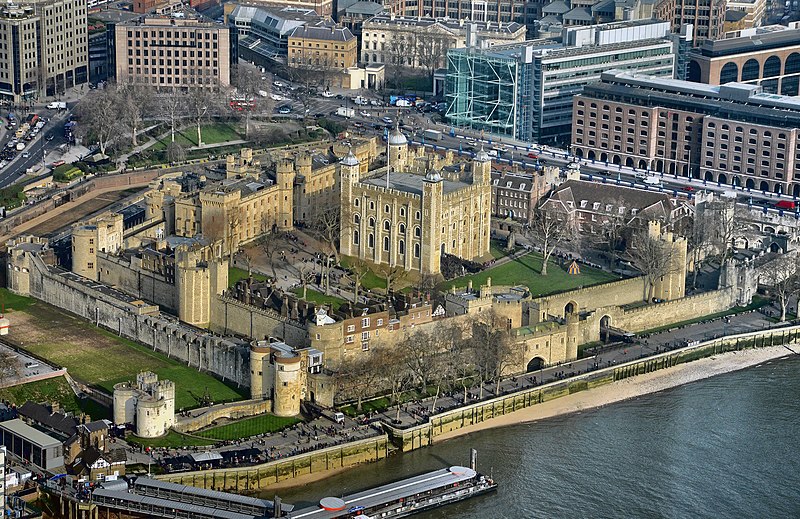
The Tower of London as it is today.
[Duncan] from Nottingham, UK, CC BY 2.0 https://creativecommons.org/licenses/by/2.0, via Wikimedia Commons

That is critically dangerous for one of London’s most prominent buildings, the Tower of London. The Tower is a military establishment, part of the city’s defences against invaders. Inside are barrels of gunpowder weighing some 600,000 lbs (272,155 kg). It’s the largest stockpile of gunpowder anywhere in the country. Massive heat alone could cause that gunpowder to ignite without the fire even getting close. The blast will destroy the Tower and nearby London Bridge. And, writes John Evelyn later, the detonation would have “sunk and torn all the vessels in the river and rendered the demolition beyond all expression for several miles about the country”.

Until now no-one at the Tower of London has been alarmed. Many times fires have started but quickly died down. Besides, the Tower is a major stone stronghold. No fire could harm the buildings or its occupants. But, as the fire raged through the city during Sunday and Monday, and now into Tuesday, the Tower’s garrison recognises this fire is very different. Despite the wind, the flames are coming their way. And they are very afraid.

The Tower of London is in fact a castle. The word ‘tower’ in the name comes from the White Tower, one of its oldest and most prominent buildings. (There are more details on the Tower of London in the footnote below.[5])

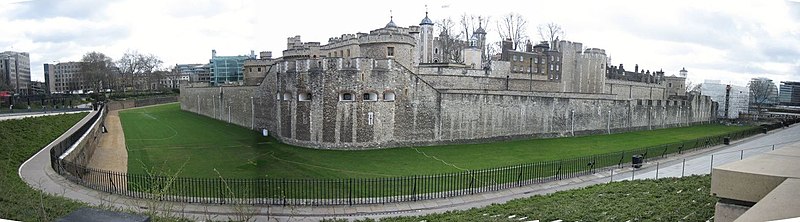
In the 13th century the initial castle walls were supplemented by outer walls, known as curtain walls. They were built behind a wide moat and a short distance further out than the walls around main buildings. Together the moat and curtain walls would be a near insurmountable barrier halting invaders getting near to the castle. So surely they would stop any fire threatening the Tower of London.

For many centuries, the landward side of the Tower of London has been protected by its curtain walls – the outer walls shown here are set apart from the inner walls.
Joy, CC BY 2.0 <https://creativecommons.org/licenses/by/2.0&gt;, via Wikimedia Commons

Except perhaps not this fire. Steadily it moves east, ever nearer to the Tower. The garrison inside know that other stone buildings – even the massive Baynard’s Castle – have been ruined by the fire. And their situation is much more perilous because of those massive stocks of gunpowder. They are almost literally sitting on a massive explosion.

Desperate requests for help are sent to James II. His men are needed today – right now – to save the Tower of London. But the firefighters never come. Every one of them has been sent west. All the assumptions are that new blazes will start where the wind blows the flames. No-one thought the flames could move east. But they do. And a catastrophe at the Tower of London is imminent.

The commanders wait and wait for firefighters until they dare wait no longer. Finally orders are given for gunpowder to be taken from the stores, planted in houses between the castle and the fire, and ignited. Those homes are privately owned, and the Tower’s soldiers have no authority to demolish them, but this is an extreme emergency.

With gunpowder placed inside dozens of houses, the order is given to detonate. The explosion is massive. Homes are blown apart, debris scattered over long distances. Above the noise of the fire, London’s citizens hear the blasts, many thinking the Tower itself is now in smithereens. But it’s safe. In fact a massive firebreak has been created, a gap so wide the fire cannot cross it. The London Gazette later reports that the fire came almost to the very gates of the Tower, by which they likely mean close to the curtain walls. But it came no further. The magazines of gunpowder inside are saved. The spread of the fire to the east is stopped.

Disaster

But it’s not stopped on the west, not where St Paul’s Cathedral sits on Ludgate Hill. The location is not close to Pudding Lane, where the fire began, but distances are not large in the city, and the wind is still driving the blaze steadily westward. Now it’s near to the cathedral.

An engraving of Old St Paul’s as it looked before the fire of 1561 in which the spire was destroyed. 
Francis Bond (1852-1918)Anton van den Wyngaerde (1525-1571W.H. Prior, Typographic Etching Co, Public domain, via Wikimedia Commons

The cathedral is the fourth church dedicated to St Paul to sit on that hill. Like many cathedrals in medieval times, it was constructed over a long period of time (from 1087 to 1314) and frequently altered later. The old cathedral was a very impressive structure, close to being the longest church in the world, and with one of the tallest spires. The beauty of its stained glass windows earned them a mention in Chaucer’s The Canterbury Tales. The length and beauty of its nave was particularly remarkable. It soon became known as ‘Paul’s walk’.

Pilgrims came from far and near to visit a shrine inside the cathedral, admiring its decoration with gold, silver and precious stones. Monarchs held occasional court sessions in the cathedral. There was at least one riot, but also royal weddings. Kings lay in state before their funerals. Bishops and nobles were entombed there.

Old St Paul’s, however, seemed to lose its spiritual focus. Paul’s Walk became a gathering place and even a marketplace in the late 1300s. The bishop had to circulate an open letter denouncing the selling of goods, firing stones and arrows at nesting birds, and those guilty of ‘playing at ball’ and breaking expensive painted windows. From then on, such perpetrators would be excommunicated.

The nave of (old) St Paul’s, known as Paul’s Walk.
Wenceslas Hollar – St. Paul’s. The nave (State 1)jpg: Wenceslas Hollar, restored by Bob Castle derivative work: Bob Castle, Public domain, via Wikimedia Commons

But many London citizens did nothing more stirring than use the ‘Walk’ as a gossip centre. In the pre-printing press age, news was shared verbally and ‘Paul’s walkers’ visited simply to stay up to date with what was happening, mostly sharing information related to commerce and state business. Some historians say that by the 1600s: ‘Infested with beggars and thieves, Paul’s walk was also a place to pick up gossip, topical jokes, and even prostitutes’.[6]

But spiritual fervour was not the only thing to deteriorate at the cathedral. By the 16th century the building’s structure was in a seriously poor condition. Partly that was due to post-Reformation action against religious centres. Partly it was simply because St Paul’s was poorly constructed in the first place.

In 1561 the near record-setting tall spire was gone. It caught fire and crashed right through the roof of the nave, the main central area of the cathedral. Blame was quickly attributed to a lightning strike which set the spire on fire, melting the bells and the spire’s lead covering, which then flowed like lava on to the roof, destroying it. Catholics and Protestants blamed each other for displeasing God.

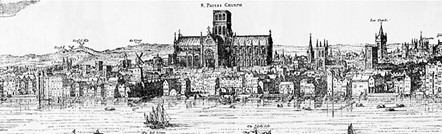
St Paul’s, set on Ludgate Hill, as it was shortly before the Great Fire. The spire no longer exists.
Claes Van Visscher, Public domain, via Wikimedia Commons

The spire was not rebuilt, and repair work on the roof was of a very poor standard. Within a few decades the roof was in danger of another collapse. When Charles II became King, he determined to restore the condition of St Paul’s. He had the very man for the job, Sir Christopher Wren. Wren surveyed the building, and, finding its whole structure unsatisfactory, recommended that the building should be completely demolished. That solution was opposed by both clergy and citizens. Wren relented, and instead proposed restructuring walls and creating a dome to replace the existing central tower.

Though debates about repairs still raged, a beginning is made in the early 1660s, and St Paul’s is covered with wooden scaffolding. And now, in 1666 with the Great Fire raging, the stone cathedral which would never burn is packed with the goods of local businesses, including the stocks of printers and booksellers from Paternoster Row. Wealthy citizens have brought in their money, paintings, valuable furniture, fine wines, gold coins. And a miscellany of ordinary, nearby residents have carried inside whatever they consider important. But what they’ve all done is put their possessions inside a building wrapped in highly flammable wood.

The sun sets, but there’s no darkness because the Great Fire has arrived.

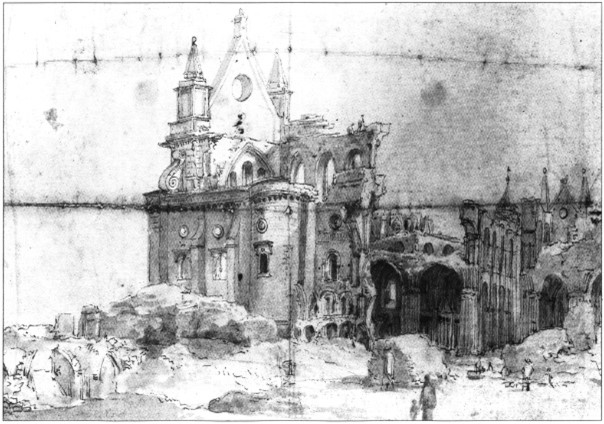
Remains of the Cathedral after the fire drawn by Thomas Wyck, c. 1673
Thomas Wyck, Public domain, via Wikimedia Commons

People hope St Paul’s will be spared because it’s a house of God, and because a wide plaza separates it from nearby homes. Their hopes are dashed. Nothing stops this fire. Around 8.00 pm burning embers settle on the scaffolding. It’s dry, and the heat as the fire approached has made it easily combustible. The wood bursts into flame, first here and then there, fire spreading from spar to spar. Soon the whole exterior of the cathedral is alight. The intensity of the blaze melts the lead remaining on the roof. Thick stones crack and break apart with loud bangs that many think are gunfire. The building is collapsing. If those sheltering inside stay they’ll die. Wisely they abandon their goods and run to save their lives. Within a few hours St Paul’s is no more.

The contemporary writer John Evelyn said that what remained was no more than a ‘sad ruine’ with very little still intact, He adds: ‘It was astonishing to see what immense stones the heate had in a manner calcin’d’[7] That included the stationers’ books which are still burning a week later.

St Paul’s Cathedral is destroyed. Wren’s dome will have to wait.

The end is nigh

Crowds watch St Paul’s burn to the ground. What they don’t know is that St Paul’s is the last major building to become a victim of the Great Fire. During the night between Tuesday and Wednesday, the easterly wind which has driven the flames finally eases.

It is the change everyone has longed for. If the fire is no longer driven from one building to the next, there is a chance it can be beaten, or even that it’ll just burn out. In fact, both those things happen during Wednesday.

No longer do embers soar over gaps and no longer is there fresh fuel for the fire to burn. Certainly, the close proximity of houses might still have allowed a slow spread of the flames, but now, without the strong wind, the creation of firebreaks actually works.

The Duke of York’s exhausted and demoralised teams of firefighters rally. They have a real chance of stopping the fire from spreading. Furiously they tear down houses. Some they blow up. There is a new ruthlessness in creating very wide firebreaks, gaps which would not be bridged by the flames. And it succeeds.

The spread of the Great Fire ends, and on that Wednesday – the fourth day – burning diminishes and by dawn the next morning the fire is practically out. Small fires continue for a while –  coal still burns in cellars for two months – but the battle is won.

Probably some celebrate, but most mourn. The diarist, Samuel Pepys, climbs a church steeple to assess the destruction, and records that it was “the saddest sight of desolation that I ever saw”. Tens of thousands have lost their homes. Some camp in any area of the city the fire has not burned, and many more settle in the fields outside the walls. Their next phase of suffering is just beginning. John Evelyn sees people huddling under makeshift tents, and writes: “Many were without a rag or any necessary utensils, bed or board … reduced to extremest misery and poverty”.

In the final part of the story of the Great Fire, we’ll learn much more about the aftermath of the fire, including the number of casualties, plans to build a new-look London, and what happened to the man convicted of starting the fire even though authorities knew he hadn’t.


My major online resources for this series on the Great Fire are listed at the foot of the first episode. See https://occasionallywise.com/2023/01/28/great-fire-of-london-1/


[1] Here and in various other places there are details drawn from History in Numbers, https://historyinnumbers.com/events/fire-of-london/

[2] Burnt paper was later found 20 miles away, and scorched silk 30 miles away.

[3] I described the city gates in the previous episode of this series: https://occasionallywise.com/2023/02/10/the-fire-that-changed-the-weather/

[4] Some of the information in this section from Wikipedia: https://en.wikipedia.org/wiki/Great_Fire_of_London

[5] Work on building the White Tower is thought to have begun in 1078, but the origins of the overall Tower of London are earlier. William the Conqueror was victorious in the Battle of Hastings in 1066, and then pressed further into England, that is into ‘enemy territory’. He ordered many castles to be built, and he particularly wanted to overawe citizens of its largest city, London. Hence he would have a large fortification there, predominantly of stone, on the south-east corner of the ancient Roman walls. The old walls would be part of its defences, and the River Thames immediately to the south would give further protection.

[6] Wikipedia: https://en.wikipedia.org/wiki/Old_St_Paul%27s_Cathedral

[7] He’s referring to ‘calcination’ which, in his day, referred to reducing an object to its base elements.

One spark, and fire consumes a city

Just one spark. Probably the embers in the baker’s oven aren’t fully extinguished, the spark sets fire to nearby kindling material, and flames spread to wooden furniture and walls. Within minutes the whole ground floor is alight.

It’s 1.00 am and upstairs from the bakery Thomas Farriner is sound asleep. Thankfully his son is not. He smells smoke, and runs to wake his father. For a moment Farriner is disoriented. He cannot understand what his son his saying. Then he too smells the smoke. He leaps from his bed and runs downstairs, but is met by a wall of smoke and flame. There is nothing he can do to halt the fire. The house has two storeys above the ground-level bakery. Farriner’s wife Hanna died in 1665, and his daughter Mary is married. But his other two children, Thomas and Hanna, are in the house. He gathers them and the maidservant. Their only hope is to go up.

It’s September 2nd, 1666, the bakery is in Pudding Lane, and the blaze there is the beginning of the Great Fire of London.

Farriner’s house – as almost every home in mediaeval London – is made entirely of wood. The late summer has been warm with no rain. The dried out wood is perfect fuel for the fire which is spreading fast. If the family don’t escape quickly, they’ll die when the flames reach them or the house collapses.

Farriner forces open an attic window. He climbs out onto the thatched roof, reaches back and pulls his children after him. He crawls to the edge of the roof, but he’s now in great danger of falling to his death on the street below. At upper levels, houses in Pudding Lane extend over the street, almost touching the houses opposite. Farriner can reach across to the butcher’s home across the street, gets his attention, and with his help Farriner and his children clamber over to safety. But not their maid. She’s still in the attic, terrified by the fire below yet too frightened of falling to climb out the window. Farriner’s maid is the first to die in the Great Fire.

This is part one of a multi-episode account of the Great Fire of London. We’ll see why fire in one house spread quickly to others, why fire-fighting attempts proved futile, how city leaders failed, and later how prejudice led to severe violence against immigrant Londoners, why the fire finally stopped, and how the building of a new London began. And much more.

Before picking up the story of the fire again, there are six background facts worth knowing in order to understand why and how events unfolded as they did.

First, London was a very large city. The population in the 1660s is estimated between 350,000 and 500,000. That’s immense for its time, around ten to fifteen times the size of other British cities. It made London likely the largest city in Europe and the third largest in the western world. Behind the old Roman walls, in the mediaeval city, a huge population lived in overcrowded streets, their houses virtually touching each other. A ring of suburbs surrounded the old city, including the independent City of Westminster.[1] A fire could spread easily and widely.

London as it was drawn by Claes Visscher in 1616. The old St Paul’s Cathedral is left of centre. London Bridge over the River Thames is in the lower right. The bridge is covered in tenement housing, much of which was destroyed in a 1633 fire. The only reason the 1666 fire did not cross the bridge was because that housing had not been rebuilt.

Second, because homes were made of wood, thatch, and doused in flammable pitch, they could catch fire easily and be completely consumed by flames within minutes. Many also stored highly flammable hay and straw. And the ‘jetties’ – the overhanging upper storeys – meant fire in one easily spread to others. But the houses were built like that because wood was a relatively cheap building material, and tax was paid only on the ground level footprint of a home, not its overall size. Officially that kind of structure was banned, but the law was not enforced by local officials, so oversized wooden homes continued to be built.

Third, fire-fighting methods were primitive by modern standards. There were essentially two techniques.

  • The first was water. There was plenty of water since the River Thames was close to Pudding Lane, but the ordinary citizens had only leather buckets which held little water and took time to get to a fire. There was no modern-style fire brigade, but London had ‘fire engines’. However, they were little more than large barrels mounted on sleds with a spout to spray water towards flames – that is, if the heat even allowed you to get close. Only some sleds had wheels, and, being immensely heavy, they were hard to haul through the streets, and doubly difficult among panicking crowds. During the Great Fire several toppled into the Thames while refilling and were lost.
  • The second technique involved partial or total demolition of homes to create firebreaks. Firehooks could pull burning thatch off a roof, and even tear down a wall. They were relatively effective. More extreme but also useful was gunpowder. Blowing up houses completely could create a larger firebreak, successful unless the fire found some way to jump across.

Buckets of water, axes, ladders, water squirts and firehooks were stored in local churches. But access to them was difficult in the early hours of the morning, and these tools were inadequate once the fire had spread.

Fourth, the Great Fire spread rapidly because of a persistent strong wind blowing east to west. Those who fought the fire couldn’t keep pace with the rapid progress caused by that wind. It also explains why burning embers drifted across firebreaks.

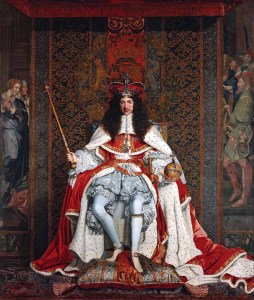
Charles II at his coronation in 1661, painted by John Michael Wright

Fifth, the governance of London failed its people when the fire erupted. London, like most English cities and towns, was managed by aldermen and a Lord Mayor. London, though, was also the location of Parliament and of the king, and that complicated matters. Here’s the super-short background. The English King Charles I was beheaded in 1649 during a period of civil wars between monarchists and parliamentarians (republicans). Under the leadership of Oliver Cromwell, reforms had taken place, but he died in 1658 and his son Richard who followed was significantly less able. Another king was needed, and Charles II came to the throne in 1660. Thus began what was called the ‘Restoration’, a period of social change which included reopening theatres (closed under the puritanism of Cromwell) and flourishing of literature. Charles II was relatively popular, and was nicknamed the ‘Merry Monarch’.[2] However, not all welcomed the restoration of the monarchy. That was particularly true in predominantly parliamentarian London, and resistance to rulership or interference by the king played its part in mismanagement of the Great Fire.

Sixth, England and the Dutch Republic were in conflict over extracting precious minerals and gold from West Africa, and that had worsened into a mainly naval war. Foreigners in London from European countries were increasingly distrusted. As we shall see, they became prime suspects for starting and spreading the fire.

But it’s in Farriner’s bakery in Pudding Lane that the fire starts in the early hours of Sunday 2nd September, 1666. Farriner is sometimes described as the king’s baker, but that’s correct only because he supplied baked biscuits to the Royal Navy. The street name Pudding Lane sounds odd in modern ears, especially for those who use the word ‘pudding’ as a near-equivalent to ‘dessert’. But pudding in those times was offal, the entrails and internal organs of an animal, material often discarded and eaten by birds or dumped into rivers like the Thames. Pudding Lane acquired its name because a great number of butchers’ shops were located there. In fact many trades were in Pudding Lane, so it was a street in which people stored tar, rope, oil, brandy and other goods that burned easily. It was the worst place  for a fire to start.

With the word ‘Fire!’ shouted loudly, parish constables arrive. In the first hour, the flames consume only a few shops and houses. But it must not be allowed to spread further, especially to warehouses alongside the nearby River Thames because they store highly dangerous materials, including lamp oil, tallow[3], spirits, and gunpowder.

The constables decide that homes on either side of those burning must be torn down to create a firebreak. But they lack the authority to demolish private property. The Lord Mayor, Sir Thomas Bloodworth,[4] does have that authority and he is soon on the scene. But he makes two fateful decisions. First, he will not allow soldiers to help. The aldermen to whom he answers were parliamentarians in the civil war, and he knows they will not tolerate the king’s army acting within city walls. Second, Bloodworth massively underestimates the danger. He thinks the fire insignificant, that it’ll die out soon. In his diary Samuel Pepys records Bloodworth’s rude and inappropriate comment that the fire is so small a woman’s piss could put it out. With that judgment, Bloodworth returns home and goes back to his bed.[5]

The fire does not die out. More and more buildings are added to the blaze. The thatch and dry wood are perfect fuel for the fire. Locals form lines to pass buckets of water taken from the Thames, but their efforts cannot keep pace with the spread of this fire. They do tear down some buildings, but the strong wind carries embers across firebreaks and the fire spreads to adjoining streets. Soon, many are no longer thinking about fighting the fire. Instead they’re gathering their families and whatever possessions they can carry, and trying to find a place of safety.

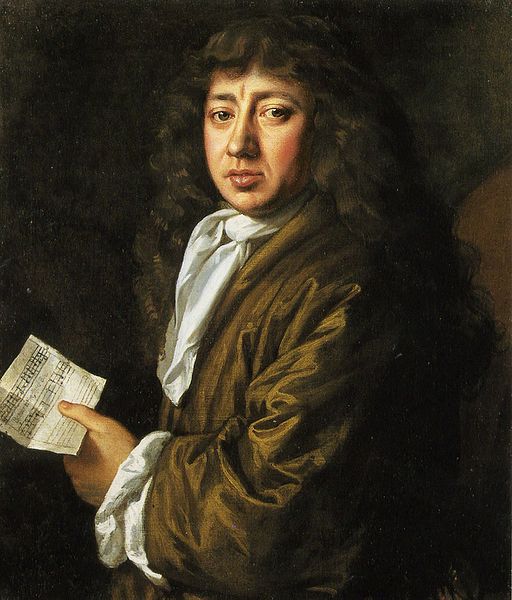
Samuel Pepys
John Hayls, Public domain, via Wikimedia Commons

Not far away Samuel Pepys[6] is wakened by a servant. Pepys is a remarkable man. He’s described as a diarist and naval administrator, but that underplays his significance. Under Charles II (and his successor James II) he became Chief Secretary to the Admiralty. He had no sea-going experience, but implemented essential reforms which organised and professionalised the navy. Additionally, he wrote down all that was happening around him during the years 1660 to 1669. His diary writings – more than a million words – were published much later and not only give invaluable insights into that decade, but especially its great events which include the Great Fire of London.

It is still the middle of the night, and 33-year-old Pepys is as reluctant as anyone to leave his bed. But the maid insists. He steps over to his bedroom window, and sees fire and smoke rising only one-third of a mile away. But he’s not especially perturbed. It’s just another London fire, and he’s suffering constant pain from bladder stones, so he returns to his bed.

He wakens again at 7.00 am. He looks out his window. The fire is now much larger. Pepys has access to the king, and thinks the monarch should be informed. First he goes to the Tower of London from where he can get a better view of the fire. He sees how fast the strong wind is pushing the flames. At the Thames he clambers onto a boat from where he has a view towards Pudding Lane. People are running from the fire with their possessions, some throwing themselves and their property into the river, and others stacking their goods on boats.

He uses his boat to reach Whitehall where the royal palace is located. King Charles is alarmed, and instructs Pepys to return to the old city, find the Lord Mayor, instruct Bloodworth to tear down houses, and tell him that the king will send soldiers to help. These are sensible measures, but the mayor will not care to be instructed by the king nor want his soldiers.

By mid-morning Pepys is touring streets by coach but has yet to find Bloodworth. The fire is widening its reach minute by minute, pushed along by an ever-stronger wind. The lanes are crammed with an odd mix of citizens. Some are dressed smartly and on their way to church. Others are covered in soot, and hurrying away from the fire carrying children and possessions. Flames reach into the sky. Dark clouds billow up over the city.

Pepys continues to search, by now on foot. The crowds have made coach travel slower than walking. At St Paul’s Cathedral he watches people pushing to gain entry, not for Sunday worship but bringing their clothes, furniture, and other goods inside. Many take them down to the crypt. St Paul’s is large and made of stone. It will not burn. It is a safe place. Or so they think.

Where is Bloodworth? Pepys heads towards the fire. People rush past him, some trying to stem the flames and others getting as far as possible from the flames. One man tells Pepys the mayor might be anywhere, and that 300 homes are burning now. He presses on, forcing his way through the throngs. He rounds a corner and for the first time feels the heat from the fire on his face. In front of him are not homes, but what looks like a giant bonfire. ‘It made me weep to see it’, writes Pepys. One writer describes his reaction: ‘This is no longer the few burning streets he’d told the king about. This is a vision of hell.’[7]

As well as what Pepys sees and feels, what he hears is terrifying. Burning wood is not silent. It breaks apart with loud bangs, like the firing of pistol shots. Everywhere fires roar. Pepys steps away, moves down alleys not yet ablaze, and finally finds Lord Mayor Bloodworth in Cannon Street surrounded by constables and locals. To Pepys he looks defeated and near to collapse. He had a chance to extinguish this fire, but now it’s too late.

Pepys tells Bloodworth he brings orders from the king. Houses in the path of the fire must be demolished. Despite the awful reality of a fire out of control, the mayor stubbornly refuses. The two men argue. For Pepys whatever can be done to save the city must be done. Bloodworth, though, will not give up his control and take commands from the king. Though the mayor has no idea what to do he will not let King Charles tell him what to do. He protests that he has been up all night, he now needs to go. And he does go, leaving his city to burn. Lord Mayor Bloodworth is never seen again while the Great Fire rages.

It’s now not even midday on Sunday, only the first day of the fire, and already hope of saving much of London is gone. And here we will pause our narrative. This has been only the introduction to our story. The worst of the Great Fire is yet to come. Details to follow in the next blog posts.

In closing, though, is there any wisdom to be gleaned from the beginning of the Great Fire of 1666? There is. Very briefly, I’ve noted four lessons.

  1. There was clearly a failure to imagine the unimaginable. London often had fires, but they were small, and their primitive fire-fighting measures were adequate. Those in authority had never imagined a fire which quickly became an inferno and then spread further and further across the city driven by a near gale force wind. But, actually, that was not ‘unimaginable’. It was simply not imagined. Very strong winds happened, often in early autumn. If only they’d planned and prepared for a fire breaking out at such a time.
  2. Laws were not enforced and that had consequences. Foolish practices, while not illegal, were allowed. There were laws about the size and overhang of houses which no-one enforced. Highly inflammable and even explosive materials were stored in wooden houses and sheds and no-one intervened. This was madness, a classic case of nothing being done until there’s a disaster. There was indeed a disaster, one that claimed lives and destroyed a large part of London.
  3. Dogma took priority over effective action. As we will see, once soldiers were organised and deployed, more effective firefighting took place. But for crucial hours the king’s men were refused. Many of London’s leaders had not wanted another king, so they certainly didn’t want his soldiers. That decision had devastating consequences.
  4. Those who should have taken decisive action failed. Most historians condemn Lord Mayor Bloodworth for his inaction. But some believe he faced impossible pressures politically, and was simply out of his depth when faced with a massive fire. Both hard judgments and soft judgments can reasonably be made about Bloodworth. But the bottom line is that he did little in the early hours, and removed himself when firm and effective action was most needed. He was the city’s leader, but he wasn’t a leader in a major crisis.

The Great Fire of London lasted four days. So far we have seen only its beginning. There is much more to come.


I have used several sources for the information in this series on the Great Fire. A special thanks is due to the podcast, Short History of the Great Fire of London. It not only gives more information than most web sources, it tells the story. I have used my own words, but, with gratitude, I’ve followed the podcast’s story line to unfold information and events on a day by day basis. I also want to warmly commend all the episodes of the ‘Short History of…’ podcast. The team cover a wide range of subjects. It is one of my most favourite podcasts – important subjects, brilliantly told, easily followed, fair interpretations. The link to its website is just below.

Here are my major web sources:

Short History of the Great Fire of London podcast. It can be found in two places:

The Monument, erected between 1671 and 1677 to commemorate the fire, and still accessible today, has a website which describes the fire at: https://www.themonument.org.uk/history

Of course Wikipedia has a wealth of information on the Great Fire and, via other pages, on many of the main characters mentioned in its story. The Great Fire entry is at: https://en.wikipedia.org/wiki/Great_Fire_of_London

London Fire Brigade can trace the inspiration for its founding back to the Great Fire. It gives its account of the fire at: https://www.london-fire.gov.uk/museum/history-and-stories/the-great-fire-of-london/#:~:text=In%201666%2C%20a%20devastating%20fire,Paul’s%20Cathedral

Inside History tells the Great Fire story in two parts.

The Museum of London has many resources related to the Great Fire. Its web pages are here: https://www.museumoflondon.org.uk/discover/great-fire-london-1666


[1] Now the location of the UK Parliament.

[2] His merriness included fathering at least 12 illegitimate children with mistresses, but he left no legitimate heir. He was succeeded on the throne by his brother James.

[3] Tallow is rendered animal fat, more commonly called ‘dripping’ in the UK. In the 17th century, one of its uses was for candles.

[4] His last name also appears as Bludwoth.

[5] Bloodworth is blamed for allowing the fire to spread in its early stages. But tearing down private property, if later deemed unnecessary, could have left him personally liable for damages unless the king had authorized his actions. But his aldermen – parliamentarians – would not have allowed the king to decide on firefighting measures in the city.

[6] The pronunciation of his last name sounds like ‘peeps’.

[7] John Hopkins & Danny Marshall, ‘Short History of the Great Fire of London’ podcast, 22’18”.