The Forth Bridge … beginnings

A tourist was told he must see the Forth Bridge. ‘Of course,’ he replies, ‘but where are the other three bridges?’ That’s an old  joke which rests on the tourist only hearing the bridge name and not knowing the spelling is Forth, not fourth, or that the bridge in question is over the Firth of Forth[1] in east central Scotland near Edinburgh.

© Sue Brown Used with permission

The Forth Bridge is only 30 miles from where I grew up. I was young when my parents took me almost underneath the bridge, down by the river where the ferry took car and foot passengers from North Queensferry across to South Queensferry. I hardly remember the ferry, but the memory has remained of the giant bridge towering over me, carrying trains high in the sky.

When I refer to the Forth Bridge, I’m using its proper name. But for some 60 years it has been commonly referred to as the Forth Rail Bridge to distinguish it from the nearby Forth Road Bridge and from the recently constructed Queensferry Crossing, a second road bridge. All three bridges impress me, but it’s the Victorian-era rail bridge that has always taken my breath away.

I’m hoping my excitement and fascination about that bridge is contagious. At the end of October 2021 I wrote a blog about the Tay Bridge and its disastrous collapse during a storm. Around 75 lives were lost. (You’ll find it here: https://occasionallywise.com/2021/10/). Many people have read that blog, including a surprising number in America. I hope this bridge story also captures interest. There’s no collapse to describe though, tragically, more died building the Forth Bridge than were lost when the Tay Bridge fell into the river.

The Tay Bridge and Forth Bridge both straddle estuaries, and they have a shared geographic connection. The Tay Bridge goes north from the county of Fife towards Dundee and the Forth Bridge goes south towards Edinburgh. As a Fifer, I like the idea that my county is at the centre.

The Forth Bridge stands where it does because it almost couldn’t have been anywhere else. The maps explain. The first one shows east central Scotland. Fife is the county in the middle – it looks like a Scottie Dog facing right. At the top of Fife lies the estuary of the River Tay. The Tay Bridge was constructed where the river narrows just south of Dundee.

Map data ©2022 Google

Look to the southern edge of Fife and you see the much wider estuary of the Forth with Edinburgh just below it. What train companies wanted was an uninterrupted route north passing through Edinburgh and Dundee. Where could a bridge be constructed over the Forth? Most of the eastern part of the estuary was too wide. To the west the river narrows the further you go upstream, but building a bridge there would be a major diversion from a straight route up the east coast of Scotland. There was just one place near the mouth of the Firth where the land to the south and north jutted out, exactly where the two Queensferry villages were located.

That point is the focus of the close-up map below. The river narrows just south of Dunfermline and Inverkeithing, which is why most ferries crossed there. That part of the river had another advantage – a small island halfway across. It’s hard to make out, but an outcrop of rock pokes its head just above the water at the midpoint. That’s Inchgarvie Island which will be a significant secure base for the central tower of the Forth Bridge.

Map data ©2022 Google

But, our story begins not just hundreds but thousands of years earlier. In this blog I’ll focus on events before the Forth Bridge was even designed.

As we begin, let me commend Anthony Murray’s book The Forth Railway Bridge,[2] one of the most valuable sources of information for me. (I suspect the book is out of print, but there are second hand copies for sale.)

The era of boats

The first crossings of the Firth of Forth happened in ancient times before history was recorded. Small boats are fragile, and the Forth estuary was no stranger to strong tides and fierce winds, so those voyages were hazardous. Yet, the people who lived by the sea or large rivers weren’t fools. They knew when to cross.

Ferry crossings also began millennia ago. Ferries would be slightly larger vessels, likely capable of carrying several people plus cows and horses. They increased in importance when Dunfermline, located just north of the river, became the ancient Scottish capital. Margaret, an English princess, married King Malcolm III of Scotland in 1070. Queen Margaret (later Saint Margaret) was a pious Christian and apparently a good influence on her husband. She became noted for her charitable works, and part of her charity was to properly establish a ferry across the Firth of Forth so pilgrims could travel more easily to St Andrews (in the north east of Fife). The ferry became known as the Queens Ferry and the villages between which the ferry crossed were called North Queensferry and South Queensferry. Some 820 years later those two places would mark the ‘ends’ of the Forth Bridge.

One of Margaret’s sons, King David I, put the ferry crossing on a sounder footing, and granted oversight of it to monks in Dunfermline. During medieval times the ferry was a profitable enterprise. In 1589 James VI (later James I of England) gave the ferry rights to his bride as a wedding present. Early in the 1600s, the ferry passage was divided between 16 feudal superiors. They didn’t operate the ferries, but raked in their share of considerable profits.

The ferrymen appear to have been rough characters, seeing off rivals trying to steal business, lacking civility to customers, and having punch-ups among themselves. In 1637 two ferrymen were fined five pounds each for fighting. That was a substantial fine but each had to pay his five pounds fine to the other, so neither won nor lost. What may have bothered the men more was an order that required them to be friends and drink together.

An oddity for us, but not for those times, was that ferry fares were charged according to the status of the passenger, ranging from three shillings and four pence for a duke, earl or viscount, down to one penny for a humble man or woman. Ordinary folk were cheaper than some animals. A horse, cow, or ox was two pennies, but 20 sheep just four pennies. Everyone and everything had its value, with a simple citizen half the price of a cow. Clearly a boatload of aristocracy was the ferryman’s dream cargo.

The ferry service was much criticised: ferries not in good condition; landing places inconvenient and dangerous; piers scarce; services irregular, and impossible when wind and tide unfavourable; no oversight of the system; ferrymen unpleasant. It was also difficult to access the shores to catch a ferry – transport was bad on the Edinburgh side and nearly non-existent on the Fife side. No airport buses departing every 15 minutes in those days.

Despite the problems, by the early 19th century ferry traffic was increasing. That stirred a demand for change. So a Board of Trustees was set up to consider what could be done. It reported that the private individuals running the ferries were not likely to take account of public convenience to the extent now required, and recommended nationalising the ferry service. The proposal was fiercely resisted by those who owned the ferries – they called it ‘a violent invasion of private property’ – but the Bill to nationalise the service was passed in 1809.

New ways to cross the river

The increased traffic, and inadequacy of the ferries, stirred ideas for other ways to cross the Forth. This was the early 1800s, close to the Age of Enlightenment, and several more-or-less enlightened ideas were put forward.

One radical proposal came from a group of Edinburgh engineers – they would tunnel under the river. They knew of a London tunnel project under the Thames, and of a mining tunnel under the Firth of Forth at Bo-ness (about 10 miles upstream) which had gone a mile out under the river without difficulty. Led by John Grieve, three engineers surveyed the bed of the Forth at Queensferry and concluded a tunnel was very possible.

But there were challenges other tunnel projects had not faced: the great depth of the water between North and South Queensferry, and the type of rock under the river bed. Both of these factors would make tunnelling difficult. They were forced to modify the route the tunnel would take, but that meant the southerly entrance would be close to Hopetoun House, considered one of Scotland’s finest stately homes with 6,500 acres of grounds. The owner, the Earl of Hopetoun, strongly objected. Grieve pressed on as best he could and drew up plans for a £160,000 project:

  • It would take four years to construct
  • There would be two separate tunnels, described by Grieve as ‘one for comers; one for goers’
  • Each passage would be 15 feet high and 15 feet wide (15 ft = approx 4.5 metres)
  • There would be a raised sidewalk for pedestrians

Grieve issued a prospectus and shares were offered at £100 each. It got little interest. He tried again the following year, but with no greater success. The scheme collapsed. Grieve was disappointed. The Earl of Hopetoun was delighted.

A quick aside: the idea of a tunnel under the Firth of Forth was revived in 1955. A Forth Road Bridge Joint Board had been set up to plan and oversee the building of a road bridge. But first the Board considered drilling a tunnel under the estuary close to the rail bridge. But, like Grieve’s proposal, after research the idea was abandoned as being too ambitious and too expensive.

Back to our main story. Between 1808 and 1817 new piers were built on both shores. These were ramped piers (sloping down into the water), allowing ferries to dock whether the tide was high or low. They were so well constructed they handled ferry traffic until 1964. It stopped then only because the Forth Road Bridge was opened, and the ferries were consigned to history.

New piers made a big difference to the ferry service, but ferries could never satisfy 19th century transport needs. This was an era of growth and innovation. Engineering flourished, new roads were built, and bridges constructed where previously they were thought impossible. Imaginative and impressive engineering projects were being developed across Scotland, and all around the world.

An Edinburgh civil engineer, John Anderson, was excited by giant wooden bridges built in China. One bridge was reported to be three miles long. Anderson’s idea was not for a wooden bridge across the Forth, but a suspension bridge so extraordinary it would be one of the wonders of the world. His favoured site was where the ferries crossed. That was the most obvious location, partly because the river at that point was narrow, and because of the small island, Inchgarvie (as explained earlier) The name Inchgarvie is Gaelic and means ‘rough island’. That’s what it is, a small island of solid rock. However, it’s not as modest as it appears, because (like an iceberg) it’s bigger below sea level than above it. Inchgarvie was barren rock but perfect for supporting the centre of a large bridge. The pillars and columns of Anderson’s bridge would be made of cast iron, and coated in linseed oil when hot to ward off rusting. The roadway would be sufficiently wide to allow two-way traffic plus pedestrians. It would be suspended by chains either 90 or 110 feet above sea level, and could be no lower as ships with tall masts had to pass underneath.

Anderson wanted his bridge to be a thing of great artistic merit. He wanted it to look very light so he would use as little iron as possible to reduce the bridge’s weight and mass. With dry humour one later writer said the bridge would indeed have looked very light and slender, almost invisible on a dull day, ‘and after a severe gale it might been no longer seen, even on a clear day’. Anderson’s imaginative but unrealistic design won no support and the plan for a near invisible bridge became exactly that: invisible.

Other developments during the 19th century were significant for the eventual construction of the Forth Bridge.

Travel by train. The first purpose built railway, a line between Liverpool and Manchester, was authorised in 1826 and opened in 1830. It was a success from the start, beating other forms of transport on time and cost. Road transport was slow and expensive. Canals were used between Liverpool and Manchester but the journey time by rail was one and three quarter hours compared to 20 hours by canal, and the charge for carriage by rail was half the cost of carriage by canal barge. From the start trains were used by the Post Office and soon after for newspaper circulation around the country.

The expansion of railways lines was fast. In 1836, 378 miles of track were open.  Eight years later that number had risen to 2210 miles and soon many more. Railways changed society. People moved out of cities because they could now commute to work. Seaside resorts were developed because they could now be reached. Businesses sent their goods throughout the nation, because transport was affordable and fast. In today’s jargon, trains were a breakthrough or disruptive technology.

Because of these economic and convenience benefits of rail travel, it was no longer realistic to think a bridge over the Firth of Forth should be designed for horses, carts and pedestrians. It must carry trains.

Oddly, though, before any bridge was built trains were already crossing the Forth estuary. They floated over.

In 1849 a young man called Thomas Bouch was appointed manager and chief engineer of the Edinburgh and Northern railway and tasked with developing travel up the east coast of Scotland. But Bouch faced two immense problems – the wide estuaries of the Tay and Forth rivers. To make a lengthy journey north or south you could take a train close to an estuary shore. Then goods and people had to detrain, board a ferry, travel through Fife by road or train, get on another ferry, and finally board another train to complete the journey. East coast travel could never prosper while those difficulties existed.

Bouch’s ambition was to build bridges, but he needed a quick fix. His initial solution for crossing the Firth of Forth was what he called a ‘floating railway’ – steam ships big enough and strong enough to carry a train. His first ferry was named ‘Leviathan’, which had proved its seaworthiness because it was built in shipyards on Scotland’s west coast, then sailed north, across the top of Scotland where wind and waves were anything but friendly, and back down the east coast to the Firth of Forth.[3]

Bouch had wasted no time. Within two years of his appointment, his train-carrying ferries began. There were already rail lines running to Granton, near Edinburgh, on the south coast of the Forth, and from Burntisland in Fife on the north coast, so the train-carrying ferries sailed between those two places. It worked, and the floating railway operated for several decades.

But Bouch’s ferries could not be a long-term solution. They had limited capacity, limited frequency, and limited convenience. The demand was for rapid and comfortable train transport, and the answer did not lie with ferries.

A bridge had to be built. And at exactly that time another major development made a large, strong bridge over the Forth a better prospect than ever before.

Reliable steel. Well into the 19th century, iron dominated the building world. It came in two forms:

  • Wrought iron – wrought is a past participle of work, so wrought iron is ‘worked iron’
  • Cast iron – iron shaped by a casting process.

Each has advantages and disadvantages.

Wrought iron is pliable when heated and reheated, so can be bent into any desired shape. It gets stronger the more it’s worked, is not prone to fatigue, and can suffer a lot of deformation before it fails. It’s been used since about 2000 BC.

Cast iron is not pure iron; it contains small elements of carbon, silicon, manganese, perhaps traces of sulphur and phosphorus. The elements are heated beyond melting point, then poured into moulds which give the cast iron its shape. It’s very hard but also brittle. When stressed it’ll break before it bends.

The advantage of cast iron is suitability for complex shapes – think of the decorative metal back to a garden seat – which would take enormous time for a blacksmith to create. But, though strong, cast iron won’t bend when pressure is put on it, and may possibly collapse.

Many buildings and bridges were built with iron. But they had limits. Several bridges collapsed because their underpinnings were cast iron.

Around the mid 1850s, Sir Henry Bessemer developed manufacturing processes to create quality steel which could be used economically in construction. He intended his work to be used for weapons, but it had wider applications. The Bessemer process is described this way: it ‘involved using oxygen in air blown through molten pig iron to burn off the impurities and thus create steel’.[4] It was revolutionary.

This new steel was sufficiently strong, resilient and economic for the grandest and greatest of engineering projects. It didn’t become used widely until about 1880, but that was exactly when it was needed for the Forth Bridge.

It was now time for a serious approach to a bridge over the Forth. The ‘beginnings’ of this story are, therefore, at an end. It’s where we pause, but the story will continue in the next blog.

Already there are lessons we can learn, including these:

  • During the early years there were people who believed a bridge spanning the Firth of Forth could never be built. They were wrong.
  • The first bridge concepts were too small and too fragile to meet the need, although understandable given the technology of the time.
  • New developments created a need and an opportunity. The creation and expansion of train services were the need. The upgrading of steel to major construction quality was the opportunity.
  • Eventually the time came to act. An age had dawned which demanded bold innovators. Those innovators emerged, and their work was and is magnificent. After more than 130 years the Forth Bridge still fulfils its purpose perfectly.

These four points make me ask these questions. What is there I could be doing but my vision is too small? Beyond me, what are the challenges of this age that need great innovators, and a population willing to adapt, so dangers like viruses, inequality, racism, and climate change can be challenged? This is not a time for saying ‘That could never be done’. It’s the time when something must be done.

Thank you for persevering through a long blog. As the story progresses, we’ll find out:

  • Was there a serious proposal for bridge supports simply to float in the river?
  • A surprising reason so many construction workers died.
  • Why Thomas Bouch was hired and then fired as bridge designer
  • When painters reached the bridge end, they began painting again at the beginning – true or false?

And many other important and not-really-important facts. So much more to come.

———————–

[1] ‘Firth’ – often used in Scotland – can refer to a river estuary or an inlet of the sea. The Firth of Forth is both.

[2] Murray, A. (1983/1988) The Forth Railway Bridge A Celebration, Mainstream Publishing Company, Edinburgh.

[3] Some of these details come from an obituary of Thomas Bouch following his death in October 1880.

[4] https://en.wikipedia.org/wiki/Henry_Bessemer

Celebration of discipline

The word ‘discipline’ has more than one meaning. So you know the sense I intend here, I’ll begin with a definition: Discipline is an attitude of mind and a way of doing things without which hardly anything worthwhile or lasting gets done.

Therefore, I’m not writing about discipline as punishment. During my school years in Scotland I had unwelcome meetings with the tawse[1] (the word is plural of taw which means whip) which inflicted considerable pain on my hand. Thankfully, this so-called discipline was abolished in the 1980s. Punishment is not what I’m meaning here when I use the word ‘discipline’.

Nor does my title ‘celebration of discipline’ imply the meaning of discipline used by Richard Foster in his 1978 book ‘Celebration of Discipline’. Wikipedia describes Foster’s book as an examination of ‘the inward disciplines of prayer, fasting, meditation, and study in the Christian life, the outward disciplines of simplicity, solitude, submission, and service, and the corporate disciplines of confession, worship, guidance, and celebration.’[2] It’s a remarkable book which has sold over a million copies. But I’m not writing about spiritual disciplines.

A few examples will show the sense of ‘discipline’ I mean.

Example 1    At the age of 17 I learned to touch type. (I was taught both shorthand and typing at a further education college, as part of training for journalism. There were only two males in a class with 20 females.) On large, old-fashioned typewriters, we learned to rest our index fingers on the ‘f’ and ‘j’ keys, and type fffff jjjjj, over and over again. Then we did fjfjfjfjfj and jfjfjfjfjf. The following week we did the same drills with middle fingers on the ‘d’ and ‘k’ keys, moving gradually from ddddd kkkkk to dfjkdfjkdfjk or kjfdkjfdkjfd or even dkfjdkfjdkfj. When more fingers and keys were in play, we moved on to simple words and sentences. Initially these exercises were mind-numbingly boring but, with practice, I did learn to touch type which gave me a great sense of achievement. While most of my fellow journalists typed with only two fingers and stared at their keyboards, I used eight fingers and one thumb (the other thumb is never used), and to this day don’t look at the keyboard. The discipline of those drills gave me a skill for life.

Example 2    For many years I prepared at least one but often two sermons every week. Often I’d write them out in full, some 4000 words each. There were two problems:

1) Never enough time to research and prepare;

2) Sometimes a mind blank about the next sermon.

There were two answers to those two problems:

1) The absolute deadline of an approaching Sunday. I had to be ready by then, which forced me to get on with the preparation;

2) The remark of Scottish theologian William Barclay about ‘writer’s block’: that the art of inspiration is the art of applying the seat of the pants to the seat of the chair. In other words, stop faffing about and get on with the work.

The discipline of the deadline and the discipline of just sitting down, starting the work, and letting inspiration come, meant my sermons were always ready.

Example 3    Twice recently we’ve noticed a woman go past our house, but she pauses after every two or three steps. Why stop like that? She’s training her young dog to walk on the lead by her side. She moves forward, so does the dog, but after only a few steps the dog pulls ahead. So, she stops, makes the dog wait, and then begins again. When the dog gets it right, it’s rewarded; when it gets it wrong, she never shouts, just waits and then they restart. Most importantly, she never gives up on the training. My wife Alison knows a lot about dog behaviour and she’s impressed. That woman’s discipline – of herself and the dog – will have huge benefits for years to come.

So, with these examples in mind, I hope you can see why, for this blog, I defined discipline as:

  • an attitude of mind
  • a way of doing things
  • without which hardly anything worthwhile or lasting gets done

Discipline is about how we think and how we act. And discipline is necessary to succeed in things that matter.

I’ll expand on each of these.

Discipline as an attitude of mind

I was probably only the right weight once: on the day I was born. That day came only a few years after World War II ended, while food shortages were still common. My parents’ idea was that a chubby child was a healthy child. In fact I was overweight. I’m still chubby, though keep protesting much of it is muscle. I’ve read various books on losing weight. One book effectively pronounced me a lost cause. The author said that, in middle age, almost no overweight person gets back to their ideal weight and stays there. The very few who maintain their right weight have rigid discipline. They’d achieve their daily step count no matter the weather, and would not eat even a single square of chocolate.

The rigidity of that statement troubled me then and still. But I got the author’s point that a seriously disciplined mindset was essential. I’ve known people try to break drinking and smoking habits who lost the battle early on because they told themselves ‘Breaking the rules won’t matter just once’ or ‘I can have a holiday day occasionally’. But those ‘just once’ and ‘holiday’ days soon become frequent, and the cause is lost. Sometimes being lax with discipline is immediately and seriously dangerous. If, when I’m riding my motorbike, I wasn’t unfailingly disciplined about doing my life-saver shoulder check, I might be dead.

Whether we’re thinking of personal safety or goal achievement, a ‘happy go lucky’ attitude isn’t good enough. A disciplined way of thinking is essential.

Discipline as a way of working

I’ve had six books published and contributed chapters to two more. Is it difficult to write a book? For me, the honest answer is ‘no’ and ‘yes’. At any moment I have 50 ideas of things I could write about, and at least one of them makes some sense and would be of interest. So I don’t lack a subject. Then, once the idea is clear, writing isn’t difficult for me. I’ve written easily since I was a child. I could churn out thousands of words a day if I needed to.

But I have at least two difficulties with a major writing project. The first is the simple but hard one of making myself sit down and type the words. My mind will flip to ten other things I could do, some of which will be more fun and give quick rewards. Writing can be a slog, and a book is a long game. The work is tough. The second challenge is editing. Writing the first draft for a book is creative and perhaps exciting, but after that comes revision after revision: correcting typos, clarifying thought, cutting unnecessary material, watching for contradictions, and so on. That’ll happen at least ten times, and I’ve edited some books more than twenty times. Editing is very tedious.

I deal with the first of these – making myself do the work – by creating a non-negotiable deadline (publishers often impose those anyway!) A favourite phrase of mine is ‘A deadline is the mother of motivation’. It works for me.

And I deal with the second – making myself do the boring work – by defining minimum targets I must meet each day. So, when I typed my 400+ page thesis on a typewriter where almost no errors can be corrected, my goal was three pages a day. I would get home from an evening meeting about 10.00, then type and retype from 11.00 to 1.00 in the morning to achieve three perfect pages. I could not do that every night (I was often travelling), but on every day possible I produced three pages without fail. It got done – and the thesis was accepted.

Each person will have their own method, but it must be a disciplined way of working.

Discipline as essential for anything worthwhile or lasting to get done

Three things fit under this heading.

First, you can be casual with trivial things but must be serious to achieve important things. When a young golfer began on the professional tour, his brilliant play got everyone’s attention. He won a few tournaments, and the experts tipped him for the top, saying that with his potential he’d win all the major championships. Yet as he moved through his 20s there were only a handful of modest successes. When he was 30, he admitted he’d put more into living the good life than into his golf game. Now he would change. But he didn’t change. He didn’t dedicate himself to practise or to follow his coach’s instruction, and never succeeded at the highest level. He lacked discipline, and never fulfilled his potential.

We’re constantly tempted to dabble. We do a little of this, then some of that. We start and then stop. We do what we like and avoid what we dislike.

Life can be lived without discipline. But it’ll be a life devoid of what’s most worthwhile.

Second, the best things in life last only with hard work. You can bring in a team of designers, gardeners, labourers and volunteers and create a beautiful garden in one or two days. Plenty TV programmes show that’s possible. But, all too often, the garden they make is at its most gorgeous only until the TV cameras leave, or for only a few days. Why not longer? Why not always? Because a garden is a living, changing thing, and without disciplines like weeding, watering, fertilising, pruning, cutting, planting its beauty won’t last.

Nor does a marriage stay wonderful without constant care and investment. Or a career mature without development and upskilling. Even a product needs continual adjustment or reinvention to meet evolving tastes and needs.

Disciplined hard work is essential for longevity.

Third, to win a race you must both start and finish. In London and Chicago I’ve watched marathon runners stream past heading for their medals at the 26 mile finishing line. I’ve stood off to the side thinking how marvellous it would be to run a marathon and get a medal. But there are two barriers for me. One, I’d never have the courage to enter. Two, I’d never have the ability to finish. And you don’t get the medal without entering and finishing.

Many read a novel and think they could write just as well as the author. Or listen to a singer and reckon their voice is just as good. Or consider they could give advice just as ingenious as the consultant their firm brought in. But they don’t do any of these things. They don’t start, or, if they do, they don’t finish. They lack determination and they lack perseverance, both of which require discipline. Only with those do the best things actually get done.

Let me finish with this. Some people are super-disciplined. Some people are ill-disciplined. Then there are those who are disciplined in some things but not others. I’m in that middle category. Usually I long to be more disciplined. I’d achieve more of the things that really matter to me. Yet I wouldn’t want the possible downsides, such as the inflexibility that I sometimes see in my super-disciplined friends. So, in respect of discipline, my report card would read: ‘Has some discipline, but might benefit from more!’ Perhaps you’d like to ponder what your report card would say…

———————-

[1] More about the tawse here: https://en.wikipedia.org/wiki/Tawse

[2] https://en.wikipedia.org/wiki/Richard_Foster_(theologian)


Celebration of ritual

Rituals get a bad press. The word implies something archaic, boring, mindless and pointless. Some rituals are. But I want to make a case for rituals, albeit rituals defined broadly enough to include reminders and procedures. Without those we’d lose track of what to do and how to do many of the important things of our lives.

But first I want to set aside the rituals which exist because people are odd or ill. Here are four examples I know:

  • When a senior manager attended a formal meeting, he always laid out three identical, good quality pens on the desk right in front of him. Likely he worried one might run out, hence having a spare. And then he needed a spare for the spare.
  • An office manager always had several pencils on his desk, all the same length, and all pointed in the same direction. When the manager went for lunch, juniors in the office would reverse some of his pencils. When he came back, the juniors watched to see how long before their manager noticed his pencils no longer all faced the same way. It was immediate, and he’d demand to know who had used his pencils.
  • One senior officer was always last out from the office at night. He’d switch off all the lights, then switch them on again, off again, on again, off again, on again, off again. Much the same happened with locking the outside door – lock, unlock, lock, unlock – at least four times before he could leave.
  • After everyone had gathered for the Sunday morning church service, Pastor George would leave his vestry, and join his congregation exactly on the hour for the service to begin. I mean ‘exactly’ on the hour. He’d watch the second hand of the clock count down and enter the sanctuary at precisely the right time.

I’m no clinician, but several of these seem like instances of Obsessive-Compulsive Disorder, which America’s National Institute of Mental Health describes: ‘Obsessive-Compulsive Disorder (OCD) is a common, chronic, and long-lasting disorder in which a person has uncontrollable, reoccurring thoughts (obsessions) and/or behaviors (compulsions) that he or she feels the urge to repeat over and over.’[1]

We’re tempted to smile at obsessive patterns, but OCD is no joke for the sufferer. Anyone with OCD deserves sympathy, not teasing.

So, to be clear, I’m not writing about uncontrollable or obsessive behaviour here, but about rituals we choose because they make our lives better. And, because they’re useful to us, we can celebrate them.

So, how do rituals make life better?

Rituals keep us safe

I’m usually last to go to bed, so it’s my job to make sure the house is secure for overnight. That consists of several tasks: 1) Make sure the dogs relieve themselves outside. That’s definitely important for them and us. 2) Once the dogs are in, check every outside door is locked, including the garage. 3) Fill the kettle so there’s no delay in making the first cup of tea in the morning. 4) Make sure all appliances and lights are off. 5) Close doors to retain heat.

I won’t be the only one with a last-thing-at-night routine. Nor the only who occasionally finds a door unlocked or a light still on. The ritual protects us.

In fact, we create many rituals to keep us safe, but we often call them rules, routines, codes or protocols. Think about these:

Safe crossing of roads: I was taught ‘Look right / Look left / Look right again / if all is clear, walk (don’t run) across’. There are more modern crossing codes now, but with the same aim. A young American, only a short time in the UK, got the ritual wrong. In a momentary mind-lapse, he stepped into the path of a car because he first looked left, as if he was still in America where traffic drives on the right. He didn’t die, but was so badly injured he never walked unaided again.

Driving routines: My driving instructor gave me a routine for every time I approached a junction or crossroads: mirror, signal, manoeuvre. That’s now been expanded and adjusted to M.S.P.S.L (Mirror, signal, position, speed and look). Motorcyclists have similar routines, with one important extra: a life-saver shoulder check. Motorcycle mirrors give limited vision, so glancing back on the side toward which you’re turning warns you if something has been in your blind spot. It’s saved me more than once.

Flying checklists: There are various checklists related to piloting and maintaining aircraft. Aviation historians say pre-flight checks were first mandated after a 1935 crash in Ohio. Accident investigators later found the pilots had tried to take off without disengaging the plane’s gust locks (which stop control surfaces moving in the wind while the plane is parked).[2] Both pilots died. These days there are checklists for each of several stages of an aircraft’s flight. You’ll be happy to know the final checklist includes ‘Landing gear – down’.

There are checklists for many industries and workplaces. But, by now you’ll have got the point – protocols are rituals that keep us safe.

Rituals bring welcome familiarity

Alison isn’t a fan of shopping in supermarkets she doesn’t normally use. ‘It’ll take me too long because I won’t know where everything is,’ she explains. Alison isn’t interested in browsing every part of a store. She knows what she wants, so shopping in her usual supermarket allows her to whizz round, get what she needs, pay, and go. Familiarity is her friend.

I like the story of the large department store which kept changing where the different sections were located. An exasperated shopper asked a member of staff, ‘Where’s the electrical goods department now?’ and got an equally exasperated reply, ‘I’m not sure but stay here and it’ll be along soon.’ Some changes are welcome, but we also appreciate familiarity, stability, even sameness. Rituals give us that.

In my earliest years as a church minister, I worried that Christmas services were much the same year after year. We sang the same carols, and Christmas sermons covered the same ground. It took me about ten years before I realised people weren’t expecting or needing novelty. They wanted to hear the old, old story told again and again, because the familiarity gave comfort. And their understanding of what it meant for God’s Son to be born in this world had grown and matured because of the regular repeating of the core truths about Christmas.

That constant focus on core truths is why some Christians follow a lectionary which focuses on major passages of the Bible (often on a three-year cycle), or structure their teaching around major Christian events (like Advent, Christmas, Lent, Easter, Ascension, and so on). Lectionaries have never been part of my tradition, but I understand why many find these rituals ensure everything major is covered, and that repetition enhances understanding. Rituals have those advantages.

Rituals keep us on track

The first time I needed a ritual was when I first lived entirely on my own. I was 18 and had a small bed-sit in a flat where the landlord wasn’t usually present. I would have a serious problem if I went out without my house key, so I developed a routine. Every time I opened the front door, I paused and checked the key was safely in my pocket. That ritual meant I was never locked out.

In another place where I rented a room, the landlady cleaned the kitchen and bathroom on Mondays, front lounge on Tuesdays, hallways on Wednesdays, and bedrooms on Thursdays and Fridays. Probably she did ‘spot cleaning’ in between, but it was mainly her weekly ritual that kept the house in good shape.

My mum had a less-regimented method for keeping our house clean, but her absolute ritual was spring cleaning. As the dark days of winter faded, it was time for the house to be vacuumed and scrubbed from top to bottom. Cupboards were emptied, carpets were beaten, furniture moved so corners impervious to normal cleaning were conquered. My dad was busy too. We had a very large garden, and in spring especially he worked there every evening and on weekends. The spring rituals were a big deal, and never missed.

Many rituals involve cars. One neighbour washed his car twice a week whether it needed it or not. I used to take the wheels off my car once a month, just to be sure I could if I got a puncture. I also checked all my tyre pressures weekly. One old car leaked oil so badly, I monitored its oil level every day (and carried a large can of oil in the car). Rituals kept me motoring.

Many Christians (and people of other faiths) make sure they take time to pray morning and night; some follow a three times a day pattern. Good rituals aid spirituality.

I asked a friend who owned a hairdressing business how frequently some customers had their hair ‘done’ – apparently some came every week. A golf store owner told me he had customers who bought new golf clubs every six months. I know people who buy a new car every three years. Some rituals are good but expensive!

Rituals can help psychologically

At the beginning of this blog, I identified rituals that have got out of hand and become an illness. But more moderate rituals help psychologically.

Most of us know the things that really matter to us. If we have a routine that gets these things done, we’re at peace. The flowers were bought for the one you love. The elderly relative was visited. The car was maintained. The study schedule was met. The medicine was taken. The budget was done. And so on. Now, all done, there’s no nagging worry that we’ve missed something important. Our routine prioritised what matters, and we followed it, so those things can’t prey on our minds. No ritual can guarantee every area of life will run smoothly, but it can ensure everything significant gets attention.

On the website of The British Psychological Society, a ‘guest blogger’ article suggests that even meaningless rituals boost our self-control by making us feel more disciplined. (You can find the article here: https://digest.bps.org.uk/2018/07/11/performing-meaningless-rituals-boosts-our-self-control-through-making-us-feel-more-self-disciplined/). I’m not a psychologist, so can’t evaluate the experiments described in the article, but I do understand the point being made – routines enhance our self-control and thus make us feel disciplined. That can’t be bad. Earlier I mostly described how rituals help us achieve more, but it’s interesting to think that rituals could also have a positive effect on our minds.

There are two reasons why writing about ‘rituals’ has been a strange subject for me. One, I dislike feeling imprisoned by a pre-defined way of doing things. Two, my friends would laugh at the idea of me recommending rituals. Not what I’m known for.

However, when I thought about rituals, I realised I’ve always had them. They’ve varied during my life, and never been the kind that gets written down and slavishly followed. But, I had a ritual about when I’d visit my dad when he was old and on his own. I have one now about how often I’ll play golf. And another about when I’ll write my weekly blog!

So, celebrate rituals. You almost certainly have them, and almost certainly benefit from them.

————————

[1] The NIMH have a useful website: https://www.nimh.nih.gov/health/topics/obsessive-compulsive-disorder-ocd#:~:text=Obsessive%2DCompulsive%20Disorder%20(OCD),to%20repeat%20over%20and%20over

[2] https://en.wikipedia.org/wiki/Preflight_checklist


Celebration of simple

I was about eight years old, and in a car with my parents. We were driving on a country road at night. Ahead, along the middle of the road, I could see a row of lights, and my Dad was keeping the car just to the side of them.

‘What are those lights in the middle of the road?’ I asked.

Mum said, ‘They’re not lights. They’re cats’ eyes.’

I had an eight-year-old’s reaction to that answer. ‘Cats’ eyes?!’

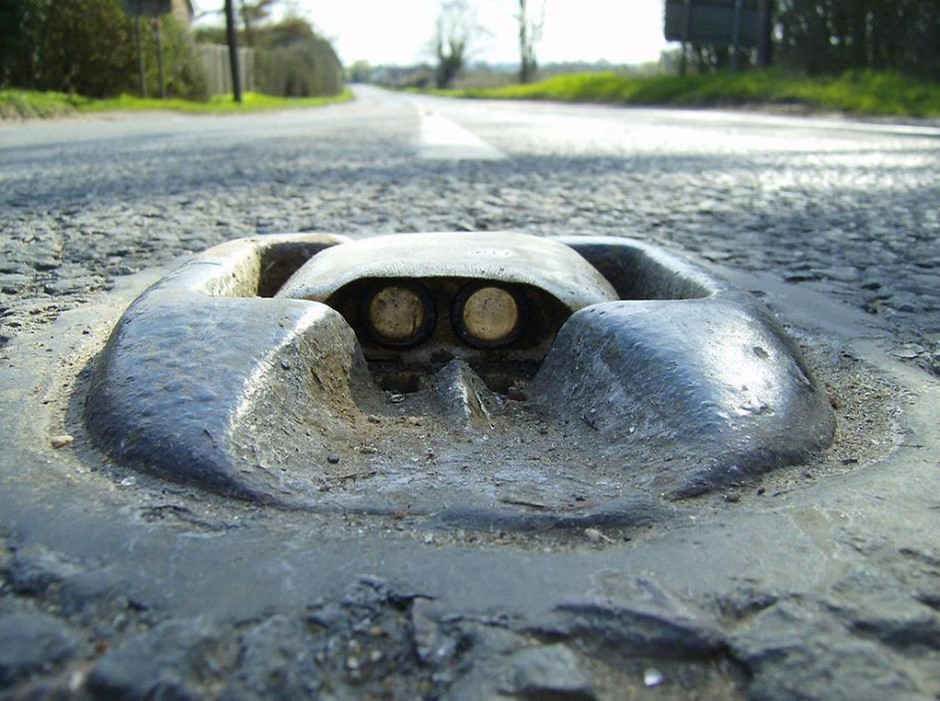
‘Not actual cats,’ she laughed. ‘They’re mirrors, and just like a cat’s eyes reflect light back, so those mirrors reflect back the beam of our car’s headlights so we can see where to go.’

I was amazed, and, of course, asked more questions. How could we could drive over mirrors without breaking them? (They sink down when compressed.) How do the mirrors stay clean? (Every time a car runs over they’re pushed down into a tiny reservoir of rain water, and they get cleaned.) To this day I’m still impressed.

A ‘cat’s eye’ set in the middle of the road. Dozens more will be spaced about 20 yards apart. The white circles are the mirrors.

Cats’ eyes were invented by Percy Shaw. There are various stories of  how he got the idea, including seeing a cat’s eyes reflecting back light on a dark night, or noticing how light bounced off tram tracks set in the road. Whatever the true story, he had the genius to translate inspiration into invention, and he patented his cat’s eye design in 1934. Initially sales were slow, but grew considerably during blackout restrictions in Britain during World War II (because roadside lights were off). Soon his firm were manufacturing more than a million ‘roadstuds’ a year and exporting them all over the world.

Percy’s idea was simple, but brilliant and lasting.

Many inventions have been simple, and so obvious we wonder ‘why no-one thought of it before’.

The wheel is the most often-cited example. Before the wheel, people dragged things along the ground, which was difficult to do and damaging to whatever was being pulled. Then came the idea of laying round tree trunks across the path, and rolling heavy objects over them. Finally someone had the simple but important thought that those trunks could be cut into narrow circles and attached to the side of ‘carts’. Soon those ‘wheels’ were put on wagons and chariots, not unlike the wheels I have now on my Nissan chariot.

Buttons were first used in the Indus Valley (in modern day Pakistan) several thousand years ago. Tiny holes were drilled into a disc so it could be sewn on to clothing, and then fastened with a loop. Amazingly simple. It changed clothing design forever.

Nails were invented 5500 years ago. Before nails, rope was used to bind interlocking boards. But rope can be of variable strength, and tends not to weather well. Once techniques were invented to cast and shape metal, someone had the idea that short, sharp lengths of bronze could be used to hold lengths of wood together. The humble, simple nail was born, and we’re still using them, albeit now made of steel.

As you’ll gather, what fascinates me about these life-changing inventions is their simplicity. Because we live in a technologically-advanced world, we think inventions must be highly complex. Some are, but others – like the cats’ eyes – have been relatively simple. Just a matter of seeing how things could be put to a new use.

And that’s true for more than inventions. ‘Identify the simple and do it’ could be a useful life principle.

John told me his children had drifted away from him. They were teenagers – and, of course, teens often want to do their own thing – but John feared something more serious was happening. We talked it through. He reckoned the change had begun when his son and daughter were about eight and ten. They started showing little interest in talking to him or being with him. ‘To be fair,’ John said, ‘my work had most of my time anyway. I couldn’t be with them very much.’

‘So, in what ways were you involved with the children?’ I asked.

‘Well, I made sure there was money for them to have the best brand clothes that would impress their friends. And we gave them TVs for their bedrooms, and the latest computer games.’

I was gentle with John, but the hard truth was that instead of building a relationship with his son and daughter he’d tried to buy one. Before it was finally too late there was one simple and vital thing he had to give them: love. Which would mean: a) reserving time to be with them, doing what they wanted to do; b) being interested in their lives and futures; c) making himself someone worth relating to.

Often the best answer to a problem or need is not complicated, at least not in principle.

For many years I listened as people poured out their troubles. They found every day wearying. Their marriage had lost its lustre. They had unpayable debt. Their career was going nowhere. They drank too much, smoked too much, ate too much.

I never claimed there were simple solutions for these problems, but for some there were certainly simple steps they could take. Energy lacking? Stop sitting up late at night watching TV, and instead get a solid night’s sleep. Children distant? Marriage lost its excitement and joy? Invest energy, commitment, inventiveness, tenderness into the relationship, and be more interested in him/her than you. Overcome with debt? Get help, make a plan, stick to it. Career boring? Do whatever it takes to get out of the rut, learn new skills, consider changing career. And so on.

Is this simplistic? Yes, if words like these are meant as a total solution. But not simplistic if seen:

  • As a direction to start out on
  • As a guide to the heart of their problem.

I like the saying that a journey of a thousand miles begins with the first step, because it points us to a destination and encourages us to get started. The biggest decision is to take the first step. But of course after that there’ll still be many challenges, and a 1000-mile journey is wearying. But worth it.

So, to be clear:

Simple does not equal easy. What’s the cure for smoking? Stopping. Sounds simple, and it is when we’re defining the goal. And it’s an achievable goal. Many have quit. But it’s hard, very hard, and plenty give up. So, let’s be honest: there are simple answers, but nothing easy about achieving them.

Simple often (though not always) identifies the core issue. You’re driving and suddenly the car engine stops. You’re able to pull over, and you ponder why the engine has failed. Maybe there wasn’t enough coolant, it overheated, and the pistons melted. Or, there wasn’t sufficient oil and, without lubrication, the engine seized. Or your transmission fluid was low, the transmission overheated and gears were damaged. Or there were electrical problems, and the clever little computer sent the wrong signals to the engine which became confused and stopped. Which of these is right? None.

Because the right answer was the simplest of all. You ran out of fuel. You meant to fill up but forgot, and cars won’t go without fuel.

We can bury ourselves among options, but the simplest one is often the right one.

The simple solution may be right before our eyes but we don’t see it. There are at least two reasons we’re blind to what’s obvious.

  • We don’t see what we’ve never seen. Long before Percy Shaw, someone else could have invented cats’ eyes. All the necessary parts existed. But nothing like a cat’s eye roadstud had ever existed, so no-one thought of it before Percy.
  • Often our vision is clouded by emotion, panic, and haste. We’re overwhelmed by the complexity of our problems, and excitement or fear turn a straight line into a spider’s web. Panic, depression, anxiety mean we can’t think straight – our vision is clouded – we can’t conceive of any answer to our troubles. One of the least helpful things to say to someone entangled by emotion is ‘just think straight’. They can’t. They see everything through the prism of their fear or nervousness. Instead, be their friend, someone not caught up in their emotions, a person they trust who can help them take steps to a better place.

Simple can feel too challenging. Many of my golfing friends slice their shots (which, for a right-handed golfer, means the ball curves in the air from left to right). Slicing means losing distance and accuracy, so golfers hate doing it. But they don’t need to. They could stop slicing by changing their swing. But, even after lessons from a professional golfer, they don’t change. Why not? Because curing a slice takes hours of practice and ongoing discipline to erase the old habit and create a new swing pattern. Most won’t put in the work. They shrug, and say, ‘I guess I’ll always be a slicer…’

There’s a general truth here: it’s one thing to know a simple answer, and quite another to apply it. It happens with priorities, with lifestyle, and with attitudes. They could change. Getting more sleep and taking more exercise would improve life. Spending more time with spouse and children would vastly improve relationships. Learning new skills could transform a career. But, for many, these things are too challenging, and they settle for a permanent second best. Which is very sad. Simple is challenging but worth it.

One last story in celebration of simple. When I was a pastor in Aberdeen, numbers grew, we searched for a larger building and were eventually able to buy one. There was work to be done to get the place ready, but there was one unexpected and welcome find: a safe. It was built into a wall, and hidden behind a panel. We’d had a safe in our previous building, but it had stayed there. We were planning to buy a new safe for our new building, but good safes are not cheap. So, finding one already installed was great news.

Except we couldn’t open it. This safe was operated by turning a key and then a handle. There was no key and the handle wouldn’t move. It was locked. People had searched everywhere in the building for the key – searched several times – but there was no key. The only way to get that safe open was bring in a locksmith. Perhaps he had a professional secret for opening a super-strong safe. In a sense, he did. The locksmith listened as we explained that the safe was locked and there was no key. He stood and looked at the safe, then walked up to it, and pushed down very hard on the handle. The safe opened. The handle had just been stiff. And inside the safe? The key.

There are times when solutions really are simple.

Have you forgotten something?

I stared at the phone, willing it to ring. Why hadn’t she phoned? Alison always phoned. She’d call, say ‘I’m on my way – about 15 minutes – put the kettle on for a cup of tea’. So why didn’t she ring today? It was well past when I expected her home. It was freezing cold outside. Maybe her car hadn’t started, but then she’d call. Maybe she’d skidded off the road, and couldn’t call. Should I head out and try to find her? Then I saw why she hadn’t called. Her phone lay on the kitchen work surface. She’d forgotten to take it with her. Five minutes later Alison breezed through the door, saying ‘Forgot the phone, but have you made tea?’

Alison was fine, of course. Just forgetful. As I have been too. I left my phone in a toilet cubicle at a massive conference centre. When I realised it was missing, a deep dread ran through me. I ran back – no phone in the toilet now. Was someone already using it to call relatives in Australia? Alison, calmly, said ‘I’ll try calling your number’. It rang and a voice answered. The thief! No, a security guard. My phone had been handed in, and within ten minutes I was reunited with it.

We all forget things.

This week – one unusually busy for me because of my studies – I’ve kept this blog simple by jotting down situations when we forget things. (Those I remember, that is.) Perhaps they’ll amuse you; perhaps make you feel guilty (‘yes, I’ve done that too’), perhaps help you think more about what matters.

Here’s my list.

Appointments or events    Until I had my first job I never needed an appointments diary. My earlier life was going to school, doing homework, playing football, watching TV. Then I was off to the big city and the world of work, and life was more complicated. Journalism isn’t a 9 to 5 job, so I had to know whether I was starting at 10.00 am, at 2.00 pm, or 8.00 pm, and who I was meeting with, and when, and where. A diary was essential. Life was even busier when I became a pastor, with more who, when, where notes to make, plus details of events at which I’d speak, funerals at which I’d officiate, and wedding services I’d conduct.

I’d have been lost without my calendar-style diary. I’d forget half of what I had to do. Besides, some things simply mustn’t be forgotten. Imagine mourners gathered at a crematorium or graveside waiting for a minister who’s on the golf course. What if I’d been in my home office still writing a sermon, while at the church building wedding guests were getting restless in the pews, the bride on hold in one room, the groom in another, and the organist stoically playing her way through the whole hymn book? Forgetting engagements like those is professional suicide.

It nearly happened to my pastor friend Jack. He didn’t miss weddings or funerals, but he started getting phone calls asking why he hadn’t turned up for a meeting, or visited a parishioner with whom he’d made an appointment. Jack would apologise, of course. He was sure he’d noted these things in his diary, but clearly hadn’t. But the ‘where are you?’ calls kept coming. That’s when Jack discovered the problem. Somehow, in his old-style diary, the month of May had been printed twice. So he really had noted down his appointments, but when he checked for upcoming events he’d looked at the ‘other’ May, and found nothing scheduled. In the future Jack always checked his annual diary had 12 months, not 13.

Names    I’m impressed when someone I’ve met only once remembers my name. They must have a really good memory for faces. Some don’t have a good memory; they’re just good at noting down who they’ve met and anything they’ve learned about them.

I’ve scrambled through life without a great memory for faces, and without the diligence of writing notes about people. I did try making notes once, just after starting ministry in a new church, but then I forgot to consult it and eventually forgot where my list was. Which was not a lot of use. My biggest struggle was that, after you’ve met someone a couple of times, it’s too embarrassing to ask their name again.

My biggest name challenges happened at large conferences. I would have met many of the attendees before, but perhaps not for one or several years. They’d greet me, ‘Hello Alistair – how are you?’ and I’d lamely reply, ‘Well hello there… So nice to see you again’. I’d no idea what their name was. Perhaps they’d be wearing a name tag, but a furtive glance down to the badge was a dead give-away that you hadn’t remembered their name. Besides, at one conference, a lady complained to the organisers that she’d never had so many men stare at her chest.

But, when Alison was with me at a conference, she’d bale me out about names. First of all, I told her, ‘If I don’t introduce you to someone, it won’t be because I’ve forgotten your name!’ And, second, she devised her own name-discovery strategy. If I didn’t introduce her, she’d quickly step forward, shake the person’s hand and say, ‘Hi, I’m Alison, Alistair’s wife – what’s your name?’ and follow up with questions about where they were from, what position they held, and did they have ten children? (Okay, she didn’t ask if they had ten.) Alison rescued me many, many times.

Birthdays / Anniversaries    Probably most find some cards or gifts don’t arrive on time. Maybe there’s a message that ‘It’s on its way’, which could mean it’s in the post or on next week’s shopping list. Happily, I remember the date of my wife’s birthday and my children’s birthdays. Unhappily, that’s far from a complete solution because I don’t always remember to buy a card or present.

But, of course, Alison has a system. For the two of us, all these key dates are in our shared electronic calendar with reminders popping up several days before. For the wider family she also sends out ‘the list’ once or twice a year. As well as birthdays, it lists changes of address, phone numbers, and additions to the family such as new nephews and nieces. But some admit they forget to check the list. Hard to criticise when you’re guilty yourself.

My phone number    In the days before mobile phones, I knew my home number because I often dialled it. But now we call people, not places. That means many more phone numbers, but we don’t need to remember them because they’re stored in our phones.

My awkward moment occurs when someone asks me for my mobile number. I can never remember it because I never dial it. So embarrassing.

Where your car is    I can’t be the only who’s lost his car in a large car park. It happened most often for me while living in America, where a shopping mall would be surrounded on all sides by expansive parking areas. The problem wasn’t just the size of the car parks, but because you might enter the mall by one door and exit by a door on the other side of the mall – and not realise that the sea of cars ahead is a different sea of cars from where you parked. I’ve always found my car again, but not quickly. Some car parks erect signs showing row numbers. Which is very helpful, providing you don’t forget to look at the sign when you park your car.

Time zone    I include this one for American friends who follow this blog. I was scheduled to preach at a church in Indiana, and, since we’d arrive the evening before, our hosts had invited us for a Saturday evening dinner at a country club. All very nice. We set off from Chicago mid afternoon for the two to three hours journey to our next door state.

Then, when we were three quarters way there, my phone rang. Our host, very calmly, said ‘Are you about to arrive? We’ve been waiting for you.’ Alison and I looked at each other, checked the time, and suddenly it hit us: Chicago is Central Time; Indiana is Eastern Time. When we crossed the state line, we ‘lost’ an hour. It was 5.00 on our watches but 6.00 in Indiana. Thankfully, the problem was more amusing than serious, we adjusted the arrangements and eventually enjoyed our host’s company and dinner at the country club. [1]

Time zones are not an issue in the UK. We only have one. But, like many countries, we adjust our clocks by an hour in spring and autumn for the changing seasons. And every year, some people would arrive an hour late or an hour early for church because they hadn’t allowed for the time change. It’s easy to forget.

Things you’ve promised to do    I don’t often borrow library books. If I did, I’d go broke paying fines because I’d always forget to return them on time. If I promise to call or write to someone, I have to do it within no more than two days because after that I’m likely to forget. But I’ll probably remember a promise to help a family member or a neighbour with something practical, because the task will rattle around in my brain until it’s done. Nor have I ever forgotten to pick up one of our children arriving by plane or train – my angst about them waiting, feeling abandoned, would guarantee I couldn’t forget.

But I’m not infallible. It was early April, and for three evenings I’d watched The Masters golf tournament from America on TV. Now it was Sunday – the final round – and there was an evening church service at which I’d lead and preach. Thankfully coverage didn’t start until about 8.00, so with a quick exit and dash home I wouldn’t miss much. ‘Can I come with you tonight?’ my daughter Rachel asked. That was fine. She was 15, and had friends who attended evening services, so it wasn’t unusual for her to tag along. The service went fine. I kept a good pace throughout, not rushing but not dawdling. The sermon was on the short side, but apparently all the more appreciated for that. When the service was over, I greeted those leaving immediately but didn’t join those staying for coffee and chat. This was not the evening for lengthy conversations. I grabbed my briefcase, drove the five miles home, and settled down in front of the TV.

Then the phone rang.

‘Surely no emergency right now!’ I hoped.

The calIer was a good friend who’d been at the evening service. ‘Did you leave anything at church tonight?’ she asked.

‘I don’t think so…’ I began.

‘How about your daughter?’

Sharp intake of breath. ‘Oh no, I’m so sorry’ Quick thinking, ‘but would you like to come here and have coffee and cake with us?’

Laughter at the other end, ‘And bring Rachel with me?’

‘Yes, that would be wonderful’.

A lot of years have passed since then, but neither Rachel nor I have forgotten how I forgot her. Just as well I’m good at apologising. I’ve so often had to be.


Never forget the things that matter most to you    This is the last but probably most important on my list. You could be the most organised person in the world – a place for everything and everything in its place. You could schedule your tasks and appointments for every 15 minute slot of the day. You could have a system to recall any name, any number, any place you’ve visited. But if you forget to care for the things of highest importance – like your family or your health – the rest won’t matter. The same is true about neglecting your character, thus gaining a bad reputation and no longer being trusted. In the film Rob Roy, Rob is accused of a theft he did not do. Friends tell him to run and hide. But he can’t. ‘My honour is at stake,’ he says. ‘I must restore it.’ Reputation matters.

There are things you never get back once they’re gone. The relationship with your spouse or partner, and with your children. The respect of colleagues and friends.

We can laugh about forgetfulness, but not about being forgetful regarding the things that matter most. Never forget those.

———————

[1] Our main host that evening was Carl Erskine who was a pitcher with the Brooklyn Dodgers baseball team (later the Los Angeles Dodgers) when they won the World Series in 1955. He’s now 95 years old. https://en.wikipedia.org/wiki/Carl_Erskine