What I wish I’d known when I was 13

Experience is something young people can’t have. It’s impossible to teach, learn from a book, or borrow from another person. Experience – good or bad – is what we discover during life’s journey. And, if there’s an advantage from being older, you’ve a lot of experience.

My mind started thinking about that after I came across a photo of me when I was 13. It was a semi-official picture taken at school, probably to have a photo of me in my file. I know exactly when the photo was taken because there’s a poppy in my lapel, which was the custom around the time of Remembrance Day each November.[1]

I look young, and untroubled by issues that concern adults. However, I began to wonder what my 13-year-old self would like to have known but didn’t. Were there things it would have been good for me to understand at age 13?

I’d like to have known that one day I’d have a girlfriend

I’m starting here because girls are exactly what this 13-year-old boy was bothered about. Girls were no longer a nuisance. In fact, they had become rather interesting.

But, at 13, and with only a brother, girls were a mystery to me. How could you know if a girl liked you, and what should you say to her? If only everyone was fitted with a light and when two were attracted to each other their lights would go on. But we hadn’t been fitted with lights, and the mystery remained for a few more years.

By my later teens, though, I had a wide circle of friends, and my breakthrough realisation was that getting close to a girl was less about attraction, and more about being interested in each other, about really getting to know someone, enjoying being together, sharing ideas and plans. Then, one Sunday evening, I found myself walking up a road in Edinburgh chatting to a girl who was more interesting than anyone else. Decades later, now with children and grandchildren, Alison is still more interesting than anyone else.

The 13-year-old me would have been so much more at peace if only I’d known that would happen.

I’d like to have had a career goal

Some know the work they want to do from an early age. Perhaps their ambition is to be a ballerina, an international footballer, win a Formula One championship, do research that wins a Nobel Peace Prize, invent world-changing technology, write block-buster novels. They’re good thoughts, but most will disappear when faced with massive challenges. Some, however, will dedicate themselves to a particular career path, and get there. They’ll be great doctors, top scientists, own a profitable business, or become a member of Parliament.

But I had no idea what I would do for a career. When I was eight or nine I thought I’d like to be a bus driver, or become an Automobile Association patrolman who rode around on an old style yellow motorcycle with sidecar looking for members whose cars needed rescue.[2] But these were just a child’s idle dreams, not serious career goals.

At 13 I had no idea what work I might do. However, when I was 15, my school ran a careers evening with spokespeople describing their work. One was a police officer, and he highlighted all the different specialities that existed within policing. The wide range of options appealed to me, so later I read up about police service. Then I found a problem. In those days the minimum height for men to enter the police force was 5’8”, and in my area even higher at 5’10”. I didn’t think I’d reach either of those heights, so abandoned that plan.[3] When I was 16 I began to think about leaving school,[4] but had no idea still about a career.

I’ve mixed feelings now about that lack of a sense of direction. A career goal would have motivated me about my school work, and reassured me about where my life was headed. Yet, without a particular goal, I was open to any possibility, and that may have been helpful. In the end I began in journalism, became a church minister, then led a large international mission agency, and finished by being President of a seminary in the USA. I changed my work (not just my employer) several times, something that is now considered normal. I was ahead of my time.

So, though I wish I’d had a career goal, the lack of one did me no harm. I was flexible, and accepted change when it presented itself.

It would have helped if I’d had confidence in my own abilities

When I was 13 I was moderately good at rugby. I could tackle, catch and pass the ball, and kick it well too. I was also good at cricket, not so much as a batter but as a bowler and fielder. Somehow I could flip my wrist to make the ball break sharply left, completely confusing batters as the ball zipped past and hit their wickets. And, because I had fast reactions and virtually never dropped a catch, I relished every chance to be a slip fielder.

But sport was simply enjoyable. It was a pastime, not a passion nor a career goal. What was supposed to matter to me aged 13 was my academic work. But, in that area, I had every reason to be modest with my expectations. My teachers were equally modest in their expectations of me. When I was 13 the set curriculum I had to study covered a wide range of subjects, including physics, chemistry, biology and Latin. When I was 14 I was allowed to narrow my schedule. I dropped all the sciences and Latin with the approval and relief of my teachers. After another year I was due to take national exams. My teachers wouldn’t present me for the German exam since I was bound to fail. And fail was exactly all I achieved in three subjects, French, Maths, and Arithmetic. My only successes were in English and history, and I passed those at a higher level the following year.

But, with that track record, I had no confidence in my abilities. I never imagined I could be admitted to university, and no-one ever suggested I should try. In fact a career advisor advised me to start work in a department store sweeping the floors, and perhaps I could work my way up to being a store manager. I swept that idea aside, but he was not the only one with low expectations of me in those early to mid teen years.

For a while that was discouraging and unhelpful. Yet, looking back, it may have triggered a desire to prove them all wrong. Which was probably the best response.

I wish I’d understood that not all people are good

I grew up in a loving family unit with two parents and a brother. Nearby were aunts, uncles, and cousins we saw regularly. Our town was relatively crime free, big enough to have shops for everyday needs but small enough that traffic jams were unknown. I walked or cycled to school, came home for lunch, and, when daylight allowed, spent evenings playing football or cricket with friends. During summer holidays from school I’d play golf in the morning and cricket in the afternoon, and when I wanted a change I’d play cricket in the morning and golf in the afternoon. I had a very privileged early life.

The only downside is that it was also a very protected life. When I was 13 almost all I knew of the ills of the world was that I should never go off with a stranger, that a girl in my class had died from a serious illness, and a boy had fallen from his bike in front of a lorry and been killed. But I didn’t know of anyone dying of cancer, anyone getting divorced, anyone without food, anyone committing a major crime. My parents would watch the news on TV, but, as far as I was concerned, bad things happened far away. I had a sheltered existence.

That resulted in an unhelpful innocence, a naivety that everyone is kind and good and no harm can befall you. Of course we must not make children fearful or untrusting. But – as with many things – I wish there had been an age-appropriate way of making me aware that bad things happen in this world.

From my later teens and into my twenties I was a journalist with a national newspaper. That gave me a rude awakening to tragedies and evils. I attended car, rail and plane disasters where mangled bodies were pulled from wreckage. I sat through murder trials, such as the killing of a 15-year-old girl by beating and strangling.[5] It shocked me that one person should so violently and deliberately end another person’s life. There were cases of gang warfare, often drug related. Some politicians were considered corrupt, others attention-seeking. I attended court sessions and local government meetings which were supremely tedious. Some of my colleagues were deep in debt, unfaithful in their marriages, addicted to alcohol, or dying of lung cancer. Of course there were also ‘good news’ stories, but I was used to them from my upbringing. It was the ‘bad news’ that jolted me into a broader understanding of the world.

It would have helped me, certainly by the time I was 13, to have learned something about the harsher sides of life.

I could have known more of how poor most of the world is

My Aunt Milla – whose working life was mostly as a community nurse – rarely spent much on her housing. During two periods she lived in run-down tenements. The first had no toilet facilities inside the building. None at all. Instead there was a small hut out the back which contained a simple toilet. No wash-hand basin, and sometimes no toilet roll, only torn sheets of newspaper which were guaranteed to leave their mark. Day or night, perhaps in pouring rain, the ‘need to go’ was an unpleasant adventure into the outdoors to use the ‘privy’. Milla moved upmarket with her later tenement living. There still was no toilet in the flat, but there was one on the ‘half-landing’ (so named because it was up some steps from the level of flats just below and down some steps from the level of flats above). Since there were two flats on each level, the toilet might be shared by four households. Perhaps queues were avoided only by exploring for ‘vacancies’ at toilets on other half-landings.

These were poor facilities – unhygienic and inconvenient – but were common in many towns and cities, and not just in the UK. We often stayed with my aunt, and therefore used the outhouse or half-landing toilets many times. At home we had indoor plumbing, but I knew many lived with facilities like my aunt, so never thought of her situation as poor or bad. When I was 13, I had no idea at all that most of the world lived in very much worse circumstances.

Almost 30 years later I visited remote desert areas of Pakistan, sleeping overnight in tribal villages. Toilet facilities? The far side of the sand dunes. In a mountainside village in Nepal, there was an outhouse for toilet use, but it was no more than a small enclosure around an open hole with charcoal six feet below to (unsuccessfully) deaden the stench. In a remote Congo village I thought that children were wearing dirty and torn t-shirts as play clothes, then realised those t-shirts were their only clothes. There I also met a mother with seriously malnourished children, hoping for help from medical missionaries. I saw many small houses with damaged roofs. I was told: “There’s no longer anyone skilled in repairing roofs. When people don’t have money to buy food, no-one pays to have their roof repaired.”

I could multiply these stories, but won’t. The hard truth is that a large part of the world’s population live in poverty. I never knew that when I was 13. As children grow up, and gradually decide on lifestyle and career priorities, shouldn’t those priorities take account of world need? In affluent countries, we shelter children from harsh realities. That’s understandable, but should they not know billions are less well off, and their needs may matter more than our comfort?

I wish I’d known what I needed to do for God to become real in my life

God was never absent from my life (nor is he from anyone’s), but when I was 13 I didn’t relate much to God other than with some prayers. My mother told me several times that she made a special commitment to God when she was 13. That commitment coloured everything she did, and a lot of her time went on supporting church activities and helping neighbours. So, when I became 13, I imagined something might happen in my life to make me a Christian like her. Nothing did, and as the next few years passed I wondered if it ever would.

What I’d failed to realise is that I had a responsibility to reach out to God. I was waiting for God to invade me while, in a sense, he was waiting to be invited. That did all change when I was 18, and I’ve written about that before (https://occasionallywise.com/2021/02/20/serious-business/).

It wasn’t that I was ignorant about the Christian message. I just needed to respond to it. Thankfully I was only five years beyond 13 in doing so. But, if I’d known sooner, my life would have changed much earlier.

Writing this blog post about what I wished I’d known when I was 13 has kept generating more thoughts than I’ve recorded here. Perhaps I’ll set them down another time. And one day I may also write things I’m glad I did know when I was 13. That seems just as important a subject.

I’d encourage you to think what you wish you’d known when you were younger, and what you’re glad you did know. You might be surprised about your conclusions.


[1] Fighting in World War I ceased at the 11th hour of the 11th month in 1918, commemorated annually throughout Commonwealth countries ever since. https://en.wikipedia.org/wiki/Remembrance_Day

[2] There’s a good photo of an AA motorcycle and sidecar here: https://www.theaa.com/breakdown-cover/our-heritage-vehicles

[3] Actually I did reach 5’8” but my interests by then lay elsewhere.

[4] In Scotland, the school leaving age was raised to 14 in 1901, and though from the 1940s there were plans to make the minimum age 15 that was never made law. The minimum age was set at 16 in 1973.

[5] The case set a new legal precedent because the accused was identified by having left unique bite marks on his victim’s body. See https://www.dentaltown.com/magazine/article/7528/the-biggar-murder-some-personal-recollections
Can’t let it go

A news podcast I listen to ends one session each week asking presenters: Is there one thing from this week which you can’t let go? What is there that you can’t stop thinking about, perhaps could never forget? The answers they give are mostly light-hearted, but sometimes about something really significant. It’s fascinating. [Info on the podcast at the end]

So, to borrow their question, what can’t you let go? Don’t restrict your answer to just this last week. Think about things you’ve acquired but can’t part with. It might be a love letter! Or recall an event which was truly wonderful. Or maybe you trekked the Sahara and climbed Everest. Or experienced something so sad it’s darkened life ever since.

I’ll suggest some kinds of things which I’ve found people can’t let go. I’ll begin with the easiest to describe.

Can’t let go of things

I’m not the best but far from the worst about keeping ‘stuff’ I don’t need any more. But I do have a lot of possessions. I left home as a teenager with everything in a small suitcase; I shudder to think how many suitcases I’d need now for all I have.

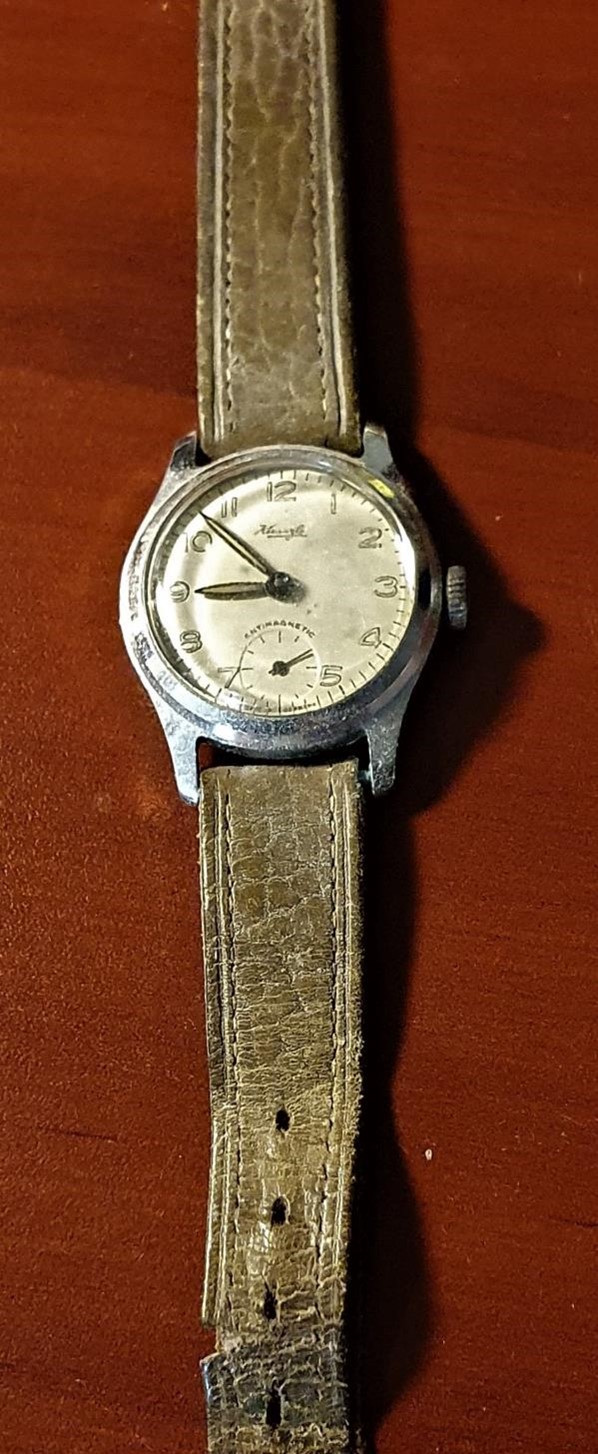
I have no keepsakes that date from my youngest years, but I do still have the watch my parents gave me just before I left home. I’d never owned a watch but now I was 16 and heading off to work in Edinburgh. So Dad took me to the only place in town that sold watches, a tiny jeweller’s shop. There was a choice of about three, and I took the one with a grey strap and a straightforward watch face. As you’ll see from the photo, it was worn for years. It was a wind-up watch, of course, and the innards seized up a long time ago. Why do I still have the watch? Two things make it significant and memorable: it was a gift from my mum and dad, and I was given it just as I left home. So I’ve kept it.

But some folks seem to have the philosophy ‘everything we get we keep’. They let go of next to nothing. I visited one home where, once through the front door, I had to edge my way between mountains of stuff – broken appliances, stacks and stacks of papers, rails filled with old clothing, hundreds of books and magazines. I was invited to sit down. I couldn’t see where, but then my host cleared some heaps and revealed a chair. This wasn’t the only home I’ve visited like that. I can’t imagine what it was like to live there, or how great the fire risk was.

I’ve also seen overflowing work offices. I called on one senior official who had completely filled his private office with paperwork, so we met in his second office which was almost submerged as well. Apparently he was negotiating for a third office. I think it was Dale Carnegie who said a CEO offered to pay him any amount for advice on how to clear his clutter. He too had filled more than one office with ‘stuff’. Carnegie gave him just one bit of advice: pick up a piece of paper and don’t put it down again until you have done something final with it (like writing a reply or throwing it in the bin). In other words, do something that means you’ll never see that paper again. The executive called him just two weeks later. He’d done exactly what he was told, and he’d already cleared several desks of everything on them, and found two typewriters that had been missing for years.

The presenters of ‘de-clutter your home’ TV programmes often say the problem people have with parting with things is emotional. Memories are attached to everything they’ve acquired. I can only respond this way: the cost of keeping is higher than the cost of parting; parting is brief pain but keeping is pain that lasts for years.

Can’t let it go? Yes you can.

Undone and unfinished things

I studied bereavement counselling while preparing to be a pastor. I was told that, as well as grief, the most common emotion felt by bereaved relatives is guilt. Guilt – because of visits not made. Guilt- because of harsh words spoken in the last conversation. Guilt – because ‘I love you’ hadn’t been said for years. Guilt – because an argument that divided the family 20 years earlier hadn’t been resolved. When it’s too late to put things right, guilt is hard to let go.

The same is true for people who missed an opportunity which never came again. Perhaps a relationship was so special it would surely lead to marriage, but no proposal was made and the couple drifted apart. But one of them can’t let go of what might have been.

Or a missed opportunity at work. A big promotion is offered, but means moving to an overseas location. That would disrupt the family, involve learning a new language, and demand working all hours. So the promotion is turned down. But the firm is unforgiving. No other promotions are offered and as year after year of mundane work goes past, it’s hard not to think ‘If only…’.

Others have missed the chance to upgrade their skills. Martin’s employer was willing to let him study part-time for a PhD. With that qualification, he’d be on track for a top position. Martin began his studies, made good progress, but after two years got involved in significant work projects, family needs, hobbies and outdoor activities. With just one more year before getting his PhD, he paused. And he never finished. Every year since, Martin couldn’t let go of disappointment he hadn’t completed his PhD degree.

‘There is a time for everything…’ says the writer of Ecclesiastes (ch. 3:1). We mustn’t miss that time.

Failure
Everyone fails. But some failures stay with us more than others.

That’s especially true when we’ve betrayed a relationship. Cheating on a marriage is an obvious example. ‘How could I do that?’ is the lingering question.

Letting a friend down is also damaging. Imagine sympathising with a colleague who has been harassed by a fellow-worker, promising that if she complains about her harassment to the boss, you’ll support her because you’ve been harassed too. Your colleague lodges her complaint, the boss isn’t sympathetic, so now you keep quiet about your experience. Your friend feels abandoned and isolated. She resigns. You feel terrible. You let her down, and ever since you can’t let go of the fact that you failed her.

Or you promised to be with a friend at a special event – his wedding, or graduation, or a family funeral – but at the last moment someone gave you a ticket for a great seat to watch a top-level football match. You couldn’t miss the chance – you had to go to the match. But your friend never understood. You’d promised to be with him, and you abandoned him for a football match! He is hurt dreadfully, and you realise you’ve made an appalling mistake. You feel dreadful, and you can’t let that feeling go.

Choices have consequences, and those consequences can last a long time.

The good things

Usually negative experiences linger longer than positives in our minds. But, thankfully, the good things are sometimes the ones which we can’t let go. Wonderful times which we’ll never forget.

I’ll supply only one experience, though it happened four times. I’ll never let go of the immense privilege and joy at watching each of my four children come into the world. Men have it easy at childbirth. Alison took all the pain and did all the hard work while I just held her hand and said encouraging words. Then, after each of the children arrived safely, I proudly held them in my arms. I could never let go of that experience. (It’s mirrored these days with the joy of seeing how their lives have developed.)

That’s not an experience everyone has. But almost everyone has something or many things for which they’re immensely grateful. They’d never have wanted that part of their lives to have been any different. So they could never let go of those moments. We should all be grateful for them.

But, in closing, how do we let go of the bad or sad memories? I could write about counselling, about finding forgiveness, or about making a firm decision not to dwell on these times. All three of those would be appropriate.

However, on this occasion I’ll end by saying we can’t let go of certain experiences and, in one sense, we shouldn’t let go of them. Why? Because these things have shaped the person we are today. Because we got things wrong or because we went through dark times we’ve been changed. Perhaps we’re determined never to do something again, never to let down a friend, never to fail a colleague in their time of need. Or, because we’ve survived we’re stronger, and we’re more understanding when others face horrible tragedies. We can’t turn the bad thing of the past into a good thing, but we can transform its effects into something useful, something that makes us better, more careful, more considerate, and more resilient than we would otherwise have been.

So, what you can’t let go needs to become what you can’t do without to be the person you are now, or the one you are on the way to becoming. I realise that’s easy to write and hard to do, so my thoughts and prayers are with all who keep struggling.

——————————–

Note 1  My apologies that this blog is posted later than I’d imagined. I anticipated a delay, but not for this long. I doubt if the gap has broken anyone’s heart, but I am sorry and hope pauses won’t happen often.

Note 2  The podcast I described is the NPR Politics Podcast: https://www.npr.org/podcasts/510310/npr-politics-podcast  It’s refreshingly unbiased, serious but never boring. To hear the ‘can’t let go’ segment you need to listen to the Friday edition where they sum up the week’s news and then use the last five minutes to describe what they ‘can’t let go’ from that week’s news, whether it’s about politics or anything else. Enjoy!

When to say no

I don’t like trite formulae for success. But – when my life was overloaded – this saying made me stop and think: If you never say no, what is your yes worth?

It makes a serious point and, years later, I’m still trying to apply its question to my time choices.

Time choices aren’t usually between right and wrong options. Our dilemma is as simple but difficult as this: should I do this good thing, or should I do that good thing? Both are worthwhile, but we shouldn’t do both. Yet often we can’t say ‘no’ to either. Instead of making choices, we squeeze everything into our lives, and, in return, become inefficient, worn out, frustrated and stressed.

So, let’s find a way to say ‘no’.

Why is saying no so difficult?

Guilt    If something is well within my abilities, I feel guilty at not taking it on. I don’t have time for it, but my mindset is: ‘I could do this, so should do this’. That’s bad logic. Could doesn’t mean should. There are a hundred things we could do, but we should do only a fraction of those. Guilt cannot decide our priorities.

We’d let someone down    This was a problem in church life. Maggie starts visiting elderly people in a nearby care home, then persuades her friend Maureen to visit too. They try to persuade others to come along, saying, ‘If only more would join us, we could spend time with everyone in the care home.’ But people don’t join them. Maggie and Maureen are overstretched, and urge: ‘This is important work. You’ve got to help us.’ At last some do. They haven’t the time but feel they can’t let Maggie and Maureen down. Visiting the elderly is good work, but they were already doing other ‘good work’ and now have little time for it. It’s been sacrificed, principally because they didn’t feel able to let Maggie and Maureen down.

We like to please people    From my earliest times as minister of a church, I realised I had power to persuade people to take on responsibilities: join a task group, attend a meeting, give money to a cause. It didn’t work with everyone, but a sizeable number accepted roles because they wanted to please me. That was helpful for me, but not always for them. They had other things to do, whether with family, leisure, work, or other activities. They were busy people. But they wanted to please, so didn’t say ‘no’.

We can’t cope with no-one doing it    A leader asks for a volunteer to take on a task. Heads go down. No-one speaks. The silence is deafening. Finally, George sighs, ‘Okay, I’ll do it if no-one else will.’ Why does George volunteer? It’s because George can’t stand the silence and can’t cope with no-one taking on the task. But George was already over his head with work so probably isn’t the right person for the task. Part of me wants to say ‘good for you’ to those who volunteer when others won’t, but it’s not good for them when they take on causes just because no-one else will. Especially if that means less time for the many things to which they were already committed. Neither embarrassment nor awkwardness is a reason to volunteer. We simply can’t fill every void that exists.

Personal ambition    People with drive and ambition often assume their work or responsibility limit is somewhere far ahead of where they are now. They can always take on something else. But most people don’t know they’ve reached their limit until they’ve passed it. And then they’re in trouble. Their drive to do more is commendable, but taking on too much only leads to problems down the line.

Overconfidence    Last week I listened to an interview with an American military commander who was reflecting on the war in Afghanistan. Sadly, he said, he couldn’t consider the 20-year conflict a success. Then he went on to describe (what he called) a dangerous ‘can do’ culture in the military. No matter how great or challenging the mission, the view was ‘we can do this’, as if anything was possible. If the strategists said there was only a 30% chance of ‘taking’ an enemy-occupied hill, they’d likely still charge up the slope. But it would cost the lives of many soldiers and the mission might well fail. Most of us don’t face life and death choices, but overconfidence – ‘I can take this on too’ – is a danger, not an asset.

So, what are the consequences of never saying no?

An unmanageable workload. When I talked about being over-busy, Hamish told me ‘all you need is to be well-organised’. Two years later he was in a senior role in an organisation, and working in his office in the early hours of the morning to meet a project deadline. When there’s more work to do than time to do it, even the best organisation isn’t enough.

An unfocused workload. When we don’t say ‘no’ we accept someone else’s agenda for our lives. We’re not prioritising what’s most important for us. That’s a bad strategy. We may succeed in a scattering of miscellaneous tasks, but fail in vital things that were uniquely for us to do.

We work outside our skill set. The big gain from making our own choices is that we play to our strengths. We do what we’re trained and skilled to do. When we accept choices made by others we lose that advantage, and struggle with tasks for which we’re not suited. If our church was looking for a new treasurer, and I agreed to take on the role, the church would be in financial chaos. I’m not a numbers person. Give me words to read or write, and I’m in my element. Give me a spreadsheet, and I’m lost. New challenges are good from time to time, but letting others define what we do is usually folly.

We experience serious stress. I can juggle two balls, and be relaxed enough to hold a conversation at the same time. Throw me a third ball, and I might keep them in the air but only with all my attention on the task. Throw me a fourth ball, and within seconds every ball would be on the floor. And perhaps I would be too. I could not juggle four balls. All of us can operate beyond our limits, but only for a very short time. After that we’re being damaged, and that’s always dangerous.

When should you say no?


When current obligations already fill your life    In theory you can always get more money, or more friends, or more possessions. But you can never get more time. I’ve often wished for 25 hours in the day, but there’s always been only 24. And when those 24 are full – including adequate time to sleep – fitting something else in only pressurises everything already there.

One way, though, to add a new thing is to throw out an existing thing. In an earlier blog I wrote about a friend who kept her house immaculately tidy by following that method ruthlessly. If she bought a new sweater, she got rid of an existing sweater. When she bought new shoes, she got rid of the old shoes. I could never be that severe, but it’s a principle which could be used to manage time. Providing, that is, you can be at peace with stopping something else. And that’s not easy. We may displease people by withdrawing our help, or leave no-one doing the task we’ve stopped. The new thing has to be weighed against the old things already filling our lives. Hard choices.

When important people would be hurt by saying yes    I’ve always been busy with studies, with church, with employment. It would have been very easy to miss the children’s growing up years. In part, I did. But, I hope, only in part. As often as I could I was home for dinner, listening to their stories, then tucking them into bed. Sometimes I watched them at swimming practice. When our son was about seven I drove miles to buy him a second hand Sinclair ZX81 (the most basic of computers). His work today is with electronics. When heavy snow was on the ground, I took one of our daughters on the back of my motorbike to deliver newspapers. (I’ve no idea now why she was safer on my motorbike.) I protected time so I could attend school concerts and athletic events. Later, when I travelled to dozens of countries, I sent them postcards, not so much so they saw a pretty picture but knew I was thinking about them. None of this was perfect, but we muddled through with a lot of laughter and togetherness. Those children are now adults, and also great friends.

Through all these years I was acutely aware that the time spent with the family would never come back. That sharpened my will when people wanted more of my time. To be away even more from my family was to impose a sacrifice on them as much as on me. Very easily we ask too much of people who care for us. Saying ‘yes’ to things may hurt most those who care for us most.

When your health would suffer    Being over-committed doesn’t directly cause conditions like depression. But taking on too much doesn’t help. We’re overtired and over-stressed. We don’t feel in control. We don’t cope. And our mental health deteriorates. Also, we can’t be experts at everything, so an overloaded life will include work for which we’re not suited. Then we’re both time-pressured and out of our depth. Quality of work suffers, as does quality of life. That’s bad, very bad. And not survivable in the long-term.

We can’t just ignore these truths, grit our teeth, and plough on with a chaotic life. Our health matters. Abusing it has serious consequences, affecting not just us but everyone who depends on us. Guarding our health is a primary reason to work up the courage to say ‘no’ to things we shouldn’t be doing.

Many of us don’t find it easy to turn down new opportunities. We hate disappointing others, or leaving a task undone. We feel obliged to help.

Maybe cold-hearted people who don’t care about consequences have no problem saying ‘no’. For the rest of us, it isn’t a simple decision. We’re faced with things that must be done, and there’s no-one else to do them. So we compromise.

But let that be the exception, not the rule. We’re in trouble very quickly when we open the floodgates for anything and everything to take over our lives. Saying ‘yes’ can ruin us and others we love. Instead, be polite but say ‘no’. Your life will be richer for using that little two letter word.

Friendships

I took a deep breath, then asked a question no friend expects. Tom’s answer could affect the rest of my life. ‘I’m planning to ask Alison to marry me. You know both of us well. Am I doing the right thing?’

Tom looked startled. He’d never imagined being asked such a question. But he didn’t hesitate. ‘Of course you’re doing the right thing. You should have asked her ages ago.’

I laughed, feeling grateful and relieved in equal measure. I wasn’t inviting Tom to make my marriage decision for me, but as a deep and close friend his support meant a lot. 

Thankfully Alison said ‘yes’ and, as well as being my wife, she’s been the closest friend of my whole life. But Tom probably came next. Sadly, Tom died several years ago but he knew me through and through, and I’d have trusted him with my life. Others have also been important, and some still are. I’ve also had many acquaintances and truly enjoyed their company, but I’ve a feeling there’s room for only a few very special friends.

So, what defines the best of friendships? I’ll share my answers, but others will have their own priorities. They’ll also vary according to who the friendship is with – every friendship is unique.

Here are nine qualities of friendships I think important. They’re not listed in any special order.

Being genuinely interested    I have a secret which is almost a confession. From about the age of 18 I realised that girls are not attracted to boys who talk endlessly about themselves, especially when they brag about their accomplishments. I’d understood that girls were much more drawn to boys who were interested in knowing them. I’d ask simple, non-intrusive questions. Not just learning facts, but discovering what they thought or felt about all sorts of things. It worked.

If that was only a technique to find a girlfriend, it would be manipulative. But if being interested in someone is sincere, it’s appreciated.

That truth isn’t limited to romantic encounters. It’s foundational to all friendships. Every relationship of depth involves really knowing the other person: thoughts, feelings, hopes and fears.

Caring    Knowing someone isn’t enough. Real friendship also involves caring about anything that concerns the other person. It means supporting through tough times, helping with hard decisions, commiserating with disappointments, rejoicing in successes.

Caring marks the difference between deep friendships and more superficial friendships. Lesser friendships aren’t bad. It’s good to have acquaintances with whom you enjoy spending time. But lower-level friendships aren’t about lives intertwined, bearing each other’s burdens, supporting through the worst days and the best days. I shared doubts, fears, ambitions, hopes and dreams with Tom. Why? Because he cared. And I was helped and strengthened by having him to lean on. I believe I was able to do the same for Tom.

Respect    There are long-term relationships that lack respect. They can be bullying or domineering or dependent relationships which go on year after year. But they’re not friendships, and they’re not healthy.

In a real friendship each accepts the other for who they are. No-one’s trying to control. No-one’s taking advantage. Each believes the other person is worth knowing, worth trusting, worth supporting, worth respecting.

At a later point in my life, I built a strong and helpful relationship with Stuart. What began with polite but guarded conversation developed over many years into sharing struggles and disappointments. Stuart was consistently supportive. Eventually I knew I could tell him anything about myself and he’d still respect me. So I talked about areas of life where I was falling short. That wasn’t easy for me to share or him to hear. But he counselled me wisely, and made it clear I was still a person of worth. That really mattered to me.

Despite failings Stuart still respected me. A good friendship has that quality.

Sharing experiences    Tom and I first met on study courses that would give us admission to university where – we discovered – we both hoped to do the same degree before entering Christian ministry. We were from different denominations, but aiming for the same vocation. Our friendship grew, and we found we had similar spiritual questions. Both of us were particularly concerned about living closer to God. We read books, went to meetings, and we talked endlessly. And then we hit on the answer: if we got together and prayed all night, surely we’d be close to God by morning.

So we chose a suitable night, one when we’d have no early classes next morning. We began our praying about 11.00 pm, sitting in chairs with our heads bowed. After an hour we decided it was more spiritual to pray on our knees. After another hour my knees ached unbearably, and I had to sit on the floor. Tom’s knees were in no better shape, so we were both seated on the floor. We got to 2.00 am, but by then our prayers were short and infrequent. Less than half an hour later, I said I’d be more comfortable lying on the floor. I knew nothing more until a short time later Tom shook me by the shoulder and said, ‘I’ve pronounced the benediction. You can go to bed now.’

Next morning we alternated between laughing and pronouncing ourselves spiritual failures. But our ‘failed’ night of prayer wasn’t the end of still seeking ways to be better Christians. Our search went on.

That was part of sharing experiences for me and Tom. Other people will go to football matches, or to music festivals, or be cinema buffs, or read the same books, or climb hills, or work in the same firm, or whatever else they share. My point is only this, that friendships involve journeying together, not merely crossing paths occasionally while going our own ways.

No hidden goals    Relationships are not friendships if either or both have ulterior motives.

I boarded a plane in Kathmandu for my flight home to the UK. Beside me was a young lady, probably aged in her mid-20s. Mo liked to chat, and I thought, ‘This could be an opportunity to share my Christian faith’. Once the plane had taken off and meal served, we had several hours to talk. We got on to the subject of belief remarkably easily. Eventually I realised why. Mo had been in Nepal to study at a Buddhist temple and school. (Buddhism is the second largest religion in Nepal.) She was fired up about her Buddhist beliefs, and as our conversation wore on I realised Mo was trying to evangelise me. So, while I was trying to convert her to Christianity, she was trying to convert me to Buddhism. Both of us had ulterior motives for our conversation. It was a very odd experience.

Friendships can’t have hidden goals. One can’t be trying to ‘sell’ something to the other, whether a religious belief or a political position. And one can’t be trying to ‘get’ something from the other, like the boy who offers a girl friendship (or, what he calls ‘love’) in order to get sex.

Strong friendships don’t come with an agenda. They’re not like business relationships where someone’s trying to make a ‘profit’. Friendships exist because each values the other. No other motive. No other goal.

Openness    Every friendship can’t involve a complete opening of hearts and minds, as if every secret must be told. That would be an impossible burden. But the strongest of friendships work only where there’s a reasonable sharing of thoughts, feelings, experiences, desires, and ambitions. A friendship can’t exist when either is ‘closed’ to the other.

Henry had a hundred friends. He wasn’t difficult to like – gifted, knowledgeable, chatty, generous. With some of the hundred he’d watch football matches, walk in the hills, go to the cinema, accept invitations for meals in their homes. But, just when people felt they were really getting to know Henry, he’d back away. Without explanation he wouldn’t seek their company any more. Why not? No-one knew for sure, other than that Henry had withdrawn as soon as relationships deepened. It seemed he didn’t want his innermost thoughts and feelings known. Which was sad.

Openness is fundamental to any kind of deep friendship. It doesn’t work otherwise.

Honesty    Friends can risk telling truths that would be resisted if spoken by anyone else.

Another way of saying that is this: A superficial friend will tell you what you want to hear. A real friend will tell you what you need to hear.

At times we act foolishly. We might voice prejudice. Or buy a vintage car that’ll cost a fortune to maintain. Or keep bad company. Or run up debt on our credit card buying a new mobile phone every six months. Or skip classes at university. Or constantly turn up late for work. And so on. Someone has to warn us; to tell us we’re being an idiot. We won’t like it. But it needs to be said. Only a friend will take the risk of telling us what we must hear. A strong relationship will stand the strain of that.

Resilience    Children – including young teenagers – fall in and out of friendships. So parents hear words laced with anxiety: ‘She doesn’t like me any more’; ‘He doesn’t want to be my friend now’. Thankfully it’s usually all different just one day later. Back to being the best of buddies.

Real friendships – friendships worth having – are far stronger than one row, one disappointment, one time of letting the other down.

I’d put it this way: deep relationships are not transactional they’re relational. In other words, they’re not like a contract where, if someone breaks the terms of the agreement, the deal is torn up. Strong friendships are like having a brother or sister. We’ll squabble but you’re still my brother or you’re still my sister, so we’ll forgive and move forward. In the same way, commitment to each other is essential to strong friendships.

Perseverance    Six-year-old Hazel comes home after her first day at a new school. Mum asks: ‘Did you make any friends today?’ ‘Yes,’ Hazel says, ‘I sat beside Jackie, and she’s now my best friend.’

Well, I’m glad Hazel found a friend at her new school. But ‘best friends’ after one day? Absolutely possible in a child’s world. But the reality check for those of older years is that the deepest and best of friendships don’t happen in one day. Houses are built brick by brick, and friendships are built day by day, month by month, year by year.

And that takes perseverance. It involves all the attributes listed above put into practice constantly. In the early days there’s no guarantee that a friendship will last. Not all friendships do. But once the days and months turn into years, friends are relaxed with each other, feel secure together, and have confidence in their relationship. Students going off to university for the first time are told: ‘The friends you make in the next year or two may well last for the rest of your life’. That often happens, but it needs commitment and effort from both sides.

Finally,  I know some find it hard to find friends, so I’ll close with one piece of advice.

Be open to friendship, but don’t grasp at it, don’t force, don’t even make friendship your goal. Just be the great person you are, relax, and let friendship happen.

I don’t know you’ll find a great friend. But I also don’t know any reason why you won’t.

Pouring your heart into what you do

In the last blog, I asked: ‘If we are to have a life well-lived, what are (at least some) of the principles we should live by?’ I used the story of building St Vitus Cathedral to illustrate three of those principles.

I’ll use another building project this time – a building so remarkable it’s one of the Seven Wonders of the World.

My work took me to India many times. Alison was able to come with me on one of those trips. While we were in Delhi, an affluent Indian friend offered to drive us to the Taj Mahal. That’s a 115 mile (185 km) journey, not far but likely to take a long time on a crowded road. It didn’t take a long time, not with my friend observing his rules of the road, which were not many.

The Taj Mahal is every bit as impressive as its reputation and its story.

It exists because of love and loss. In 1607 the 14-year-old Shah Jahan, soon to be Mughal emperor, glimpsed a girl selling silk and glass beads. She was Mumtaz Mahal, a Persian princess aged just 15. Jahan told his father he wanted to marry this girl. Five years later he did.

He had other wives as well, but his love was supremely for Mumtaz who travelled everywhere with him, and bore him many children. In 1631 she died giving birth to their 14th child. Jahan was distraught, and vowed to build the richest and finest of mausoleums over her grave.

He kept his word.

At the heart of the Taj Mahal complex is a tomb built of white marble brought from all over India and central Asia. Throughout the site 28 varieties of precious and semi-precious stones were used for inlay work. More than 1000 elephants transported construction materials. A 9.3 mile earth ramp was built to bring the heavy stone close to the building site, where an intricate post-and-beam pulley system placed the blocks exactly in position. Overall some 20,000 skilled artisans worked on the Taj – masons, stonecutters, dome-builders, inlayers, carvers, painters, embroiderers, calligraphers.

The tomb itself consists of a large square plinth on which stands a symmetrical building topped by a large dome and four lesser domes. Four minarets are built just outside the plinth, each tilted slightly away so that they could never collapse on to the tomb. Other magnificent buildings were constructed, and beautiful gardens with long pools, paths, fountains and ornamental trees. One of the breathtaking views is to see the Taj reflected in the water, the exact hue of the white marble varying according to the intensity of the sunlight or moonlight.

It took some 22 years until the whole site was complete. As well as being one of the Seven Wonders, the Taj Mahal is a UNESCO World Heritage Site. It draws between 7 and 8 million visitors each year (though less during Covid virus restrictions).

From its story, I draw these lessons for how to do our best with our lives.

Not to plan is to plan to fail

I’m not a fan of the sub-heading I’ve just used; it seems to denigrate spontaneity. But it has truth. Big enterprises require good planning and preparation. Without those, they do fail.

I’ll give two examples from my home country.

Above Oban – which sits on the west coast of Scotland – stands McCaig’s Tower. It’s also known as McCaig’s Folly. John Stuart McCaig was a wealthy banker who admired Greek and Roman architecture. So, for the hill overlooking his town, he designed an elaborate building based on the Colosseum in Rome. Inside its walls would be a museum, art gallery, and a central tower in which he’d place statues of McCaig and his family. Work began in 1897, and by 1902 the outer ring had been built. It was 200 metres in circumference, with two tiers of 94 arches. It was very impressive.

But that’s all there ever was. All work stopped in 1902 because McCaig died of a cardiac arrest, aged 78.

Personally I feel a Colosseum look-a-like above a Scottish coastal town is out of place. But I commend McCaig for being a man of vision. However, I can’t commend planning which doesn’t include funds to complete the project if the benefactor dies. McCaig’s Folly has never been finished.

Edinburgh has a monument with a similar story. In 1822 wealthy Edinburgh citizens raised money for a memorial to Scots soldiers who had died in the Napoleonic wars. They wanted to replicate the Parthenon in Athens stone for stone. It would be built on Calton Hill which overlooks the centre of the city.

The work began, and twelve columns were raised. The lintels were put in place, using the largest and heaviest stone ever quarried in Scotland. It took 12 horses and 70 men to get the stone up the hill.

In 1829 the money ran out. Only half the funds needed had been raised. The wealthy citizens had not put together an adequate ‘business plan’ to take the project to completion. Perhaps they blamed others for not being generous, but the folly of bad planning was theirs. What was intended as a National Monument is sometimes called a ‘national disgrace’.

Failure to plan or prepare adequately never works.

I have interviewed dozens of people for jobs. I’d ask: ‘What do you know about our organisation? Perhaps you’ve got information from our website?’ And about 50 per cent of the time, the answer would be, ‘No, I don’t really know anything. I didn’t look at your website.’ That was a bad answer. How could people think I’d appoint them to a senior position in a major organisation about which they hadn’t bothered to do the most basic research? It was a terrible failure of preparation for an interview.

Detailed and careful preparation went into the construction of the Taj Mahal. That building really mattered to the emperor, so he ensured everything was done right.

There is a timeless principle there. What we do should matter so much, we plan and prepare well.

If something is worth doing, it’s worth doing well

For a few years, Alison and I helped a small church in a run-down area of Edinburgh. We ran a children’s club, did pastoral visiting, and I did occasional preaching. There were many challenges for that church, including its building. It was small and inadequate for the work the leaders wished they could do. Why so small? Because it was never meant to be more than the hall alongside the main building, but the main building had never been built.

That’s not unique. On my preaching travels around the UK, several times I went to a church which began decades earlier meeting in a hall until its main worship building was erected. But they were still in the hall. Nothing more had ever been done.

Lack of money would be one reason for the incomplete work. But, sometimes, complacency. I imagine the first members found the hall met their needs because, in those days, there weren’t many people. As the years passed, only a few more joined them. There was always enough space. Unsurprisingly the motivation to give sacrificially to erect their main sanctuary building gradually faded. Their hall was ‘good enough’. And so it had stayed for a hundred  years.

I’m no fan of millions getting spent on large church buildings, but I am a great fan of doing everything needed for the mission of the church. Originally there was a big vision for those churches, but over the years it had dimmed and died. I can’t be glad about that.

I’d say the same about any enterprise. It’s about finishing what you start. Committing all the skills and resources that are needed. Believing that if a job is worth doing, it’s worth doing well.

The Taj Mahal teaches me that lesson. Of course the Taj is extravagant, but probably not outrageously extravagant for an emperor. And not for an emperor grieving for the princess he’d loved with all his heart. He longed to give her the best he could give. And he did.

Living life well always means giving the best we can give.

Pouring your heart into what you do

We enjoyed living in Aberdeen in the north east of Scotland. Summer was Alison’s favourite season, not for the weather but because she could work in the garden until after 11.00 each evening. Aberdeen is far enough north that night-time in mid-summer is truly dark for only two or three hours. Alison could probably have gardened until midnight, so 11.00 was no problem.

She loves gardening. It’s more of a passion than a hobby. She belongs to the local gardening group where experts give lectures. She joins webinars with top gardeners sharing their knowledge. She plans out her garden work, and keeps a journal of what she’s planted and how it’s prospered. A garden is never finished, always on the way, so Alison is never quite satisfied with her flowers or vegetables. But – as the principal beneficiary – I know she does a great job.

The simple truth is that we give our best to the things we love. In high school my best marks were in English and history because I enjoyed studying those subjects. My friend David excelled in all things scientific, and became a leading research scientist. Another of my school contemporaries was great at golf, poured his heart into it, became a professional and played in the Open Championship.

We strive for excellence in the things we love. What we love isn’t always related to our career. It can be family, or church, or our sport, or our hobby, or taking on civic responsibilities, or caring for the disadvantaged in our community, or rehoming abandoned dogs, or studying philosophy. We’re all unique, and so will be our passions. And where they lie, so we will direct our energy, our time, and our skill.

It’s good and right to bring passion to bear on all we do. Emperor Shah Jahan never dreamed of building a mausoleum for his wife. But then she died, and the love he’d had for her motivated him to build a supreme tribute to her that millions today admire. He poured his heart into the Taj Mahal. And it shows.

A life well-lived involves planning and preparing wisely. Doing everything well. Pouring our heart into all we do.

One more set of principles next time, again from a construction project. But this one is different. It fell down.

——————————

If you’ve found this blog post useful, you won’t be alone. Use the ‘Share’ button to send it on to a friend or family member. Or point them to www.occasionallywise.com  Thank you!